Crew Blog | Kaniela Lyman-Mersereau: Rowing on the Rappahannock

:

Today we got a chance to literally go with the flow as we met up with a crew from the American Canoe Association (ACA) for a day of canoe paddling down the mighty Rappahannock River. Our hosts were part of a major restoration project of removing a dam 11 years ago in this river. Their passion for the health of this river led to the ultimate demolition of the 22-foot high hydroelectric dam. This made the Rappahannock River the longest free-flowing river in the 64,000 square mile (encompassing seven states) Chesapeake Bay watershed. This opened up hundreds of miles of river to migratory fish including American shad, hickory shad and blueback herring for the first time since 1854. Rivers are meant to flow for people and fish and birds and trees and everything else that enjoys this wonderful source of life. I could not help but think of our precious waters back home as we heard the story of the Rappahannock. It is so hard to convince big government and energy companies to take away something that has already been built for the sake of development. It was refreshing to hear a story where the people went to bat for nature and came out on top.  

IMG_7922

The sky is overcast as we get briefed by our guide, and the crew is excited to take part in this adventure which involves paddling downstream through a few rapids in replica dugout canoes. This place was once populated by the Powhatan people. I imagine them skillfully navigating these waters to find food, for enjoyment, for sport. Canoes can bridge the gap between man and nature no matter where you are in the world. We know this. They know this.

IMG_4046

We will paddle in pairs and some solo. The water is brown and cold. There are ospreys and eagles in the distance gracefully gliding over the river. The air is warm, and we quickly warm up as we put our energy into each stroke. Oak and cyprus trees look down upon us as families of red-bellied turtles relax along the riverbanks. The rapids are just exciting enough to give us that fix we miss back home so much: Waves. Moving water.

I look for different pathways between rocks and under overhanging trees. I experiment with standing up. These canoes are surprisingly stable, but I better play it safe as my canoe partner is 71 year old uncle Robbie, aka “Flash the Flying Squirrel.” I let him rest as much as he wants and am happy to put the pressure on my energy after a month of lots of eating and little exercise. Next thing I know we’re coming to a 3-foot drop off that runs into some boiling rapids. I watch our leader go first, followed by Maleko and Mikiala navigate it perfectly coming out unscathed. As we approach I regret not listening to the part about keeping the weight in the back. Robbie is about 40 pounds heavier than me and not the most balanced individual. But he did want me to steer. Here we go Robbie! My last dry sight is Robbie plunging into the churning white bubbles below me. We tip and I slide out the back seat, paddle in hand bouncing butt first off slippery boulders at the mercy of the river flow. I pop up and realize Robbie is stuck under the overturned canoe. My uncontrollable giggles turn into worry as I am helpless in the rapids and cannot move towards Robbie. He pops up and gasps for air with that classic wide-eyed worried look in his eyes. We drift into a shallow section and are able to get ourselves back into the canoe soaking wet with nothing but our pride hurt and our clothes soaked. Robbie is okay. We can laugh about it now. The rest of the way is smooth drifting. We had our excitement. The sun comes out and the cold, brown water turns out to be invigorating and refreshing. We tell everyone we meant to do that. It was getting too hot anyway. We make it back to base camp and a few of us make our way another mile down a rougher part of the river. I drop Robbie off to warm up next to the fire and dry off. I jump in the solo canoe for the next rapids. Our wa’a skills come in handy as Duane, Jason, myself and a few of the ACA guys navigate the windy rapids. The ACA guys are all impressed at how well we handle the river rapids. We humbly thank them for their lessons in river canoeing and sharing this unforgettable experience. I’m in awe of the beauty of all that this river encompasses. There is life and happiness here. We must take care of these places.


More than Adventure

Beyond a daring expedition, the Worldwide Voyage is quite possibly the most important mission that Hawaiʻi has ever attempted. As people of Oceania, we are leading a campaign that gives voice to our ocean and planet by highlighting innovative solutions practiced by cultures around the planet.

We could not have begun this great journey without your support, nor can we continue to its completion.
Crew Blog | Kaniela Lyman-Mersereau: The Powhatan People

We awake to gray skies and light wind. Hōkūleʻa sits calmly amidst the ever changing weather, tides, and wind. It is hard not to miss home when you are in cold, moody spring weather. I couldn’t quite peel myself out of bed to join Starr on her early morning run. She came back with exciting photos and stories of revolutionary war reenactments and Cornwallis’ cave. There’s some kind of colonial festival going on in Yorktown this weekend with people dressed like pirates and colonials. Canons and gunshots echo through the air. Exciting stuff for the tourists who dare to brave the cold, gray day.

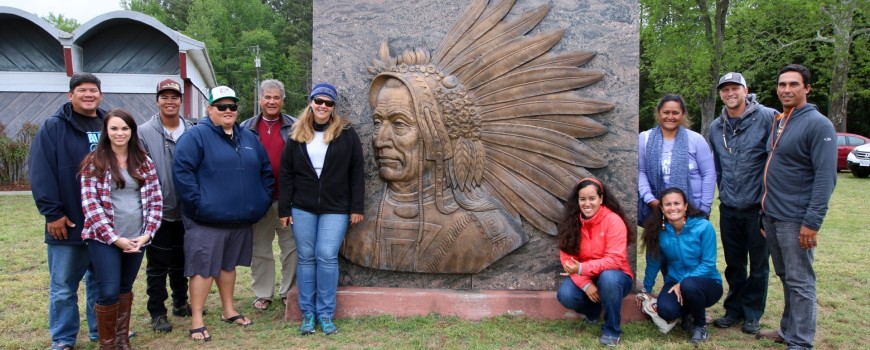
Our plans take us elsewhere to a contrasting scene to meet people who cared deeply for the land and water of this place. Long before tall ships and longboats filled these waterways, the great chief Powhatan’s people moved skillfully with the rivers and tides in dugout canoes and enjoyed the abundance of resources that the land, sea and river offered. We had the privilege to meet two out of 32 Powhatan tribes today at their respective reservations, the Pamunkey and Mattaponi. They are the oldest reservations in North America.

IMG_8547

Touring through small museums packed with amazing historical artifacts from Matoaka’s necklace she wore in 1607 to the wooden club meant for John Smith’s execution. Matoaka is Pocahontas’ given name at birth by her father, chief Powhatan. 200 year old dugout canoes, stone tools and tomahawks, countless arrowheads, intricate clay pottery and gourds brought the history of this amazing culture alive. We could not help but feel the connection to home so far away from home. Here is a place that thrived off the water and woods. There was no need to travel from this paradise, but what is it like now?

IMG_8550

After being filled with amazing stories about the historic use of certain artifacts to the process of becoming an independent reservation with their own laws to the real story not told about Pocahontas, we learn about a new struggle with regards to the ecology of their river system. Our hosts have figured out a way that was first developed in 1918 to maximize their yield of a fish known as shad and minimize their impact to the populations. They have engineered multiple holding tanks that are used to hatch and take care of young shad until it is safe to return them to the wild. They then put them back in the river system where they will grow in the estuaries then the ocean before coming back to the exact same place they hatched where they can be harvested and ‘milked’ for their eggs once more. This successful process has allowed them to put up to 5 million premature shad back in their river at one time. This process should be taking place right now, but as we enter the hatchery distracted by several large turkey vultures and a bald eagle gliding from tree to tree over a coffee brown river we find a somber sight: No shad to catch, no shad to hatch, no shad to eat.

The elderly man who has had the knowledge of subsistence shad fishing passed down through generations before him says this is the first time he has never had any shad to catch during their normal spawning season. They are over a month late he explains as we learn about the process looking into empty, dry holding tanks. He speaks of various reasons for this change including water temperature and severe weather events, but is not really sure.

IMG_8576

As the gray sky becomes darker, we find ourselves at a Pamunkey tribal fish fry event that is usually designated for the running of the shad . The dinner and dessert is delicious and the crew gorge themselves on the amazing buffet, but there are a few dishes missing. The ones that require shad . Sitting, eating, trying not to freeze, we learn about the love for the water that the Pamunkey people have. The chief tells us it is everything to them. From food to recreation, this river is their life. Our host Ashley explains how the peninsula they are on is as close to an island as you can get because of the creek running through it. We share our manaʻo of places we have been along this voyage to places we love back home that share the same love for the water as well as similar struggles in maintaining it. She smiles with her two year old boy in her arms. She is unsure about the shad , but optimistic for the resilience of her people.

IMG_4015

We offer our oli mahalo and some makana from home. Moani Heimuli gives a pohaku from her and Hōkūleʻa’s birthplace to the chief in hopes that it will help bring the shad back. The Pamunkey chief accepts it with profound gratitude as the most important gift we gave.


More than Adventure

Beyond a daring expedition, the Worldwide Voyage is quite possibly the most important mission that Hawaiʻi has ever attempted. As people of Oceania, we are leading a campaign that gives voice to our ocean and planet by highlighting innovative solutions practiced by cultures around the planet.

We could not have begun this great journey without your support, nor can we continue to its completion.

Hōkūleʻa Update | April 28, 2016

Today was a particularly busy day engaging with the community of Newport News, Virginia. Kaniela, Mark, Jason, Duane, and myself served on an education and outreach group to visit two schools. We started at Hampton High School, where we visited a senior International Baccalaureate biology class in a school that is predominantly African-American. The class had been studying marine debris and was fully engaged and excited by our visit. Kaniela gave a powerful presentation about his experience finding marine debris in remote areas of Australia during another leg of the Worldwide Voyage as well as a separate trip he took to the Great Pacific Garbage Patch. We fielded a bunch of fantastic questions, and sent them off with with a keener sense of our mission to Mālama Honua. One student was particularly excited to hear that we would traveling through her homeland of Panama in the next several months.

IMG_8257

We then visited New Horizons Regional Education Centers, which serves students with special needs from six surrounding districts. Some students are bussed in from as far as two hours away. We had a group of 40 middle school kids rotating through four 10-minute stations: creating aloha ʻāina quilt squares, practicing knot tying and line throwing, learning the star compass, and exploring life on the canoe with our voyaging gear. The students were animated, engaged, and hilarious. One kid told Duane, “You’re talking. And I’m tired.” We cracked up all day imagining the integration at his station. Their spirits were truly special, and there were numerous teachers and helpers who said how memorable this day would be for the students. One teacher even said that it was the best engagement she felt the school had ever experienced in her seven years at the school. She explained that unfortunately New Horizons usually gets passed over for educational enrichment that regular public and charter schools get to experience. This really touched us and reminded us of the power of education for all learners.

image2

After a couple hours of rest following the school visits, the entire crew headed to the Mariner’s Museum at Newport News. There we were a part of a four-part lecture series the museum has been conducting. We met with the board members, major donors, and executives in one of the exhibition halls. Then our current captain Mark Ellis and apprentice navigator Jason Patterson partnered to give a fabulous tag-team presentation to a room of over 300 attendees. So to give a lecture with such composed delivery could not have been easy. Our entire crew was very proud of them, and the audience was clearly engaged and interested given the number of people who stayed late to get signatures and ask further questions. It is exciting that this community has taken such an interest in the story of Polynesian wayfinding and the voyagers of the modern day. Given the number of students and adults we touched today, we are expecting a large turnout at our canoe tours on Sunday, May 1 from 9am-6pm at Riverwalk Landing. (That is assuming the thunder and lightning show that we are seeing this evening, moves out of the Chesapeake and Yorktown area.) Aloha and mahalo for following!


More than Adventure

Beyond a daring expedition, the Worldwide Voyage is quite possibly the most important mission that Hawaiʻi has ever attempted. As people of Oceania, we are leading a campaign that gives voice to our ocean and planet by highlighting innovative solutions practiced by cultures around the planet.

We could not have begun this great journey without your support, nor can we continue to its completion.

Heidi Sails Home

“When we pulled in, the dock we pulled into was the National Park Service dock that I used to walk from every morning to catch the 7 o’ clock ferry with the school kids to go to St. Thomas for School and walk back to every day after the 3 o clock ferry and do my homework in front of. For me it was like going home to my dad. And that was a big deal. Knowing that we were coming home to my dad, meant more to me than I probably told anybody,” said Heidi Guth, Chief Operating Officer at the Polynesian Voyaging Society.

“Aloha, my name is Heidi Guth. I was born on Maui, I grew up in the Virgin Islands and now I live in Maunalua on Oʻahu and I’m the Chief Operating Officer for the Polynesian Voyaging Society.”

As the chief operating officer, Heidi is responsible for much of the never ending logistical work that allows Hōkūleʻa and her crew to sail around the world.

heidihome_1

Nainoa Thompson, master navigator and President of the Polynesian Voyaging Society said, “It’s easy for me to say let’s go make the sail plan form A to B and C and D, and say let’s just go do it. To actually make it happen in terms of the almost infinite amount of logistical issues that have to be weighed and measured and every time I make a change, it impacts everything and so you know Heidi is the one that deal with all of that. 

Guth said, “Basically we try to make sure that everything is in preparation for the crew and the canoe when they enter every single port. So we have to first start with asking permission from each port to enter. I mean there is quite a variety of layers that we have to go through to make sure everyone is well fed, well cared for and respectful of the place both customarily and regulatory.”

Thompson said, “What Heidi brings is that you can’t you know you just can’t go find it when you’re hiring you can’t put it in the job description. She loves these canoes, she loves what hey stand for and she believes in their work and their possibilities and their future. She’s committed to the value and purpose of the Worldwide Voyage and when I say committed she commits everything.”

Guth explained, “I only started working as an employee at PVS about 3 years ago, really focusing on the Worldwide Voyage. So the opportunity to sail during this particular voyage in a couple of different legs has not only been kind of the carrot at the end of the stick to keep me going, a lot of the times, but also it’s actually helped me to do my job better and not only do I get to do the logistics from onboard the waʻa, but I also get to learn what could be more helpful from the office for people on the waʻa.”

Thompson said, “I knew that she needed to get out of the office, and interesting I’ve asked her before and she said I can’t go, I got too much to do, but this one was almost a demand on my part because essentially she was going to be sailing home. 

In early February 2016 Heidi and the rest of the World Wide Voyage leg 17 crew set sail from Natal Brazil to make their way up the Atlantic ocean to find the island of St. John in the Caribbean.

heidihome_2

 Guth said, “This last leg was special for a number of reasons, many of which transpired during the voyage. Everybody on board got along. And it was just this amazing amalgamation of crewmembers where everybody fit together perfectly and was really kind and just really expressed what I think we always try to exemplify from the waʻa that everyone has a special role to play independently and collectively. And then for me personally to be able to bring that crew that I had grown so close to like just as a real ʻohana to a place that had raised me and where I had hānai family waiting for us was just a blessing. And I didn’t realize the depth of affection that I had for that place until I saw that silhouette coming up in the predawn light.

 “There was a little bit of rain, there was this gorgeous sunrise, there was this amazing rainbow that turned into a double rainbow. Everything around us, all of the hōʻailona were just so positive and welcoming and gracious and approving. And then at the dock was my hānai family.”

“And I can’t express how grateful I am to both of those families, the one on St. John and then the one on Hōkūleʻa and how they each represented themselves so beautifully and caringly to each other. It was just, it’s an indescribable feeling to feel like you’ve really been welcomed home and your life has come full circle in such a happy way. “


More than Adventure

Beyond a daring expedition, the Worldwide Voyage is quite possibly the most important mission that Hawaiʻi has ever attempted. As people of Oceania, we are leading a campaign that gives voice to our ocean and planet by highlighting innovative solutions practiced by cultures around the planet.

We could not have begun this great journey without your support, nor can we continue to its completion.

Hōkūleʻa Update | Hōkūleʻa Arrives in Historic Yorktown, Virginia

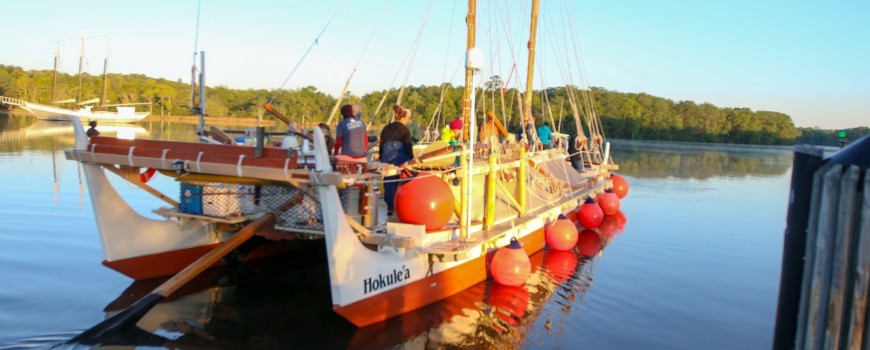
Legendary voyaging canoe Hōkūleʻa arrived at historic Yorktown, VA, on the morning of Sunday, April 24, 2016,  greeted by the area’s Native American tribes and about 300 people from the community.  The arrival ceremony included a cultural welcome by Virginia Indian tribal chiefs from the Pamunkey Indian Tribe, Mattaponi Tribe and the Nottway Indian Tribe of Virginia.

IMG_7981

The Hōkūleʻa crew arrived at Yorktown with the blowing of the pū (conch) and a chant to the tribes requesting permission to enter the area.  The ceremony also included performances by the Native Virginia tribes and a presentation of gifts from the crew to the Virginia hosts.

The canoe will be docked at Yorktown until May 7 where tours and educational outreach activities will take place throughout the week including a crew lecture at the Mariners’ Museum on April 28.  On April 29, the Museum will hold a homeschool community day conducted by Hōkūleʻa canoe members who will lead classes with hands-on activities that explore the ways in which Polynesians navigated the seas and interacted with the ocean.

IMG_7955

On Saturday, Hōkūleʻa arrived at Newport News, VA, and docked at the James River Bridge Fishing Pier to teach the community about Polynesian voyaging and the importance of Mālama Honua (caring for Island Earth). The engagement at the Pier was part of an Earth Day Celebration organized by the Mariners’ Museum and Park.

IMG_8015

“We greatly appreciate the efforts of our partners at the Mariners’ Museum and Yorktown who have planning months to work our Hōkūleʻa’s visit into their programming,” said Bruce Blankenfeld, captain  and pwo navigator.  “As a result, this engagement will allow us to reach and interact with hundreds of students, teachers and other members of this part of Virginia,” he added.

After departing Yorktown on May 7, Hōkūleʻa’s next engagement stop will be Tangier Island, VA, in the Chesapeake Bay.

For Hōkūleʻa’s most up-to-date schedule, visit http://www.hokulea.com/hokuleas-planned-east-coast-port-stops/

To follow the Mālama Honua Worldwide Voyage, visit http://hokulea.com/track-the-voyage


More than Adventure

Beyond a daring expedition, the Worldwide Voyage is quite possibly the most important mission that Hawaiʻi has ever attempted. As people of Oceania, we are leading a campaign that gives voice to our ocean and planet by highlighting innovative solutions practiced by cultures around the planet.

We could not have begun this great journey without your support, nor can we continue to its completion.
Hōkūleʻa Update | April 21, 2016

Another great day on the Intracoastal Waterways (ICW). We have been a crew for about 2 weeks now, and we really work well with each other. Most mornings start off with a crew call at 6am. Our tow line is flaked on deck, someone starts the hot water for coffee, teas and coco. We then single up the lines and make ready to pull away from the dock.

IMG_7369

Each day we also rotate 2 crew members in to the American Canoe Association’s Subaru that they have loaned us. It is the land crew’s responsibility to secure the next marina, as well as doing advance work for Captain Bruce to provide him some local knowledge about the marina, where we will dock, which side we will tie up on, if there is a current running. Other items that crew members are waiting for are, wifi access codes, laundry facilities and bathroom codes, they also secure other resources as needed.

IMG_7713

Back on Hōkūleʻa, dock lines are released and we start our way up north on the ICW. Breakfast is then started today we had corn beef and onions with pancakes. We stated our travels today with a 20 mile long canal system which water looked like black coffee. We then make our way to Alligator River went under a few fixed bridges and thru one swing bridge that we had to call in on the radio to have it open.

IMG_7385

For lunch we had some fried mahi mahi that a local fisherman gave us the other day. We run our normal watch systems of three 4-hour shifts, taking care of steering Hōkūleʻa thru the ICW.

Today we connected via online video conferencing with a middle school class back home in Hawaii, and two crew member spent about 15 minutes answering questions and giving the students a tour of Hōkūleʻa.

At about 5pm, we are making our way into another marina. Today we also had to set up our sails (bend the sails), which required all of the crew working together to lower the spar, attach the crab crawl sails to spar and boom, raise them up and open and close them to be sure everything is fine.

IMG_7560

We then have dinner and get updates and the plan for the next couple of days, including getting into Newport News to celebrate Earth Day on April 23.

The last event for the night is anchor watch for the night.

It’s now about 11pm and in a few hours we start up again.


More than Adventure

Beyond a daring expedition, the Worldwide Voyage is quite possibly the most important mission that Hawaiʻi has ever attempted. As people of Oceania, we are leading a campaign that gives voice to our ocean and planet by highlighting innovative solutions practiced by cultures around the planet.

We could not have begun this great journey without your support, nor can we continue to its completion.

Crew Blog | Starr Johnson: Voyaging Up the ICW

The morning we pulled out of Charleston, South Carolina had lighter winds than we came in, which was a relief, but today it was much colder! It felt like 40 degrees until about noon when it really warmed up to the point where we had to shed our layers of outerwear. It turned into a beautiful and productive day! We fixed the cleat that broke coming in a few days ago, we cleaned up the unraveling loose lines, rethreaded the canvas, did some general “spring cleaning” and enjoyed the most beautiful scenery we have seen since departing Titusville.

IMG_7203

Traveling up South Carolina’s Intracoastal Waterway sometimes feels as if I am transported to another reality – one in text books or storybooks. For the most part the ICW shows few signs of humans (little to no people or rubbish other than the occasional shipwreck). We stare into the thick old looking forests coming right into the water with Spanish moss hanging from the branches and enjoy spotting the osprey nests sitting atop the dead trees, but for much of the time my mind wanders to my own stories playing out along the banks or beyond the thick marshlands. I imagine Tom Sawyer and Huckleberry Finn sitting on the bank of one of these many creeks, or think of the soldiers fighting off the “enemy” from Fort Sumter, or picture the huge homes connecting to vast plantations and the slaves that once were forced to work them.

IMG_7198

Occasionally my imagination stops as we wave to a couple older men wearing overalls and fishing with a confused look and give a soft wave as we go by. One person even said in a thick southern accent, “What kinda pontoon is that?!”  What probably surprises us the most is when we hear an “Aloha!” coming from an individual or family standing at the end of a long dock seeming to be in the middle of no where.

IMG_7306

It is amazing to think of the people that Hōkūleʻa has touched, taught, and inspired. It is also powerful though to think of the people of this place who have touched, taught, and inspired our crew: from the children at the CREECS charter school who have goats, chickens, and bees at their school, to those from NOAA and Surfers Healing who hosted us for dinner, or those who brought us sweatshirts, hydroflasks and soup at night and donuts at sunrise, or made peace flags at James Island  Outdoor Festival, or talked about their own journey to aloha ʻāina, mālama honua, or aloha kekahi i kekahi. The mo’olelo continues as we travel north along the ICW.


More than Adventure

Beyond a daring expedition, the Worldwide Voyage is quite possibly the most important mission that Hawaiʻi has ever attempted. As people of Oceania, we are leading a campaign that gives voice to our ocean and planet by highlighting innovative solutions practiced by cultures around the planet.

We could not have begun this great journey without your support, nor can we continue to its completion.

Hōkūleʻa Update | April 20, 2016

Aloha, this is Mark Ellis on board Hōkūleʻa on Leg 19 of the Worldwide Voyage. We are currently in the Intracoastal Waterway. We left a few days ago from Charleston, South Carolina. It was a great stop. We did outreach at charter school out there, and we also did some outreach at the Charleston Outdoor Festival.  What was really great about that stop is that we also met family and friends from Hawaiʻi as well as from South Carolina. We’re currently making our way up towards Newport News, Virginia. Join us on April 23 at the James River Fishing Pier from 10am-2pm for canoe tours. Mahalo once again for all your support and please continue follow us on Hokulea.com. Aloha!


More than Adventure

Beyond a daring expedition, the Worldwide Voyage is quite possibly the most important mission that Hawaiʻi has ever attempted. As people of Oceania, we are leading a campaign that gives voice to our ocean and planet by highlighting innovative solutions practiced by cultures around the planet.

We could not have begun this great journey without your support, nor can we continue to its completion.