Crew Blog | Nā’ālehu Anthony: Road Tripping the Old-Fashioned Way

:

Today the “land waʻa” crew – Navigator Kālepa Baybayan, Keala Kimura and myself – picked up a car with the ambitious mission of driving across Nova Scotia and into New Brunswick to take the Voyage a little further north, without the canoe.  Our purpose is to check out the tidal shifts at Hopewell Rocks, which are in the Bay of Fundy, reported to have the largest tidal shifts in the world. It turns out that we’re expecting Hopewell Rocks to have a tidal range of 42′ in only 6 hours.  Sounds amazing.

But first we gotta get there.

Here’s the challenge:  We’re in Canada now, and none of our phones allow for the kind of data we usually use back at home. In short, no GPS or Google Maps.  So, we have to traverse entirely new terrain in another country for a 1200 kilometer round-trip using these dreaded things called “paper maps”. We picked up a map or two at the rental car center, and with a few discussions we were on our way – hopefully to Hopewell Rocks (I know, this could be ironic).

The last time I can remember using a paper map, I was in my late 20’s running through L.A. looking for my cousin’s wedding. This time, navigating with the aid of the paper map is a bit easier. For one thing, there’s pretty much only one road leading out of Yarmouth – step one accomplished, we know how to head in the right direction.   This one road heads northeast out of town, or in a general south direction.   We chose northeast and took off towards Digby, one of the next towns over, in search of a local who could help to explain the phenomena of these massive tidal shifts in the Bay of Fundy.

At a local coffee shop in Digby, we met with Greg Turner.   He was kind enough to take us to the waterfront to show us the interpretive signs that help to tie in the movement of the moon and tidal resonance to these intense tide changes.   Both contribute to a tide that can shift as much as 50 feet in some places. We bid farewell to Greg and thanked him for his time, and we were off again with about 500 kilometers to go.

The 101 highway took us through great farming country. We saw corn and other vegetable crops littering the landscape; when we couldn’t see farms it was because the proud pines stood together so thick that they built an impenetrable barrier to anyone wanting to see past.  We passed rivers and lakes, and also started to see what were likely tributaries connected to the Bay as they were wet and muddy but no water was in them.   We had been told that as the tide lowers, some of these small veins of the bay would be empty.

A huge left turn put us on the Trans Canada highway.   This took us through the rest of Nova Scotia and we took a quick pit stop at the border to get new maps – the ones we had were only for the district and ended with Nova Scotia.   Luckily the kind people at the border had some for their neighbor, New Brunswick.  We asked questions about the route as well as other tourist-like questions and every single person we talked to was courteous and kind – all the people we have interacted with in Canada have been really genuinely nice. Maybe they extended extra kindness to us because we really did live up to the cliche – us guys had a hard enough time stopping and asking for directions. But stopping to do so really made the drive a lot easier.

The detail in the maps were fine until we had to find our way through the cities along the way.   I’m pretty sure it was the skill and intuition of our driver Keala that got us through without a wrong turn.   The only unfortunate part came when Keala commented that he was happy that we had not encountered any traffic thus far.   Yes, you guessed it, no more than 30 seconds later we sat, stopped on the freeway, in afternoon traffic for 20 minutes. Still, it was a small price to pay for 500 km of unscathed transit.

After driving in mostly a northerly direction we started to head south again, closer to Hopewell Rocks.   It was a little too late to to try any time lapse photography today but we did want to check out the scene and talk to people about shooting on site.   The staff at the park were really friendly, and we took some photos of the massive landscape that would be underwater again in just a few hours.  We’re excited to shoot at the Rocks a couple of different ways, and are really looking forward to bringing you all a terrific description of what an incredible place this is.

Of course, I still can’t figure out how to fold a paper map, but it was a lot of fun getting here the “old-fashioned” way.   More to come as we travel back to Hopewell Rocks to photograph this incredible place tomorrow.

Until then we’ll be SB 68,

Aloha,
Nāʻālehu


Help fund the Voyage as we sail the East Coast

Hōkūle‘a’s visit to the eastern United States is a historic milestone in her 40 years of voyaging.

Celebrate with us by pledging your support to the Mālama Honua Worldwide Voyage.

Crew Blog | Kaʻai McAfee-Torco: Finding Family Far From Home

:

image (2)On July 30, 2016, we made a brief visit to the Abbe Museum in Bar Harbor, Maine where I was pleasantly surprised to see the teal Smithsonian flag that’s visible near the entrance, representing it as an affiliate of the Smithsonian Institution. I thought about my internship at the Smithsonian Center for Folklife and Culture Heritage under curator and educational specialist, Marjorie Hunt. She always enthusiastically talked about the Abbe Museum during my time working with her in DC. I would’ve never thought that Hōkūleʻa would give me the opportunity to visit this place in person.

Even more unexpected was the fortunate opportunity to see Gabe Paul, a friend Kalepa and I met while participating in the Smithsonian Folklife Festival in 2013, entitled One World, Many Voices: Endangered Languages and Cultural Heritage. He and a group of nine family members welcomed our crew to Bangor, Maine at the airport. Someone from the crew asked, “Kaai, is this your family?” “Kind of,” I responded. Not related by blood, but a relationship built on common beliefs of the importance and value of indigenous knowledge. I’m grateful that they came, it felt like seeing family.

imageGabe is a member of the Wabanaki, a group of indigenous people in the New England area, who comes from the Penobscot tribe. His leadership, dedication and passion to ensuring the survival of the Penobscot culture, language and history continues to inspire me. Although Gabe didn’t visit the museum with us, he was featured on one of the displays.

image (3)

Towards the immaculately designed exhibit, the “Circle of Four Directions” was by far my favorite part that I hope to visit again in the future. In Wabanaki culture, not only does directions provide location, but also refers to phases of life. East is associated with childhood, South is adolescence, West is adulthood, North is our elder years. At this level, elders are passing on knowledge, however, are reliant on others like they once did as a child. A cycle of life. There are further affiliations for each cardinal direction. Children are related to the East, women in the South, men in the West and elders in the North.

In the Circle of Four Directions, every description begins with East, just like how I learned to teach the star compass beginning with East. Knowledge that was passed down from Papa Mau, to Makalii, to Kanehunamoku, to me. In the paafu, the Micronesian star compass that Papa Mau used, emphasis is placed on East. East is where the day begins; where the sun rises. The arrival of Kanehoalani, the sun, is one of the most important times during the day for a navigator, when East can be found easily.

image (1)

Stepping into the Circle of Four Directions, eyes are immediately drawn to the sky above. The design of the ceiling mimics a wigwam, a traditional Wabanaki shelter. Based on the themes of each direction and the relative location of each tribe, four baskets are displayed. The basket in the East was made by a Maliseet child; the South, a Passamaquoddy woman; the West, a Penobscot man; the North, a Micmac elder.

I hear the voice of a language warrior. On the recording, Gabe tells a part of his peoples’ creation story in Penobscot. Along with the voices of individuals who play a key role in keeping their culture alive is the sound of the ash log being pounded in the background, like the kuku kani o ke kapa, the beating sound of wauke bark. The Wabanaki say that the sound of the ash log is the “sound of creation.”

More similarities were found as we went through the museum. The Wabanaki have Koluskap who is reminiscent of Maui, a kupua; not man nor god, but in between; someone who is sent to carry out instructions. These characters in legends teach life lessons in disguise of moolelo (stories). One tells of Koluskap splitting a brown ash tree in half by shooting an arrow and this is how the Wabanaki people were created. 

The brown ash tree, in its importance in the Wabanaki creation story, is similar to taro. In a Hawaiian creation story, Wakea and Hoohokukalani gave birth to a still-born baby. They buried their precious child into the honua (earth) and out grew the first kalo (taro), Haloanakalaukapalili. Sky father and the woman of the stars had a second child, the first Hawaiian man. Both peoples were formed from nature; Wabanaki from the brown ash tree, Hawaiians from taro.

To recognize people in the exhibit from the Wabanaki delegation I met at the Smithsonian folklife festival and personally know was an extremely special experience to me. The connections that I’ve made and are making from this voyage, continues to connect seemingly random points on my life journey. Although this is my first leg on the Worldwide Voyage, I know that being on Hōkūleʻa will allow me to have experiences I wouldn’t have had otherwise and will continue to connect everything together.

Follow me and the rest of the crew as we head to Canada on hokulea.com.


Help fund the Voyage as we sail the East Coast

Hōkūle‘a’s visit to the eastern United States is a historic milestone in her 40 years of voyaging.

Celebrate with us by pledging your support to the Mālama Honua Worldwide Voyage.

Hōkūleʻa Update | July 31, 2016

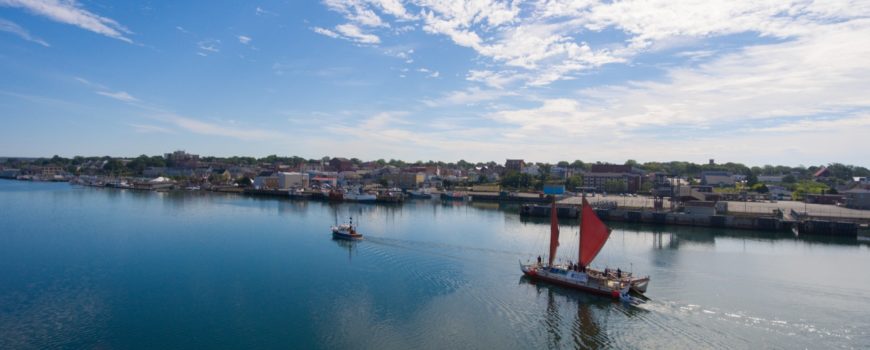
Hōkūleʻa, Hawaii’s iconic traditional canoe, took the Mālama Honua Worldwide Voyage north of the United States as it arrived at Canada’s Port of Yarmouth early this morning. Crew members were welcomed by the Nova Scotia community, dignitaries and members of the Mi’kmaw (pronounced “Meeg Maw”) Nation on the Yarmouth dock, some who attended the occasion in traditional garb. The Mi’kmaw are part of the Wabanaki that Hōkūleʻa and her crew honored during the voyage’s recent Portsmouth and Mt. Desert stops.

IMG_0039

The celebratory arrival ceremony featured cultural dances and the rhythmic beating of drums. Feathers were presented by a representative of the Mi’kmaw to each Hōkūleʻa crew member as a symbol of peace and unity. Canadian legislators were also in attendance: the Honourable Zach Churchill, Yarmouth Mayor Pam Mood, Warden Murray Goodwin from the Municipality of Yarmouth, and Warden Aldric d’Entremont from the Municipality of Argyle.

 IMG_0134

“This makes me believe that we’re more alike than we’re different. When we come here and you tell us to come to your place, and thank us for being here, and for being happy – that’s aloha,” said Nainoa Thompson, pwo (master) navigator and president of the Polynesian Voyaging Society, during the arrival ceremony. “The Worldwide Voyage is trying to take this little canoe and aloha around the world, and we came to Yarmouth for that purpose,” he added.

IMG_0213

Chief Deborah Robinson of the Acadia First Nations (Mi’kmaw Nation) also spoke at the event. “The Mi’kmaw as part of the indigenous community of Canada, has always struggled and continue to strive to protect Mother Earth and all the natural resources for the future. The preservation of our environment and conservation of the resource is of utmost importance to us as the Mi’kmaw. We all have the same goal – in ensuring a future for our children, and for children for generations to come.”

IMG_0262 

While in Canada, Hōkūleʻa crew members hope to learn more about cultural and environmental sustainability practices from the Bay of Fundy and the Southwest Nova Biosphere Reserve-a UNESCO-designated area that serves as a model for demonstrating a balanced relationship between humans and the environment. The Hōkūleʻa crew hopes to document and share what they learn from the visit with students in classrooms throughout Hawaii. They will stay for about six days to engage with the area’s First Nations, learn about Nova Scotia’s natural resources and conservation efforts and offer canoe tours to the community.


Help fund the Voyage as we sail the East Coast

Hōkūle‘a’s visit to the eastern United States is a historic milestone in her 40 years of voyaging.

Celebrate with us by pledging your support to the Mālama Honua Worldwide Voyage.

Hōkūleʻa Update | July 30, 2016

We are in final preparation today for a departure tomorrow. The winds are currently light and the fog is pretty thick, but the winds are supposed to turn favorable tomorrow and the fog may dissipate. We got the bulk of our work done yesterday, and our friendly National Parks Ranger Lynne Dominy offered to take our crew on a tour of Acadia National Park today.  Mt. Desert Island and Acadia National Park have so many amazing amenities, making this place a huge attraction for people in the summer when things thaw out.  Thousands of people were at the park today; from the look of the license plates in the parking lots, they come from far and wide to visit Acadia.  There are a ton of new amenities in the park this year as they are celebrating their centennial, but the real beauty in this place is something that has been here for thousands of years.

DJI_0014

We started off the morning at Wapuwoc, which is more commonly known as Cadillac Mountain. It is the highest mountain in the eastern seaboard and provides a stunning view of the surrounding lakes, forests and granite stone features. We lucked out arriving early enough to share the view with only a couple of other visitors, and the fog was light enough to let us see some of the sights.  Even though the mountain is barely more than 1/10th  the of height of our beloved Mauna Kea, I still experienced that feeling of being above the clouds with the fog surrounding us on the mountain. We spent about an hour up on the peaceful mountain learning about the Mt. Desert Island community.

IMG_9691

As we were getting ready to leave the mountain, ranger Lynne pointed out a blueberry shrub that was just off the parking lot. The whole crew was amazed that these grew wild so close to the road. I have to say, the absolute best part of the day was the blueberries.  Apparently these delicious items grow on low bushes and taller shrubs; I’ve only seen them before in plastic cases in the Safeway.  It was an unexpected treat to be able to pick these tiny candies and eat them fresh off the shrub. The fact that these things grow all over the place in the park made for a pretty unreal treasure hunt at each stop.  By the time we finished the day, we had several hundred of them that fit nicely in a bowl we shared over dinner.

IMG_9751

The land of this popular park, I learned, comes from gifts of families that want to see the land conserved and protected.  They way of life on Mt. Desert is something that really got me thinking—so many parallels to Hawaiʻi, yet so different in landscape and rhythm. The contrast of the imposing warm granite to the green hues of the conifers and other wild flora sets up for stunning photos at all of the stops. When the fog overlays across the two, it’s like nature’s way of applying a Gaussian blur effect, commonly used by us photographers in post-production.  Add to this incredible visual feast a visit to one of the only sand beaches for literally hundreds of miles. This beach is made entirely of seashells that have been crushed up in the gentle surf until soft sand is all that remains. It is bound by cliffs of granite on either side with pines that tower over the skyline. Even though the old growth trees are mostly gone due to logging more than a century back, we were still witness to some pretty large trees throughout the day – these on the beach were no exception. The crew took some time to walk the shores looking for shells and other memorabilia –  but crewmember and master chef Tamiko took the time instead to perform an impromptu beach cleanup, collecting plastic and other trash along her walk.

IMG_9764

In this place, nature has really been given the latitude and respect to be the priority. That doesn’t mean that this was always the case. Like everywhere else where humans have interacted with the environment, missteps were made and natural resources were used to create wealth in some method of extraction.  Trees were cut for timber, granite was mined to create buildings in D.C. and Philadelphia, and the list goes on and on.  But the natural beauty here won the hearts and minds of those with the resources to turn it all around – they donated the land to make it a national park.  All the residents here revel in the beauty of the place and now protect it fiercely. In the face of this stunning landscape, I’m really struggling with the question – when will we in Hawai’i come together like they have here to protect our precious island home?

SB 71,
Nā’ālehu


Help fund the Voyage as we sail the East Coast

Hōkūle‘a’s visit to the eastern United States is a historic milestone in her 40 years of voyaging.

Celebrate with us by pledging your support to the Mālama Honua Worldwide Voyage.

Hōkūleʻa Update | July 27, 2016

Aloha nui kakou,

We said aloha to the crew of Leg 21 today.  Pwo Navigator Bruce Blakenfeld and his crew departed John Williams Boat Company after lunch, after a morning focused on handing off kuleana from 21 to 22.  Safety gear, communications equipment, medical supplies, mooring gear, food, and canoe manifest are just a few categories of the multitude of kuleana that has to be coordinated from crew to crew.  JW Boat Co has provided us a massive 4-bay warehouse to store all of our canoe supplies and food. The warehouse also serves as our sleeping quarters until we depart in a few days. We’ve set up shop here, packing day boxes and going through the process of manifesting and re-manifesting the entire canoe. We are very thankful to the Leg 21 crew for turning over Hōkūleʻa in such great shape; they worked til the last minute to turn over a shiny and clean vessel.

IMG_8589

Maine is a stunning place. The boat yard is surrounded by granite cliffs and pine trees on all sides. Nature seems to take the front seat, with humans filling in the space left over. Massive pines grow right up to the shoreline in some places. We’ve seen deer and squirrels who seemed unfazed by the human intruders in their habitat.  Twelve foot tides reveal a coastline of seaweed twice a day. The granite shoreline is pitted in some places by the quarries of yesteryear.

IMG_9261

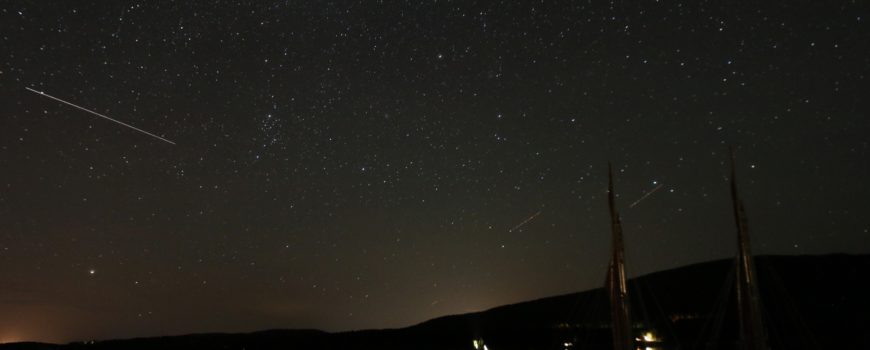
But when the sun finally set, we found beauty in the sky that we rarely get to see on land at home. The night sky in Mt. Desert is amazing mostly because there are few lights at night. We could clearly see the Milky Way over head, with the Dipper setting behind the mountain.  The crew slept on cots in the middle of the yard to watch the shooting stars and practice their star knowledge, ever training for navigation tests. We’re so far north; Hoku Pa’a was much much higher than we are used to seeing at home in Hawaiʻi.  I contemplated this reminder of how far we are from home, and felt again the weight of the privilege and responsibility of being part of the crew that is about to take Hōkūleʻa farther north than she has ever been before.

We will continue to prepare for departure until the weather allows us to leave. Standing by, 71.

Aloha nui,
Nāʻālehu


Help fund the Voyage as we sail the East Coast

Hōkūle‘a’s visit to the eastern United States is a historic milestone in her 40 years of voyaging.

Celebrate with us by pledging your support to the Mālama Honua Worldwide Voyage.

Hōkūleʻa Update | July 26, 2016

:

Aloha nui kākou,

Crew 22 made it safely to Maine! We are sitting about 5 miles from where Hōkūleʻa is moored, in Mt. Desert. Heidi and Moani picked us up at the airport in Bangor to make the hour and a half drive back to join the rest of the Leg 21 crew in Mt. Desert.

IMG_8541

We met up with the Leg 21 crew at the home of John “Jock” Williams. Jock and his wife are ‘ohana to Nainoa and Bruce, and are hosting the canoe and the crew at his boatyard where he is well-known for custom boat-builds. In fact, as part of the extensive work done to prepare Hōkūleʻa for the Worldwide Voyage, Jock rebuilt her ‘iako. Coming to Mt. Desert is in part an opportunity to pay respect to this part of our far-flung family that is part of the genealogy of the canoe.

IMG_8562

This outgoing crew is in great shape and very high spirits even after about a dozen stops over the last 5 weeks. They have interacted with port communities and indigenous peoples along this whole East Coast from New York to Maine, making frequent stops to celebrate hosts and local communities. Leg 21 was a leg of celebration and connection. As crewmewmbers know, land engagement is often more exhausting than sailing time! And so they are also ready to go home, to see their families and get back into the rhythm of land life.

IMG_8563

Our crew overlap in port is only barely a day for this crossover, but it is precious time that we get to spend together to hand off kuleana from one crew to the next, and to also enjoy some time together. Many of us don’t get a chance to sail together based on the various schedules we have to balance against sailing and the selection process for each leg crew by our captains. So nights like these serve as a great reminder of the commonality we find through the voyage, and the depth of our connection as ʻohana waʻa. We gathered at the Williams hale for dinner – 5000 miles from home and 30 of us from Hawaiʻi can come together for a meal and feel just like we’re at home. The crew ate Maine lobster, lasagna and other local favorites while telling stories about the people and places that the Leg 21 crew encountered over the last few weeks. As it turns out we had a couple of birthdays in the house (and I’d also like to wish my niece Haʻena a Happy Birthday from Maine!) – we had the pleasure of celebrating with Tom from Leg 21 and Niko from Leg 22 . Two birthday cakes were served and everyone sang “Happy Birthday” for the birthday boys. This time together builds the strength of our ‘ohana — strength that will serve us well over the many miles left to cover before Hōkūleʻa returns home.

SB 71,
Lehu


Help fund the Voyage as we sail the East Coast

Hōkūle‘a’s visit to the eastern United States is a historic milestone in her 40 years of voyaging.

Celebrate with us by pledging your support to the Mālama Honua Worldwide Voyage.
Continue Reading

Hōkūleʻa Update | July 23, 2016

Hōkūleʻa, the traditional voyaging canoe from Hawaii, made her anticipated arrival at Mt. Desert and was officially welcomed by the community on Saturday morning. On this current leg of the Mālama Honua Worldwide Voyage, the crew is continuing to honor First Peoples in the East Coast region, teaching and learning about traditions and practices of protecting cultural and environmental resources.

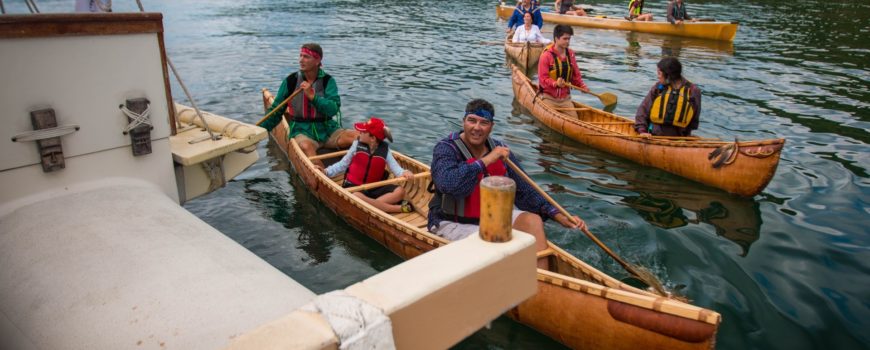
 Canoes deployed by tribes of the Wabanaki Nation sailed alongside the vessel to welcome her before she docked at JW Boat Company (Hall Quarry Road). Hōkūleʻa and her crew were greeted with a welcome ceremony from the Wabanaki and members of the Mt. Desert community. The ceremony gave Hōkūleʻa crew members and the Mt. Desert community a chance to interact with each other through exchanges of cultural traditions, and share their thoughts on the historic significance of the connection made between the groups. After the ceremony, the crew engaged with the public and conducted canoe tours. Today, a crew presentation was scheduled at JW Boat Company and the public was invited to attend. 

On Tuesday, youth groups from the area are slated to visit Hōkūleʻa. Later that afternoon, there will be another crew presentation in the Gallery at Abbe Museum on Mount Desert Street that will be open to the public. 

Mt. Desert is the last stop for this leg (Leg 21) of the Voyage, which has included engagements throughout the New England area over the last five weeks. A new crew will be departing Honolulu for Mt. Desert tomorrow to start the next leg (Leg 22) of the journey, which will take Hōkūleʻa to Canada for the first time in history.


Help fund the Voyage as we sail the East Coast

Hōkūle‘a’s visit to the eastern United States is a historic milestone in her 40 years of voyaging.

Celebrate with us by pledging your support to the Mālama Honua Worldwide Voyage.

Hōkūleʻa Update | Nainoa Thompson: Presentation at the National Institute of Health

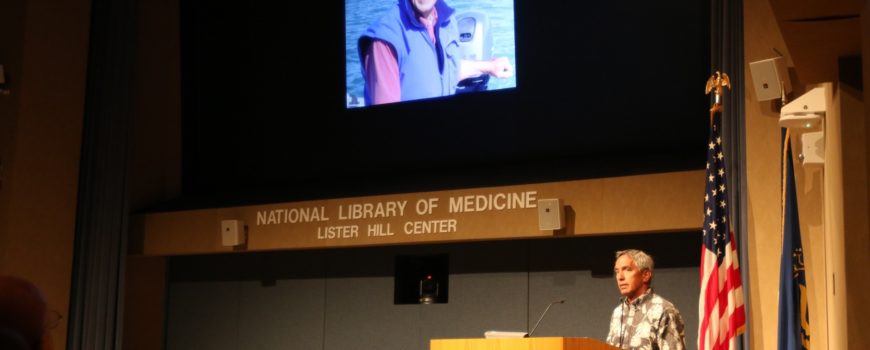
Master navigator and Polynesian Voyaging Society President Nainoa Thompson presented at the US National Library of Medicine in Washington, DC on May 23, 2016. The presentation focused on the intersection of the Hawaiian Renaissance of the 1970s, including Hōkūleʻa, and current Native Hawaiian health and well-being.

If you are having trouble viewing the video in your browser and or would like a transcript,
please go to
http://www.nlm.nih.gov/news/Hokulea_Lecture.html


Help fund the Voyage as we sail the East Coast

Hōkūle‘a’s visit to the eastern United States is a historic milestone in her 40 years of voyaging.

Celebrate with us by pledging your support to the Mālama Honua Worldwide Voyage.