Crew Blog | Lurline McGregor: Sharing in Friendship

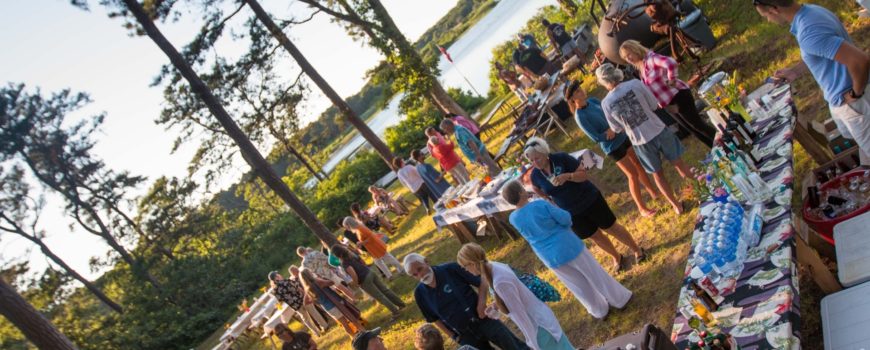
Sam Low, who has taken such good care of us throughout our visit to Martha’s Vineyard, threw a huge pā’ina at his house on our last night. Crewmembers, friends and relatives, around 100 people in all, came to enjoy a beautiful summer evening in Sam’s back yard. We feasted on excellent clam chowder that was made on an outdoor fire with freshly shucked quahog clams, a smoked pig, fresh caught fish and many other treats and delicacies of New England.

The evening was a chance for me to finally spend time with my host family, who I hadn’t really seen much of after meeting them on the day of our arrival. It was nice to relax, enjoy the camaraderie of everyone who has been so helpful throughout our stay on the Island, from our host families to our van drivers who took roundabout routes to the dock to give us tours of other parts of the island and tell us about the history of Martha’s Vineyard.  Having time to sit down and talk story with community members and learn about each other’s home is a special part of this trip, and we leave with fond memories and promises of seeing each other again. Mahalo!


Help fund the Voyage as we sail the East Coast

Hōkūle‘a’s visit to the eastern United States is a historic milestone in her 40 years of voyaging.

Celebrate with us by pledging your support to the Mālama Honua Worldwide Voyage.

Hōkūleʻa Update | July 2, 2016

Hawaii’s iconic voyaging canoe Hōkūleʻa started the month of July with a sail to a new destination. After various engagements within the Martha’s Vineyard community, Hōkūleʻa departed at 10:00 a.m. on Friday, July 1 to make the journey over to Woods Hole. A few members of the Aquinnah Wampanoag tribe and local community organizers that the crew connected with at Martha’s Vineyard accompanied the Hōkūleʻa crewmembers on their latest sail.

IMG_2013

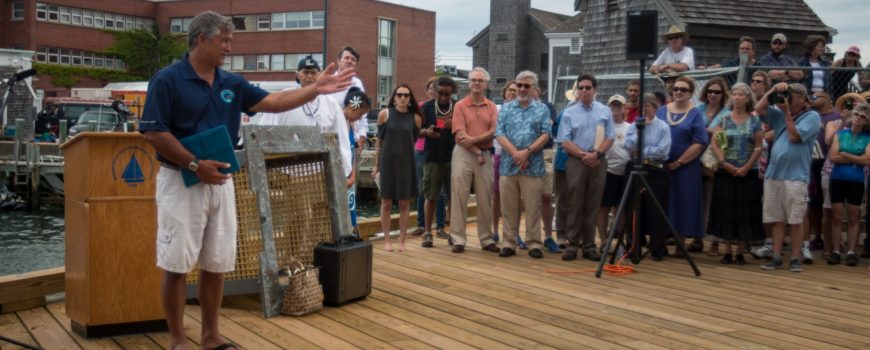
The canoe’s noon arrival at Woods Hole was marked by a greeting at Dyer’s Dock from representatives of the Mashpee Wampanoag tribal nation and the Woods Hole Oceanographic Institute community. A short welcome ceremony was performed, including the performance of a song written about Hōkūleʻa by the children of the Neekun School, a Wopanaak Language immersion program.

IMG_2052

“In this day and age, we know that it can be confusing about what is meaningful. But this is. This gathering, this togetherness is historical and we will speak of it for generations to come,” said Ramona Peters, an elder of the Mashpee Wampanoag, during the arrival ceremony.

Today, the Hokulea crew are attending the  Mashpee Wampanoag’s 95th annual powwow. The three-day long Native American event filled with traditional songs, dances, cultural ceremonies and other intertribal activities will honor Hōkūleʻa as part of the program.

IMG_2111

The Mashpee Wampanoag Tribe, known as the People of the First Light, has inhabited present-day Massachusetts for more than 12,000 years.

 The crew and canoe are scheduled to participate in Woods Hole community events on July 4, departing July 5 for New Bedford followed by Boston.  


Help fund the Voyage as we sail the East Coast

Hōkūle‘a’s visit to the eastern United States is a historic milestone in her 40 years of voyaging.

Celebrate with us by pledging your support to the Mālama Honua Worldwide Voyage.

Crew Blog | Catherine Fuller: Wampanoags Across the Water

On Friday, July 1st, we sailed perhaps the shortest portion of our leg from Martha’s Vineyard to Woods Hole, being approximately 8 miles.  The departure ceremony was very moving, and it was obvious how much our visit had meant to Tobias Vanderhoop, the tribal chairman of the Aquinnah Wampanoag tribe.  The tears he shed that day were tears of gratitude for the inspiration we had given the tribe and the happiness at having acquired a whole new family of Hawaiians.  He expressed his profound thankfulness for our visit and for the good medicine it had brought his people.

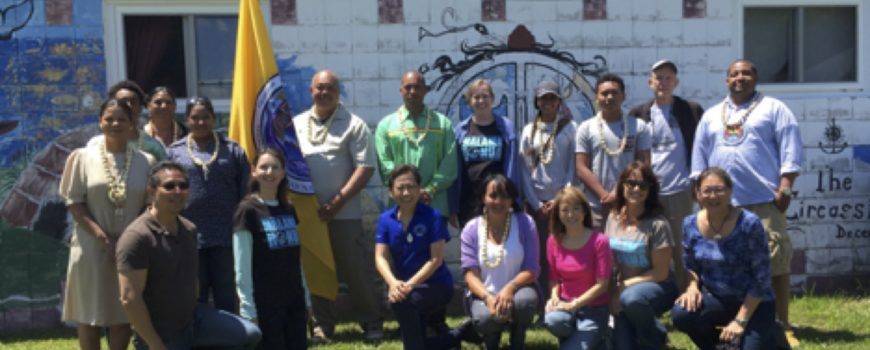
Although Tobias himself was not able to accompany us to Woods Hole, we took four tribal members on board the canoe with us: Andrew DeVido, Yannick Gonsalves, Bettina Washington and Brianna Randolph.  Bettina is the tribal historic preservation officer for the Aquinnah, and Andrew was one of the young men who helped build and paddle the mishoon.  Beside the tribal representatives, our crew also included our hosts, and Martha’s Vineyard outreach coordinators, Sam Low and Nan Bacon.  Sam, having been a crewmember on previous voyages, was right at home with the steering and the lines.  The four Aquinnah enjoyed their taste of sailing, and the three younger guests all got involved with handling lines and steering.

Being blessed with good winds for departure, we made our way across the channel pretty quickly, and were able to enjoy a little extra sailing as we waited for our appointed arrival time.

We were greeted at Dyer Dock by the Mashpee Wampanoag leadership including Chief Vernon “Silent Drum” Lopez, as well as by Woods Hole Oceanographic Institute president and director Mark Abbott.  Also taking part in the ceremony were children from the Neekun afterschool language program, which teaches youngsters to speak the Wampanoag language.  It was quite moving for our Aquinnah friends to come across the waters and greet their Mashpee cousins, and a treat for us as well.


Help fund the Voyage as we sail the East Coast

Hōkūle‘a’s visit to the eastern United States is a historic milestone in her 40 years of voyaging.

Celebrate with us by pledging your support to the Mālama Honua Worldwide Voyage.

Crew Blog | Michelle Knoetgen: Dockside Engagement at Martha’s Vineyard

Leading up to Hōkūleʻa’s landfall in Martha’s Vineyard, I’d been receiving frequent emails from Sam Low, Hōkūleʻa crewmember, and author of Hawaiki Rising, about ways our crew could engage with the community. Sam started planning this momentous event in September of 2015 and educated the East Coast community about Hōkūleʻa, creating a buzz of excitement through radio segments, news articles, book tours, and social media.

The long anticipated arrival of Hōkūleʻa in Martha’s Vineyard included two sunny days, full of dockside engagement at Vineyard Haven harbor. Volunteers set up Tisbury Wharf with huge white tents, including a stage and microphone for sharing music, hula, and moʻolelo (stories) and various tables for exhibits about sustainable agriculture, protecting the ocean, and native wisdom.

At the Wampanoag cultural exchange table, Aquinnah historian Bettina Washington and others from her tribe shared information about their home land of Noepe (also known as Martha’s Vineyard) and the connection the Aquinnah have to water and whaling. The Aquinnah Wampanoag’s newly carved 26 foot mishoon (canoe), was on display, proudly tied to the dock in front of Hōkūleʻa’s bow. Hōkūleʻa’s presence at Noepe created an overwhelming and unexplainable feeling for the Wampanoag and the crew. We all felt the presence of our ancestors, and saw the healing power of Hōkūleʻa in action. What is being accomplished through this connection is transformation and strengthening of indigenous culture.

For the outreach, Hōkūleʻa crew were “all hands on deck,” with everyone at different stations: aloha ʻāina flags, science at sea, star compass, a voyaging exhibit including ʻumeke and traditional fish hooks, in addition to the sharing tent where Faith Ako, and brothers Leo and Keiki Lindsay played Hawaiian music. I got to hear the Cunningham brothers, Mike and Tom, answer questions about their experiences at sea. Since everyone wants to hear the most harrowing tales, Mike told the audience about crossing the Tasman Sea with Captain Bruce in inclement weather, being wet for days with 25 foot seas with 30 knot winds, temperatures at 50 degrees with driving rain.

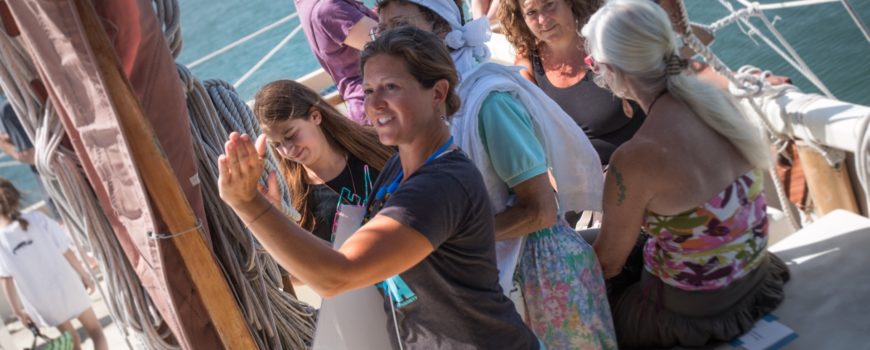
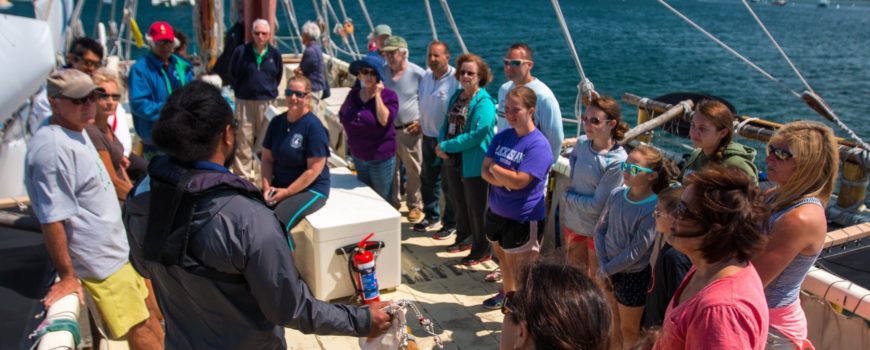
Over 1,000 people boarded Hōkūleʻa for canoe tours, asking everything from basic to technical and spiritual questions, and showing strong support for the mission of Mālama Honua.


Help fund the Voyage as we sail the East Coast

Hōkūle‘a’s visit to the eastern United States is a historic milestone in her 40 years of voyaging.

Celebrate with us by pledging your support to the Mālama Honua Worldwide Voyage.

Crew Blog | Catherine Fuller: From Mau to a Mishoon

Forty-one years ago, a small group of men conceived an idea to recreate a Polynesian voyaging canoe.  This was a vessel that had not been built in over six hundred years, and there were many who said it could not be done.  It was.  Those same men then sought out a navigator for their canoe, one who had skills that our people had lost, to guide it to Tahiti.  There were those who said it could not be done.  It was.  Later, Pius Mau Piailug, the Navigator, agreed to go beyond his own culture to share his skills with the Hawaiian people.  This sharing was the greatest gift one man could have given to us – a spark that helped to rekindle pride and interest in Hawaiian culture.  Hōkūleʻa’s achievements were a pebble dropped in a larger cultural pond.  As the ripples spread, they touched not only the people of our islands, but of our Polynesian cousins as well.

IMG_3011

Since that time, canoe culture has enjoyed a rebirth, but so have other aspects of culture as well.  When you have a canoe, you must have protocols.  You must learn the proper terms for parts of the canoe, for the winds, the skies, the waves, the fish and the birds.  You must learn about our oceans and our landforms to be able to recognize them readily.  Having the skill to navigate our canoes gave us the skill to navigate our destiny as Hawaiians; all that was the gift of one man.

IMG_0881

About six months ago, Nainoa Thompson broached the idea of Hōkūleʻa making a stop in Martha’s Vineyard to pay a visit to his cousin Sam Low, a lifelong resident.  Sam, in his planning, approached Tobias Vanderhoop, the head of the Aquinnah Wampanoag Council, and asked how Hōkūleʻa might properly make landfall on the island in accordance with traditional protocols.  Sam asked Tobias for a letter of invitation for the crew.  He waited for an answer, and with Hōkūleʻa’s arrival now three months away, he approached Tobias again.  The response he got this time was that the proper way to greet a traditional canoe was with another canoe.

IMG_1316

A small group of the Aquinnah tribe literally worked night and day for weeks to shape and burn out a tulip poplar tree to create their mishoon.  Like Hōkūleʻa, many in the tribe asked why a mishoon should be built and doubted the abilities of the young men who worked on it.  The canoe builders were able to launch it only the day before we arrived, and paddled out to greet us after a mere ten minutes of paddling practice.  Despite the rush to complete it, the fact that the mishoon came out to greet us at sea was enough to bring tears to the eyes of Wampanoag elders.  This mishoon is small in size compared to Hōkūleʻa, being only large enough to seat between six and eight people, yet it is a vessel of great importance.  No mishoon had been constructed in Aquinnah for more than three hundred years.

IMG_1377

At our arrival ceremony, and again at the departure, Tobias’ voice shook with emotion as he described the pride that the mishoon gave to the tribe and their gratitude to Hōkūleʻa for inspiring them.  He spoke of the connection forged between the Wampanoags and the Hawaiians and the spark that has now been lit in his own people.  Tribal historian Bettina Washington couldn’t stop smiling.  Many conversations I had with her centered around the revival of culture that this particular vessel might now bring to the tribe, including gathering stories of stars, winds and seas to create their own star compass and deeper understanding of their environment.

IMG_1498

The Aquinnah Wampanoag are now in a space that we once occupied; finding themselves with not only a canoe, but a key to a living culture.  In them we see a reflection of ourselves, seeking a revival of what was once lost.  The gift that Papa Mau gave to us, we are privileged and humbled to pass on.  We wish them luck as they begin their own journey of discovery, and look forward to the day we can again meet as people of the sea.


Help fund the Voyage as we sail the East Coast

Hōkūle‘a’s visit to the eastern United States is a historic milestone in her 40 years of voyaging.

Celebrate with us by pledging your support to the Mālama Honua Worldwide Voyage.

Hōkūleʻa Update | June 23, 2016

While docked on Block Island on Wednesday, crewmembers of Hawaii’s iconic voyaging canoe Hōkūleʻa began the detailed process of a crew switch. The latest crew of the Mālama Honua Worldwide Voyage arrived safely on Block Island, where they spent the day in training, preparing and receiving information from the canoe’s leg 20 crew, for leg 21 of Hōkūleʻa’s sail. Captain Bruce Blankenfeld conducted an orientation for the canoe’s latest crewmembers, as well as a brief overview of future port stops.

The Hōkūleʻa crew’s time on Block Island was spent engaging the local community through canoe tours and educational outreach. The canoe’s next stop is about 50 nautical miles away in Mystic Seaport, Connecticut where crewmembers will conduct lectures and interactive demonstrations of Polynesian wayfinding, voyaging and navigation at the Mystic Seaport Museum’s 25th Annual Wooden Boat Show.


Help fund the Voyage as we sail the East Coast

Hōkūle‘a’s visit to the eastern United States is a historic milestone in her 40 years of voyaging.

Celebrate with us by pledging your support to the Mālama Honua Worldwide Voyage.

Crew Blog | Shawn Kanaʻiaupuni: The Promise of Mālama Honua in New York City

Behind the Worldwide Voyage (WWV) is a Promise to Children signed by educational leaders throughout the state of Hawaiʻi and in each new port that Hōkūleʻa visits across the globe. Launched in 2014 and inspired by the mission of Mālama Honua, the Promise invites signatories to embrace the values of wayfinding and mālama honua to  create, sustain, and navigate a movement dedicated to future generations, imbued with the goodness of Hōkūle‘a and the wisdom born of her legacy.  Since its inception, The Promise to Children has been signed by hundreds of individuals from around the world who support and are dedicated to charting a better sail plan for our Island Earth with our children as the captains and navigators of this effort.  Before Hōkūleʻa left Hawaiʻi’s waters for the longest journey of her lifetime, the visionary leaders of Hawaiʻi’s entire public education system from kindergarten to graduate school, our largest private education institutions, and the network of private schools for a public purpose came together on the deck of Hōkūleʻa to commit to the Promise to Children with the intention of ensuring that Hōkūleʻa returns to a better Hawaiʻi.

The United Nationʻs World Oceans Day in New York City provided an amazing opportunity for a delegation of these leaders to share their Promise on June 8th. Traveling as part of the Promise to Children were David Lassner, President of the University of Hawaiʻi; Andrea Bartlett, Department Chair of UHM Curriculum Studies College of Education; Kathryn Matayoshi, Superintendent of the Hawaiʻi Department of Education; Waiʻaleʻale Sarsona, Director of Community Education and Randie Fong Director of Hoʻokahua at Kamehameha Schools; Judy Oliveira Vice-Chancellor of Student Services at UHWO, and many others, including Helen Whippe from Chaminade, Marjorie Mau of the UH School of Medicineʻs Department of Native Hawaiian health, and Gerard Akaka, physician, and Sharlene Tsuda, Director of Community Relations, from Queenʻs Healthcare System.

Not only did the Promise leaders witness the incredible, historic visit of Hōkūleʻa, a traditional Hawaiian sailing canoe, arriving to New York City on the Hudson River, they also met with various schools, students, and organizations during their stay. A first eye-opening visit was to the New York Harbor School on Governors Island. The schoolʻs career pathways tie directly to a vibrant maritime industry along the waterways and rivers of the area. Its students learn to sail, drive ships, and, importantly, the science of restoring natural habitats and animals, including oysters. The schoolʻs challenge is to produce one billion oysters. It considers success the point when oysters are reproducing naturally in the wild and when students are applying their knowledge to protect natural habitats.

The Promise delegation also visited Rachel Carson High School for Coastal Studies in Brooklyn. The principal and his leadership team were wonderful hosts. They happily shared about their marine-focused STEM program, including the MATE underwater robotics program and award winning science projects to replenish horseshoe crabs native to the New York waters. The school serves a diverse student body, including a large proportion of special education students.

The group spent the next day at NYU, touring the Wayfinding Exhibit of the Asian Pacific American Institute and learning about the the NYU Wallerstein Collaborative for Urban Environmental Education and the graduate program of Environmental Conservation Education. NYU has supported the Mālama Honua Worldwide Voyage, and also promotes teaching and learning aligned with the values of mālama honua and cultural revitalization and resurgence, The day wrapped up with reflections and implications to take home, followed by a beautiful evening presentation by the UH Hilo Imiloa Astronomy Center team with Captain Kalepa Baybayan at the Museum of Natural History Planetarium.

The next day, the United Nations auditorium was filled with supporters from Hawaiʻi and all over the world and Promise leaders joined the many Hawaiian-focused charter school students, educators and others from Hawaiʻi to learn and share their declarations. Following this wonderful day at the United Nations, the Promise leaders set out to Southampton to visit the Shinnecock Reservation. The Shinnecock have an amazing history, including recently achieving federal recognition after thirty years of effort. A group of tribal leaders had hosted Hawaiian students earlier in the week. With our guide and Director of the Youth Council, Weyhan Smith, they joyfully described the wonderful cultural exchange between their youth council and our haumana.

Several Tribal Trustees and Administrators met with us to share their stories with the Promise leaders. Some of the stories included work to gain back lands that were once theirs while protecting the 900 acres in their care from developers and those seeking to build their mansions on the beach. We visited the beautiful museum, the community center, and the pow-wow site, learned about their 275 year old Presbytarian history, efforts in the community to heal domestic violence, provide quality early childhood care teaching children their language, and the array of community programs and services offered at the health clinic.

The last stop was at the beautiful and yet undeveloped Shinnecock beach and burial grounds. We heard a familiar story to our Hawaiian islands as we looked farther down the beaches to the huge mansions lining the waterfront on both sides of the bay. We prayed for their fortitude and success in the continued protection of these lands before we headed back to the Big Apple on our bus. Only three hours in traffic! It was a rich and rewarding day.

The next dayʻs visits included the Isaac Newton Middle School, where Principal Lisa Nelsson and her teachers run a highly reputed school focused on science and math. Later that day, the delegation visited the East Harlem Scholars Academy, hosted by Andrea Wenner and several teachers. We learned about the charter school and after school programs that have been able to achieve significant turnaround with high quality educational opportunities for students, many of whom come from low-income, diverse backgrounds.

The trip wrapped up for those still in the city with a day on Pier 26 with all the Outrigger canoe teams who had arrived to participate in the Liberty Challenge, including a Hōkūleʻa and Hikianalia team, one steered by Nainoa Thompson and the other by Archie Kalepa. The day was filled with cultural performances and educational tours of the waʻa.

IMG_5905

The Worldwide voyage is engaging all of Island Earth – highlighting how cultures live sustainably at every port visit, while also sharing Polynesian culture, learning from the past, from each other, and fostering global relationships. This past week in New York was a significant milestone in this journey. As the Promise leaders head home, the rich and varied experiences provide learning, insights and reflective opportunities. Being together stimulated many new ideas and possibilities for the collaborative work necessary to create a better world worthy of our children, one full of hope and new frontiers about how to care for our ʻāina, our kai, our honua, and each other. I mua kākou, e mālama honua.


Help fund the Voyage as we sail the East Coast

Hōkūle‘a’s visit to the eastern United States is a historic milestone in her 40 years of voyaging.

Celebrate with us by pledging your support to the Mālama Honua Worldwide Voyage.
Worldwide Voyage | Seaport Foundation

As they make their way up the East Coast, crew aboard Hōkūleʻa have the unique opportunity of connecting with organizations and individuals who are creating hope in the world.

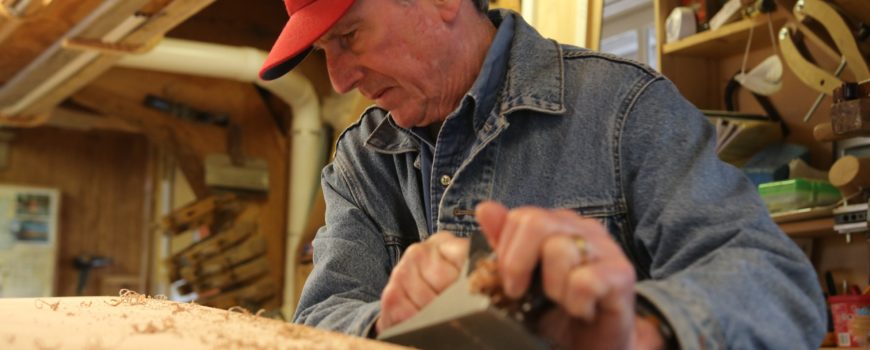
Seaport Foundation in Old Town Alexandria accomplishes this by enriching the lives of young adults through their apprentice program.

Apprentice Program Lead, Evan Waksler said, “So our apprentice program is a 6 to 8 month program for young adults. We help 18-22 year olds facing difficulties in their life. 5hey come from a background that gives them barriers to achieving full time employment.What we do is we provide an opportunity for them to learn some skills, the hard skills like carpentry and the soft skills like communications and goal planning. And what we do is as they go through this program it is a chance for them to really learn, grow, and understand what their full potential is.”

Waksler said, “Programs like this are so important because they help people that otherwise might not receive the kind of the attention that they need. What I found in this program is that all of the young adults that come through here, they are great people, but what they have is they have difficulty doing or fulfilling the duties of a traditional employee or they donʻt have the background or skills to be able to have that you know three to five years experience that you need for a new job. So this is just a chance for them to get that.”

Crewmembers spent some time talking to apprentices — sharing their experiences from the Worldwide Voyage and finding commonalities between their work at Seaport Foundation and on Hōkūleʻa to educate and train a new generation.

Hōkūleʻa crewmember Mark Keʻala Kimura said, “I think it is very important that they give these young people a way to get started, a way to get into the industry, give them focus, teach them some life skills, some job skills that helps them become employable and a productive part of society.”

Kimura reflected, “I see the similarities and we are all looking down the same thing. Itʻs basically educating the next generation and giving them those skills so that they can take over the canoe, they can become the people responsible for Hōkūleʻa.”


Help fund the Voyage as we sail the East Coast

Hōkūle‘a’s visit to the eastern United States is a historic milestone in her 40 years of voyaging.

Celebrate with us by pledging your support to the Mālama Honua Worldwide Voyage.