Hōkūleʻa Update | Charleston Community Outreach

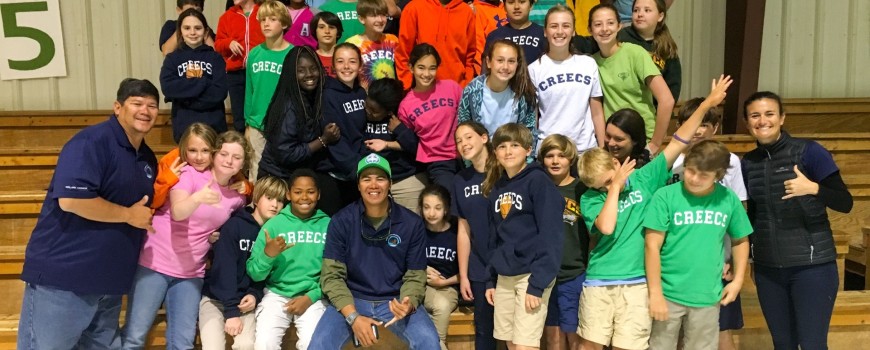
Since arriving in Charleston, SC on Thursday, April 14, the Hōkūleʻa crew spent three days connecting with the community by visiting students at Cape Romain Environmental Education Charter School, conducting canoe tours at Charleston Maritime Center and participating in the 26th annual Charleston Outdoor Festival where Hōkūleʻa Captain and pwo navigator Bruce Blankenfeld made a keynote presentation at its East Coast Sea Kayak Symposium.  The legendary canoe departed Charleston this morning to continue her sail up the East Coast.

IMG_7028

“Throughout our three days in Charleston we were able to share our messages of Mālama Honua and cultural and environmental sustainability with hundreds of people in the community,” said Blankenfeld.  “We are very thankful to the Charleston community for welcoming our crew and giving us this opportunity to engage with so many residents and students,” he added.

IMG_7111

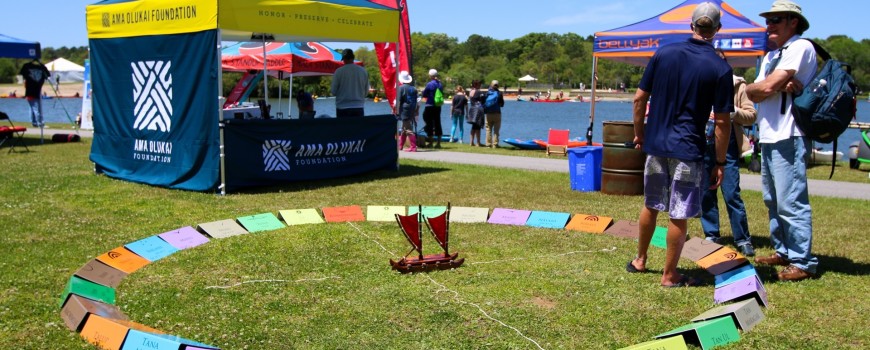
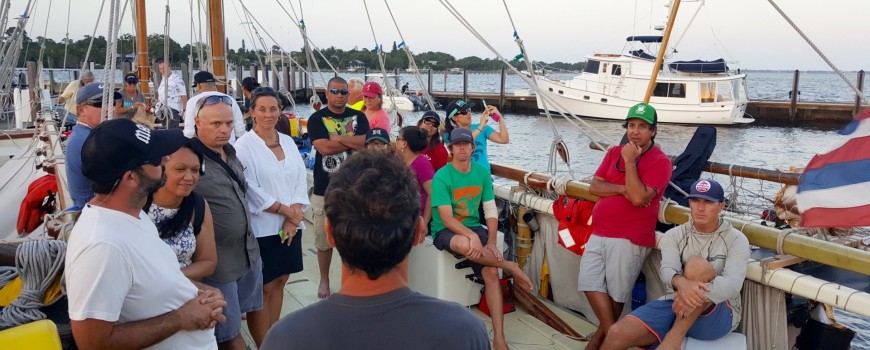
The Charleston Outdoor Festival was held from Friday, April 15 through Sunday, April 17, at James Island County Park. In addition to conducting canoe tours, the Polynesian Voyaging Society also had a Worldwide Voyage information booth at the event.  The festival also features the East Coast Sea Kayak Symposium, where Blankenfeld was the keynote speaker sharing experiences from the Mālama Honua Worldwide Voyage.  The symposium was a three-day immersion in the history, technique, hands-on experience, and fun of kayaking, canoeing, SUP and other paddlesports topics.

IMG_6870

Organized by the Charleston County Park and Recreational Commission, the Charleston Outdoor Festival brings together enthusiasts of all ages and experience levels with world-renowned instructors and sports equipment manufacturers. The three-day event also includes a multitude of activities like mountain biking, slack lining, archery, climbing, and disc golf. For more information on the festival, visit CharlestonCountyParks.com.

IMG_6638

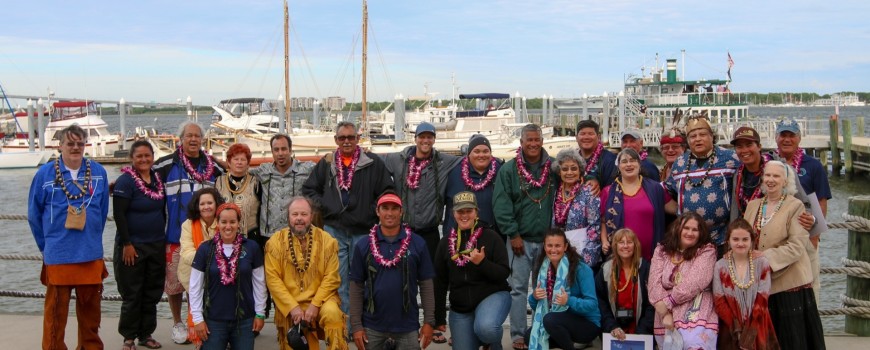
Hōkūleʻa was greeted with an arrival ceremony when the canoe arrived on April 14, at the Charleston Maritime Center.  Various chiefs from native American tribes in the area and other community leaders attended the ceremony to welcome the canoe’s momentous arrival to South Carolina. The Charleston destination marks another first in Hōkūleʻa’s sailing history.  Hōkūle`a’s next scheduled engagement will at Newport News, VA, on April 23.

For Hōkūleʻa’s most up-to-date schedule, visit http://www.hokulea.com/hokuleas-planned-east-coast-port-stops/

To follow the Mālama Honua Worldwide Voyage, visit http://hokulea.com/track-the-voyage


More than Adventure

Beyond a daring expedition, the Worldwide Voyage is quite possibly the most important mission that Hawaiʻi has ever attempted. As people of Oceania, we are leading a campaign that gives voice to our ocean and planet by highlighting innovative solutions practiced by cultures around the planet.

We could not have begun this great journey without your support, nor can we continue to its completion.
Hōkūleʻa Update | April 16, 2016

Aloha mai kākou, ʻo Hōkū Johnson koʻu inoa. I’m here at James Island County Outdoor Festival near Charleston, South Carolina. This is a great event where people are sharing outdoor education, flanked by our supporters here Ama Olukai, Oceans Earth, and the American Canoe Association. We even have our own Worldwide Voyage booth going on with our star compass to share information about navigation. We are also putting together some peace flags to make quilts to share around the world, which as been fun for the keiki. Meanwhile, the rest of the crew is getting Hōkūleʻa ready for departure early tomorrow morning alogn the Intracoastal Waterway. Please continue to follow us on Hokulea.com. Aloha!


More than Adventure

Beyond a daring expedition, the Worldwide Voyage is quite possibly the most important mission that Hawaiʻi has ever attempted. As people of Oceania, we are leading a campaign that gives voice to our ocean and planet by highlighting innovative solutions practiced by cultures around the planet.

We could not have begun this great journey without your support, nor can we continue to its completion.

Hōkūleʻa Update | April 14, 2016 – Charleston, SC Arrival

Hōkūleʻa is set to make more community connections during her East Coast leg of the Worldwide Voyage. Charleston County Parks in South Carolina will be welcoming the historic canoe to their 26th annual Charleston Outdoor Festival. Formerly known as the East Coast Paddlesports and Outdoor Festival, the event will feature Hōkūleʻa’s crew members as key note speakers at its East Coast Sea Kayak Symposium along with community outreach activities, while the iconic canoe will be docked at the Charleston Maritime Center this weekend.

IMG_6637

“We’re very thankful to the Charleston community for welcoming our crew, and are looking forward to sharing our experiences and lessons that embody the Mālama Honua messages of sustainability and environmental protection, of taking care of Island Earth,” said said Bruce Blankenfeld, Hōkūleʻa captain and pwo navigator. 

Hōkūleʻa was greeted with an arrival ceremony today, April 14 at the Charleston Maritime Center from 2:30-3:30 p.m. EDT.  Various chiefs from Native American tribes in the area and other community leaders attended the ceremony to welcome the canoe’s momentous arrival to South Carolina. The Charleston destination marks another first in Hōkūleʻa’s sailing history.

IMG_6681

The Charleston Outdoor Festival runs from Friday, April 15 through Sunday, April 17 at James Island County Park. On Friday, April 15, Hōkūleʻa crew will hold canoe tours from 2:00-6:00 p.m. at the Charleston Maritime Center. There will also be a Polynesian Voyaging Society Worldwide Voyage information booth at James Island that day from 1:00-5:00 p.m. and on Saturday, April 16 from 9:00 a.m.-4:00 p.m. Select Hōkūleʻa crew members will speak on Saturday, April 16 at 8:00 p.m., as part of the East Coast Sea Kayak Symposium at James Island County Park’s Edisto Hall. The session is free and open to the public, and registration will not be required. The crew will share their experiences with the Mālama Honua Worldwide Voyage to make cultural and environmental connections. The East Coast Sea Kayak Symposium is a three-day immersion in the history, technique, hands-on experience, and fun of kayaking, canoeing, SUP and other paddlesports topics.

IMG_6638

The Charleston Outdoor Festival brings together enthusiasts of all ages and experience levels with world-renowned instructors and sports equipment manufacturers. The three-day event also includes a multitude of activities like mountain biking, slack lining, archery, climbing, and disc golf. For more information on the festival, visit CharlestonCountyParks.com.

For Hōkūleʻa’s most up-to-date schedule, visit http://www.hokulea.com/hokuleas-planned-east-coast-port-stops/


More than Adventure

Beyond a daring expedition, the Worldwide Voyage is quite possibly the most important mission that Hawaiʻi has ever attempted. As people of Oceania, we are leading a campaign that gives voice to our ocean and planet by highlighting innovative solutions practiced by cultures around the planet.

We could not have begun this great journey without your support, nor can we continue to its completion.

Continue Reading

Hōkūleʻa Update | April 13, 2016

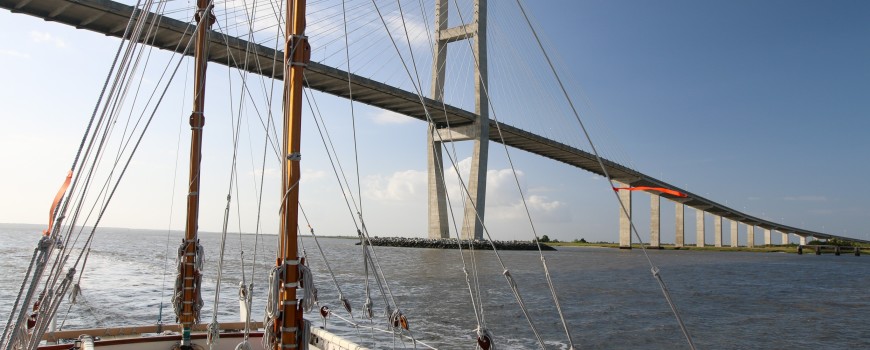
Aloha mai nei kākou, ʻo Maleko Lorenzo ma ke pola o Hōkūleʻa. We are having an awesome time here on Leg 19 of the Malama Honua Worldwide Voyage. We have been faced with some challenges, navigating and maneuvering through the Intracoastal Waterway. There’s been some winding parts traveling up the canals and rivers, and we’ve been going under a few bridges. But it’s good fun. The communities have been awesome and welcoming us to every port we’ve been stopping at for the nights. One in particular – Ft. McAllister – we were welcome to sounds of an ‘ukulele and some beautiful Hawaiian music, a reminder of home. We just left Savannah city this morning en route to Bohicket Marina and then onto Charleston the following day. Please come visit us at the Charleston Maritime Museum at 2:30pm on Thursday, April 14 and continue to follow us on Hokulea.com. Aloha!


More than Adventure

Beyond a daring expedition, the Worldwide Voyage is quite possibly the most important mission that Hawaiʻi has ever attempted. As people of Oceania, we are leading a campaign that gives voice to our ocean and planet by highlighting innovative solutions practiced by cultures around the planet.

We could not have begun this great journey without your support, nor can we continue to its completion.
Crew Blog | Darren Kamalu: The Physics of Raising the Mast

Ma ka hana ka ʻike
Information is absorbed by studying books and listening to teachers.
Lessons are learned by applying the information in real life. 

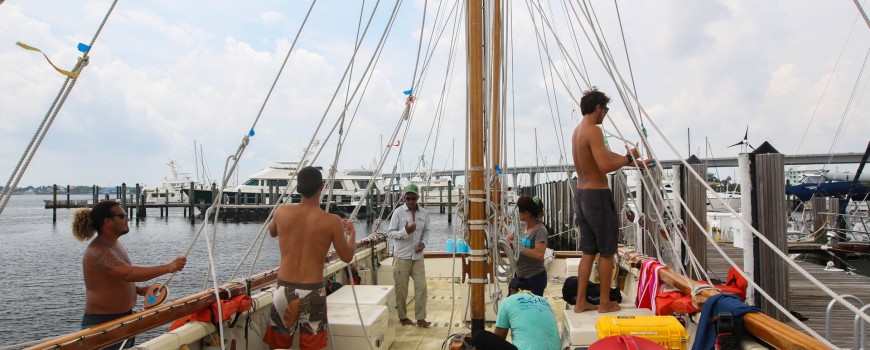
On board Hōkūleʻa, the crew learns complex physics concepts through hands-on training.  In Indian Harbor, Nainoa Thompson walked the crew through the difficult and dangerous task of raising and lowering the masts while teaching them the salient principles of torque and static equilibrium that must be understood to safely complete the task.

Without ever needing to use the specific terminology, the crew was taught to understand by things like:

  • Torque – a force applied to an object causing it to rotate (the mast).
  • Fulcrum – the pivot point about which an object rotates (the base of the mast).
  • Lever Arm – the distance from the fulcrum to the point of the applied force.
  • Center of Mass – the location where an object can be balanced by applying a force to offset gravity.
  • Normal Forces – the forces applied by the deck and the mast housing.
  • Tension – the forces applied by the ropes.
  • Mechanical Advantage – the increased force available through a pulley system used while raising the mast.
  • Moment of Inertia – a measure of the difficulty encountered when attempting to rotate and object about a given axis.
  • Static Equilibrium – the balancing of forces and torques to hold an object in place.
  • Stable and Unstable Equilibrium – the tendency of an object to break free from static equilibrium.

All of these concepts are taught in physics classes and can take weeks or months (maybe years) to grasp when there is no real world application.  On Hōkūleʻa, the crew understood the ideas in short order because of the quality of the lesson and the patience of the teacher coupled with the understanding of the importance of the task and that sometimes you have to get it right on the first try.

After all, the sails don’t go up and the waʻa doesn’t go unless the masts are raised.


More than Adventure

Beyond a daring expedition, the Worldwide Voyage is quite possibly the most important mission that Hawaiʻi has ever attempted. As people of Oceania, we are leading a campaign that gives voice to our ocean and planet by highlighting innovative solutions practiced by cultures around the planet.

We could not have begun this great journey without your support, nor can we continue to its completion.
Crew Blog | Noelani Kamalu: Family Reflection

:

The Polynesian Voyaging Society is guided by a group of core values two of which are mālama (to care for) and aloha (to love).  Wherever Hōkūleʻa travels, these values are overwhelmingly displayed by the communities that she visits.  In Florida in particular, complete strangers offered food, shelter, and transportation to a crew of people that they had never met.  They simply wanted to help Hōkūleʻa`a and her crew in any way they could.  For some of the Floridians who moved there from Hawaii, it was a connection back to a place that they will forever call home.  For others, they were inspired by her mission of Mālama Honua.  For my family, it was that, and then some…

I happen to have an Uncle Kalani, an Aunty Ananta, and cousins Tricia, Leilani, and Keala Kamalu who live in Florida, who helped to host and mālama the crew of Hōkūleʻa. They greeted us on the dock, made us `ono food, and were overall amazing hosts.  And, while I would like to say that they did it because they had relatives aboard Hōkūleʻa, I know that they would have taken care of the crew, regardless of my family’s involvement in the Worldwide Voyage.  But I have to admit that it was a special treat for me to be able to spend time with my family whom I rarely see, and to see the amount of work and preparation that they did in order to make us feel “at home.”  What I mean is, the food was broke da mout’!  After being away from home for so long, chicken long rice, lumpia, and kalua pig really hit the spot!

Ultimately, Florida was a reminder that Hōkūleʻa and her mission are not only for those who have the privilege of sailing aboard her, but that she is for the world to appreciate. The people of Florida truly embodied the essence of Mālama Honua, which the crew and I will never forget.

On a personal note, I would like to thank my family for being the awesome people that they are!—Mahalo for everything, and see you soon!


More than Adventure

Beyond a daring expedition, the Worldwide Voyage is quite possibly the most important mission that Hawaiʻi has ever attempted. As people of Oceania, we are leading a campaign that gives voice to our ocean and planet by highlighting innovative solutions practiced by cultures around the planet.

We could not have begun this great journey without your support, nor can we continue to its completion.

Crew Blog | Shawn Malia Kanaʻiaupuni: A Hui Hou from Leg 18

Yesterday came to a close in the golden glow of Florida’s afternoon sun with a few tears and amazing memories of shared laughter, love, and learning aboard Hōkūleʻa for the crew of Leg 18. Just two days ago, we traveled from the aloha-filled community of Indian Harbor to Titusville, arriving in the afternoon to a huge crowd of over 200 people waiting for the canoe. Many had heard from local newspapers and word of mouth as the news spread between ‘ohana and friends that Hōkūleʻa and her crew were in town. Many familiar faces smiled back at us from earlier ports, greeting us anew, flowing with support and the spirit of aloha that the wa’a carries wherever she goes. It has truly been a privilege and honor for all of us to welcome Florida keiki, makua, and kupuna with open arms as they share tears, joy, and wonder stepping aboard the catwalk. For those getting to know the canoe for the first time, the message of Mālama Honua hit a strong chord, given the state of the waterways and fish environments in the area. Later, the hula hālau that performed in Indian Harbor danced on Hōkūleʻa, providing a magical moment as the sun set in addition to mea ‘ai for dinnner, wrapping up a perfect day.

As we boarded our flight in Orlando, our crew reflected on the past few amazing days in Florida. We watched a baby manatee chewing on some weeds in the marina before the early morning event on Wednesday honoring the nation’s space navigators, Lacy Veach and Ellison Onizuka. It was a historical moment to represent Hawai’i, meet Lacy’s family members, and receive a powerful welcome from NASA Kennedy Space Center director, Robert Cabana. Later in the day, NASA staff guided crew 18 and 19 through the various, immense space vehicle assembly and launch facilities. We learned about the many commonalities that we as sea voyaging crew share with space voyagers. What an incredible feeling! One of our crew members joked that he should be recruited for the next space crew based on his experience as a navigator, knowledge of the stars, being able to live aboard a vessel and sleep in small spaces, familiarity with port, starboard, bow and stern (also terms used on a rocket ship), and leadership of a crew. Very cool. I guess you need a little rocket science sprinkled in there somewhere, too. Study up, all you students out there, the next voyage is to Mars!

IMG_0850

The following day, the sun blazed while both crews worked from dawn to dusk to prep the canoe. A team headed off to NASA to teach school children the star compass, while Nainoa and Bruce each gave well-received presentations at various locations. We knew they made an impact by the late afternoon visitors who said they simply had to see Hokulea after hearing their stories. The official transition to Crew 19 in the late afternoon came with a “huli” call from Cap Kawika. Although it wasn’t possible to do canoe tours because we were still working, a steady flow of visitors stood on the dock all day long watching and taking in the serene elegance of the wa’a, even as spars, booms, sails and finally the masts were lowered, pausing to applaud the crew as we took a minute to wipe the sweat away before cleaning up the stays and lines.

The evening’s festivities made the hard work all worthwhile with dinner a la ‘ohana Kamalu. Mahalo nui iā ʻoukou from all of us. That’s the best Hawaiian food I’ve had after 5 weeks of a lot of saimin and crackers (no complaints about our cooks who fed us well with many fabulous single pot meals). And so, it is with well-nourished kino and na’au that we head to our beautiful pae ‘āina Hawai’i to be in our place with our families once again, forever transformed by the mana and aloha of Hōkūleʻa and all that she embodies for our Lāhui. Ke Akua pū a hui hou. Me ke aloha pumehana from the Leg 18 crew.


More than Adventure

Beyond a daring expedition, the Worldwide Voyage is quite possibly the most important mission that Hawaiʻi has ever attempted. As people of Oceania, we are leading a campaign that gives voice to our ocean and planet by highlighting innovative solutions practiced by cultures around the planet.

We could not have begun this great journey without your support, nor can we continue to its completion.
Continue Reading

Crew Blog | Hye Jung Kim: The Worldwide Voyage Reaches South Korea

It was not until I got involved with the Polynesian Voyaging Society that I started to think more about where I come from and the history of my ancestors. Funny how I have to be all the way in Hawaiʻi to get to appreciate my Korean ancestry! That is the beauty of the Polynesian Voyaging Society; the value that is placed on the history of the places that we visit is something that made me appreciate where I come from, and want to learn more about my roots.

While I was teaching mathematics at University Laboratory School PCS on Oʻahu, I had the opportunity to work with some of my students on the Propagate Peace Project: One million trees for the Worldwide Voyage. The purpose was to have a million trees go in the ground around the world in commemoration of the voyage and to thank the organizations and individuals who are taking the time to plant these trees. It was a substantial task that the students took on and the students were somewhat overwhelmed — rightfully so. A million trees – the mind can barely imagine it.

3134

Naturally, I turned to the person who taught me to mālama ʻāina in the first place, my father. My father works at the Miryang City Hall in the forestry department and I asked him if our city had plans to plant trees. He said “Of course, about ten thousand”. You should have seen the excitement on my face. My next question was, “Dad, you think we can plant in commemoration of the voyage?” After explaining my students’ project to my father, ten thousand trees in Miryang were counted towards the one million for the voyage!

The Worldwide Voyage has been highlighting the actions of people and organizations that are taking care of our precious earth and I am very excited to have found a story in Korea through my father. On my last visit to South Korea on March 20, 2016, I learned so much more about the City’s systematic planting of trees every year. What I have learned is a small part of the larger picture but similar government-funded tree plantings happen in every city of South Korea. For me personally, it was a way to ground myself back to the city that I lived in and where my parents currently reside.

3132

More than ten thousand trees go in the ground every spring in the city of Miryang, South Korea. The entire process is funded by the government and all the outplantings are done systematically. One of the exciting aspects of Miryang city is that they offer to plant trees on private land as well. Each year the experts at the city hall surveys the city to locate plots of land to plant trees. Some of the regions that are selected are the sections burned by fire in previous years, areas that trees had to be cut down due to diseases, or areas that many trees have fallen due to diseases.

Every year, there are nurseries that grow the trees to be out planted later on in the year, the locations are designated by members of the city hall’s forestry division, and seasonal workers make sure the trees go in the ground in the various locations. The entire process is funded by the government and year after year it is a budget item that does not disappear. The value that the South Korean government places on tree planting is one that I am amazed by and thankful for. The story of South Korea is one that I makes me so proud of where I come from and is inspirational.

Propagate Peace

Here in Hawaiʻi, my former students Baylee Jackson, Brandon Caliwag, and Kuʻu Hanohano have presented their project to Hawaiʻi’s Community College faculty group at a conference, they have made connections to schools and organizations in Florida, and they have planted trees at their former school University Laboratory School prior to graduating. The project has evolved to include more students in Hawaiʻi and more specifically Nā Kelamoku, Polynesian Voyaging Society’s Youth Leadership Initiative, the group who will be heading over to various islands and projects to help the organizations plant trees. The Propagate Peace Project is one that could not be completed without the help of others and I am truly honored and thankful to have this group of youth who inspire me every day.

Please continue to visit Hokule.com and follow us on Facebook to hear more about our tree planting and other mālama honua volunteer opportunities and activities!


More than Adventure

Beyond a daring expedition, the Worldwide Voyage is quite possibly the most important mission that Hawaiʻi has ever attempted. As people of Oceania, we are leading a campaign that gives voice to our ocean and planet by highlighting innovative solutions practiced by cultures around the planet.

We could not have begun this great journey without your support, nor can we continue to its completion.