Crew Blog | Heidi Guth: St. John and Hōkūleʻa

As Hōkūleʻa sailed into the Caribbean Sea, headed from the Atlantic Ocean toward the channel between St. Lucia and Martinique, we seemed to be chasing a vibrant double rainbow, always just ahead of us, arcing from port to starboard.  It lasted long enough to be used as a course-setting mark for those of us steering into the sea.  What a beautiful hoʻāilona from the Caribbean!

IMG_5361

Warm, tropical rain brings laughter and giddiness to our crew as we jump around in our first fresh water showers in days, rinsing salt water off of our skin and out of our hair and clothes.  Generally, our showers and laundry washing come from buckets of salt water that we pull out of the sea from the canoe and dump over our heads or clothes after lathering up.  The simple joy among the crew reminds me of when it would rain enough on St. John, Virgin Islands, that our home’s cistern (water catchment under our house) would overflow, and we would race for the rarity of being able to take a shower without having to turn off the water between lathering and rinsing.  On Hōkūleʻa, we carry our rationed fresh water in jugs in the hulls.  On St. John, we store our fresh water in the foundations of our homes, relying on the gifts of the rainy season falling on our corrugated roofs.

IMG_3157

The closer Hōkūleʻa gets to St. John, the more similarities come to mind.  With the water jugs in our hulls, we also carry boxes of food, labeled by day, with breakfast, snacks and dinner planned and packed ahead of time by volunteers and crew.  My mom used to take the ferry to the island of St. Thomas once a week with her two-wheeled luggage rack to go grocery shopping.  In an all-day event, she packed our week’s food into boxes that she wheeled on the luggage rack to the open-air bus, the ferry and then our car on St. John, packing everything with care, including milk and meats that were sorted with frozen blocks that she brought from home.

DCIM100GOPROGOPR6326.

Living on a small island – whether it is a floating one like Hōkūleʻa or a stationary one like St. John – takes a lot of care, preparation and effort.  A small population learns to know and care for one another’s better qualities and skills.  We respect each other’s solitude and enjoy each other’s company.  We become colleagues, teachers, students, friends, family, teammates and crewmates in equal measure.  We learn how important a sense of humor can be: laughing at ourselves at least as much as we laugh with others.  We look out for each other in times of danger and in preparation for the possibility of life’s and nature’s storms.

IMG_4475

Island and voyaging people are constantly surrounded by inspirational, natural beauty.  Tourists used to ask me as a child if we just got used to our tropical views on St. John.  I remember answering no, that part of why we loved our home was because the beauty always awestruck us.  The same is true of the marine vistas from the waʻa.  We are constantly appreciating the scenery and the regularly renewed realization that the ocean is our avenue to anywhere.  The sea spikes our curiosity and fuels our need for adventure and discovery.  As any islander or coastal dweller knows, the ocean can be our best medicine, spiritual guide, experiential teacher and a source of both inspiration and humbleness, as we seek to care for that which cares for us.

IMG_5750

Both St. John during my childhood and Hōkūleʻa now have limited communications (despite incredible advances in satellite technology) and electricity (many nights, I did homework by kerosene lantern on St. John, and on Hōkūleʻa, we do everything at night under the glow of the moon or our red head lamps so that we do not blind each other or disrupt the navigators’ and steersmen’s views of the stars).  Provisioning, resupplying and repairs can be expensive and time-consuming projects, with required items having to be innovatively created or come from overseas on a different timeline from that of many continental dwellers.  Recreation, besides outdoor activity, generally includes song and storytelling.

IMG_5567

Growing up on St. John, I was proud to tell people I was born in Hawaiʻi.  While it didn’t hold the same credibility as having been born in the Virgin Islands, at least I had been born on an island, and one with an equally special heritage and living culture.  I first learned about traditional Polynesian navigation and Hōkūleʻa while living on St. John and going to school on St. Thomas, via the daily school kids’ ferry.  Today, far from the Pacific, Hōkūleʻa is being navigated to St. John by pwo (master) navigator Kālepa Baybayan and apprentice navigator Brad Wong.  Our earth’s oceans continue to connect people, places, ideas and inter-generational learning opportunities in a basic and majestic way.

IMG_5655

It is astonishing to be sailing home to St. John on board an iconic part of Hawaiʻi – another place I’m honored to call home – getting ready to introduce two sets of my hanai (adoptive) families to each other.  Some of the happiest moments of my life have been on St. John and on board this waʻa kaulua.  To have the oceanic people of both island places physically connect is phenomenal.  St. John is a special flower in the lei of hope, peace and awareness that Hōkūleʻa is weaving around the world.  The majority of St. John’s land and surrounding seas are protected within the National Park that brought my father to the island for work, and its proud heritage of the indigenous Taino and homegrown West Indian Virgin Islanders make it a beacon for island and cultural sustainability.  Mahalo nui loa to all who have enabled our crew to be able to experience this connection and who have helped to make St. John and Hawaiʻi’s canoe – Hōkūleʻa – significant representatives of cultural perpetuation and environmental protection.


Crossing North

After a 20-month sojourn in oceans south of the equator, Hōkūleʻa has returned to the northern hemisphere in the blue waters of the Atlantic. Please, help celebrate our crew by supporting their journey.

Hōkūleʻa Update | February 25, 2016

There are times when not even words give justice to a special moment or time in life. This morning was one of them when we sailed under a majestic double rainbow as if it was made especially for Hōkūleʻa. We all understood that it was a hōʻailona (a sign) of aloha that goes beyond our understanding. Just past the rainbows marked the crossing point from the Atlantic Ocean to the Caribbean Sea. But to us, it meant something much deeper than that.

IMG_5367

Then word that Eddie Aikau’s Big Wave event was on in Hawaiʻi, and it was then that we knew it had to be Eddie guiding us. Being on Hōkūleʻa at that moment, crewmembers gathered to give respect and aloha to Eddie, who unconditionally gave his life to others. An ʻawa ceremony took place on board where moʻolelo (stories) of Eddie were shared by older crew members who knew him very well. As a matter of fact, crewmember uncle Snake Ah Hee was on Hōkūleʻa when we lost Eddie. A man of very few words, tears of aloha streamed down his face as he shared his memories. While he spoke, his eyes went into a place of the past. Like reels of tape playing in his head, we felt a presence of mana that exudes aloha at its very core – a powerful, spiritual moment indeed for all of us. Our prayers of aloha to the Aikau ʻohana on this day of his event and remembrance.

IMG_5237

According to our calculations, we have crossed over 1,900 miles to date.  The crew is in good spirits and weather has been ideal for Hōkūleʻa as she sails the Caribbean Sea for the first time. Though we can’t literally see the island of St. Johns, we see it in our minds as we steer toward Manu/Nalani Ho’olua to pull her out of the horizon. The end of our journey is just below the horizon at the end of a rainbow. Mahalo Eddie and all who have left us and guided us throughout this Worldwide Voyage. We shall never forget. Let the stories be told. Ke Akua pū a me a hui hou


Crossing North

After a 20-month sojourn in oceans south of the equator, Hōkūleʻa has returned to the northern hemisphere in the blue waters of the Atlantic. Please, help celebrate our crew by supporting their journey.
Hōkūleʻa Update | February 24, 2016

We all stare intently into the horizon looking for the island of Barbados. There is an unspoken competition for who can spot land first as if somehow his name becomes written in infinite history. But as it should be, like a teacher to his students, master navigator Kālepa Baybayan spots land first as the sun sets and we see the glowing lights of Barbados.  This is the first time the crew has seen land since leaving Natal, Brazil 13 days ago.  A truly special moment for all, yet we still have a few hundred miles to go, steering in the direction of Noio Hoʻolua to find St. John, US Virgin Islands.

IMG_4554

Swells seem to have more urgency now as we get closer to reaching the shores of many islands up the Caribbean chain, and it hits our steering paddle with much force. But many years of steering in Hawaiʻi’s ocean waters make us more than capable and ready. Today we celebrated crewmate and apprentice navigator Brad Wong’s birthday. Our chef Nakua Konohia-Lind made a chocolate-nutella-peanut butter crunch cake, which most devoured after a heartfelt birthday speech Kālepa. In Brad’s boyish mischievous tone, he thanked everyone as we all sang happy birthday to him.

IMG_4644

As night approaches, it brings all our souls to settle. Following and memorizing ancient star lines that our ancestors used for hundreds, if not thousands of years puts us in a clear, spiritual state of mind. Our approach to what we do is truly culturally rooted. Not just bringing Hōkūle’a to the shores of others around the world, but more importantly in the manner of how we do it. To be pono. With respect and much understanding of our surroundings. We constantly give thanks through prayer. Spirits are high, and everyone is in good health. We have crossed 1,700 miles of open ocean, and we are all still in awe of nature’s beauty in all the things we see. Hence, our message of Mālama Honua, to take care of Mother Earth, is definitely worth every mile and sacrifice. We are truly humbled and honored to carry this message across the world.  Ke Akua pū a me a hui hou. Eō Hōkūle’a, Eō Hawaii.

Na’u
na Kawika


Crossing North

After a 20-month sojourn in oceans south of the equator, Hōkūleʻa has returned to the northern hemisphere in the blue waters of the Atlantic. Please, help celebrate our crew by supporting their journey.

Hōkūleʻa Update | February 23, 2016

It’s been 12 days and 1,700 miles since departure from Natal, Brazil, and according to our calculations of our captain and navigator Kālepa Baybayan and his haumana Brad Wong, we should be seeing the island of Barbados tomorrow evening. Sunny days and clear night skies have made it a little easier to navigate and keep our heading towards Noio Ho’olua. Hokulei (Capella) has been our star of choice to follow. Hōkūleʻa is averaging easily 6-7 knots throughout the day.

IMG_4226

Music, jokes, personal stories have been this crew’s morale booster. From personal stories of Brada Iz Kamakawiwaole to heartfelt memories of Eddie Aikau and my uncle George Helm, songs from different generations of Hawaiian music echo on the deck of Hōkūleʻa. We have become more than just crewmembers; We have become ʻohana. We are family. Though we are separated from our ʻohana back home, little do they know each of our ʻohana has grown. We can’t wait to share our stories of the things that we have witnessed, the people we have met, and the places we have been. But in the meantime, the story is still being told. Hōkūleʻa still sails because somewhere beyond the blue horizon there is an island waiting for us. Eō Hōkūleʻa.

Na’u
na Kawika


Crossing North

After a 20-month sojourn in oceans south of the equator, Hōkūleʻa has returned to the northern hemisphere in the blue waters of the Atlantic. Please, help celebrate our crew by supporting their journey.

Crew Blog | Kawika Crivello: Hōkūleʻa and the Noio

The relationship between our voyaging canoes and birds is well-documented, although sometimes the occurrences seem more magical and story-like than realistic.  But isnʻt that the beauty of our moʻolelo, of our living stories?  That our every day lives, experienced from the deck of our wahi pana or sacred spaces like our beloved Hōkūleʻa, are indeed magical, as well as real?  I want to share with you today some of the stories I have heard and I have lived about the beauty and magic of the Noio bird, from the voyagers of Hōkūleʻa.

DSCF2174

When a Noio is seen by our Navigators and crew during a deep sea voyage, we know that there is land ahead, which lifts everyone’s spirits.  But the Noio is not just a guider of voyagers to land; the Noio is also a guider of voyagers to kupuna, to ancestry. We are approximately halfway in our journey on this leg of the Worldwide Voyage from Natal, Brazil to St. John, US Virgin Islands.  So far, we have been visited by a noio bird on three different occasions.  On each of those three occasions, even in storm-like conditions, like clock-work a noio would fly around Hōkūleʻa in the wee hours of the morning, land on the starboard side of the canoe, and rest there until sunrise. The somewhat surprising note is that the only times we’ve landed fish so far are on those occasions the Noio visited us and landed on our waʻa.  We caught two ono on the first day, then 1 mahimahi, then another mahimahi on the third visit.  Others may say that is a coincidence, but we know that the Noio signify our kupuna (elders) are watching over us.  

IMG_3773

Our latest visit by the noio, just last night, included two of them that stayed with us until morning.  We acknowledge them by name – Uncle Mel Paoa and Uncle Wally Froseith.  During the last leg from Cape Town to Brazil, first-time voyager Lohiao Paoa, son of late long-time voyager Uncle Mel, was visited by a noio hundreds of miles out at sea in the Atlantic.  Lohiau made eye contact with the bird, lifted his hand to the noio, and connected by spirit as the noio landed on his finger.  This very magical and very real moment took place on Uncle Mel’s birthday. Uncle Wally – legendary big-wave surfer, master canoe builder, and steward of Hōkūleʻa – sails with us still, his spirit strengthened on board this leg by his moʻopuna, Ben Dumaran. We know they are both here with us, as well as countless other great voyagers and kupuna.  How honored we are by their protective presence.  We keep our headings toward Noio Hoʻolua, living the story of Hōkūleʻa and her Noio birds, sailing our beloved canoe around the world to share the story of our people, celebrate our past, and set our sights on a pono future for our precious honua.  

Eō Hōkūleʻa! 

Naʻu
na Kawika


Crossing North

After a 20-month sojourn in oceans south of the equator, Hōkūleʻa has returned to the northern hemisphere in the blue waters of the Atlantic. Please, help celebrate our crew by supporting their journey.
Hōkūleʻa Update | February 21, 2016

Aloha, this is Kālepa Baybayan on board the Hōkūleʻa sailing towards the Caribbean from Natal, Brazil. We are more than halfway to our target destination, roughly about 7º north and 51º west. The crew is doing fine, and the canoe is functioning well. We are now sailing into the Azores High, which is a broad band of fresh winds. The winds are averaging 20 knots, so we are traveling at about 7 knots. So we are making good speed towards our target, and the crew is doing well. Everyone is working as best of possible in these rough conditions, and I wish you all a good day, and keep following us on Hokulea.com. A hui hou and aloha!


Crossing North

After a 20-month sojourn in oceans south of the equator, Hōkūleʻa has returned to the northern hemisphere in the blue waters of the Atlantic. Please, help celebrate our crew by supporting their journey.

Hikianalia Update | East Hawaiʻi Outreach

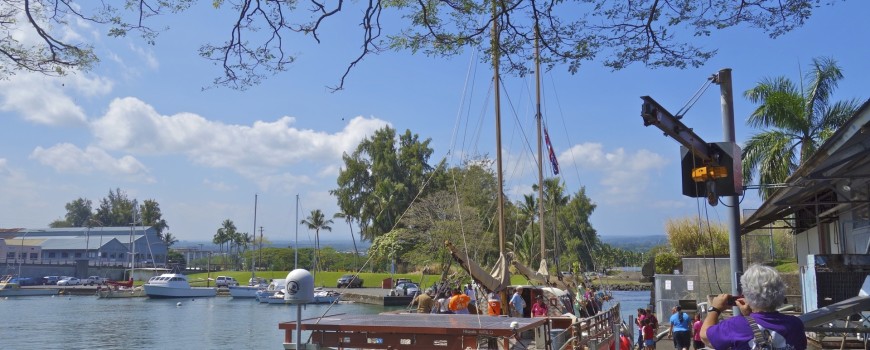
As Hikianalia made her way from Maui to Moku O Keawe, the welcoming committee and ʻOhana Waʻa Hawaiʻi Island hosted an Education Day on February 19, 2016 for over 300 students and adults with participants from 2nd grade thru college, coming from as far as Kona.  Four learning stations quickly grew into a dozen, including: Hikianalia/Mālama Honua Info Station, Star Compass lessons, Parts of the canoe game, Hōkūleʻa Sleeping quarters replica and foulie/gear try-on, 6 knot tying stations, Bust-a-bundle rope teamwork game,  Canoe tours & sail setting (smaller canoes), Lawaiʻa (Fishing game), Marine awareness & touch tank hosted by UHH Keaholoa, CPR & First Aid skills and challenge tent, Rescue techniques, and skills games hosted by ʻOhana Waʻa safety trainers, and a Ke Ana Laʻahana PCS Hōʻike student project tent.

Education Day 2

As part our our design and intention to have an emphasis on peer-to-peer learning and sharing, most of our stations were manned by voyaging students and supported by Kumu.  These amazing students came from Nāwahīokalaniʻōpuʻu, Ka ʻUmeke Kāʻeo, and Ke Ana Laʻahana schools.  

Community Day 12

On February 20, 2016, we welcomed Hikianalia into Hilo Bay – she made her grand entrance at the exact time our Community Day festivities kicked off (Mahalo Captain Bob for the perfect timing!).  She was greeted by pū and oli from the bluff overlooking Kanukuokamanō, the entrance into the Wailoa river; then another greeting at the pier of pū an oli again with a response for the holokai of Hikianalia.  Our preliminary numbers from our team of volunteers and community members estimates 500 attendees, with about 300 who participated in canoe tours aboard Hikianalia.  We also had a star compass lesson, knot tying stations, live music and an Aloha ʻĀina tent, again with high student involvement in the sharing.

Mahalo to all for helping to make this 2-day engagement so successful!

Me ka haʻahaʻa,
Kaimana, on behalf of the welcoming committee & ʻOhana Waʻa Hawaii Island

For upcoming Hikianalia events on Hawai’i Island, visit our Event Page.

Photos by Kaimana Bacarse


Crossing North

After a 20-month sojourn in oceans south of the equator, Hōkūleʻa has returned to the northern hemisphere in the blue waters of the Atlantic. Please, help celebrate our crew by supporting their journey.