Learning Journey – Wailupe Valley Ahupua’a

Wailupe, O‘ahu — 

By Max Mukai.  A big mahalo to all of those who came to see the wa‘a thus far. I want to mahalo the rest of the crew for welcoming back to the fold of Hōkūle‘a. I have been away for a long time and it is great to be back participating in the ways of our ancestors. It was a real blessing to sail from Waimanalo to the bay of Maunalua.

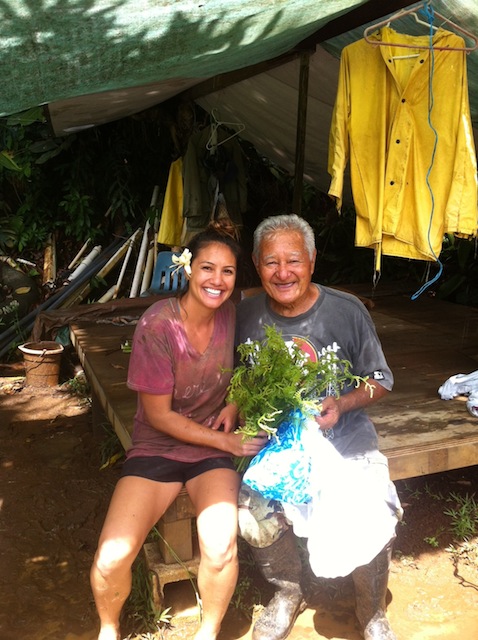
Today we had a blast with some of the Kaiser student leaders helping us with the many keiki that came to see the wa‘a. Such joy the waa has brought to our community. Later today, we were able to hike a trail in the back of ‘Aina Haina that led to the beautiful ʻElepaio sanctuary. The leaders of that project were kind enough to guide us and a few local residents up mauka.

Oli were given to protect our steps and to bring life to the native foliage that is making a comeback due to the efforts of protecting and rehabilitating the ʻElepaio sanctuary. It is these kinds of connections that we make as a community crucial as the wa‘a herself is literally kui i ka lei o Hawai‘i, or sewing us and our various communities together like a lei. I know that aloha still resides here in this great wahi. E mau ana ke aloha o kēia wahi nei.

Enjoy these pictures from our adventures mauka. Ke aloha no.

Continue Reading

Reflections from Popoiʻa Island / October 16

Kailua, Koʻolaupoko —

By Brad Wong.

On Wednesday October 16th, after an amazing greeting by the Kailua community in Kailua bay, Hōkūleʻa crew members paddled to the nearby Popoiʻa island and worked with the DLNR Division of Forestry and Wildlife, along with Kailua Sailboards and Kayaks on the restoration of the nearby offshore island.  The importance of the trip was to visit a location to where seabirds actively nest and to mālama some of the wildlife that help us as voyagers find islands while navigating out at sea.

Amarisa from DOFAW talked to us about Popoiʻa island just offshore from Kailua Beach. The island is special as it is dominated by native coastal plants, rare for the coastlines of Hawaii these days.  The island also used to have a fishing ahu located on it.

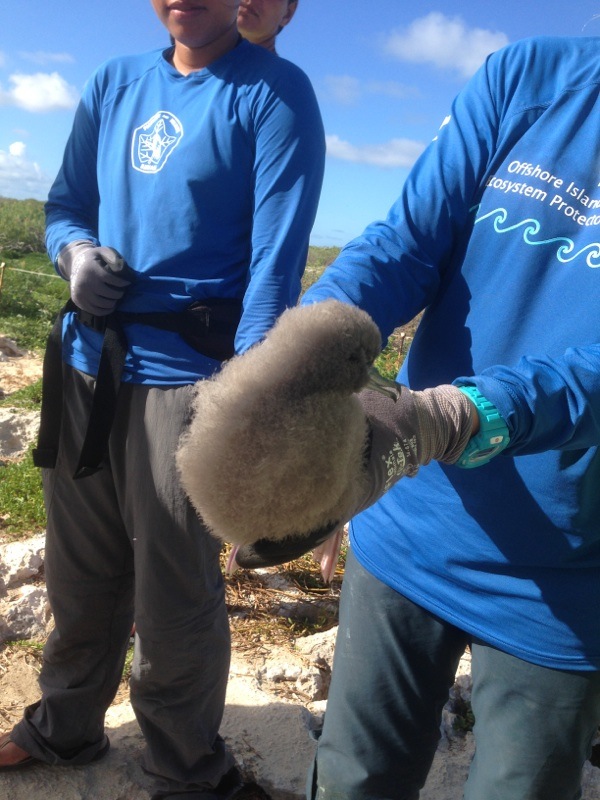
The DOFAW offshore island team showed us the various bird species located on island including an Uaʻu kani chick. The island is a seabird sanctuary, like all of the offshore islands along Koʻolaupoko, and many Uaʻu kani actively nest here on Popoiʻa island.

Maiapilo, a rare native coastal plant grows on Popoiʻa and is thriving along with other native plants including ʻāweoweo, nohu, ʻōhelo kai, and ʻākulikuli.

Our mission for the afternoon was to remove invasive pickleweed Batis maritima from a corner of the island. At the end of the day, we successfully removed all of the invasive plant from our area we were assigned!  A great start to the visit at Kailua.

Continue Reading

Crew Blog: Waimānalo Weekend

Waimānalo, Oʻahu — 

By Michi Wong and Jenna Ishii.

This past weekend, Hōkūleʻa visited beautiful Waimānalo. For weeks, the community has come together to plan for Hōkūleʻa’s stay. This weekend was also the Waimānalo Country Fair, and we are so grateful to the organizing committee for allowing us to be a part of the Fair and for hosting our crew members with such aloha. As we sailed into Waimānalo, the children and community members all gathered on the beach and welcomed Hōkūleʻa. We could hear the sound of the drums from the ocean as we were surrounded and escorted by sailing canoes, outrigger canoes, surfers and swimmers.

Hui Mālama O Ke Kai helped to organize over 60 organizations, families and community partners for this weekend. Their young leaders Kalani and Mina were at the heart of reaching out to the community and organizing the various welcoming events, dinners, huakaʻi, and departure. Hui Mālama O Ke Kaiʻs mission is developing community pride and fostering leadership in Waimānalo’s youth and families through the teaching of Native Hawaiian culture and values.  They hosted the crew at their beautiful new location and we got to know the families and youth of Waimānalo through eating together and looking at the night sky on their big grassy field.

Six of us returned to Waimānalo Beach after star gazing at Hui Mālama O Ke Kai. We were assigned to anchor watch and had agreed to awaken every hour throughout the night to check on Hōkūleʻa. We arose earlier than expected at 3 am, had our coffee with the sunrise, then headed to Puʻuhonua O Waimānalo.The village of Puʻuhonua O Waimānalo is the first of it's kind – a land base for the developing of a sovereign Hawaiian nation, where Kanaka Maoli and our extended ʻohana are living close to the ʻāina in a self-determined community dedicated to cultural, social, political, and economic advancement of the people. Puʻuhonua – the refuge – was born out of struggle and out of hope.

Deep in the valley, the families and kūpuna invited us into their social place of refuge, a lace of social, cultural, and economic restoration. As we hiked up the road lined with humble homes, Brandon gave us an overview of the sociopolitical history, and stated that the mission is to practice peaceful coexistence, self-governance, and to restore food and economic security for Hawaiians.

The families have begun rebuilding the ahupua'a. They have cleared the valley of eucalyptus, and the land is latticed by red dirt terraces and an irrigation system. Many varieties of taro are being propagated so that they will have enough, 12,000 taro, to fill the lo'i. There is ko, ulu, momi, and olena. There are chickens and tilapia growing fat in aquaculture tanks. There is a heiau with iwi, and there are new beginnings. This is a place of aloha.

We enjoyed delicious hot bread pudding at the hale at the valley. The view was breathtaking, the taro field, the red dirt terraces, the expanse of Waimānalo below, sunlight glancing off the sheer cliffs, Mānana Island to the west, and Olomana to the east. We headed down the road for a lovely brunch prepared for us by the youth of Hawaiʻi Job Corp. Back at the beach, we hosted the families of Waimānalo, welcoming them to visit Hōkūleʻa, and children made aloha ʻāina flags for the Worldwide Voyage.

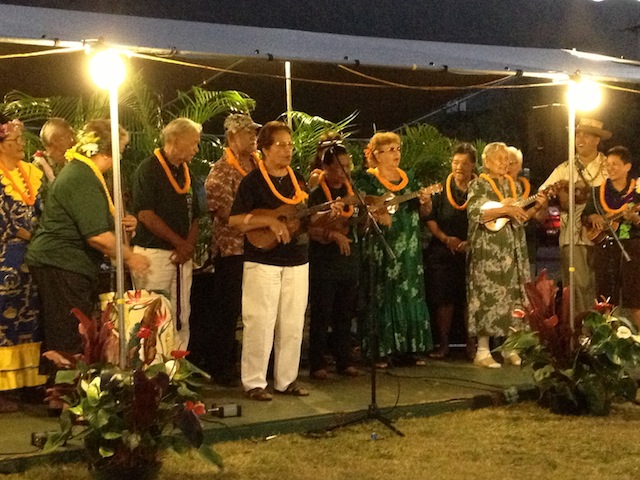
To end our incredible weekend in Waimānalo, about 300 community members gathered for a paʻina at Hui Mālama O Ke Kai for food, music, dancing and talking story. We are so grateful for all of the aloha, support, and ono food that was shared with Hōkūleʻa and our crew.

For more information about Puʻuhonua O Waimānalo, go to http://www.hawaii-nation.org/puuhonua.html.

For more information about Hui Mālama O Ke Kai, go to: http://www.huimalamaokekai.org/.

For more information about Job Corps, go to: http://hawaii.jobcorps.gov/home.aspx.

Continue Reading

Learning Journey – Moku O Lo‘e

Moku O Lo‘e, Kāne‘ohe —

By Jenna Ishii, Haunani Kane and Mark Heckman.

Last week, Hōkūleʻa was invited to sail to Moku O Loʻe and the crew learned about the history of the island, which is now the home base for the Hawai‘i Institute of Marine Biology (HIMB).

Mark Heckman who is the Education Specialist for HIMB sailed to Moku O Loʻe with the crew and took us on a tour of some of the research labs on the island to learn how HIMB is contributing to learning about and caring for our oceans. Mark shared that HIMB’s main educational goal is to create access to the island for the local community and school groups. HIMB hosts about 6,000 + people per year starting with students as young as the 5th grade.

We then visited the Karl Lab and met with his research students Annick and Jonathan. Annick is working with Palau’s marine protected area network looking at DNA tissue samples of coral to tell how closely related coral are throughout Palau. She asks the questions, “Where do coral larvae go?” and “How related are coral to one another?” Answering questions like this will help to understand how best to protect reef ecosystems throughout the world.

Crew members also visited a lab where students are measuring coral reef erosion, the natural breakdown of the reef, with high tech photographic imaging technology. Nyssa who is a graduate student is hoping that by taking 3D images of coral reefs, she can learn about how coral reef growth and erosion may change over time. Another research student, Chelsie Councell, is studying reef fish ecology to see how reef fish settle and how well connected they are. And finally, we learned how water quality affects the reproduction of native Hawaiian sea urchins from graduate student, Jenny Fung. These urchins are being out planted in Kāne‘ohe Bay because they can maintain a low algae cover in the bay once a team of scientists clean the algae with a super sucker.

One of the key ways that the University of Hawai‘i has supported the Worldwide Voyage is through the time and commitment of their graduate students. Alexis Rudd and Eric Tong are just a few of the graduate researchers that are designing projects aimed to help us learn more about that world's oceans. In the upcoming months crew members will be trained to collect and preserve fish caught on the canoe, and to maintain Hikianalia's ecological acoustic recorder which allows us to observe the ocean through sound. It is our hope that youth around the world will be inspired by the cultural connections between modern science and traditional exploration.

Mahalo nui to the HIMB ‘ohana for allowing Hōkūleʻa and our crew to learn about the incredible and very important work your researchers and students are doing to share how we can protect our oceans through marine research. For more information about HIMB, go to: http://www.hawaii.edu/himb/.

Continue Reading

Learning Journey: Ahupuaʻa O Kahana, with Uncle Nana Gorai / October 11

Kahana Valley, Oʻahu —

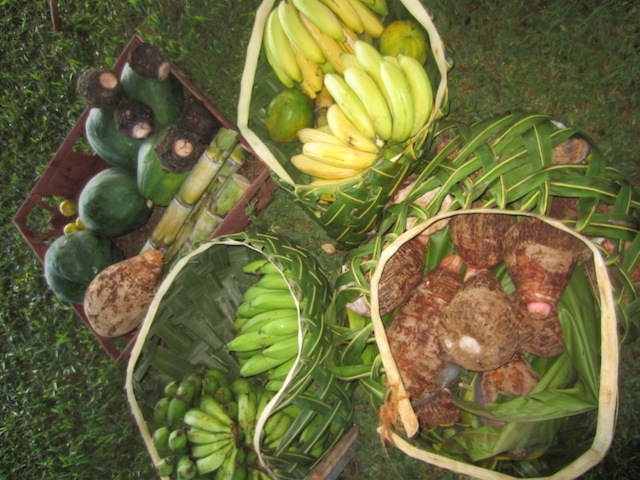
By Miki Tomita. PVS Crew were invited to participate in a Learning Journey hosted by Kahana community and students from University Laboratory School.  Students and crew spent the day with Uncle Nana Gorai, kupuna to Kahana Valley, learning about the history of the Valley, its residents, and its mission as a living park dedicated to cultural education.Students and crew spent the morning with Uncle Nana in his loʻi, learning about his family history tied to that ʻāina, and the varieties of kalo he is growing.

Students and crew spent the morning with Uncle Nana in his loʻi, learning about his family history tied to that ʻāina, and the varieties of kalo he is growing.

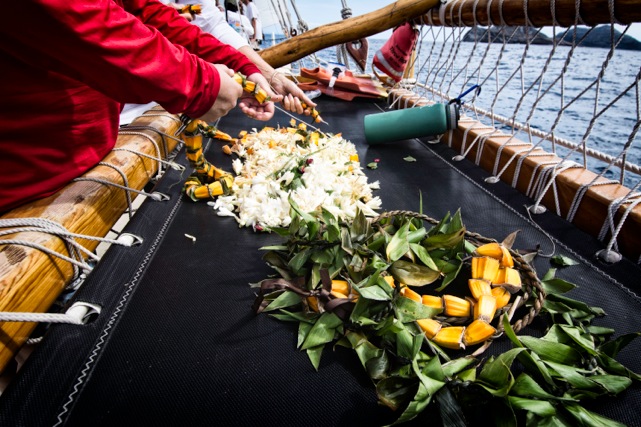
We gathered kalo, hoio, and ti for hoʻokupu and makana to welcome crew and community to Kahana.

The afternoon was spent preparing for Hōkūleʻa’s arrival, cooking and making lei.

We learned so much from Uncle Nana and the Kahana community.  Thank you so much for hosting us and sharing the wealth of your land and people with students and crew!

Continue Reading

Kahana Waiwai

Kahana, Oʻahu

By Michi H. Wong. 

I aloha aʻe au i ka ʻĀhiu o Kahana, I greet the wild wind of Kahana.

Thunder, lightning and torrential downpour marked the day Hōkūle‘a arrived in Kahana Bay, Friday, October 11, 2013.  The rain was a befitting welcome.

‘Ahupua‘a o Kahana is a place rich in natural resources.  Rain, from the clouds captured by the mountains, flows down into fertile valleys once filled with lo‘i, where farmers cultivated kalo in pondfields irrigated by the ‘auwai.

The waters from the sea also provided abundance.  Kapa‘ele‘ele ko‘a, a fishing shrine that stands on the Punalu‘u side of the bay, is a sacred place where offerings are given to ensure the return of schools of akule.  Huilua is the fishpond that sits near the mouth of Kahana Stream, where the mix of fresh and salt water creates ideal conditions for raising ‘ama‘ama.

‘Ahupua‘a o Kahana, known to be waiwai, or having wealth, plenitude, and prosperity.  It is a place representative of Hawaiian genius in agriculture and aquaculture engineering, and of the ancestors’ wisdom in good stewardship, ensuring community security, and creating a place of sustainability, mauka to makai.

Kahana is remarkable for the present day families who fight, as their parents and grandparents did, to continue to practice their traditional ways of life, culture, language and self-sustainability in the valley.

The community greeted the Hōkūle‘a crew, cared for us by providing shelter and wonderful meals made from the bounty of their land and sea.  All of what we learned, all that was given and shared, was done so with the warmest of aloha.

Sunny and Aunty Mae were generous with their time and knowledge, teaching us about the ‘ahupua‘a.  They invited us to the Kahana “Store,” now a museum, located in the heart of the community, brimming with the spirit of the people and the specialness of this place.  There we caught a glimpse of the genealogy of Kahana, the sociopolitical history, and saw artifacts of tools, weapons, musical instruments, implements, toys and art.

Anagin shared the nearby garden filled with bananas, taro, ulu, sweet potatoes, guava, mailelauli‘i, ginger, māmaki, wauke, and varieties of plants from throughout Polynesia and Asia, and much more.  As importantly, the values cultivated here included the promise that everyone would be cared for and no one would go hungry in Kahana.

The sun shone intensely on Sunday, our last day there.  Absent were the sometimes wild tempests and untamed wind called ʻĀhiu.  The seas were calm and clear, the bay like glass, gentle waves lapping the fine sand.  The families of Kahana gathered on shore to pule and wish Hōkūle‘a a safe journey.  Nainoa spoke for us all, with mahalo and aloha, no good-bye, but until we meet again.

Then the kona winds shifted, and the trades blew.  Thunder rolled in, Uncle Maka sounded the pū, heralding Hōkūle‘a’s departure.  As we left Kahana Bay, it began to rain again.

Continue Reading

Hōkūle‘a departs Kahana Bay on October 13; Final Events of Statewide Sail

O‘ahu –

After departing from Kahana Bay on October 13, Hōkūleʻa heads for her final stops on the 2013 statewide sail: Kailua, Waimānalo, Maunalua Bay, and Ko Olina. The Mālama Hawai'i statewide sail ends on Nov. 1, after which Hōkūleʻa will return to HCC's Marine Education and Training Center (METC) on Sand Island to prepare for 2014 departure to Tahiti, the first international stop on her Mālama Honua Worldwide Voyage.

(Click on images to enlarge them.)

 Kailua, Oct. 16-19

Flyer KAILUA 2013-Oct16-19 - final

Waimānalo Country Fair welcomes Hōkūle‘a, Oct. 19-20

Have fun on land and sea at the Wai­mā­nalo Country Fair, Friday to Oct. 20.


A visit by  Hōkūle‘a and some new carnival rides will spice up this year's fair, held at Wai­mā­nalo Beach Park.  Hōkūle‘a, which is starting a world tour with stops at various places around the islands, will be greeted by a special ceremony at 1:30 p.m. Oct. 19 and will be open for tours from noon-4 p.m. Oct. 20. The public is invited to meet with navigators and crew members.

The fair runs Friday from 6 to 11 p.m., Oct. 19 from noon to 11 p.m. and Oct. 20 from noon to 8 p.m. (From Kalakoa!, Star-Advertiser, Oct. 12, 2013).

Maunalua Bay, Oct. 21-26

Flyer MAUNALUA 2013-Oct21-26 - final

Ko Olina, Oct. 28- Nov. 1

Ko Olina Flyer JPEG

Continue Reading