The Mālama Honua Worldwide Voyage

Our Polynesian voyaging canoes, Hōkūleʻa and Hikianalia, are traveling over 50,000 nautical miles around the earth, bringing people around the world together to set a course for a sustainable future.

We are sailing like our ancestors have for a thousand years—using wayfinding. On board, there is no compass, sextant, or cellphone, watch, or GPS for direction. In wayfinding, the sun, moon, and stars are a map that surrounds the navigators. When clouds and storms make it impossible to see that map, wave patterns, currents, and animal behavior give a navigator directional clues to find tiny islands in the vast ocean.

Hōkūleʻa has sailed using wayfinding for 40 years, and her navigators find their destinations  using nature as a guide. Now Hōkūleʻa, her sister canoe Hikianalia, and their navigators are taking that knowledge to find a new destination—a healthy ocean and island earth. The planet that sustains all is facing huge challenges, and every step in the right direction will make a positive difference.

Everyone can be a navigator for Earth’s needs. Every person on earth can help navigate us to a healthy future where our Island Earth is safe and thriving again. Stories of hope and local solutions that blend indigenous wisdom with other best practices can be found all over the world.  If we find and share those stories with each other, we can help chart a positive course for our planet.

We are asking kids, families, governments, communities, and businesses to share how they mālama honua—take care of our Island Earth.  Please visit our Mālama Honua map, and help us grow the movement by adding stories of hope that can inspire and educate us all.  Add yourself and the people and organizations you most admire to the map, and help Hōkūleʻa thread this lei of hope around the world as she navigates earth’s oceans.

To learn more, you can watch a 3-minute introductory video below, and follow our voyage by signing up for Mālama Honua stories and updates on the bar to the right.


Help us make history

As the mainstay of support to PVS, our members are allowing us to voyage beyond the boundaries of Polynesia to inspire a global movement to care for our earth.

Learning Journey: Kahanahaiki – Learning By Doing…

By Diane Tom-Ogata, Kimberlee Stuart, and Shari Jumalon, Ho’ala School, Wahiawa, O’ahu

Kahanahaiki is an ahupua’a (chiefdom) in the moku (district) of Waianae on the mokupuni (island) of O’ahu. Currently, Kahanahaiki is managed by both the state and federal programs that rely heavily on both paid employees and volunteer groups.

On Friday January 17, 2014, Maggie Pulver, Teacher at Hoala School & A’o Hawaii Educator, gathered thirteen Ho’ala middle school students on the lanai, along with representatives from O’ahu Army Natural Resources Program (OANRP) and A’o Hawaii Educators for a field trip to Kahanahaiki in the Wai’anae Mountains.

Kim Welch, OANRP team leader and Ho’ala School parent, conducted a safety briefing, reminding students to stay hydrated, pay attention, and keep on the trail. She also went over certain protocols in place, like using the bathroom and what to do if you get lost.

Excited students prepared to document their trip as part of a writing assignment to investigate endemic and introduced Hawaii plants with backpacks packed with their camera, phone, notebooks & food.

3 vans drove up to their destination where students clamored out of the vans to admire & take pictures of the breathtaking views of the west & north shore, large surf, hear a brief summary of the area and brush off their shoes to prevent the transfer of alien seeds, bacteria, etc into the preserve.

image003

At the entry of the red path, an ‘oli, “E Ho Mai”, was presented asking for wisdom to be bestowed upon the participants where a special kind of learning would take place in this forest.

While trekking up the slippery, and at times steep, path students assisted each other and provided words of encouragement. The group periodically stopped along the trail to learn about particular plants referring to vocabulary which were introduced to earlier in the week (indigenous, endemic, parasitic, etc). They observed markers where planted propagated endangered plants are monitored, identified & learned about the importance and how the native plants were used in Hawaiian culture.

At one point a 3 foot high corrugated metal exclosure suddenly appeared: one of the first built for the protection of Kahuli, the endemic Hawaiian Tree Snail, from unwanted predators like rats, Jackson Chameleons, and carnivorous snails.

Here excitement filled the air with the spotting of a Kahuli.

The Kahuli are hermaphrodites that reside on the same plant for its entire lifespan & have approximately 4 live births per year.

Arriving at the beautiful vista with a stunning view of makua valley and beach, all sat to eat lunch while enjoying the view, the incoming shrouding clouds and each other through reflection conversation.

After recharging at the summit, the group headed back to the vans but stopped to take back a planting stand that was no longer needed.

Throughout the hike, it was evident through student actions they shared a mutual admiration for each other and respect for the environment.

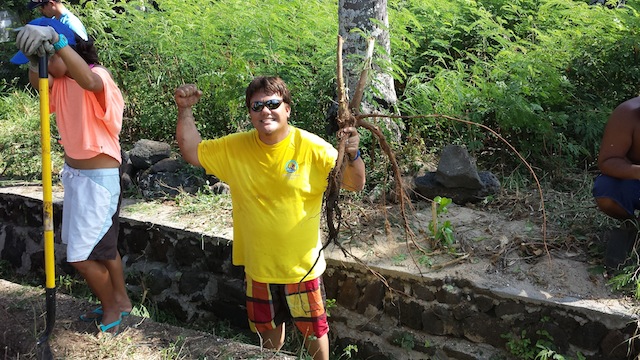
image015

This truly was a huaka’i ‘imi’ike (a journey to see & learn) with laulima (working together) interlaced, where students learned the importance to malama honua as well as malama i kekahi i kekahi, where the message of the World Wide Voyage to “Malama Island Earth – our natural environment, children and humankind” was evident.

Note: An ahupua’a is a traditional Hawaiian type land division, similar to a town. However, unlike “modern” land divisions, ahupua’a stretched from mauka (mountain) to makai (ocean), and usually included a source of wai (water). This helped to ensure that anyone living in the ahupua’a would have access to all of the resources they needed to survive.

Continue Reading

Crew Training Sail and Rainbow Invite Regatta, January 2014

METC, Honolulu Harbor —

By Miki Tomita.

This past weekend, PVS provided the UH Sailing Team with a moving viewing platform for families who flew in to view the Rainbow Invite Regatta.  Captained by Bob Perkins, Noa Noa provided both a viewing experience for UH parents, as well as a training opportunity for PVS crew members.

In addition to viewing the Regatta, crew practiced tacking, man overboard protocol, and reading relative bearings.

What a great day of sailing and training!  Thank you to Captain Bob for helping provide this amazing sailing opportunity in the middle of dry dock.

Continue Reading

Training Sails on Hikianalia

METC, Honolulu Harbor —

By Karen Holman. As Hōkūleʻa brings the Mālama Hawai‘i leg of the Worldwide Voyage to a close, Captain Bob Perkins has been leading training sails on Hikianalia. These numerous opportunities allow crew to practice drills under a variety of weather conditions.

Three watch captains are appointed for each sail and are tasked with being captain for a portion of the sail, as well as leading 3 to 4 crew members under their watch. This two-tiered approach allows crew to be train at multiple levels simultaneously and practice skills such as docking, tacking, and jibing, as well as opening, closing, and changing sails.

We are challenged each day and learn the more delicate process steering the canoe solely by her sails, without the steering sweep, attuning ourselves to the wind and subtle shifts in the canoe. For now we sail in the familiar waters off Waikiki, where it is easy to get comfortable on a calm evening, with magnificent sunsets on mirrored water.

Despite the well-traveled waters of our training sails, we must remember that soon we will be traveling global and unknown waters and it is invaluable for skills to become second nature, and easily performed in the dark during a squall and high seas.

It has been inspiring to watch crew of varied experience levels guiding and supporting one another as we all deepen our skills as sailors.

Next Hōkūleʻa and Hikianalia will go into dry dock in preparation for the Worldwide Voyage before a series of final training sails in which the canoes will sail side by side.

Mālama Hawai’i Statewide Sail, May-November 2013

During the Mālama Hawai’i Statewide Sail, a staggering 20,000 school children  visited Hōkūleʻa.

Crew  participated in learning journeys, visiting sacred sites, participating in service projects, and growing deeply inspired about how local communities are caring for place.

During their visit children  communicated their thoughts of Aloha ʻĀina and Peace on flags as messages to be shared with the world, stepped on board Hōkūleʻa in canoe tours, and learned about plankton.

The voyage is already having profound impacts. This morning a group of middle school students from Maui traveled to O‘ahu to teach students about voyaging, the star compass, and navigation. As students teach their peers and leadership trains the youth, mentoring grows across many contexts.

The display of community, learning, and stewardship we have encountered is astounding and we have yet to even leave home… imagine all that awaits.

Continue Reading

Learning Journey: Kawaikui Beach Park, October 25

Kawaikui, Wailupe, Kona, Oʻahu —

By Diane Tom-Ogata.

A symphony of excitement, curiosity, and smiles invaded Kawaikui Park as Kumu Michelle Kapana-Baird & her students from Kaiser High School led groups of Ms. Dori Kim’s Aina Haina Elementary students through rounds of hands-on learning and wonderment.

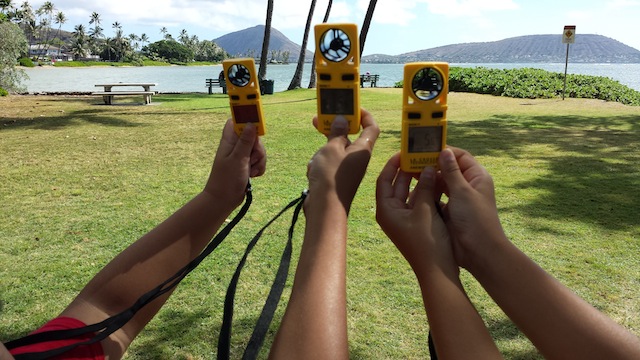
Amongst the soft lapping of the ocean & warm slow breeze, you could see the glee as students ran with their kites, the expressions of surprise at the taste of limu, the tilt of a head & slightly furrowed brow as students listened intently about the importance of limu, the looks of anticipation waiting to see how much limu was collected along the beach, the determined intense faces & chatter while making limu lei and the amazement of using an anemometer to measure wind speed.

Littered along the shore was debris which transects were placed over. Using gloves as a safety measure, dried debris was collected within the transect & deposited in an assigned a mesh bag.

At the limu tent, were two Citizen Science Kupuna to share their mana’o. Both Uncles were steadfast in their belief that passing down knowledge to kids is important.

Uncle Henry described limu as a “vegetable” as students munched on a couple of varieties. “I think it’s important that we teach the kids about limu,” says Uncle Wally, “And I think it’s because it’s a big part of the environment. What people don’t realize is that limu is the base of the food web of the ocean.”

Uncle Wally shared the cultural traditional & importance of limu. Probing questions and challenging pronunciation of Palahalaha added to the enjoyment of learning.

The limu lesson was not over: PVS crew member Max Mukai shared with the kids that “the amazing thing about limu is that, when the invasive are taken away, the native will return and find a way to flourish.” Students made limu lei and watched as PVS Crew Members took out the limu “lei” to plant.

This was a day of fun learning that no rubric or standard can measure. And memories which will be imbedded in the minds of these children forever.

Continue Reading

Crew Blog: Na Pōhaku o Hauwahine, Ulupō Heiau and Kailua

Kailua, Koʻolaupoko —

By Brad Kaʻaleleo Wong.

On Friday October 18th, the Hōkūleʻa crew visited two restoration projects bordering majestic Kawainui.  The first stop was at Na Pōhaku O Hauwahine, a large basalt rock outcropping located on the west section of Kawainui along Kapaʻa Quarry road.  Here, the community group ʻAhahui Mālama I Ka Lōkahi works to restore the area into a native dryland forest.  Once overgrown with introduced koa haole and java plum trees, the area now boasts a large area of native plant species creating a rare complete dryland forest ecosystem from ground cover to canopy.  For over a decade, volunteers and other workers have cleared invasive vegetation and created a trail system through the area where panoramic views of the Kailua ahupuaʻa from Oneawa to Maunawili can be seen.  A couple of us on the trip were amazed at the progress the area has made since our time at Kamehameha Schools where Doc Burrows, a former teacher, had us do volunteer work in the area.

Na Pōhaku o Hauwahine is also rich in moʻolelo, and as the name suggests, was a hangout spot for the moʻo of Kailua, Hauwahine.  In the travels of Hiʻiaka, Hauwahine was the only moʻo that Hiʻiaka did not fight.  As we stood at the lookout overlooking Kawainui, the mele O Kailua I ke oho o ka Malanai was offered to Hauwahine.  This mele was chanted by Hiʻiaka as she passed by the area to reveal Hauwahine as a moʻo.  As we continued on the trail, it was also shown to us by our hosts that one of the rock formations is also shaped like the head of a giant moʻo.

The purpose of our visit to Na Pōhaku was to plant niu at the site to build the foundation of a relationship between Kailua and Hōkūleʻa.  Crew members planted 4 niu pointed in the cardinal directions, with plenty of water and an oli to follow.  It was an awesome start to the day, and we quickly headed out to our second stop, Ulupō Heiau.

Once again, ʻAhahui Mālama I Ka Lōkahi greeted us along with the Kailua Hawaiian Civic Club, and gave us a brief history of one of the largest heiau on Oʻahu.  Ulupō is located on the eastern edge of Kawainui opposite of Na Pōhaku.  The specific type of heiau has changed several times, starting off as a māpele or agricultural heiau, then to a luakini, and recently rededicated back to a māpele.  Below the heiau, restoration work is being done on numerous loʻi kalo fed by multiple springs.  At the bottom where the hill meets Kawainui, active clearing of invasive grass was taking place, and this is where we helped out for the day.

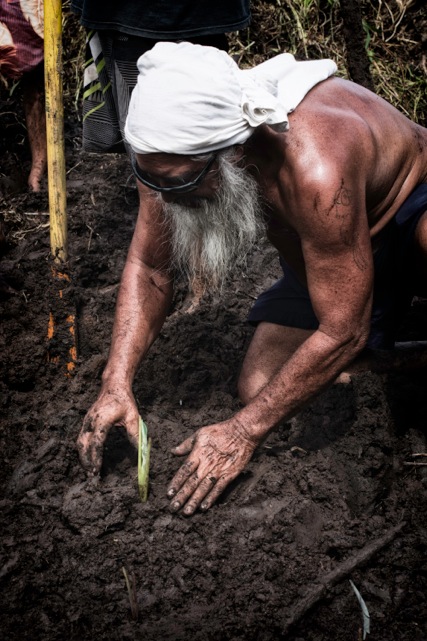
After removing a black tarp used to kill the grass and clearing out any sticks or other vegetation, the crew planted the first kalo in that section of Kawainui in over a hundred years.

This was a special day paying tribute to two locations along Kawainui, which was one of the main food sources for many aliʻi, with Kawainui itself being a large fishpond and many loʻi kalo covering its banks.  The crew learned a lot of this place and shared in the joy and dedication that this community has to mālama honua.

The next day, Hōkūleʻa departed Kailua after an unbelievable sendoff with hula from 6 halau of Kailua.  The ceremony was topped by a performance from almost a hundred keiki.  As the crew prepared to leave on a windless morning, the malanai breeze picked up just enough as they were ready to depart, and the canoe was able to sail out of the bay. Those four days that Hōkūleʻa was in Kailua were probably the four most perfect days I had every seen in Kailua, complete with epic sunrise and sunsets each day.  There are a few of us crewmembers who have lived in Kailua all if not most of our lives, and the experience was definitely very surreal and special, one we will always remember.

Continue Reading

Learning Journey: Giving Back to Maunalua

Maunalua, Kona, ʻOahu–

By Ben Dumaran Jr. (October 26, 2013).

Today the Polynesian Voyaging Society and Hokule`a Crew members gave back to the Maunalua Community just a portion of the support they have shown us. We provided physical labor, a students ear or a young heart to various organizations within the community and it was with great respect, aloha and mahalo we did so.

 To start off the day we met with Chris Cramer and the Maunalua fishpond Heritage Crew at Kalauha`iha`i Fishpond. The crews goal was to provide Chris and his team with labor in clearing the invasive Koa Haole bush so Chris briefly gave us the sad background of this small but amazing pond, the plans for the work and then we attacked. It’s amazing what a group of people working together for a common purpose can achieve. 

 At our second stop of the day, Laura Kaakua working with Liveable Hawaii Kai Hui gave us a tour and history lesson of Hawea Heiau and Keawawa Wetlands. Rich in cultural history, Hawea has one of the last ancient coconut groves in the islands and boasts the tallest recorded coconut tree in the nation. Laura and the Hui saved the last 5 acres of Keawawa Wetlands from destruction by careless developers and commercial housing.

The last stop took us to see the source of our spirit, our knowledge and our culture; to see our Kupuna at Lunalilo Retirement Home. The Kupuna studied the history of the Polynesian Voyaging Society and Hokule`a prior to the canoes arrival in Maunalua and it showed in their excitement upon meeting us. Songs and stories were shared from both sides which made for a lively time. Talking with the Kupuna is always a great way to brighten and enrich your life.

Information on these organizations can be found at: www.maunaluafishpondheritage.org , maunalua.net , Liveable Hawaii Kai Hui and Lunalilo.org .

Continue Reading

The Power of Exploration – 12th Annual Lacy Veach Day

Ka Punahou, Oʻahu —

By Michi H. Wong (October 26, 2013).

The Thompson twins played happily, running around the stage, inconspicuously small against the giant screen, now nightly lit by an orb of spotlights.  Moments before the auditorium was filled with an audience of rapt students, parents and teachers.  The screen was filled with the image of our blue planet from space, the Hawaiian Islands framed by the window of the U.S. Columbia space shuttle, and to the left, a stone adz from Hawai‘i floating weightless inside the capsule.

adz_in_space

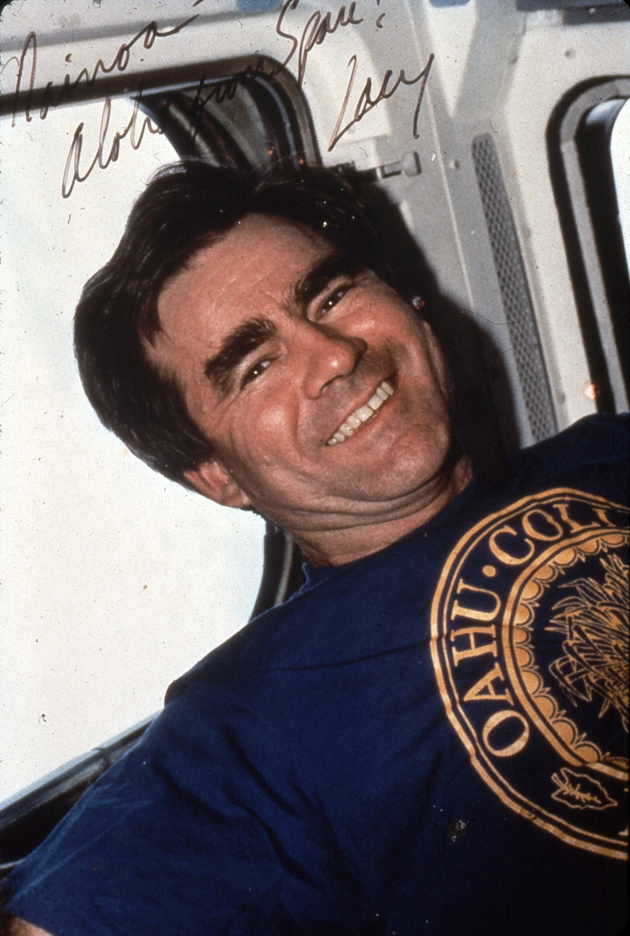
The photograph was taken by astronaut Lacy Veach in 1992 during the voyage No Nā Mamo, For the Children as Nainoa navigated Hōkūle‘a to Rarotonga.

The ethereal image captured the essence of the keynote address delivered by Nainoa Thompson for Lacy Veach Day at Punahou School:  Theirs was a story of friendship, often maintained over long distances, and at times interrupted by seemingly insurmountable challenges.  But because they held on to their dreams, the seeds of the Worldwide Voyage were planted long ago.

lacy_in_space

When they could, they met once a year in Hilo, sat and talked in the middle of lava fields, where the black surface absorbs the light, and the stars shine brightly.  Inspired by stars and bound by friendship, Nainoa and Lacy made good on their promise to teach children to want to explore, to nourish minds and hearts, and to empower them with a greater awareness of the specialness of life on our planet earth.

Back at the PVS educational booth, we crew members hosted scores of children and their parents, sharing stories about sailing Hōkūle‘a, star navigation, and the upcoming Worldwide Voyage.

One special visitor from the island of Hawai‘i was moved by Nainoa’s tribute.  Lacy’s sister Diana had heard the story of Nainoa and Lacy, explorers and friends, and the depths of their dreams for a worldwide voyage.  This, however, was the first time she had heard Nainoa tell the story since her brother passed away 18 years ago.  And she remembered.

“When we figure out how to live well on our islands, we will have the most important gift we can give to the earth, and that is hope.”   Lacy Veach

Continue Reading