Hikianalia Finds Nihoa / September 9

Nihoa, Papahānaumokuākea —

With east winds, Hikianalia departed Hanalei at about 8:30 am, on Sunday, Sept. 8.

At 6:30 am, on Monday, Sept. 9, the crew reported via satellite phone that they had Nihoa in sight and arrived at the island at 10 am.

On Monday evening, the canoe was on her way back to Kaua‘i.

Continue Reading

Hōkūle‘a in Nawiliwili; Hikianalia Preparing to Sail for Nihoa

Kaua‘i —

On Saturday, Sept. 7, Hōkūle'a sailed/towed from Hanalei Bay on the north shore of Kaua‘i, around the west side, to Kalapaki, Nawiliwili, on the southeast side, with a brief stop in Waimea. This morning she will move to the boat ramp at the Nawiliwili small boat harbor, for educational outreach programs.

Hikinanalia remained in Hanalei Bay preparing for her navigation training sail to Nihoa, scheduled to depart Monday, Sept. 9, pending weather.

Hikianalia Crew Blog. by Haunani Kane

As we wait for the rest of our crew to arrive in Hanalei, we continue to prepare Hikianalia for her maiden sail to Nihoa, in Papahānaumokuākea Marine National Monument. The Nihoa sail will be the first deep sea sail of the Worldwide Voyage, and the first deep sea navigational challenge for us  apprentice navigators. We are deeply humbled and honored to be given the opportunity to visit one of the kūpuna islands, and to be a part of the crew with the pwo navigators and leadership.

Going to Papahānaumokuākea is important to us as Hawaiians and people living in Hawaii to re-affirm our connection to aloha āina and caring for our traditions using a waa kaulua (double-hulled voyaging canoe).

Over the past couple of weeks we have been working as a team with Nainoa to map our sail plan and identify the celestial bodies that we will use to navigate. Nainoa said yesterday that finding Nihoa is like trying to find Mānana island (Rabbit Island) in Waimanalo from Kona. (The two islands are similar in size.) Nihoa is approximately 118 miles northwest of Niʻihau.

The sail plan calls for sailing to the northwest side of Ni‘iahu;  then heading Noio Hoʻolua (NW by W) for Nihoa, from Mt. Pānī‘au (highest point on  Ni‘ihau, on its northeast coast).

Today we were finally able to study on the canoe using the star houses that we put on the night before Hikianalia arrived in Hanalei.  The markings of the star houses allow us to overlay or imagine the canoe as a star compass.

For example if we want to head ʻākau (north) and the sun sets in komohana (west ), then the navigator would sit in the starboard navigators chair and align the the star off the port beam.

*compoass_rose

Click here for a explanation of the star compass: Star Compass

The sail plan is a little trickier than this example as the sun is setting slightly north of west at this time of the year, and Nihoa is about 30 degrees north of west.

All in all, we are excited to be a part of this upcoming sail.

Continue Reading

Outreach to Kauaʻi Schools: Hanalei Bay / September 5

Hanalei, Kaua‘i —

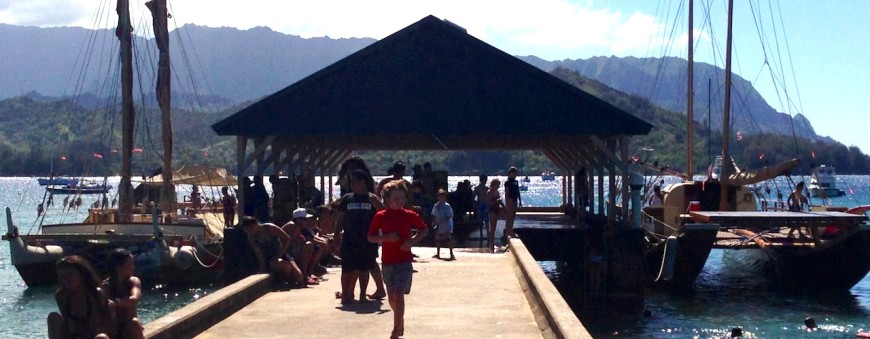
By Kimberlee Stuart. At 9:00 a.m. the crew was ready; the star compass was rolled out, the world map was prepared, and Hōkūleʻa and Hikianalia glinted on either side of the pier in the bright Hanalei sun. Right on time the buses pulled up, and out stepped the nearly 150 students, parents and teachers of Hui Ikaika and Hui Onipa’a of Kapa’a High.  One of 4 full days of working with students from Kaua’i schools, this was one of Hanalei’s biggest days.

Student watch captains were selected and groups dispersed for a day full of fun and interesting learning activities. While one group got to board the Hōkūleʻa and experience a bit about voyaging, Coral McCarthy traced her finger along a large beach ball globe to show another group where the Polynesian voyagers will have to turn to avoid pirates and how the wa’a will dip to round the Cape of Good Hope. Steve Soltysik had students assembling model sailing canoes and determining ways to navigate on the open ocean at night.

Meanwhile down the beach, over 15 stations organized by Lea Weldon of the Waipa Foundation, kept students active and engaged.  Along the beach young people could be seen throwing net, watching traditional hale lashing, learning about net removal, monk seal protection, examining seabird bolus, tying knots, identifying plankton under the microscope, tossing buoys with the U.S. Coast Guard, and much more.

At the end of their visit, student representatives walked solemnly down Hanalei pier, chanting an oli and presenting a hae flag to be shared during the World Wide Voyage.  As one smiling teacher, Nicole McKamey commented; “These students have had a full day of learning that engaged every student in a way that was both meaningful and fun. It is a day none of us will forget.” It was clear that these young people will be watching closely as the Hikianalia and Hōkūleʻa bring their message of Malama Honua around the world, and meanwhile they will surely do their part to malama their beautiful island of Kaua’i.

Lea Weldon

Youth Programs Director/Administrative Manager
Waipā Foundation
www.waipafoundation.org

059

Continue Reading

Learning Journey: Limahuli Gardens, Hā‘ena

Hā‘ena, Kauaʻi —

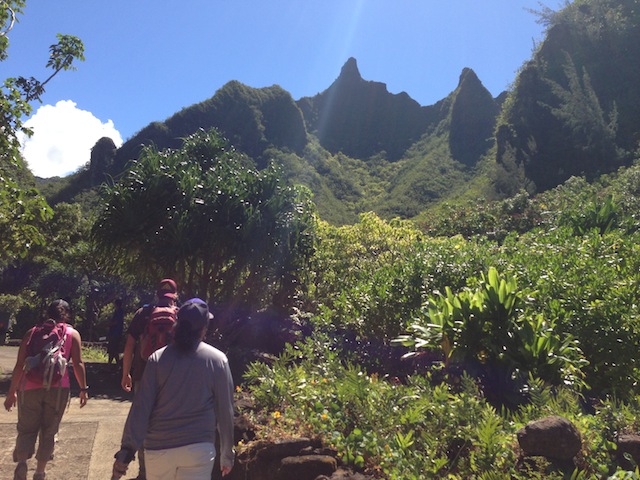
By Kimberlee Stuart. Walking up the dirt road to greet the hard working team Limahuli, the trickle of pristine Limahuli stream could be heard through the foliage.  Crew members sat down under a big ulu tree with Kawika Winters, the director and ‘head steward’ of the gardens and he talked to us a bit about what we had in store on this beautiful day.  The term ‘Learning journey’ was already befitting as we heard about the cultural, ecological, and educational goals of Limahuli.

One of these goals, to perpetuate traditional practices and ways of knowing was beautifully evident as we walked up through carefully restored lo’i.  Kawika shared that the Kalo cultivars here share the same genealogy of those from 100s of years ago.  Above the lo’i sits the newly built traditional hale with it’s beautiful thick roof of endemic loulu fronds, and solid pohaku, or stone foundation.

Visiting beautiful Limahuli, it is easy to understand why the people here so clearly love this place. Yet with this love comes a certain level of concern.  Kawika asked us to consider; “When the land is unhealthy what happens to the ocean? And when the ocean is not well what happens to the land?”  Two endangered ground nesting sea birds, the `ua`a and a`o (endangered ground-nesting sea birds), are not coming back from their trips to the sea in large numbers; a sign that things are not well in the ocean. Those that are left are many times disoriented and crash due to our night time lights. These are the same birds that nourish the land with phosphorous and are used in navigation and fishing.

Up in the preserve the Hōkūleʻa and Hikianalia crews helped to plant papala and Uncle Moku told us the story of his epic hike up the Makana cliffs where he and his son threw the burning plants down to the sea for the first 'ōahi ceremony in many decades.  The bright flashes, seen all the way to Kilauea, remind us that when we malama honua, and care for nature’s gifts, we also preserve a culture and a way of knowing that can be passed to the next generation.

Kawika Winters  Program Director Limahuli Garden and Preserve
P. O. Box 808
Hanalei, HI 96714 USA  (808) 826-1668

http://ntbg.org/gardens/limahuli.php

Continue Reading

Hōkūleʻa and Hikianalia in Hanalei Bay, Kauaʻi/September 1

Hanalei, Kauaʻi–

Hōkūleʻa and Hikianalia arrived in Hanalei, Kauaʻi on Sunday, September 1, after a successful and beautiful crossing of the Kaʻieʻie Waho channel between Oʻahu and Kauaʻi.  Crew members reported clear skies and shooting stars between the islands.  The two waʻa kaulua tied up on either side of the Hanalei Pier, and since arrival the crew have felt welcomed and cared for.

Mahalo nui loa to our fellow ʻOhana Waʻa crew members on Kauaʻi, especially members of Nā Kalai Waʻa O Kauaʻi, who have coordinated our visit with Kauaʻi and canoe tours by hundreds of school children.  Crew members note that the activities in Hanalei for the kids have been interactive, inspiring and engaging for students in elementary through high school.  Blogs are currently being written describing these events as well as Learning Journeys that have been prepared for crew members and community by teachers on Kauaʻi.

The waʻa kaulua will be in Hanalei until Saturday morning, when Hōkūleʻa will set sail for Waimea and then Nawiliwili.  Hōkūleʻa will be in Nawiliwili all of next week, and full mornings of canoe tours with school children on that side of the island have already been scheduled.

From Hanalei Hikianalia plans to sail (weather permitting) to Nihoa in Papahānaumokuākea Marine National Monument this weekend for a navigation training sail.

Please come visit Hawaiʻi's canoe before she returns to Oʻahu for that portion of the Mālama Hawaiʻi voyage and before she and Hikianalia leave for the international portion of the Worldwide Voyage next Spring.

We are deeply grateful for the community's welcome and support here in Hanalei.  We have been well fed, educated and entertained.  Kūpuna have come to share food, music, stories and dance with us, and keiki have inspired us with their questions and their energetic commitment to become future crew members.  The beauty of Hanalei Bay and Kauaʻi's people will stay with us for a long time.  We will carry you all with us on the decks of our waʻa and in our hearts wherever we voyage.

Continue Reading

Caring for the Earth: A Canoe as Our Classroom

Honolulu, Hawai’i —

By Karen Holman. We are in a time of transformation, one in which the future of our planet dangles precariously before us, and the wisdom of our past beckons to be heard. We are concerned for future generations, for biodiversity, and for the health of our atmosphere and ecosystems. In the midst of a time when ancient culture and traditional knowledge are vulnerable to vanishing, a canoe sets sail, and in her wake lies hope. Her name is Hōkūle`a, the star of gladness.

A double-hulled Polynesian voyaging canoe, Hōkūle`a first sailed in 1976, but her soul is centuries old. She was built to voyage once, from Hawaii to Tahiti, to demonstrate that the first Polynesians to arrive in the Hawaiian Islands were the greatest explorers on the planet, skilled navigators who sailed by the stars with intention and understanding. The image of a voyaging canoe surrounded by an estimated 17,000 people upon her arrival in Tahiti remains ingrained in the mind of all those fortunate to be present.

A canoe only 62 feet long was at the forefront of a cultural revival thousands of people wide. One hundred and thirty thousand miles later, she continues to voyage. Today, she sets sail with an urgent mission, a four-year Worldwide Voyage rooted in the concept of Mālama Honua, to care for the Earth. In an epic journey of 45,000 miles to visit 26 countries, Hōkūle`a, accompanied by her sister canoe Hikianalia, will circumnavigate the planet, merging ancestral wisdom with the best of modern technology to navigate towards a sustainable future. Hōkūle`a represents traditions and ancestry. She will be navigated without instrumentation, using only the celestial bodies, swells, currents, and birds. Hikianaila, a more modern canoe with a solar powered engine, will the platform for science and communication, transmitting images, video, and blogs to the world.

In Hawaii, we honor each other and welcome travelers to the islands with a lei, a collection of flowers strung together on a thread. As Hōkūle`a and Hikianalia set sail across the oceans that connect us all, they become a needle, threading a lei of dedicated communities around the planet, inspiring others by their work to care for our island Earth. The journey began in May of 2013, with the first leg of the voyage, across the Main Hawaiian Islands and named “Mālama Hawaii”.

Hawaii is a special, sacred place and traveling these islands with Hōkūle`a brings one close to the inner workings of humbled and empowered communities that exemplify Aloha. Grounded in the relationship of land to sea, amazing individuals are nurturing a culture of caring as keepers of their homes. They are sharing these values with youth in classrooms without walls, but rather the classroom of place and of living sustainably in our island homes. These extraordinary communities are working with nature, using permaculture to manage erosion, restoring ancient fishponds, planting trees, and protecting coastal areas devoted to traditional subsistence, to mention but a few examples. A movement is growing and as the canoes share stories from around the world they become a catalyst for positive change, planting seeds for our children to live in a healthy, peaceful, and safe planet Earth.

Education is the core of this voyage, with the vision to inspire children and their communities to Mālama Honua, to care for one another and our natural and cultural environments. The voyage supports education as a value-based, place-based, socially and culturally relevant program that highlights the interconnectedness of all life, the importance of cultural diversity, and the value system of caring and compassion. Innovative teachers in a group known as Aʻo Hawaii are working towards sustained educational transformation, designing inter-disciplinary curriculum that will relate to themes of the voyage and endure beyond, based on the principle that “the canoe is the classroom and the classroom is the canoe”.

The oceans and mountains of Hawaii become the classroom as we redefine our entire concept of a school, to one approached from the mind of a navigator and the values intrinsic to voyaging. The art of celestial navigation requires us to listen to nature as well as the instinctual, intuitive self, and contains powerful lessons for the present. Traditional Navigators are attuned to the world around them, from the heavens down to the water drop, constantly noticing the shape of the sea and the character of light through the clouds. In recent times, the ancient art of wayfinding was nearly extinct until one of its last keepers, master navigator Mau Piailug from Micronesia, on the island of Satawal, chose to teach. In traditional ceremony, he appointed five Hawaiians as Pwo navigators. Mau explained Pwo as light, love, kindness and compassion. In embodying these qualities, the navigator must sail and bring gifts of knowledge and understanding back home.

Gathering those gifts by way of canoe is a unique way to travel, one that intrinsically brings people together, spreading without words the message that we are all one family. The canoe is origin and possibility, heritage and story, and a poetic, powerful metaphor of planet Earth, reminding us that we are an island of finite resources, floating in the sea of space. As she voyages, she embodies balance, harmony, teamwork, and respect. If one of her hulls is damaged, we take actions to repair it and prevent sinking. So too is our responsibility for the Earth, to care for our home as though the planet is on loan to us from future generations yet to be born.

The canoe is filled with ancient whisperings, as though a channel to ancestral wisdom, timeless collective experience, and exploration. The sight of a voyaging canoe, with majestic sails traveling by way of the wind and guided by the stars, stirs the ancient inside of us. She carries a magic, but more than anything, she carries the power of the story.  A dream manifested into reality, the canoe calls for a new vision, a new sail plan for Island Earth, drawing on the ancient island wisdom of sustainability to guide us.

Continue Reading

Kamahele, the Support of Both an Escort and a Community

Honolulu, Hawaiʻi —

By Karen Holman. It takes an entire village to launch a canoe. These words form an old saying in Hawaii, echoing traditional ways of life, but also relevant to contemporary living. Nowhere is this truth more apparent than in the magnitude and breadth of a journey as enormous as the Worldwide Voyage of Hōkūleʻa. The components of a worldwide voyage are infinite…from the crew themselves to the support of their families, as well as dry dock of the canoe and all the considerations inherent in a voyage that include food preparations, customs, travel plans, safety, weather patterns, cultural protocols and education.

Although not as high profile as the voyaging canoes themselves, an essential partner in any voyage is the escort vessel. The backbone of the canoe, the escort vessel is a critical support system to make voyaging successful. An enduring guardian, she is always there, watching over the canoe from afar. The canoes simply could not sail without their escort.

The Worldwide Voyage of Mālama Honua, or care for the Earth, is a journey to globally unite communities that are preserving their ecosystems and cultures, and committed to nurturing a balanced relationship with out planet. Hōkūleʻa and her sister vessel Hikianalia will sail 145,000 miles and stop in 26 countries. It is a voyage that would not be possible without community support, rooted in kindness and from the heart, support that is often unspoken and invisible to the public eye.

One such “unsung hero” is Keʻehi Marine Center (KMC), a marine and boatyard facility on Sand Island, and one of the few commercial and professional dry docks where sailors can repair and renew their vessels. KMC has been supporting The Polynesian Voyaging Society (PVS) since 1995. The center offered PVS a space without asking for any monetary gestures in return, and recently gave 75 days of dry dock in kind, an irreplaceable and invaluable example of community support. The people at KMC consider the Worldwide Voyage to be such a valuable service to the community that that they want to support it, a very generous gift from a for- profit enterprise.

This escort is named Kamahele, which translates as “the traveler” or “a strong branch off the trunk of a tree.” A 48 foot sloop made of steel, Kamahele holds true to her name and, in one of several voyages, she towed two canoes (Hōkūleʻa and Maisu) over 300 miles to Japan. In navigating unchartered waters, she is a forgiving boat, but also very tough. She was built by a man named Alex Jakubenko in 1995, with a custom design specifically for escorting voyaging canoes.

Alex determined the needs and built them into his vessels.  He seems to be somewhat of an enigma, with a colorful and mysterious background. He learned to build steel boats in Australia or possibly France, and has roots in Russia or the Ukraine. In WW2, during the purge of Russia, his parents were killed and he grew up to be an underground fighter for the resistance in France. Alex is his code name, one he has kept all these years, but his real name is reportedly Gregory.

Captain Bruce Blankenfeld describes him with a smile, noting that after the war, fighting was over for him, for he was a compassionate man. He worked deliveries in France and Germany, which is how he met his wife, a woman born into the very people he fought.

His partner never spoke to him again for marrying a German woman, but he chose love over nationalism and conflict. Bruce explained that “he had a human side to him”, and a marked tenacity as a young man, fighting for a cause at age 18. Through his emotive description, Bruce painted an enduring image in the mind through, summarizing with the statement, “that guy was a tiger.”

There is an old, frequently referenced story of a sudden squall enveloping Hōkūleʻa off the Hamakua coast of Hawaii Island in 1980. The escort vessel at the time was Ishka, named after Alexʻs granddaughter. Mau Pialug was sailing on Hōkūleʻa as she began drifting inshore. The winds were strong and Alex attempted to grab the towline, but missed. He came around again, in dangerous conditions, and succeeded, towing the canoe to safety in Kawaihae. Bruce recalls his spirit, mana, and Aloha, remembering his words, “I will take care of you guys no matter what it takes.”

The stories seem to create a fond remembrance in Bruceʻs eyes. He launches back to the days of building the voyaging canoe Hawaii Loa. Hawai`i Loa was first built in the early 1990’s in the traditional way. After searching widely, no Koa large enough for a canoe could be found in the forests of Hawai`i, where they were once plentiful. Hawai`i Loa speaks to the need for wise resource management, but also to a gift given by sharing and cultural exchange. While the forests of Hawai`i stood depleted, the Tlingit and Haida tribes of Alaska generously donated two massive Sitka Spruce trees, from which the hulls of Hawai`i Loa were carved.

Bruce recalls the humble recognition of the Alaskan people in their words,  “we gave you wood, you guys gave us dreams.” In referring to Yoshi and Muroka of Keʻehi Marine Center, Bruce says, “they are like that”, humble and giving, recognizing the gift for the dream. As Hōkūleʻa and Hikianalia begin their voyage around the Earth, these stories live on, amongst all the stories yet to be born, stories of the innate kindness that unites us, stories of Aloha.

Continue Reading

Learning Journey: Loko Ea Fishpond and Waimea Valley/August 29

North Shore, O‘ahu —

By Tricia Dang and Jenna Ishii. Hosted by the beautiful community of the North Shore on Oahu – today’s land-based exploration reminded me that strategic community driven action ensures the ability to create conservation opportunities and implement sustainable practices for today and the future. Walking a few minutes from our temporary home on Waialua Bay is Loko Ea fishpond. Loko Ea is an ancient Hawaiian Fishpond that is being restored for cultural and environmental education. The restored pond is 6 acres wide; however, long-time residents are quick to remind us that the pond stretches much further north. Malama Loko Ea gladly host’s community service opportunities!

Blake McElheny, community leader and a member of the voyaging family, talked about the North Shore community land trust (http://northshoreland.org/) and presented the design plans for Haleiwa Beach Park Improvements, an area next to Loko Ea fishpond. The plan is to connect spaces and improve facilities with new features such as a canoe hale (shelter for local groups to safely store canoes). We like this one! For more information about  Loko Ea Fishpond, visit “Mālama Loko Ea” on Facebook.

Later in the day, we were invited to visit Waimea Valley. Managed by Hiipaka LLC, Waimea Valley is the least developed of all the ahupuaa (land divisions – mountain to the sea) on the island of O‘ahu. Most familiar is Waimea Bay; the waters from Kamananui Stream in Waimea Valley flow into the Bay. Rich in Hawaiian history and traditios, Waimea Valley has numerous ancient Hawaiian sites.

The valley also has an extensive botanical garden – we were mindful of the red signs signifying rare plants such as the Loulu Pritchardia Viscosa, and had a great time checking out plants from regions we will be visiting during the Worldwide Voyage such as the Toromiro from Rapa Nui. Later, we put in some time to help with landscape work at the Kauhale (traditional ancient Hawaiian living complex) and discussed future opportunities to support Waimea Valley’s projects.

We ended the day by hiking into the back of the valley and swimming in the waterfall. That evening, Kamaki Worthington and our crew members gave a public presentation to the community about the the history of Hōkūle‘a and the upcoming Worldwide Voyage. We drove back to Haleiwa that night with a million stars in the sky, and we talked about how this community truly exemplifies the values of mālama honua (to care for the Earth).

For more information about Waimea Valley, visit http://www.waimeavalley.net/.

Continue Reading