Learning Journey: Ka Honua Momona (July 11)

 Molokaʻi (Malia Ane & Gail Peiterson) —

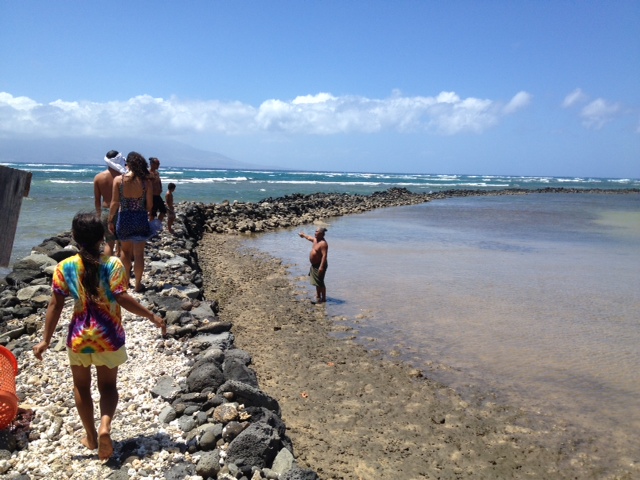
Along Kamehameha Highway V between mile marker 2 and 3 lies a cultural treasure: Ka Honua Momona (KHM). The website sites the mission:  to be a model of sustainability mauka a makai (from the mountains to the sea). We seek to foster connections between all aspects of the island ecosystem, including the people and culture, and we firmly believe that Molokai can again return to abundance and become a self-sufficient model for all nations.

The facilities and programs at Ka Honua Momona, were a rich blend of old and new.  The offices were state of the art and off the grid with the feel of the offices mirroring the cultural significance of the fishponds and ocean.

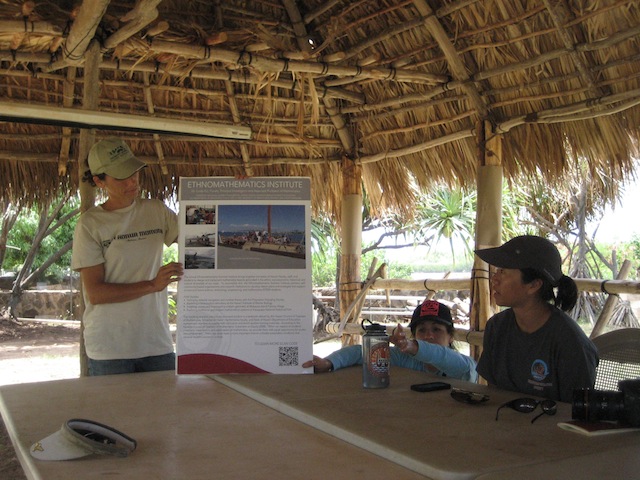
The halau, built by interns and community groups, uses the invasive plants that were removed from the fishponds and other inland restoration sites. Ironwood, mangrove, and kiawe logs provide support for the loulu fronds that provide the thatching for the halau and also hides the LED lighting and the Wi-Fi availability to do state of the art presentations in the same location our ancestors once gathered.

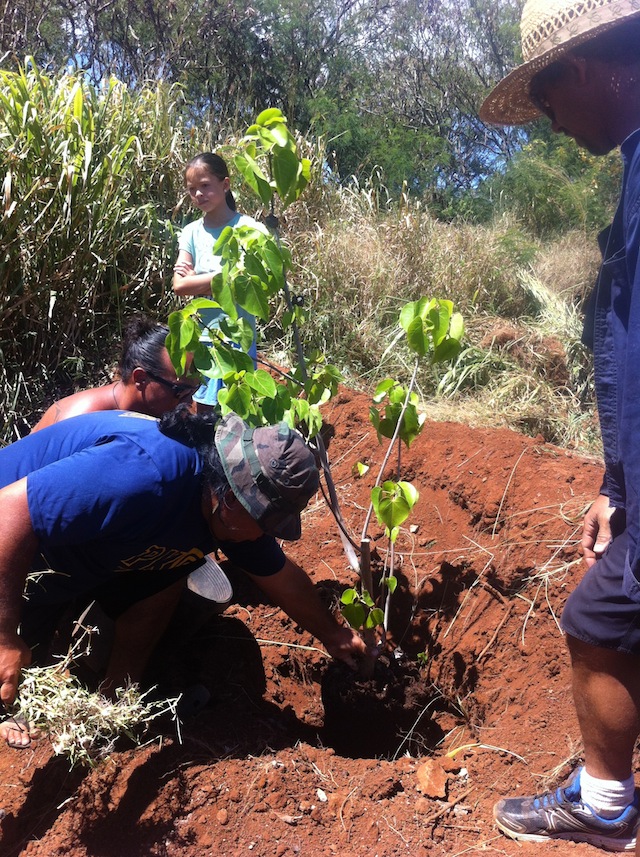
The day was enjoyable and educational because of the positive interactions with the KHM and KUPU interns.  They greeted us with their protocol oli and honi and then shared the work that they proudly accomplished.  It was clear to see by being involved in the restoring of the fishponds they were also restoring themselves and their eyes were opened to possibilities of what could be.

Ka Honua Momonaʻs primary long-term goals are:  To develop indigenous education systems by revitalizing natural and cultural resources and to perpetuate traditional knowledge and stewardship while evolving with modern technology.  The work at KHM reflects the World Wide Voyage values and goals: “CLOVE ” and Mālama Honua.

  • Culture and Indigenous knowledge: Learning the protocol and reviving cultural practices through hands on experiences.
  • Leadership: Developing future leaders as the interns lead tours, directed rotations for visiting school groups and are working with community partners.
  • Ocean Awareness and Protection: Restoration of fishponds and protecting off shore reefs.
  • Voyaging Skills and Values: Value of teamwork, preparation and knowing one's kuleana to reach the destination.
  • Education: Each generation's knowledge and experiences are shared, valued and celebrated.
Continue Reading

Learning Journey on Molokai : History of the Land (July 9)

Molokai  (Tara O’Neill, Mahina Hou and Mililani Hanapi). On the morning of July 9, 2013 crew members of Hōkūle‘a took part in their first learning journey on the island of Molokai.  This journey encompassed many stops but one theme.  The focus was on kupuna who have dedicated their lives to preserving and protecting the culture, land and history of Molokai and have done so without grant or external funding and often in conflict with the regulations and intentions of the state and federal government.  All of the kupuna who were so kind to share their manao with us, have dedicated their lives to the types of peaceful, courageous and productive lifestyle that helped sustain the Native Hawaiian renaissance in the 1970ʻs and reminds current and future generations of the multiple means of protecting a culture and standing up against oppression.

Our journey began driving east under the guidance of Auntie Mililani Hanapi.  She started by sharing the history of the land from Kawela to Pualei.  During the time of Alapai nui, before the time of Kamehameha, this land area was engaged in a heated battle involving four armies from O‘ahu, Kauai, Maui and Hawaii.  The armies of Oahu and Kauai sought to control the island of Molokai because of its strategic location within the island chain and because the island was a rich food source.  The armies of Hawaii and Maui formed an alliance with Molokai and fought to protect her and her people. Kamalo was where the fighting began with the Hawaii, Maui and Molokai forces pushing back the Oahu and Kauai armies to Naiwa and Kalamaula on the west side of the island. There were many lost on both sides. Kamalo was one of three landing sites visible from the main channel when sailing the Pu‘u O Mo‘o a Kamalo served as a visual guide to the harbor.

Our next stop was Puuloli, a look out point in the ahupua‘a of Ahaino. From Puuloli here we could see the harbor of Honomuni. This is the second port you can see from the main channel along the south shore. Here Auntie Mililani and Uncle Alapa‘i explained how this land (and their home) had been pasted down for generations through Auntie Mililani’s ancestors and how they have dedicated their lives to reclaiming their native lands and over coming insurmountable odds. Auntie Mililani and Uncle Alapa‘i are renown artist and educators of Hawaiian history. They have regained rights and access to their lands in their ahupua‘a and plan to build a museum to educate others to preserve the history of this land and the multiple generations who have inhabited it.

We where shown an 1893 survey map done by M.D. Monsarrat of the Honomuni Fishery/Honomuni Harbor. Three Fishponds line the shore Kiha loko,Waihilahila and Kualaalamihi. Kiha loko is dated at approximately 600 years old and the linage of the land can be connected to voyagers from Tahiti. Six families link a part of our past on Molokai to Kapukapuahakea or Taputapuatea . The names are recorded as Haua, Kahalanui, Kalahookaalii, Kauluna, Moelehu, Namahana. These names are linked to Kapukapuahakea a migration site.

On the North shore in Wailau is also a heiau known to the people of Molokai as a Tahitian Heiau. Molokai has three known landing sites.  The third one is Halawa Valley and is said to be one of Hawaii’s oldest landing sites first visited by people who sailed from Marquesas.   This place is located at the bottom of Pu‘u O Hoku (the hill of stars) located on the eastern most tip of Molokai. Auntie Mililani and Uncle Alapa‘a believe it is important to malama, take care and know these places because it is important to understand the connections of the place and how people are connected to the land.

Uncle Maka, a Hōkūle‘a crew member, summarized the importance of understanding the history of this land, it’s history, it’s culture and it’s people by saying, “you gotta see what no can see.  You gotta hear what no can hear”.  This is the goal of Aunty Mililani and Uncle Alapa‘i, to make visible what we can no longer see by sharing the stories of this place and in so doing bringing connections between the people.

The third stop on our journey was to Uncle Leimana Naki’s fishpond where we engaged in a service learning project to help maintain the pond walls.  Here the Hōkūle‘a crew members were taught the history of this place and introduced to the multiple species of sea life who live here and have served as a critical part of the Native Hawaiian diet for generations.  Uncle Leimana expressed his excitement that many school children on Molokai visit the fishpond, learn about the culture and help to maintain this place but called on men and women of the islands to “do their part to build and maintain fishponds and culture”.  He then posed a questions to the crew: “You only have a short time in life.  What are you going to leave?”

For Uncle Leimana, this place is his legacy and he proudly explains how this fishpond was built and maintained independent of government or corporate grants.  In his words, “it is not part of the system” and this he believes is important for maintaining the integrity of the cultural connection to this place.

The final stop on our journey was to the ohana lands of Hōkūle‘a crewmember, Mahina Hou and his wife Tammy.  Historically, Halawa Valley is thought to be one of the first places inhabited by Native Hawaiian people.  Generations ago, this land was rich with lo‘i fields and free flowing streams. It was know as the land of plenty as illustrated by the meaning of the place name: Ha (breath of life) and Lawa (adequate or enough).  This valley once had streams with pleanty of fish and rich land for farming kalo.  However, the lo‘i and the streams that served them were damaged by tidal waves and floods.  With the loss of their fields people stopped farming this land and moved.  In 1996 Mahina Hou, Tammy and their children began to restore the streams and kalo once abundant on their ancestral lands.  Hōkūle‘a crew members were honored to assist in this restoration process by sharing fellowship as they helped to maintain the lo‘i and aid in the multifaceted process of Malama Honua.

Continue Reading

Learning Journey: Sust’ainable Moloka‘i and Moloka‘i High School Permaculture Garden (July 12)

Moloka‘i (Jenna Ishii) —

This past week, the Moloka‘i community embraced Hōkūleʻa and her crew by sharing their aloha, cooking for the crew members, bringing their children to visit the waʻa, and hosting crew members in their sacred places to share how they mālama honua – care for Island Earth.

Our culminating learning journey this week was a visit to Moloka‘i High School’s Permaculture Garden to learn from Sust’ainable Moloka‘i about their vision to inspire youth and all Moloka‘i residents to work toward a more sust’ainable future for their island.

School garden coordinator Fred Richardson shared with us the importance of their school garden as a central location for students and community members to gather and learn how to grow food plants, trees and native plants in a dry area. Using techniques of permaculture and lessons from our kupuna, Fred teaches his students about the importance of keeping water on the land as long as possible.

Emilia Noordhoek of Sust’ainable Moloka’i shared the connection between their school garden in the mountains and the ocean below: “You want the water to move as slowly as possible to stop the erosion from flowing to the ocean.” This permaculture garden serves as a test site for their greater vision to support the restoration the Kamalo Watershed which is 3,800 acres of land from mauka to makai (mountain to ocean).

 Crew members helped Fred and his volunteers plant 40 types of native trees, food plants and ground cover to expand the school garden site. At the end of the day, Emilia shared the importance of youth-driven change and entrepreneurialism: “We want them to feel empowered to see a space in this garden and do what they want.” Students, teachers and community members are allowed to take what they need to feed their families, and in turn, they volunteer and contribute to the school garden.

Mahalo nui to Sust’ainable Moloka‘i and Moloka‘i High School Permaculture Garden for hosting our crew and allowing us to learn about the techniques of mitigating silt erosion and propagating food, trees and plants for future generations.

Click here for more information about Sust’ainable Moloka’i.

Continue Reading

Learning Journey: Adaptive Management Model of Sustainability

Moloka‘i —

E ke hoa aloha aina

Mai ka piina o ka la i Kapuupoi, wahi kapu o KaulukukuioLanikaula a i ka wailele kaulana o Mooula ua kipa na hoa o Hokulea i na kuaaina o nae, i Halawa, i Moanui a Ahaino.  Ua ike i na awa pae o nae, Honomuni, Pukoo, a me Kamalo. He la maikai loa.  A laila i ke kaulana o ka la i Kalaeokalaau, kipa makou i na kupa o ka aina o Hoolehua, i ko lakou haawina hoomoana e ao i ka lawaia kupono i na poe kamalii a opio o ka moku o Palaau. Ua hoonanea makou i kai o Moomomi, ka ipukai o na poe noho paa i ka aina hoopulapula o Holehua.  Ua ona kai ai a nahenahe ka leo o ka aina.  Mahalo nui e ke Akua na aumakua a me na kupuna no ke alakai kiai kakoo a hoopomaikai mai ia makou poe kanaka. (Blog by Mahinahou Ross)

IMG_1290

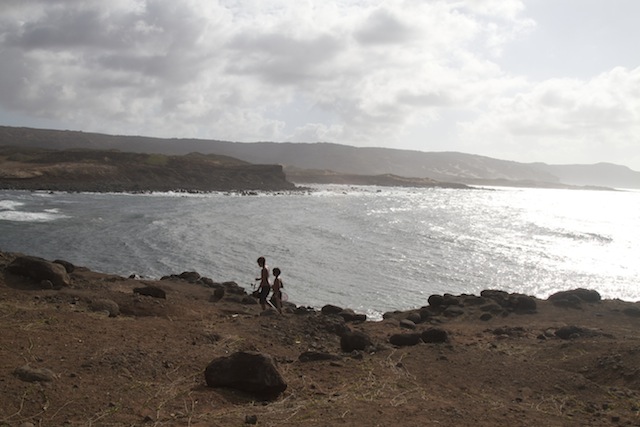
Under the glistening, pulsating rays of the sun, we embark on a learning journey that will shape the course of our lives.  We travel in the back of a pickup truck along a windy, dusty road that coats our clothes and skin with multiple layers of red and orange hues.  We eventually emerge at Moʻomomi on the northwest shore of Molokaʻi to a canvas of pristine sea greens and calming blues.  As described in the historical moʻolelo (story), we envision a graceful lizard resting upon the reef with scales glistening like pearls.  The moʻo (lizard) relaxes endlessly across the horizon as the day comes to a close under a lavender sky that perfectly completes the color spectrum.

On July 10, 2013, we listened and learned firsthand about the background, culture, and love of the land from Konohiki Kelson Kapule Poepoe, Opuʻulani Albino, and Kanoho Helm who shared their manaʻo (thoughts) with a captivated audience of 19 crew members and 23 community participants.  For centuries, ʻohana lived peacefully and fruitfully from the land and ocean, using traditional methods and only taking what they needed.  Moʻomomi was the ipu kai (ocean icebox) and fed all of Hoʻolehua.  According to Konohiki Kelson Kapule Poepoe, affectionately known as Uncle Mac, “We mālama this place and speak from a viewpoint of many generations…listen to nature, nature always presents the truth.”

IMG_1252

Once the realization came that the resources were not limitless, there was an awakening of consciousness.  The decision was made by leadership to follow a plan of adaptive management that eventually led to a model of sustainability.  This had a deep and profound impact across generations, and is encapsulated in the words of 15-year old Kamakaleihiwa Purdy-Arelino,

To me, mālama honua means we’ve been given so much, it’s about time to give back.  Just take what we need and don’t overfish.  He aliʻi ka ʻāina, he kauā ke kanaka.  To care for the world, you have to know your own piko first.

Kamaka and her young peers recently participated in Lawaiʻa Camp, a four-day experience on pono (resourceful) fishing at Moʻomomi.  This unique multigenerational event is an invitation and call to mālama honua.

There is also a message for the rest of the world.  We must start with the piko by knowing and respecting our special, intricate communities.  Only then can we authentically share this sustainable aloha. (Blog by Linda Furuto; Photos by Karen Holman)

IMG_1300


No nā kūmole a ʻikepili no ka Huakaʻi Holo Puni Honua, ʻo Mālama Honua, ma ka ʻōlelo Hawaiʻi!

Talking Story with Snake Ah Hee, Veteran Hōkūle‘a Crew Member

Lāhainā (Lesley Iaukea) —

To talk about Hōkūle‘a and the vision of the Worldwide Voyage, one would have to mention those that came before us and who have showed us the way. Uncle Snake Ah Hee was born and raised in Lāhainā, Maui, where he graduated from Lāhaināluna High School.  Uncle grew up in a fishing family that also surfed, dived and paddled canoe all the time. By the time he became a lifeguard at the hotels on Maui, uncle was known for his water skills and humble personality.

In 1968, after joining the National Guard, uncle was called upon to go on tour in Vietnam. After serving for his country, he returned home with a stronger mind and an appreciation for life. He realized that he “wanted to see peace – all the time, all over the world.”

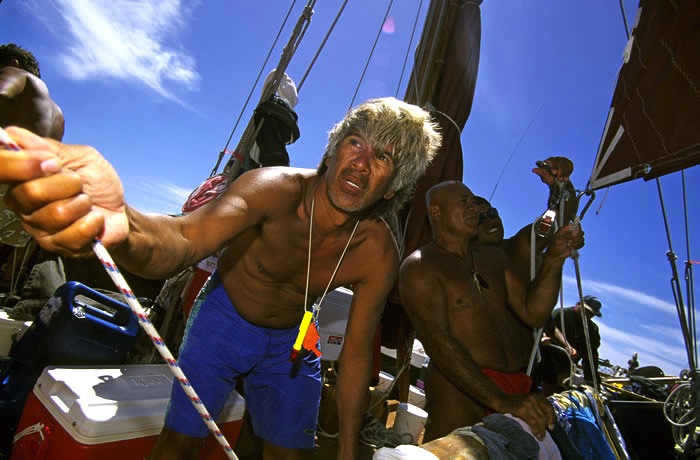
Introduced to Lāhainā in 1975 by Sam Ka’ai and George Paoa, uncle was asked to be on the return trip from Tahiti to Hawai’i in 1976. His training consisted of surfing ten hours at a time, just to be ready for the voyage home. “The ocean has taken hold of me spiritually and mentally. I think it’s because it’s tied in with my family, with being raised on the ocean.” Over the last thirty eight years, uncle has been on most of Hōkūle‘a’s  deep sea voyages. Uncle still surfs, paddles, and dives regularly today; and was seen charging the last big swell at Honolua Bay on Maui, most recently.

Uncle has become a legend in his own right and the crew is always humbled to sail with him as he teaches us more than sailing but rather how to take action that will lead us all to a better tomorrow for our children. Uncle holds the respect of all due to his skills of being a waterman, but mostly because of his humility. “I’m here to teach the younger generation who are sailing with us – how to take care of themselves and each other – how to be humble. For me that’s the one key part. If you’re humble everything will be fine. Everyone will think the same, work the same, be closer together. Only if you are humble can you learn.”

Continue Reading

Educational Outreach and Community Events on Moloka‘i

Kaunakakai (Karen Holman) —

[Note: Photos by K. Holman.] Hokule’a has arrived on the island of Molokai where she has been warmly received by the community, the aina, and the kai. Stories circulate about the special relationship Hōkūle’a has with Moloka‘i, and even tales of sails where she is destined for Hawaii Island, but has somehow ‘sailed herself’ to Moloka‘i along the way.

As we share Hōkūle'a with the children of, the canoe's mana is deepened, as is that of the crew, energized by playful children with a strong sense of community. The children are also enchanted with Hōkūle'a, displaying excitement and radiating smiles at being aboard. One young boy named Justice turns to me after a canoe tour followed by educational activities, and says, “can we tour the canoe again?”

Molokai Outreach 2

Molokai Outreach 3

Molokai Outreach 9

Molokai Outreach 10

Molokai outreach 7

Molokai Outreach 6

Molokai outreach 8

Molokai Outreach 5

Molokai Outreach 4

While some of the crew shared the canoe with children and community, others went to Halawa valley learn about sustainable living and dig their hands into the Earth to mālama Moloka‘i. [Photo from Hōkūle'a Crew Facebook page:]

Molokai Outreach 15

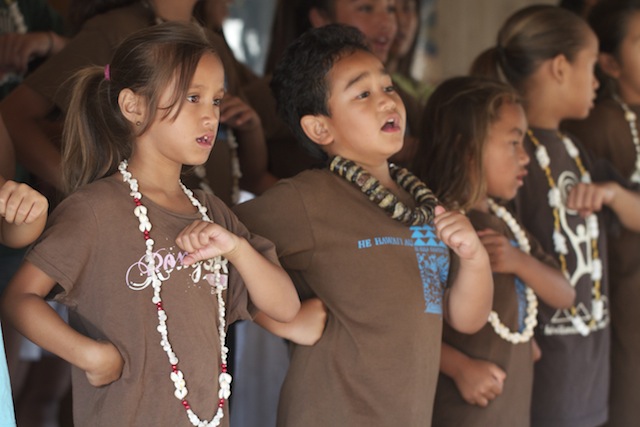
In the evening, approximately one hundred community members gathered for a potluck event. Local children performed a moving hula dedicated to Hōkūle'a, and Nainoa Thompson delivered a powerful speech about the history, vision, and purpose of the Worldwide Voyage.

The community responded with both care and insight, offering a gift of kava from Pu'u Hoku, as well as seeds from a wiliwili tree that is now gone. The author Gaellen Quin was also present and gifted a copy of her book “The Last Aloha”.

It was an evening of reflection, for past and future, and all seemed to agree that Hōkūle'a and her Worldwide voyage represents a planting of seeds, and of hope for our children to live in a sustainable, healthy, peaceful, and safe planet Earth. As Nainoa spoke to the community, several images revolved in a slideshow behind him, and one was of the Earth from Space as he spoke of the astronaut Lacey Veach's observation that, “you never know how extraordinarily beautiful the island Earth is until you see the whole thing from space, and from there, you understand the infinite complexities and relationships of the only thing we know that we have on Earth and do not have anywhere else in the universe…” and “that”, Nainoa says with an intensity in his eyes, “is life, and we are screwing it up.”

He went on to pose the haunting and thought-provoking question, “how in the world could we take that precious gift that is inherently our childrens' and take it away from them?”
The room is silent, as the audience takes in the depth and meaning of Nainoa's question, and it is more clear than ever before why we must sail.

Continue Reading

Lāna‘i A Hui Hou Pā‘ina, July 7

Lāna‘i-

It is the early evening of Sunday, July 7th. The Lāna`i community has assembled to pay tribute to the Hōkūle`a, her sister Wa'a Hikianalia, and the dedicated voyagers vested with the solemn tasks of mālama the wa`a and practicing the philosophy of A`o by learning how other cultures Mālama Honua while sharing their own mana`o of how Hawai'i cares for this island Earth.

In the past four short days Lānaʻi has reacquainted itself with the Hōkūle`a and welcomed her sister wa`a Hikianalia along with their exceptional crews. Tomorrow Hōkūle`a will set sail for Moloka'i, and Lāna'i will have to wait another four years before Hōkūle`a will drop anchor in our waters again. Hōkūle`a and her crews may not be with us physically, but our mana have been shared and our intentions are aligned. Together we will act as one to Mālama Honua.

Continue Reading

Learning Journey: Maunalei Ahupua’a Community Marine & Terrestrial Management Area, July 5

Lāna‘i (Karen Holman) —

As Hokule’a and Hikianalia set sail across the oceans that connect us all, they become a needle, threading a lei of dedicated communities around the planet that inspire us by their efforts to care for our island Earth. Our journey has only just begun and such caring has been powerfully demonstrated here at home, in the Hawaiian Islands. It was late afternoon on Lanai island, a place exemplary of community and aloha. We traveled in the back of a pick-up truck, reveling in the crisp, clean air of sparsely developed land and enraptured with the view of an expansive ocean, nestled between the islands of Molokai and Maui. Valleys were carved through red earth by the forces of nature and everything felt alive, yet as we made our way down this windy, single lane road, we could see an orange plume of silt in the ocean, hugging the immediate coastline below. We discovered both the reason, as well as an innovative remedy for this silt blanketing the reef during our learning journey to Maunalei Ahupua’a Community Marine and Terrestrial Management Area.

Uncle Sol Kaho’ohalahala began by relaying a conversation that took place several years ago, when Nainoa expressed that if Hokule’a is to carry the message of malama or caring around the world, we must ensure that we too are living examples of Malama Honua at home. The community of Lanai is an extraordinary reflection of this value system. One and a half years ago, Uncle Sol of Lanai and Jay Carpio of Maui were selected by Conservation International as funding recipients for their community based ocean resource management plans and their dedication to be keepers of their own ocean area. Initially, funders wished to focus solely on marine related projects, however, Uncle Sol convinced them otherwise as on an island like Lanai, the ocean and the land must necessarily be managed as one whole, integrated system.

Kaalakahikina

Not only is the community looking from land to sea, but they are also looking from present to future in a comparative study over time. In partnership with the University of Hawaii and Stanford, they are conducting baseline assessments, and have already accomplished 120 dives to record existing fish, seaweed, and coral species. Maunalei is the site of traditional subsistence fishing for generations and a critical resource to the community. To capture its value, community members are participating in pakini or krill surveys to answer questions such as: Who are the fisherman? How many? How often? What methods are used? What do they take, how much, and what do they do with it? This information will help the community determine if their practices are regenerative and sustainable.

Community members are involved in these surveys and encouraged to observe the environment as they monitor activity around this important resource. Noting ocean conditions, or the quality of light, mirrors Hawaiian views of place and time in a system that connects these observations to cycles, posing questions like: is the spawning cycle the best time to fish? Management systems of the past took these elements into account. Maunalei Ahupua’a seeks to improve decision making as a community, without an external law imposing restrictions, but rather allowing the community to drive what is right.

The land of Lanai island is largely denuded of vegetation due to a 100 year history of ranching and ever growing populations of sheep and deer. Heavy rains send large amounts of clay into the ocean and the orange plume we observed from above is now a daily occurrence, churned up with every change of the tides. To address these problems, the community has turned to permaculture, an agricultural design system rooted in the observation of nature and the interconnectedness of all living things.

Uncle Sol and his family are stewards of family Hawaiian lands that have been passed down through the generations. Today, they are applying the natural design of “gabions”- barriers made of kiawe logs laid across a stream bed, acting not as a dam, but rather as a system to slow the flow of the water while still allowing it to permeate through. We visit the site in the perfect timing of late afternoon, and the kiawe grove resembles a labyrinth of golden light and innovative design.

The results of the gabions are incredible. After two large rain events, up to six inches of newly deposited silt had gathered along the sides of the gabions, silt that would have otherwise ended up in the ocean and suffocate the coral reef. Furthermore, Uncle Sol plans to vegetate the area with certain plants to hold the soil in place, interspersed with food plants. The project is addressing not only erosion and sedimentation, but also issues of food security.

Maunalei is an amazing example to help community learn what they can do to be responsible in caring for their ocean by caring for the land. The site is even used as a camp for children, where they learn to be responsible fishermen, how to care for their resources, and how take care of the land. Maunalei Ahupua’a is building a culture of caring as keepers of the land and sea, a classroom without walls, the classroom of place, and of living sustainably in our island homes. Uncle Sol sees a much bigger picture than the four acres he cares for in his ahupua’a. He is aware of the power of providing models of success and if adopted in other streams, the sediment plumes could be stopped in a short period of time. The process did not cost much money, only man power, and this, he says, “is community”. He recognizes the process as intergenerational and critical, as he tells us with passion, “we rely on this land, and it is our collective interest to take care of this land for generations”.

Uncle Sol speaks of the future with personal investment as he holds his beautiful granddaughter on his lap. The keiki (children) today, he notes “have no other view of their home except this. They are quick to define the issues, but ask them how to fix it and it is difficult. We are hoping they do not capture this as their future. We must change that image of what their potential is, change their view of what aina (land) is all about, change this place to be productive again so that they see things differently. Right now they see very little value in the land as it is and this is not the kind of image that gives them any hope.”

Maunalei Ahupua’a provides a special vision of hope for children as an amazing example of community taking charge of their place, a place that has remained within a family for generations. Uncle Sol shows us a slideshow with stirring black and white images of his ancestors. He wants the children to know the Kupuna of this land and realize that we really are following in their footsteps. Although she is very young, Uncle Sol’s granddaughter, Ka’alkahikina has a pensive look in her eyes, as though she is absorbing and contemplating the kuleana she carries for her future.

At the end of our experience we journey to the ocean to visit the place known as Kalaehi, a point that jets out into the ocean and points perfectly into the middle of the Pailolo channel. This special place marks the beginning mo’olelo or story of Lanai island. On a day in the future, I can see an image of people standing at this same point and also speaking of beginnings, beginnings of community action to protect and restore an island that has suffered impacts. As he considers the process of removing those impacts, Uncle Sol poses the question, “Will the aina recover? I think she will” and so too will we as we recover our relationship with the natural world and begin to care for our home in the same way our ancestors always have.
Continue Reading