Reflection: Hōkūle‘a & Hikianalia on Kaho‘olawe (July 1-3)

Honokanai‘a (K. Ku‘ulei Birnie)

‘Ane hiki mai
‘Ane hiki mai
‘Oukou lehua lanalana o Kanaloa
E pae, e pae
Eia lā ka leo, ‘ae

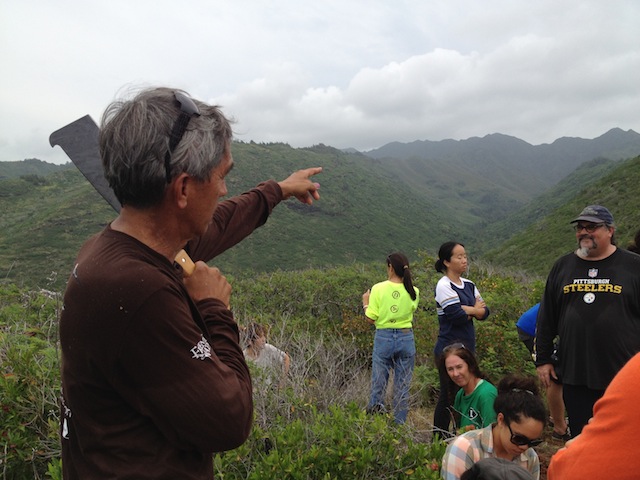
The crews of Hōkūle‘a and Hikianalia were welcomed to the island of Kaho‘olawe on July 1 by members of the Protect Kaho‘olawe ‘Ohana (PKO), staff of the Kaho‘olawe Island Reserve Commission (KIRC), and volunteers from Hawai‘i Youth Conservation Corps/KUPU Hawai‘i who happened to be engaged in mālama ‘āina activities that week.

Hōkūle‘a is not new to Honokanai‘a. She was here in approx. 1985 with Kamehameha Schools students who hiked all over the island and spent the night at Moa‘ulaiki with PVS crew.  She was here in June 2001 co-celebrating the 25th anniversaries of both PVS and the Protect Kaho‘olawe ‘Ohana.  She and representatives from other wa‘a kaulua Hawai‘i returned with Papa Mau Piailug in October 2004 to dedicate the new platform, Kahua Kuhike‘e, at Kealaikahiki, to the training of traditional Hawaiian wayfinding.

There were many firsts this week.  Sister canoe Hikianalia visited, mooring in Honokanai‘a.  And it was the maiden visit for several crewmembers, most particularly Pwo navigator Shorty Bertelmann.

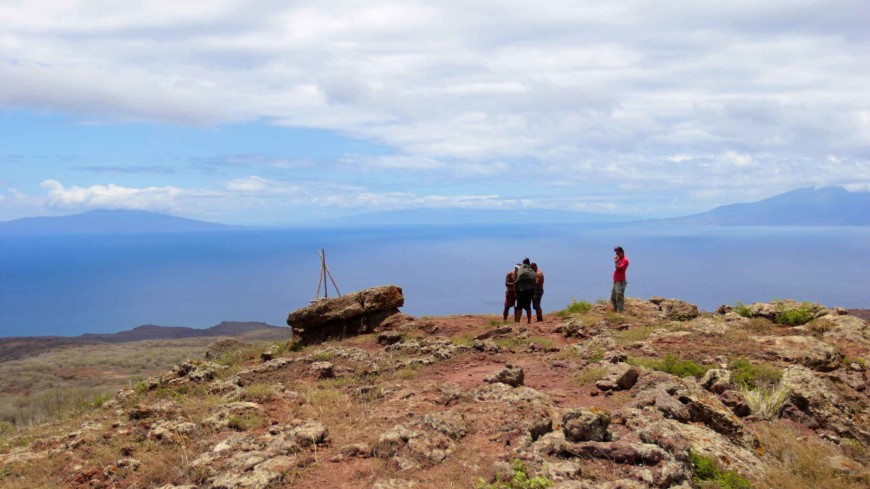
One of the original names of this island is Kanaloa (Tangaroa, to the Maori), for the Hawaiian god of voyaging, the deep ocean, and the creatures within.  At the pu‘u called Moa‘ulaiki, there is a platform that was used for a navigational school and a house site for the kahuna.  From the high point, where on most days students have a panorama to four other islands, one can easily observe the cloud patterns, several channels and their currents, and, at night, the movement of the stars.  Moa‘ulaiki was a place to study the heavens early in the training of celestial navigation.

Lae o Kealaikahiki, or Pathway-to-Tahiti, is the westernmost point of the island used later in the training of student wayfinders as both due north and south can be seen on the horizon from sea level.  The place name reinforces the tradition as a landmark for voyagers as they leave Hawai‘i for Tahiti.  In October 2011, the Pacific Voyagers waka Faafaite was directed to depart from Kaho‘olawe, the first time a Tahitian canoe had returned to Tahiti from Kealaikahiki in more than 750 years.

Another ancient name for Kaho‘olawe is Kohe-mālamalama-o-Kanaloa, the shining birth canal of Kanaloa; again, a directional aid for wayfinders as they embark on deep sea voyages to the south.

But as we rode in the back of pick-up trucks over old military roads past places with remnant names like LZ-1 and Seagull, expecting to see bombs on the side of the road, we were reminded of the more recent history of this island and how important it is to the vision of Mālama Honua.  Kaho‘olawe is a cautionary tale of intentional destruction without consideration for sacred space, human impact and pristine environment.  Fifty years of live munitions assault from land, air and sea has created a barren landscape and devastating loss of the water table, damage that can never be completely repaired. The corrupted reefs adjoining traditional fishing grounds are littered with ordnance, some unexploded, that will never be cleaned up.

Nevertheless, a lot of good work is being done.  There are extraordinary efforts to capture soil and water so native plant restoration can continue.  The island is also maintained as a cultural reserve, a place where Hawaiian traditions and religion can be practiced freely and consistently.

Those who have worked to stop the bombing and protect the island’s natural and cultural resources learned lessons from other places around the world, such as the Caribbean island of Culebra.  We hope that as we sail around the world we can share the story of Kaho‘olawe, as we learn how others’ wise practices have succeeded in protecting their homelands.

Aloha ‘Āina, Malama ‘Āina, Mālama Hawai‘i, Mālama Honua

For a gallery of photos, see Photos: Kahoʻolawe July 1-3, 2013.

Continue Reading

Aʻo Hawaiʻi: Teaching and Learning

By Karen Holman —

[Overview: Aʻo Hawaiʻi is a community of educators working together with PVS and other organizations to support the educational mission of the Worldwide Voyage and to design inter-disciplinary curriculum that will relate to themes of the voyage and endure beyond, based on the principle that “the canoe is the classroom and the classroom is the canoe”.]

The morning began with a pule or prayer beside Hōkūle’a. It is a familiar image, of people holding hands in a circle beside the canoe, one that has unfolded over generations and geography, and continually reminds us of just how powerful Hōkūle’a is in bringing people together, and establishing a sense of unity, connection, and aloha in an instant. One person began the oli that binds the group together, and all others followed.

Throughout the day, the same oli or chant was used as a way of brining everyone together in the present moment, to drop whatever may have been happening in that moment to gather and chant. It is an amazing synchrony, like migrating birds flying in a perfect v shaped formation, an unspoken communication that travels like a ripple across the sea.

At the sound of the chant, an incredibly humbly and inspiring group of educators gather. They are Aʻo Hawaii teacher crew members, a community of formal and informal educators who, via the Federal Department of Education grant awarded to the College of Education, work in a collaborative partnership between the Polynesian Voyaging Society (PVS), the Pacific American Foundation (PAF), professors from the University of Hawaiʻi (UH) system wide (UH-M College of Education, Honolulu Community College (HCC) and UH-West Oahu), the Center for Microbial Oceanography (C-MORE), and a diverse group of educators from public schools, private schools, charter schools, and informal education institutions (ie. YMCA) from across the Hawaiian Islands, to support the educational mission of the Worldwide Voyage.

Aʻo Hawaiʻi teacher crew members serve as ambassadors for the Worldwide Voyage and the Statewide Sails in their communities. These innovative teachers are designing inter-disciplinary curriculum that will relate to themes of the voyage and endure beyond, based on the principle that “the canoe is the classroom and the classroom is the canoe”.

The mission of the Worldwide Voyage is Mālama Honua – to care for the Earth. Education is the core of this voyage, with the vision to inspire children and their communities to Mālama Honua to care for one another and our natural and cultural environments, and to create sustained educational transformation.

The theory of change is that if you inspire children to care for Island Earth, they will protect it. The education canoe crew are “actively navigating these new waters of learning and teaching”, and developing creative ways not only to connect children to the canoe, but also to navigate educational transformation into the future and towards a sustainable destination for our children. This group is based on a philosophy of reciprocity, for in Hawaiian culture, “Aʻo means to teach and to learn” We are both teacher and learner, and “Aʻo Hawaiʻi is the teaching and learning of our place and connection to others”.

On selected weekends Aʻo Hawaiʻi teachers convene from across the islands to build their curriculum during a two-day exploration and appreciation of our island home. Supporting engaging and unique curriculum centered around themes of Pacific Unity, Environmental Stewardship, Community, Indigenous knowledge and Perpetuation, Marine Conservation, Justice, and Leadership, weekends include lively discussions and special adventures.

These teachers have imagined the future, sailing with Hōkūle’a and learning the star compass through a theoretical journey to Tahiti, and they have ventured into the past, on a hike into the mountains with Nainoa Thompson, recalling the history of Maunalua Bay.

On one such weekend, discussions began around STEMS education. STEMS education is “a place-based, project-based, and problem solving technique approach that integrates Science, Technology, Engineering, and Mathematics, (and other supporting disciplines such as language and arts) in order to promote critical thinking, community, global stewardship, and civic action.”

Teaching from a STEM perspective traditionally means to teach integrating science, technology, engineering, and mathematics via the use of project-based, real world, problem solving curriculum (Rogers & Portsmore, 2004; Gutstein 2003; Knaupp et al., 2002).

However, in order to authentically engage students in real world problem solving they must understand the context of the problem. This contextual understanding is based in social studies. Thus, we propose the addition of the “S” to the traditional narrative of STEM.

Knowledge becomes far more powerful when it can be applied to real world situations. When learning is made culturally, socially, and environmentally relevant, students that were previously unengaged, become captivated and fascinated. The knowledge becomes real, tangible, and eternal; geometry, for example, becomes vivid when applied to the optimal shape of a sail in order to catch the wind, while algebra comes alive when framed within a star compass and figuring out how to sail from Hawai‘i to Tahiti. In reference to social studies, values are deeply embedded in a floating canoe of finite resources where how we treat each other carries a legacy that sails alongside us always.

The idea behind STEMS is that learning can be approached from an inter-disciplinary perspective that does not draw hard boundaries between subject areas, but rather sees math, science, English, social studies and other realms as interwoven and necessarily entwined when taught from a real world perspective.

Recently, we were asked to write about our personal view of the goal behind the grant. My own perspective of Aʻo Hawaiʻi is “to transform education to become a value-based, place-based, socially and culturally relevant program, that highlights the interconnectedness of all life, the importance of cultural diversity, and the value system of caring and compassion. Intrinsic to this value-based program will be the notion that we have a shared and global responsibility to care for our island home Earth, to which we are all Indigenous. Our children will grow up with the skills, values, and heart centered insight to cope with a changing climate and contribute to a healthy, balanced, sustainable community and planet Earth”.

Testaments as to why a new sail plan is necessary are bountiful in our world today. A time in our recent history illuminates how we lost sight of our values, a time poignantly visible in our hike up into the ridgelines that surround Nainoa’s home.

As we climbed up a hillside of Kiawe trees, we passed native plants and ancient Hawaiian walls, symbols of our past not entirely lost. Nainoa shares with us the Hawaiian place names or each ridgeline and valley, names absent from contemporary discourse, but still alive and laden with mana and meaning.

In his vivid storytelling, we are launched back to a time of the Konohiki, when there were fish. We imagine the Ahupuaʻa as it once was; Maunalua Bay with virtually no houses, when the present highway was a coral road, and when the ocean held a healthy fishpond and a fresh water spring so abundant that Laura Thompsons has a picture in her living room of her horses drinking fresh water right off the surface of the sea.

Nainoa recalls his childhood, when a stream full of eels and mullet coursed through the valley. A stream that always flowed, is now a big sandbar that only opens during heavy rains. He was there the day when, in the building of the shopping center, a crew backed up their truck and dumped several 55 gallon drums of oil straight into the stream.

“In that single day,” he recalls, “it was over, never again, and now there is nothing but tilapia”. He remembers the Hawaiian fishpond upon which multi million dollar homes presently sit over a dredged reef in an area that is supposedly a seabird sanctuary, and he remembers all the people, farmers that were displaced along the highway in the process.

We look down from the ridgeline to a green cavern in the reef that he calls the blue hole, a place where in the winter, sharks would lay their eggs in the tide pools and lobsters would march in great numbers, “today none of that happens”, he says, “and this whole sense of understanding the power of life, I can’t show that to my kids. Where do I take them? Palau?”

His biggest regret in life is to have witnessed Mauanlua Bay being destroyed, to have witnessed the change without being a part of the change, the way that, as communities, we can let things happen to us.

“There was a time”, Nainoa recalls, “when someone else’s vision ran over your whole lifestyle and now it is this issue of the belief in restoration”. He highlights the movement happening in Maunalua Bay, one of restoration in the streams and on the reefs. The bay itself will be a training ground for the crew of the Worldwide voyage, teachers, and youth leadership, her waters linking the 3 pieces together.

Maunalua Bay will become an ocean education reserve, not defined by creating restrictions, but rather as an expression of “reserving and protecting the values we believe in and the way that we protect it is through teaching it.” The oceans and mountains of Hawaii become the school as we redefine our entire concept of a school, approached from the mind of a navigator, and the values intrinsic to voyaging, which include:

  • Aloha: To love
  • Mālama: To care for
  • ‘Imi ‘Ike: To seek knowledge
  • Lokomaika‘i: To share with each other
  • Na‘au Pono: To nurture a deep sense of justice
  • Olakino Maika‘i: To live healthy

As we prepare to descend back into the valley, a teacher from Hawaiʻi Island asks Nainoa, “you know what this place looked like when you were a kid, what do you think it will look like when your children are standing here at your age?”

“What will it look like?” he replies, “we should have marae built, we should have teachers coming up here, we should have students coming, we should be going back into the valley and creating small sanctuaries for native plants, we should figure out how to capture water. Each place should be a learning site so that we should use the land the way my grandparents intended it to be. Restore what we can in line with the protection of plants and animals for the restoration of the valley and do what we can. And that is what we need to be comfortable with – do what you can, otherwise it is to set up unrealistic dreams you will always fail at, or don’t do anything at all. I don’t know exactly what they will look like because it is another voyage. You learn along the way, it is like getting on Hōkūle‘a, she will teach you along the way, this valley will teach us along the way”.

Upon returning from the hike, we discuss our compass and our destination in a light tinged with the pink of the setting sun and filled with a sense of our interwoven dependency on the Earth beneath us.

Nainoa describes the purpose behind the first leg of the Worldwide Voyage, Mālama Hawai‘i, a sail across the Hawaiian Islands to pay respect to our home and our communities and to thank those, who in many diverse ways, are fulfilling our shared mission by caring for the values we believe in. He reminds us that there are thousands of people taking care of Hawai‘i, we don’t know them and they don’t know us.

The voyage, he says, “is not about sailing across the ocean, it is about that movement and then you transcend that microcosm of Hawai‘i to the millions of people across the earth that are reacting in more instinctual, innate ways that are deeply grounded in what makes us human, that the destruction of the Earth is not okay”.

We ground ourselves in this movement and Hōkūle‘a “becomes the teacher in making that happen, bringing us together, allowing us to sail together and to look at how can we believe in the fact that the larger movement going on across the planet is going to make the difference in the canoe. If the premise is that we can navigate our future the best way is going to be through the long term movement of education, we need to give children the tools and teach them the values of caring”.

The core, Nainoa emphasizes, is “ all about how you see the world. Change how you see the world because the way we do will not work. We can do the arithmetic of population alongside food, water, energy and space, and it will not work. It is about being honest and stepping on the voyage that people believe you can’t do”. Lacy Veach, an astronaut from Hawai‘i, looked down upon the islands from space and said, “here is the laboratory for living well on the islands, and here is the school, and in the teaching is a gift to the rest of the Earth”.

In the “piko” room of METC, where all the visioning behind the voyage takes place, there is a quote on the whiteboard:

Hawaiʻi… “in sharing the same Ha (breath), Wai (water), and I (spirituality, connection to one another), Hawaiʻi has much to teach the world and learn from the world.”

We think of ourselves as both teacher and learner, with so much to share and so much to learn. Personally, I have learned so much about our Earth through the eyes of a child and through the window of other cultures. Reciprocity is the basis of all relationships on Earth and we must nurture this same relationship with our home. When we care for our home, she cares for us, just as is life on the canoe, so too is life on land. As Hōkūle‘a sets sail as a catalyst for change, and a needle, weaving a lei of inspiring communities around the planet, I can only begin to imagine what lies beyond the horizon.

In Nainoaʻs words, “we need to stop thinking of Hawaii as segmented in counties, and stop allowing newspaper reports of how bad economy is to define who we are. We need to look at this place as sacred, as a special place, start to believe it and reframe it”. He poses a question to the educators of Aʻo Hawaiʻi:

“Can you help us make the Mālama Hawai‘i sail move us in that direction, and advance ideas in the beauty and the power of Hawai‘i?”

With the support our communities, I know that we can, and we will.

Nainoa reminds us that hope lies in the change and the change first begins in your mind. He emphasizes the importance that we all become active voices in envisioning the future of our communities, cautioning us that if we do not do it ourselves, someone else will, and perhaps without the same value system. When we hiked up the hillside and back in time with him, he left us with a thought that transformed us, a truth he has learned over his lifetime, that “if you don’t have a vision for your place, someone will come along and fill it for you.” As a community, we have a vision of a healthy and sustainable future for our children. It is a vision based on values and we must, as Nainoa puts it, “embrace the Earth in those values.”


For more on the development of Maunalua Bay as a ocean and navigation learning center, see “School of Navigation in Honor of Mau Piailug.”
Educational Outreach on Lāna‘i

Manele (Karen Holman) —

After visiting Kaho‘olawe from July 1-3, Hōkūle‘a returned to Maui, then sailed with Hikianalia to Manele, Lāna‘i. See photos of the sail below. [Photos by Karen Holman.]

Children are our greatest teachers, a truth especially apparent on the small island of Lanai, where the youth has grown up with an intimate knowledge of the relationship of land to sea, witnessing first hand the importance of caring for our Earth as an integrated and whole living system.

Education on Lanai 1

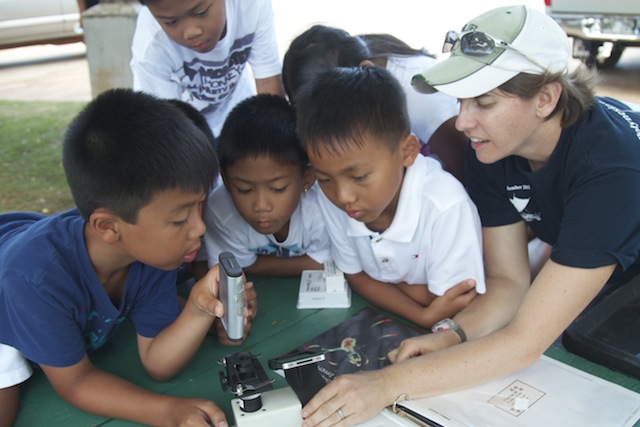
The children of Lanai took part in a variety of educational activities alongside Hokule’a, learning about the ocean from the microcosmic level of plankton to envisioning the vastness of the sea through the magnitude of a journey as far reaching as the Worldwide Voyage.

Education on Lanai 2

They explored depths completely invisible with the eye by actually collecting water from Manele harbor themselves and observing the living, moving microscopic creatures under a cell scope.

Education on Lanai 3

Education on Lanai 4

Sol Kahoohalahala gave a lively presentation about the star compass, which allowed students a virtual understanding of voyaging and celestial navigation.

Education on Lanai 5

Education on Lanai 6

Students were able to step aboard Hokule’a and experience life on board, with hands on experiences including trying on a safety harness, practicing with the steering sweep, and sitting in the navigator’s seat. They were also able to learn about the science that will take place during the voyage as well as gain insight into the urgent challenges facing our oceans, such as ocean acidification.

Education on Lanai 7

Education on Lanai 8

When we asked the children to share their own insight, the effect was profound. They made ‘peace flags’, small cloth squares upon which they could express their message to the world. We explained that their flags would be sewn into one large tapestry that will sail the Earth with Hokule’a and in this way their own mana would travel with her and touch other children around the planet. The thought that their own flag might be sewn alongside a child’s flag from far away places  seemed to elevate the task to a high level of importance for them. They took great care in their drawings and messages, writing of world peace and compassion.  Children are our future, and an incredibly inspiring vision of hope.

Education on Lanai 9

Education on Lanai 10

Sail to Lāna‘i

Continue Reading

Learning Journeys: Waihe’e (June 21) & Honokōwai (June 24)

Maui (Mary Anna Waldrop) —

Waihe’e Coastal Dunes and Wetlands Refuge (June 21)

“What fires me up is reaching back into the past to see what our kupuna did to care for the land so that we can learn from them to live more compatibly in our own time.”  It was easy to get fired up listening to Scott Fisher, manager of Waihe’e Coastal Dunes and Wetlands Refuge on Maui, as he described the history and goals of this sensitive Learning Journey site.  Standing in the “Piko of the Refuge” on this the longest day of the year, the presence of the ancestors is so strong that the air feels thin. Silence can be heard. Time disappears – the past is now, the future is yesterday.

waihee1

Just a decade ago, a destination golf resort was planned on this sacred space. Instead, on this historically cultural, eco-sensitive wetlands site, invasive species are continually being cleared and replanted with native species. Restoration of the ecosystem, protection and cultural preservation of the 93 archaeological sites and education are the present goals.

waihee2

And for the future, Scott “would like to see water in a community supported fish pond and a habitat for native sea birds.” Relating to our aina determines how sustainable we can live. The answer to “How do you Mālama Honua?” is readily apparent at the Waihe’e Coastal Dunes and Wetlands Refuge, and not just on the Summer Solstice. Mahalo nui loa to the unhurried, valuable time Scott gave us, teaching, laughing and embracing this beautiful area. To learn more about the Coastal Dunes and Wetlands Refuge on Maui, go to www.hilt.org/protected-lands/maui/waihee-refuge.

waihee3


Planting the Past for the Future in Honokōwai Valley (June 24)

Early in the morning, twelve people gathered at the Pu’ukoli’i Train Station in Ka’ana’pali to begin an Adventure of Connection. Auntie Puanani Lindsey, who for the past 14 years, has continued to carry on the love of restoring Honokōwai Valley, was our leader along with her son, Ekolu Lindsey, the president of Maui Cultural Lands. Driving slowly so as not to cover the trucks behind in a cloud of red dust, we reached the gathering area. Hiking along a narrow well-traveled trail, we were greeted with the majestic beauty of lush mountains and the verdant valley below.

Puanani chanted a kahea calling to our aumakua which was answered by Anela followed by the calling out of the pu (conch shell). The depth of the moment was felt by all. Not only were we invited to participate in being a part of restoring this sacred land that once was a thriving Hawaiian village dating back to Pre Columbus and the Great Wall of China, we were part of the present time of honoring the 4th anniversary of the death of Ed Lindsey, the Maui Treasure who began Mālama Honokōwai in 2000.

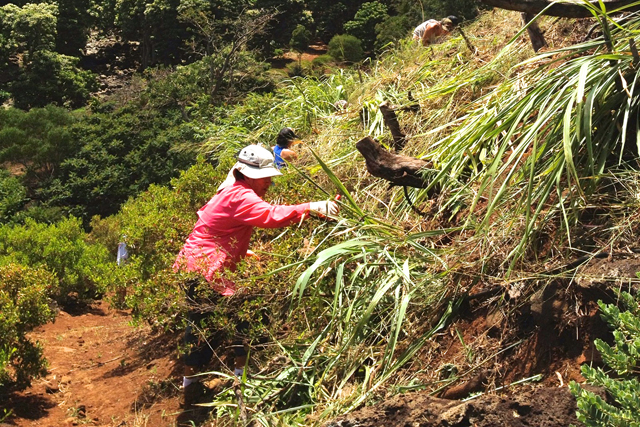
Dwayne Minton carried on an encyclopedic stream of information about every plant, tree and weed we passed. Noni, a’ali’i, akia, ulei, pokulakalaka (munroidendron), medicinal and Hawaiian uses, geographic distribution, species interconnectedness and interdependencies as well as preservation and conservation strategies flew over our heads.

Sitting beneath a towering red wall, we listened as Ekolu explained how his dad, Uncle Ed, would answer students’ questions with a question. He explained how when the Sacred Hearts School students came up to honor Uncle Ed’s passing four months after his death, that he “got” what he was supposed to do and what his part in Maui Cultural Lands was. “This is for the future, creating for the future one weed at a time, one plant at a time, to create leadership for tomorrow.”

After weeding the steepest hillside we’ve ever tried to stand on, we shared lunch while Puanani contemplated where Hokule’a crew would plant the pokulakalaka to honor the special occasion to memorialize Uncle Ed’s 4th anniversary. The Hokule’a crew cut digging sticks while the spot was chosen. It was important to Auntie Puanani that the hands of Hokule’a crew dig, plant and water the tree. “Seeing the crew in a circle as they chanted, the earth lifted, I did a pule to the earth and felt so special.” Plans to dedicate a plaque with each crew member’s name who touched the aina that day are in process.

Having Hokule’a crew members honor Ed Lindsey, one of the original island voyagers on Mo’olele, symbolized the connection of the Valley to the ocean. “Honokawai Valley is our canoe,” Ekolu stated. “We are connecting the Valley to a different kind of world. We are sharing our culture, grounding our culture.” It wasn’t only Auntie Puanani who had tears this day. Each of us felt the connection to Uncle Ed, whether meeting him for the first time or knowing him well. As we returned, it was possible to see the “fleet of canoes” across the ocean he dreamed of. We thank the Lindsey ‘ohana for their kindness and generosity.

Click here for more about Mālama Honokōwai Valley.

Continue Reading

Praise for the Voyage: Environmentalist, Entrepreneur & Author Paul Hawken

Hōkūle‘a, en route to Maui —

Paul Hawken is an environmentalist, entrepreneur, and author. His work includes starting ecological businesses, writing about the impact of commerce on living systems, and consulting with heads of state and CEOs on economic development, industrial ecology, and environmental policy.

The worldwide voyage of Hōkūleʻa has many meanings; its impacts are multiple and diverse. On the face of it, a traditional Polynesian voyaging canoe with a twelve- person crew will traverse a 46,000 mile path around the world, an astounding feat in itself. The canoe is simple. It is lashed together without steel rigging, screws, bolts, or metal fasteners. It sails without a cabin, galley, or head, powered by two crab claw sails. It has no engine, no compass, no GPS, no sextant. Its mission is to visit indigenous peoples around the world and share the story of how a traditional culture, in this case Hawaiian, is bringing to life its knowledge, intelligence, science, language and cultural integrity by restoring the practices that allowed it to endure.

If this were being done to honor the past and preserve traditions for the future, it would be worthy. But its meaning goes beyond that. Traditional Polynesian cultures were acutely attuned to their environment. Their food, language, narratives, agriculture, mores and spiritual practices were intimately intertwined to the rhythms and constraints of the land they lived upon and the waters that held them. They created vibrant cultures of healthy women and men who left a legacy of elegant mastery, both rational and intuitive, that was almost obliterated by modernity. In this, Hawaiians mirror the experience of indigenous people everywhere.

The voyage of Hōkūleʻa will connect wisdom traditions around the world. Indigenous science and understandings are not artifacts from the past, but guides to the future, markers and pointers that can instruct and root an industrial culture that is based on an illusion of no limits. The art of the voyage, its simplicity, the absence of anything except that which is truly necessary carries an important teaching. The voyage depends on a proficiency and awareness that can only be found in human consciousness. The frugality of means that accompanies each step of the voyage celebrates the ingenuity of humanity in ways that we have forgotten, do not appreciate, or do not know. Each leg of the voyage is a test of that knowledge, a refinement of awareness. Wayfinding has always held deeper meanings in Polynesian cultures, but with the voyage of Hōkūleʻa, wayfnding becomes a metaphor for the world, a way of seeing. The earth is a canoe, sailing through space, a craft packed with people who may have too little or too much, and who must discover how to share and collaborate in rhythm with the gifts of the earth in order to move forward into the future.

Crew Blog: Lesley Iaukea, June 26 (and June 20)

Maui (Lesley Iaukea) —

June 26

Tonight, the crew went to the Whale Sanctuary in Kihei to give a free presentation on the WorldwideVoyage for Hokule'a and were met with about a hundred smiling faces and a room full of positive energy. We also had a few kupuna crew members there to support and share their mana'o with us and the crowd.

Kaiulani Murphy started off the presentation with a powerpoint that gave the history of Hokule'a and Polynesian Voyaging Society; and the path that has led us here today with the WorldWideVoyage. Kaiulani talked about the founders of Polynesian Voyaging Society, along with known figures that are no longer here with us as a way to connect the audience to the wa'a.

kaiulani_chad_hawaii_Ka‘iulani

Kala Babayan then spoke about the voyaging canoe on Maui and her experiences with being Po Navigator Kalepa Babayan's daughter. It was a great insight into her world where she is also very knowledgeable about the star compass as she recalls stories from her youth with her father.

Kala BaybayanKala

Kealoha Hoe completed the presentation by describing the typical life on board while on a voyage, the food that is being used and different food menus that is gearing the crew towards a healthier tomorrow; sustainability and prepping, as we prepare to grow our own food on board.

Kealoha HoeKealoha

We then had a Q and A period where the audience posed some really great questions and foresight to the voyage ahead. The education program was introduced and information on how to use Hokule'as voyages as part of a curriculum was discussed.

It was a great night amongst new friends and the crew would like to thank the community for coming out and showing their support; as well as share with us their great mana and 'ike. This island of Maui has been supportive and loving towards us while we are here and we leave soon knowing that there is definitely a huge presence of people that are living aloha and preparing the future for their keiki. Aloha…


June 20

In the afternoon, the crew went to “talk-story” with Uncle Leslie Kuloloio. A well known Hawaiian activist and knowledgeable kupuna in oral histories. To set the tone for the meeting, Uncle Les and 'ohana greeted us with their mo'oku'auhau kahea. The crew in response returned the greeting with the Hokule'a kahea.

Uncle Leslie Kuloloio. Photo credit: Lesley Iaukea Uncle Leslie Kuloloio. Photo credit: Lesley Iaukea

We were given a tour of the 'ohana property where there was once a living and thriving fishpond and village. This property is located across the street from 'Big Beach' in Makena and is a symbol of place for this 'ohana that has genealogical roots to Maui and Kaho'olawe. We were given the history of Kealakahiki, the pathway to Tahiti; as well as the oral history of how Maui and Kaho'olawe are and were connected. We felt very lucky to hear this mo'olelo from a kupuna, as he gave us all a visual of what once was in these islands.

Crew with Uncle Les Crew with Uncle Les. Photo credit: Leina'ala Kuloloio

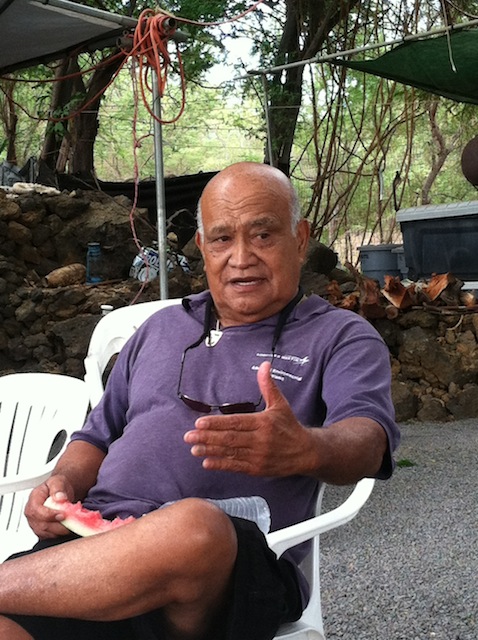
As the Kupuna Representative of Kaho'olawe and Chairman to Aha Moku, Uncle Les sat the crew down in a circle where he proceeded to talk about culture, kuleana, and most important, the future for native Hawaiians. By the middle of our 'talk-story', we were all pretty much understanding the spiritual connection to our ancestors and the role that Hokule'a plays for many hawaiians and non-hawaiians in regards to perpetuation of culture. Needless to say, the 2 hour meeting lasted for 4 hours, and at the end of this spiritual and deep talk, the crew ended up at Big Beach, where we sat together looking out at Kaho'olawe and thought about our kuleana to our 'ohana and Hokule'a; and ultimately, our kuleana to 'Malama Honua'.

View of Kaho'olawe View of Kaho'olawe.

Mahalo nui loa to Uncle Leslie Kuloloio, Leina'ala Kuloloio, and keiki for their deep sense of kuleana and the humbleness he has in giving away his mana'o freely to the younger generations. We truly learned from our kupuna today as he gave us much more to think about while sailing the first year of our voyage in Hawai'i.

Continue Reading

Learning Journey: Exploring Olowalu, Maui, June 23

Olowalu, Maui (Miki Tomita) —

We began our Olowalu journey with Keola Sequeira, one of the original craftsman of the double-hulled voyaging canoe.  Uncle Keola shared with us his research and experiences into hull design and canoe building of Mo‘olele, a 42-foot double-hulled sailing canoe and the soon-to-be-launched double-hulled voyaging canoe Mo‘okiha. Joined by members of the Olowalu Cultural Reserve, crew members learned about the history of canoe building in that historic Olowalu location.

Led by Uncle John Duey, we were blessed to lay our eyes upon the largest grouping of kiʻi pōhaku on Maui, at the base of Puʻu Kīlea.  As the crew moved quietly and respectfully to view the many images, Uncle John told us about the volunteer-led loʻi and ahupuaʻa restoration projects of the Olowalu Culture Reserve.

olowalu kiʻi pohaku

Ki‘i Pōhaku. Photo by M. Tomita

Uncle Charlie Lindsey led us through the lands that are kuleana to his family, pointing out key features in the landscape related to voyaging and star navigation.  He also recounted to us the history of the land, from its past as a thriving ahupuaʻa through its use for growing sugar cane, to a description of what he and his ʻohana envision as the future of the area.

olowalu_hike

Hiking a Ridge. Photo by M. Tomita

From this vantage point, we were able to simultaneously view Pu‘u Kukui, Haleakalā and Kaho‘olawe, and the shower-cloud bridge that brings moisture from Maui to Kaho‘olawe.

olowalu naulu

Shower-cloud bridge from Maui to Kaho‘olawe.. Photo by M. Tomita

We were moved by Aunty Rose Lindsey to think deeply about our purpose and intention as we make our Worldwide Voyage –about what our protocol and our canoe means to us, both the physical canoe and the canoe we sail into the future.  She asked us to consider how ready we are for a journey such as this, and to make ourselves ready as best we can in all ways, prioritizing our culture, our canoe and the safety of our crew – he waʻa he moku, he moku he wa‘a. (“The canoe is an island, and the island a canoe.”)

Continue Reading