The Legend Returns

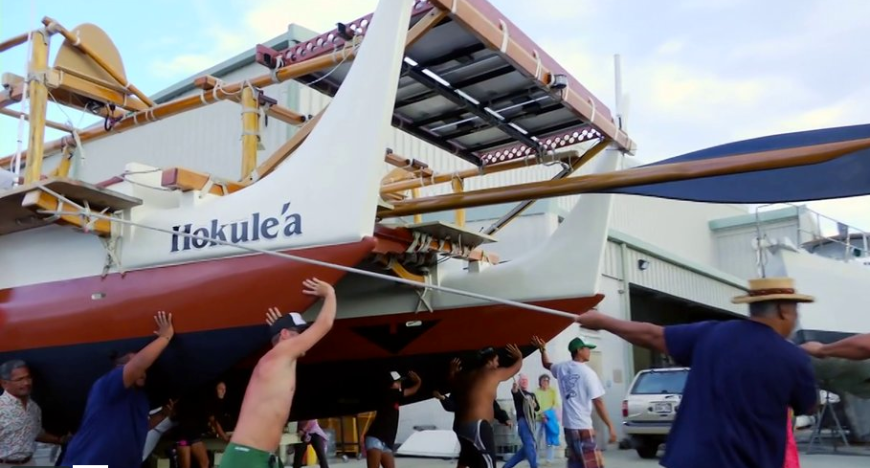
On March 24, 2014, the traditional sailing canoe Hawaiʻiloa returned to the sea after more than a decade on land. Led by master canoe builder Uncle Jerry Ongies, a small, committed group of volunteers has worked tirelessly to accomplish this historic task.

“It has been a long time. But I feel that we – the Friends and the other people who have associated with the canoe – have done a good job. You know, this canoe was nurtured by many people. We kind of like to think that in restoring the canoe, we were giving new life to Bow’s dream. Wrighto Bowman,” said master canoe builder Jerry Ongies.

“Anytime you work on a canoe and do it consistently. I think that’s key – consistency. You’re putting your mana into the canoe,” said Kalā Thomas, a member of Nā Kālai Waʻa.

Hawaiʻiloa will now train future crew members of the Worldwide Voyage being undertaken by her sister canoes Hōkūleʻa and Hikianalia.

“The work that we’ve done, we tried to do the best work that we could. We worked on a limited budget, but thanks to all of the people who contributed to our cause, we got the job done,” said Jerry.

“I feel great. And I’m glad that I could really supply something to get this ready in time so that they would have it to use. I knew had we taken any longer, they might have gone and we wouldn’t have anything to train on. So I’m glad not only did we get it out in time but we got it done well,” said Timmy Makuakane, Jerryʻs grandson.

“Probably over the next week or two, we’ll be standing up the masts and the spars. After we do the standing rigging, we will do what we call the running rigging. So I’ll say in two weeks, she’ll be ready to sail. Hopefully she’ll be sailing for many, many years to come. And I’m hoping that a new generation of young people will become associated with the canoe, with sailing the canoe, and maintaining the canoe,” said Jerry.
Continue Reading

Carving the Waʻa Community

“I started to bring that canoe down here. The first year it was like, just rubber banned together. And people said, ʻHo man! How are you going to repair this?ʻ Then we brought it last year, it was a little better, and today I have it here again for its third time,” said canoe carver Bobby Puakea.

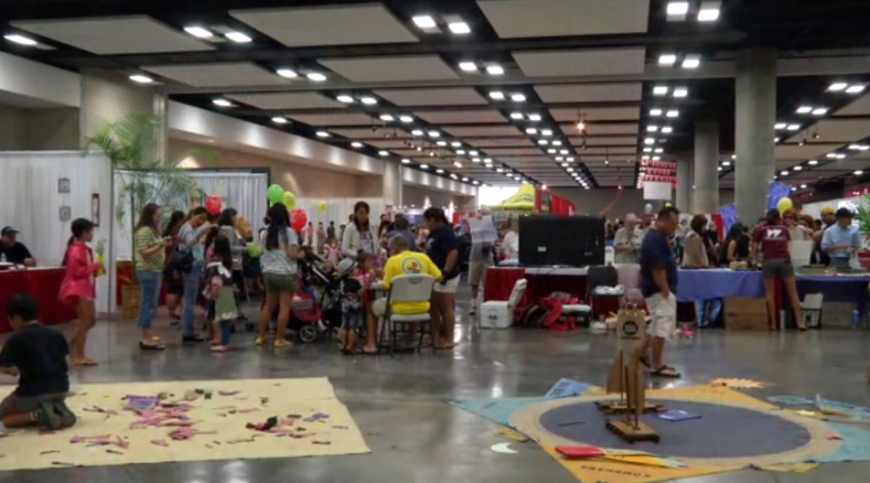
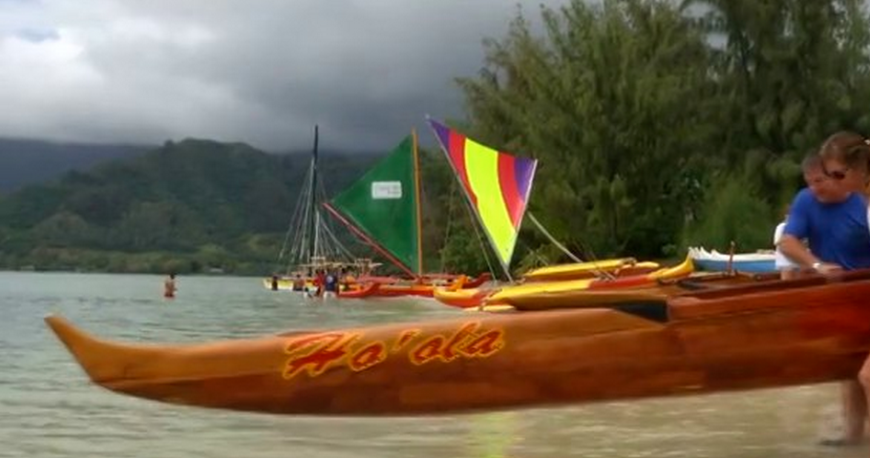
A canoe that was rebuilt by strong, yet loving hands, and brought to the hearts of the community who would launch Hoʻola at the fifth annual canoe festival at Kualoa Beach Park.

“To be launched from here, where Hōkūleʻa was launched some years back, I felt that it was just like an honor to be here and to launch her here,” said Bobby.

A mutual feeling for the Hōkūleʻa crew who believes that Hoʻola, as its name suggests, is a testament for the bigger picture that Uncle Bobby stands for.

“I think it’s awesome for someone like Uncle Bobby to be here. H e brings a lot of that kind of the old time knowledge. And then as far as leadership, it’s nice to see the younger people here that are learning from people who are really interested in sharing their knowledge and passing it on so that we have this continuance of our canoe culture,” said Kaʻiulani Murphy, a navigator with Hōkūleʻa.

“To keep our canoe culture alive, we are actually carvers,” said Bobby.

And Uncle Bobby, Hōkūleʻa, and other leaders of ʻike waʻa are doing just that. They are carving and building a larger waʻa community.

“And our community is interested, I mean they’re coming here on a rainy day. It’s a nice mellow event. So it’s just another good gathering of people,” said Kaʻiulani.

“I guess the word is educate, especially our young people. Perpetuating our culture. Whether it’s the canoe construction, kalo, whatever. Our young people, our young children need to know about that,” said Bobby.

Continue Reading

Canoe and Crew

“The canoe is the mother. And the navigator is the father. And the crew members, that pretty much makes us all brothers and sisters. What makes Makali’i special is this relationship we have with each other.”

This strong bond between canoe and crew has been a key reason for Makali’iʻs success, beginning with the original builder Clay Bertlemann.

“He wanted to build a canoe for his younger brother, Shorty that was becoming a navigator because at that time Hōkūleʻa was the only canoe, she couldn’t be on every island, at every community that wanted to experience her. But in building Makaliʻi, that we would just continue what Hōkūleʻa had started but being able to do it here within our community,” said master navigator Chadd ʻŌnohi Paishon.

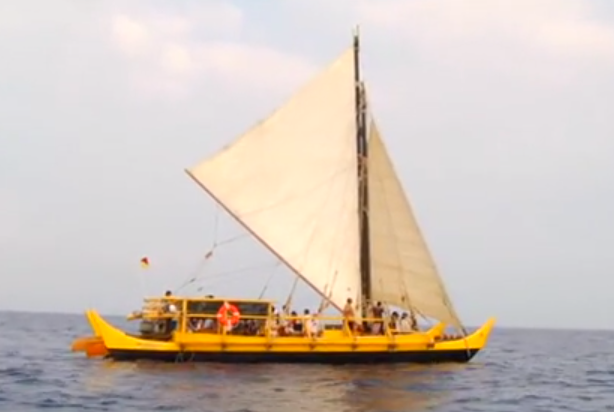
After serving as a classroom for numerous community programs. Makaliʻi recently returned to the sea after completing changes to her hull in preparation for future voyages.

“This past drydock we focused on reopening the bows, the manus, on the bow of Makaliʻi to really look at them and reinforce them because we want to add a spreader across the front. And that allows us a little more opportunity as far as setting sails and everything else,” said ʻŌnohi.

“You know, we’re not a huge group. We have a pretty solid crew and a lot of our young guys who are coming through, they’ve been with us a long time. There’s a strong backing by the community from the years its involvement with the community. And that’s what kept us really strong.” said Nicholas Kaipara Marr.

“You know, one of the biggest things is when you help on the canoe, your energy or your mana stays with the canoe. So even when we’re voyaging, part of them is with us and helps us to sail safely from their hard work too,” said Mike Manu, a crew member on Makaliʻi.

“Preparation is, maybe it’s, you never get to do enough. But once you’re out there, you’re in the hands of the ocean and the elements. And that’s a place we love to be. And that’s where everything comes together. I think it’s just creating that base of that next generation coming through. And we learn consistently, you know, we learn the same way so that one thing I do like about our crew is once we get on, we’re all on the same page,” said Nicholas.

“And even as Hōkūleʻa and Hikianalia will be gone from us, we can utilize Makaliʻi as one of the training canoes for the rest of ʻohana waʻa. The upcoming dry docks that we have ahead of us will be really focused towards getting Makaliʻi ready within the fourth year of the Worldwide Voyage to meet up with Hōkūleʻa and Hikianalia… Hopefully that we can join them there and return with them to Hawaiʻi,” said ʻŌnohi.

Continue Reading

Holopuni Iā Hawaiʻi

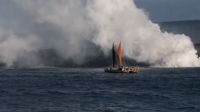
“When we went down to Kaʻū, we sailed and got to see all of the volcanoes, erupting and flowing into the ocean. I was on Hoʻokela, but, I have this beautiful image of Hōkūleʻa and Hikianalia in the background with just this steam, of the lava going into the ocean, and no people, just lava. Thatʻs kind of what I imagine what it would have been like to have seen Hawaiʻi for the first time, with the first Hawaiians,” said Haunani Kane, an apprentice navigator on Hōkūleʻa

“The canoe has always been there since the beginning of Hawaiʻi. I can only see that it becomes more relevant than it has been already,” said apprentice navigator Lehua Kamalu.

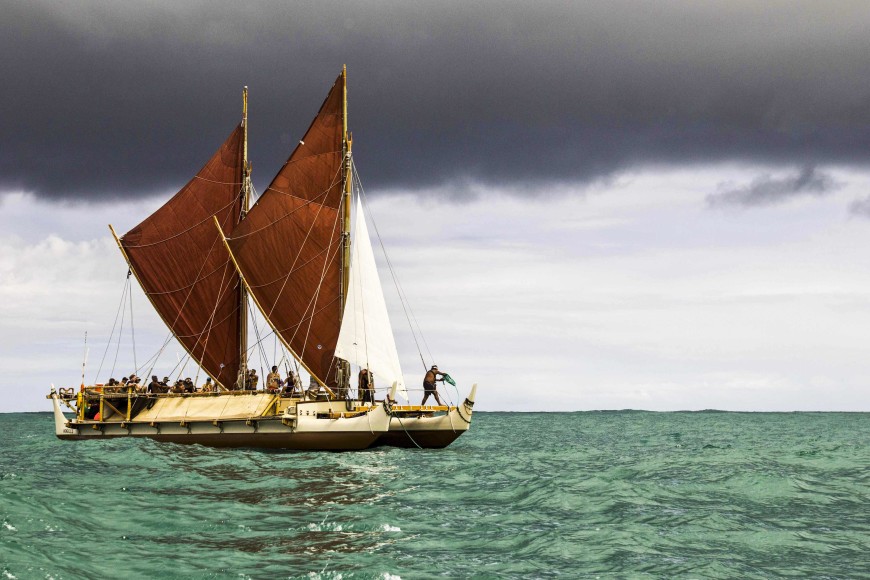
As Hōkūleʻa and Hikianalia made their way across the Hawaiian islands last year, their paths intertwined, bridging the past with the present, using traditional knowledge to face modern environmental issues. This kuleana became a journey called Mālama Hawaiʻi, the first leg of their larger Worldwide Voyage.

It is a voyage that intends to bring respect and aloha and to make sure that our communities knew that we took the time and we took the effort, we took the energy to connect with them, to link with them and to in a respectful, humble way, to explain why we are doing this voyage,” said master navigator Nainoa Thompson.

“Kaho’olawe, Kealaikahiki, that name, that place, the pathway that story of the island itself, the healing of the island. I think a lot of us can relate to that and that’s what we’re looking for too, with this world voyage is stories of hope, taking care of our place even if maybe, it wasn’t taken care of. But there is hope that life can come back to places that have suffered,” said Kaʻiulani Murphy a navigator on Hōkūleʻa.

This hope lies within the many generations who will follow in the wake of Hōkūleʻa and Hikianalia in continuing this ʻike that is unique to our Hawaiʻi, but relevant around the world.

“I think that was one of the really amazing features of this past voyage. In getting all these 20,000 kids out. Any child can touch the canoe, any child can be on it. It’s something that is closer to them, and just gives them that daily pride, and that confidence,” said Lehua.

“Having our haumāna, having our kamaliʻi from Miloliʻi to be able to witness Hōkūleʻa coming in today, it was such a blessing, and you could see the excitement in their faces cause now that circle has come fully around,” said Lei Kaupu, a teacher from Miloliʻi.

“In the last Mālama Hawaiʻi, when we went to all these communities, you had people from all walks of life come together and sit on the same deck,” said Lehua.

“People have responded, and long after the voyage, we are going to be connected with these communities still around the world and be able to see those ripple effects, 20 years, 50 years down the road,” said Jenna.

Continue Reading