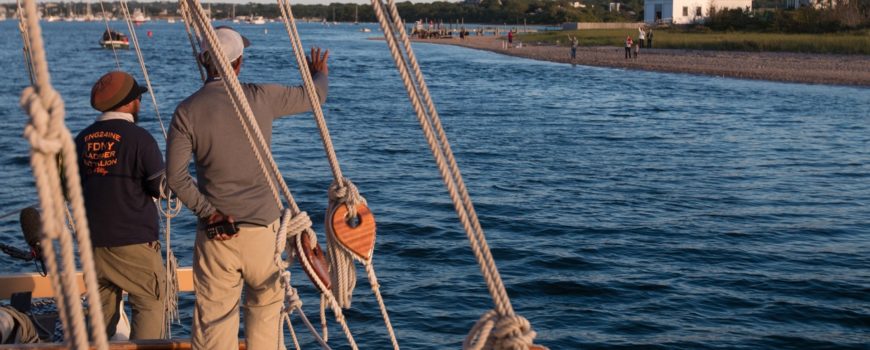
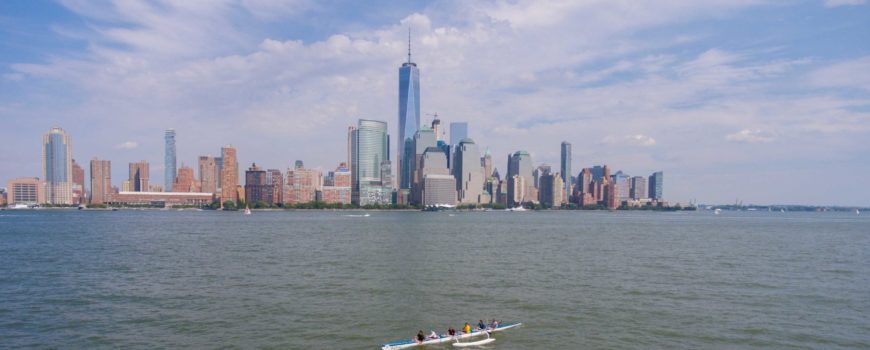
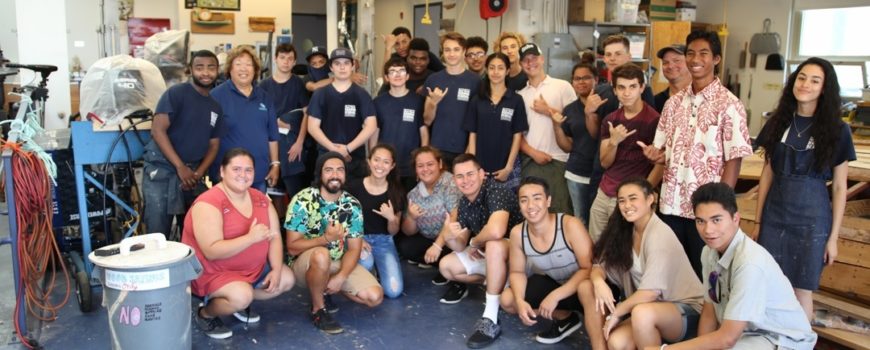
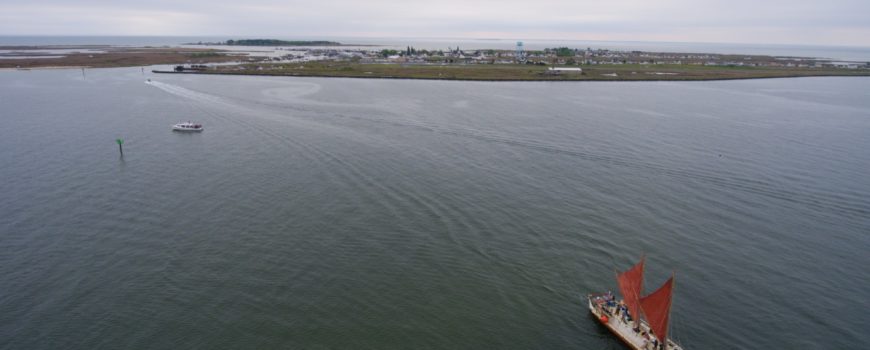
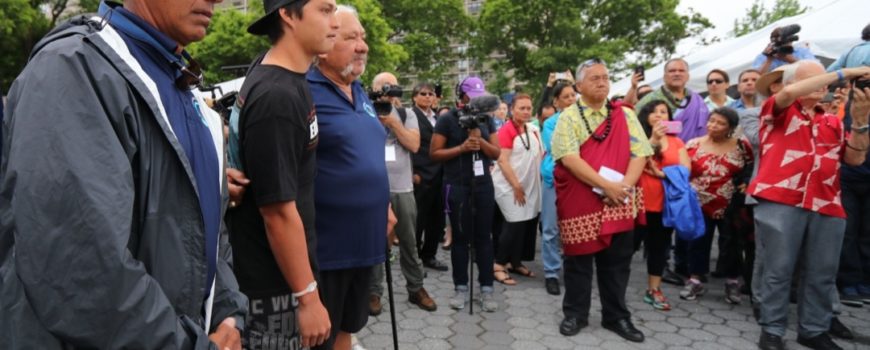
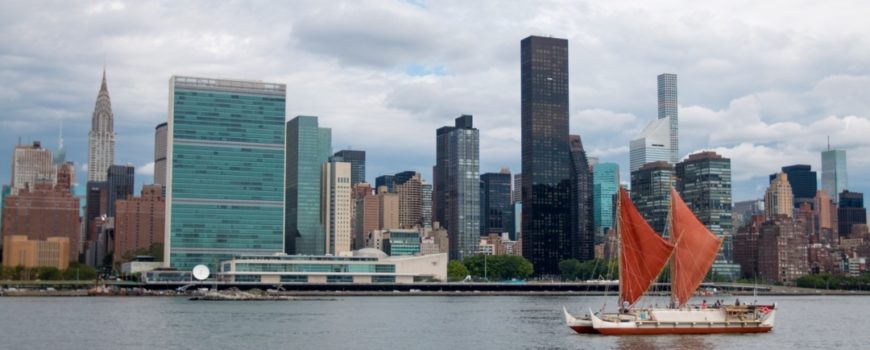
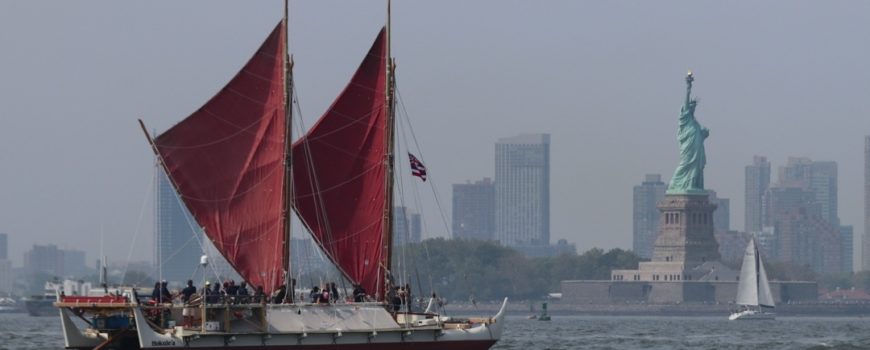
Aloha everyone, we are here on beautiful Block Island with the crew that sailed Hōkūleʻa from Virginia to Washington, DC and on to New York City. We left New York City on Saturday and spent a beautiful night sailing here. We are finally in beautiful water in this small village and will be connecting with the locals in the next couple of days. Leg 21 is about to come in tomorrow. So weʻll be doing a handover with both crews as they get ready to sail to Maine. Tomorrow, we will have canoe tours for the community from 11am-3pm. If you are on Block Island, please come down. Weʻre just excited to end our leg in this beautiful place and want thank everyone for your support all the way up through New York City. Keep following us on Hokulea.com. Aloha!
Help fund the Voyage as we sail the East Coast
Hōkūle‘a’s visit to the eastern United States is a historic milestone in her 40 years of voyaging.
Celebrate with us by pledging your support to the Mālama Honua Worldwide Voyage.
During their stay in New York City, Hōkūleʻa was a part of the Hawaiian Airlines Liberty Challenge hosted by New York Outrigger, the largest outrigger regatta on the East Coast. Crewmembers provided dockside tours and educational outreach through star compass demonstrations and other activities.
In addition to being an opportunity to engage a larger audience in the mālama honua voyage, it also provided some time for fun and competition. Hōkūleʻa crewmembers jumped right into the 11 mile mixed crew race with two competing teams, team Hōkūleʻa which included master navigators Bruce Blankenfeld and Nainoa Thompson and team Hikianalia with apprentice navigators Jenna Ishii and Lehua Kamalu along with Hawaiʻi waterman Archie Kalepa.
The Hōkūleʻa team finished on top placing 4th out of over 30 crews with the Hikianalia crew coming in a close second at 11th place. To find out more about Hōkūleʻa and future outreach opportunities, follow us at Hokulea.com
Help fund the Voyage as we sail the East Coast
Hōkūle‘a’s visit to the eastern United States is a historic milestone in her 40 years of voyaging.
Celebrate with us by pledging your support to the Mālama Honua Worldwide Voyage.
A short ferry ride from the hustle and bustle of New York City lies Governors Island — the home base for the Billion Oyster Project.
Director of the project, Peter Malinowski said, “The Billion Oyster Project is a restoration and education project aimed at restoring a sustainable oyster population in New York harbor and reigniting in New Yorkers a passion and appreciation for the harbor. And we do that by growing oysters here on Governors Island with New York Harbor School and building reefs and through our schools program. Now we have 60 schools throughout the city where we train math and science teachers to teach their lessons through the lens of oyster restoration.”
The project aims to distribute one billion live oysters around 100 acres of reef by 2030 to rehabilitate New York cityʻs marine ecosystem. And its success in galvanizing schools, government organizations, as well as non profits made it an incredible learning opportunity for Hōkūleʻa and the mālama honua crew.
Hōkūleʻa crewmember Miki Tomita said,We’re brining them here to learn about how the school is integrated into a community wide restoration project. It is looking at one of the most polluted waterways in the area, the Hudson river and using oyster remediation, a technology that was in existence here for hundreds of years that um went away for a while because of human impact. Using the Billion Oysters Project to bring back that natural habitat and to incorporate experimental education and innovation and community efforts to better their environment.”
The group participated in discussions and tours of classrooms and facilities at New York Harbor School. It was a time for deep thought and conversation for Hawaiʻi students, government officials and especially our educational leadership.
Mahina Paishon Duarte, Co-Director of Kanu o Ka ʻĀina Public Charter School said, “I think itʻs really important that we are here at Governors island to learn about the Billion Oyster Project because we are in a critical place as an education system. I am wondering from this experience how can we come together to really utilize education to solve our problems, both locally, nationally and at a global level and I think thatʻs the beauty of mālama honua it helps to galvanize us around a central purpose and a central theme.”
Help fund the Voyage as we sail the East Coast
Hōkūle‘a’s visit to the eastern United States is a historic milestone in her 40 years of voyaging.
Celebrate with us by pledging your support to the Mālama Honua Worldwide Voyage.
When reflecting on Hōkūleʻa’s Worldwide Voyage George Cannon, a waterman fromTangier Island said, “They are traveling all over the world taking their time and giving their time traveling all over the world to let people know about their heritage. And we’re losing our heritage and we’re going to lose it and we know this.”
President of the Polynesian Voyaging Society Nainoa Thomspon said, “We found Tangier as part of the research, but initially it came out of the research as this enormous environmental challenge.”
James Eskridge mayor of Tangier Island said,“For some areas around Tangier we were losing 25 to 30 feet of shoreline each year.”
Thompson said, “These people would be the first refugees of climate change and the consequences of sea level rising and that’s how we initially saw why we would come, to capture that story of a drowning community.”
Eskridge said, “This has been going on forever but weʻre just running out of land to give up now and like I tell folks when it gets to your doorsteps you pay more attention to it. weʻre running out of time and land and we really need to get some protection for the island.”
As one of the first communities in the United States to suffer the consequences of a combination of environmental issues including rising sea levels and erosion, Tangier Island, Virginia was an imperative stop for the crew of Hōkūleʻa to learn about the plight of these fellow islanders.
Eskridge said, “Having the Hōkūleʻa here and the crew I had read some about it about the vessel and the voyages that she had made and but to actually have her come into Tangier as part of her World Voyage — itʻs just unbelievable that they made us a part of their voyage and that they came into our harbor and that I actually got to sail on the vessel.”
Cannon said, “It was good I wouldn’t take it out of my life. I told my wife, ready to go home now, ready to go home this is a good thing in my life. And it was a scary thought to go out there, I got a picture of your ancestors on that boat, they knew the lord too. You better believe that they did, they had somebody on their side, they do.”
Thompson said, “To have them on the deck of the canoe and to have the kind of conversations that we had with them, these are ocean people and they pride themselves on that. You know they donʻt call themselves refugees even though on the outside thereʻs this suggestion that they are going to be the the first refugees to climate change in the United States. They are not willing to be lowered to that kind of definition and that kind of standard.”
Eskridge said, “Tangier is a unique place its a very close knit community the people are close together they help each other. And on Tangier everybody knows everybody else. And we have been fishermen and crabbers for a couple hundred years now. It’s a very nice place to grow up, it’s a nice place for kids. It’s a safe place. Being a fisherman and crabber can be a hard job it has it’s ups and downs. But all in all it’s very nice, I enjoy it.”
Cannon said, “I’ve always thought life was on Tangier was a good life. The heritage that we got the love that we have for each other.”
Thompson said, “Being with them talking to them, they are committed to their home, they are committed to their place, they are committed to the children. They are very family oriented.”
The community of Tangier is actively working with the Federal government and the Army Core of Engineers to look at options that will prevent further loss of land on Tangier Island.
Thompson said, “These are hard working people and they are going to find a solution. Their great grandparents did it, their grandparents did it, their parents did it and they are going to do it. This place Tangier is a lot like Hawaiʻi. It has just been very powerful being in a place and with the people to help us re-think what is really important. It has been a place where I have come to be very thoughtful about about when I go home what am I going to do.”
Cannon said, “Met some people just like me, you all are, you got the same heart that I got and that’s good.”
Thompson said, “That’s the power of the canoe and voyaging and the magic of the Worldwide Voyage is that you end up in places with people and you make connections that you could never imagine until you go, until you go.”
More than Adventure
Beyond a daring expedition, the Worldwide Voyage is quite possibly the most important mission that Hawaiʻi has ever attempted. As people of Oceania, we are leading a campaign that gives voice to our ocean and planet by highlighting innovative solutions practiced by cultures around the planet.
We could not have begun this great journey without your support, nor can we continue to its completion.
Hawaii’s legendary traditional voyaging canoe Hōkūleʻa achieved the pinnacle of her historic four-year sail around the world at today’s United Nations (UN) celebration of World Oceans Day: a global event focused on ocean celebration and collaboration for a better future. This year’s theme of “Healthy Oceans, Healthy Planet” encouraged individuals and organizations across the globe to take action in preventing plastic pollution in our ocean, with programming that featured the powerful and lasting presence of the Polynesian Voyaging Society.
“Captain Nainoa, I wish you and your entire crew a wonderful return journey,” said UN Secretary-General Ban Ki-moon, who sailed on Hōkūleʻa in Apia, Samoa in 2014. “I count on your leadership and commitment as we carry out our plans to make this world safer and more sustainable for all. On World Oceans Day, let us renew our resolve to protect these marine treasures for generations to come.”
In today’s morning ceremony at Gantry Plaza State Park, Thompson presented UN Secretary-General Ban Ki-moon and Gyan Chandra Acharya, UN Under-Secretary-General and High Representative for the Least Developed Countries, Landlocked Developing Countries and Small Island Developing States, and Palau President Tommy E. Remengesau Jr. with ocean protection declarations and messages of hope that the Hōkūleʻa crew members collected from their worldwide journey promoting sustainable oceans.
Later in the afternoon, Thompson joined Palau President Tommy E. Remengesau Jr. and representatives of the Federated States of Micronesia, for a talk-story session on the UN’s Ocean Agenda and goals. The leaders also discussed development regarding the negotiation of a new legally binding instrument to protect biodiversity in marine areas in the high seas.
Help fund the Voyage as we sail the East Coast
Hōkūle‘a’s visit to the eastern United States is a historic milestone in her 40 years of voyaging.
Celebrate with us by pledging your support to the Mālama Honua Worldwide Voyage.
Today, crewmembers of the legendary voyaging canoe Hōkūleʻa continued their momentum of focusing on community outreach through the New York Education and Environment Summit. The crew was joined by educators and community members from Hawaii and New York.
The summit was held on Governors Island, where the delegation was received by the Trust for Governors Island, the National Park Service, New York Harbor School, and the Billion Oyster Project. The Hawaii delegation included University of Hawaii President David Lassner, Kanu o Ka Aina and Ka Waihona o Ka Na auao charter schools’ administrators and students, and representatives and students from Kamehameha Schools. Honolulu City and County Mayor Kirk Caldwell was also present for the discussions that centered on sustainability and protection of the environment.
Nainoa Thompson, president of the Polynesian Voyaging Society, delivered a short speech on the Mālama Honua Worldwide Voyage and its significant connections with the Billion Oyster Project – a STEM-based initiative aimed at restoring one billion live oysters in the New York Harbor. After the morning’s presentations and discussions, the New York Harbor School conducted tours of the facilities. Event attendees visited the aquaculture lab at the New York Harbor School where the oysters for the Billion Oyster Project are raised, and visited other indoor and outdoor learning environments at the innovative school. Billion Oyster Project Director Pete Malinowski answered questions from the Hawaii educators and students. The summit is part of a roster of community events leading up to Hōkūleʻa’s significant role in the upcoming World Oceans Day gathering at the United Nations on Wednesday.
More than Adventure
Beyond a daring expedition, the Worldwide Voyage is quite possibly the most important mission that Hawaiʻi has ever attempted. As people of Oceania, we are leading a campaign that gives voice to our ocean and planet by highlighting innovative solutions practiced by cultures around the planet.
We could not have begun this great journey without your support, nor can we continue to its completion.
After years of preparation, legendary voyaging canoe Hōkūleʻa arrived in New York City and was officially welcomed this morning by thousands of New York residents and a delegation of Hawaii leaders, educators, students and supporters. Among those in attendance were Governor Ige’s Chief of Staff Mike McCartney, Honolulu Mayor Kirk Caldwell, Hawaii Island Mayor Billy Kenoi, Kauai Mayor Bernard Carvalho, Hawaii Island Senator Kai Kahele, Honolulu City Councilman Ikaika Anderson, Hawaii Tourism Authority President and CEO George Szigeti, Solomon “Sol” Aikau (Eddie Aikau’s older brother), marine artist Wyland and Solar Impulse pilots Bertrand Piccard and Andre Borschberg.
The arrival event began with a traditional ceremonial welcome by Native American tribes from the area including the Ramapough Lenape Nation, Moraviantown Delaware Nation, Shinnecock, Unkechaug, Mohegan, and the Haudenosaunee Confederacy. A traditional Hawaiian aha awa, or awa ceremony, was held by Hui Kipaepae of New York. Various hula halau (groups) from New York and Hawaii also offered performances celebrating the historic occasion.
“There is something special that this canoe carries on behalf of our home that I think this world not only respects, but needs,” said Nainoa Thompson, president of the Polynesian Voyaging Society. “This day of celebration is really the step we need to give us strength to go to the United Nations on behalf of all of the people who are doing their part to be responsible for our island home called Earth.”
On World Oceans Day on June 8, a series of events with the United Nations will include a ceremonial presentation of ocean protection declarations by Thompson to Secretary General Ban-ki Moon. The canoe’s arrival at Manhattan’s North Cove Marina – the doorstep of the 9/11 Memorial, New York’s financial business district – marks the pinnacle point of the Malama Honua Worldwide Voyage sponsored by Hawaiian Airlines.
During their time in New York, Hōkūleʻa crew members have a robust schedule of outreach and engagement, in which they will lead, participate in, and support the following events:
Monday, June 6: Malama Honua Education & Environment Summit at Governors Island
Tuesday, June 7: Presentation by master navigator Kalepa Baybayan on behalf of Imiloa Astronomy Center at Hayden Planetarium at the American Museum of Natural History
Wednesday, June 8: World Oceans Day
Thursday, June 9: Hōkūleʻa Storytellers Evening at Patagonia New York SoHo
Saturday, June 11: Hawaiian Airlines Liberty Challenge
Help fund the Voyage as we sail the East Coast
Hōkūle‘a’s visit to the eastern United States is an historic milestone in her 40 years of voyaging.
Celebrate with us by pledging your support to the Mālama Honua Worldwide Voyage.