Crew Blog | Craig Thomas: Flying Fish

At dawn this morning we sighted the volcanic peak of Lombok Island, our first land fall in Indonesia. Nice navigating Jenna, Bali is close.

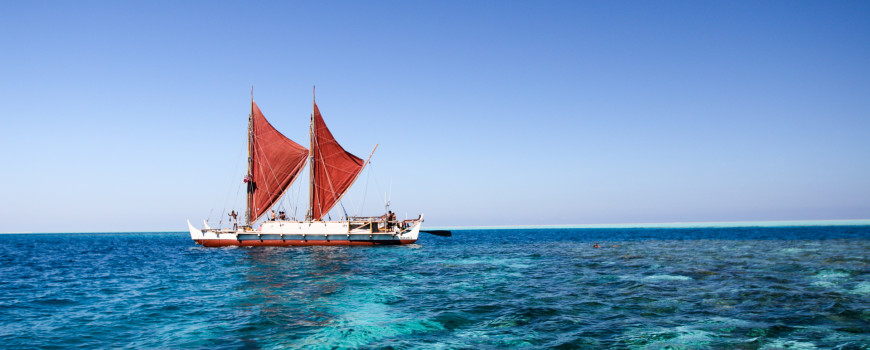
The events of last evening inspired me to write about a fish I saw in the Ashmore Lagoon, the ʻAha or needlefish.

During the day we saw schools of small malolo (flying fish) taking flight around the canoe. As dusk fell, they could no longer see Hōkūleʻa and came flying aboard. Four of us were hit – I was doing the dishes and was very surprised to be thumped in the back. These blunt nosed 6” fish give a wallop but arenʻt dangerous unless they hit your face. All of us are fine. During the night we relaunched about 10 malolo but this morning found about half a dozen more dried out on the deck.

IMG_3008

Had we been struck by malolo’s distant cousin ʻaha instead, the results would’ve been serious. Both types of fish launch themselves into the air at about 38 mph, but malolo are blunt nosed, winged gliders whereas ʻaha are needle-nosed javelins up to three feet long. The bluish/silver fish launch themselves when startled and penetrate deeply enough to kill if they strike a vital area. Even when they hit an extremity and the entry wound looks small, the injury can be serious and usually requires local surgery to remove the jaw which breaks off deep in the cut.

These fish are common in Hawaiʻi; Nainoa, our captain of this leg, has been hit in the shoulder and both knees while paddling after dusk. A night fisherman on Kauaʻi was killed. Risk is much lower during daylight although a windsurfer on Maui sustained a serious knee injury from an ʻaha. Worldwide fatality rates are unknown but likely exceeds that from sharks. 

First aid is managing bleeding, usually direct pressure is sufficient. After stabilizing the patient, even apparently minor wounds need to be explored for beak/jaw fragments. Once the victim arrives at an ER, imaging can help find retained fragments. As with all ocean related wound thorough cleaning and close observation for signs of infection is essential.


Please help keep us sailing for future generations. All contributions make a difference for our voyage. Mahalo nui loa!
Crew Blog | Craig Thomas: Encountering Sea Snakes

Aloha all. This is the first medical blog posting for the Indian Ocean legs of the Worldwide Voyage. The blog will cover medical aspects of the wildlife we encounter plus the injuries and illnesses we’re encountering on our passage. Please, send questions and topics youʻd like discussed in upcoming blogs.

Our passage since leaving Darwin, Australia has been excellent, calm seas, spectacular animal life and several days becalmed inside isolated Ashmore Reef. The reef teams with colorful corals, giant clams, huge sting rays and the occasional black tip reef shark. Above water were multiple species of terns, noddies and squadrons of brown boobies.

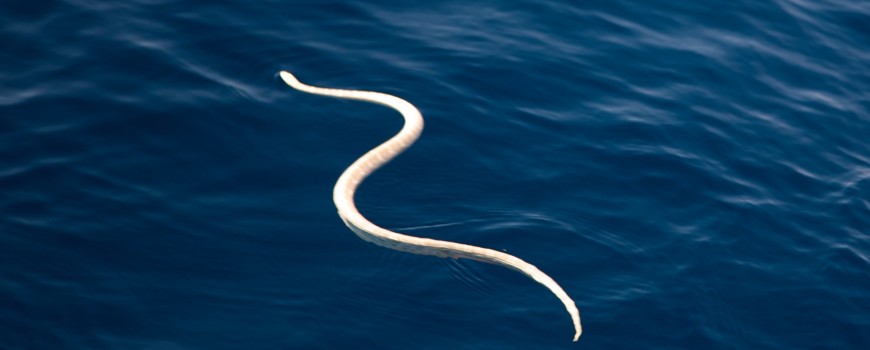
The calm waters offshore enabled us to see dolphins, false killer whales, large orange jellyfish and numerous sea snakes swimming along as we passed. The snakes undulated on the surface like wiggling ropes. I’m used to seeing them underwater but not from on deck. These snakes are air breathing venomous creatures distantly related to cobras and commonly mistaken for eels. They primarily eat fish, paralyzing them with their venom, then swallowing them whole. Sea snakes can dive as deep as 300 feet and hold their breath for two hours. There are at least 52 species of sea snake–all venomous in the tropical Pacific and Indian Oceans. Only the pelagic yellow-bellied sea snake visits Hawaiʻi.

Sea snake venom is among the most potent poisons known, and can cause paralysis and death. The snakes are not aggressive. Swimming with them is safe, and most bites occur when fisherman catch them. Our plan on Hōkūleʻa is to cut the line if we accidentally hook one.

The snakes’ mouths are adapted to biting small fish, but they can bite humans if provoked. Surprisingly, the bites generally don’t hurt, and look like a pin prick. Fortunately, most of the time that sea-snakes bite humans they don’t inject venom. Sadly, sometimes they do and these bites can be fatal. Most rapid recorded death after a bite is two and one-half hours; without antivenin mortality is about 8%; with antivenin this drops to about 1%. Since the venoms are closely related the same antivenin works for many types of sea snake.

The only first aid is applying a pressure bandage to the bite–do not cut or suck on the bite. The toxin is not affected by heat/cold or changes in pH. If the person has no symptoms after eight hours the snake did not inject venom. Advanced medical care includes ventilatory support for respiratory paralysis, antivenin and treatment of muscle break down and kidney failure.

Watching the snakes swim along Hōkūleʻa’s side enriched our voyage, reminding us of the multiple niches the tropical seas provide for diverse life forms.


Please help keep us sailing for future generations. All contributions make a difference for our voyage. Mahalo nui loa!
Hikianalia Update | Voyaging to Papahānaumokuākea

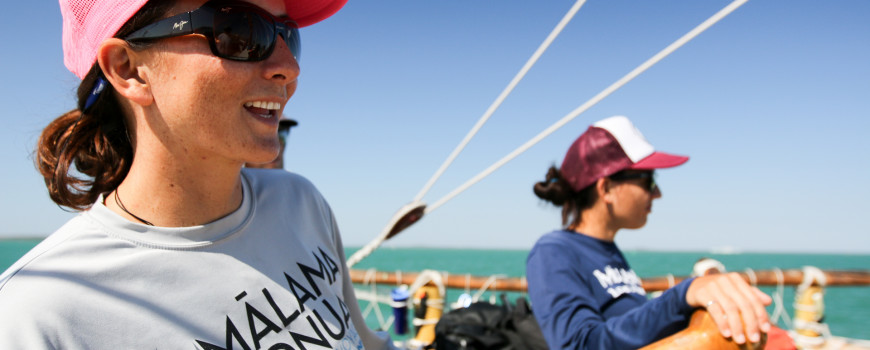
Mālama Honua Worldwide Voyage crewmembers return from the Papahānaumokuākea Marine National Monument having completed the first joint expedition expressly combining traditional navigators, cultural practitioners, and government and university researchers.

IMG_8609

The Polynesian double-hulled sailing canoe Hikianalia and modern research vessel Searcher embarked on an ambitious expedition to conduct various activities, including: navigator training for future legs of the Polynesian Voyaging Society’s Mālama Honua Worldwide Voyage; shoreline ‘opihi (Hawaiian limpet) counts; reef fish surveys; and exchange of ideas on how to better manage Hawaiʻi’s marine resources.

P1260187

“The best part about the joint expedition was being able to talk with the Hikianalia crew about ways to mālama, or care for, our ocean resources,” said Makani Gregg, cultural researcher traveling aboard the Searcher. “We were able to get on the shoreline with each other and count ‘opihi on some of the healthiest shorelines in the world.”

P1250435

Hikianalia’s voyage to Nihoa was yet another step toward the important and necessary transition of leadership to the next generation of voyagers and navigators. For navigator Kaleo Wong, it was his first time as captain of a voyage.

“Nihoa and Mokumanamana have always been places of high spiritual mana (power),” said Wong. “Situated near the transition of and ao (the realms of light and dark, and life and afterlife), they remain sacred wahi pana (celebrated places) and allow us to practice many aspects of our culture, one of which is gaining vital open ocean navigation experience while remaining relatively safe in our home waters of Hawaiʻi.”

Once at Nihoa, team members from Hikianalia and the Searcher surveyed reef fish habitat, conducted ‘opihi monitoring, and offered mele (chants) and ho‘okupu (gifts) to honor the islands.

Chris Bird, Ph.D. and Patricia Crockett, researchers with Texas A&M University, continued their work on ‘opihi, a Hawaiian delicacy and culturally important species, making some interesting finds.

P1260410

“It appears that Nihoa is the ‘Fort Knox’ of ‘opihi in terms of genetic diversity,” said Bird. “This is significant because ‘opihi populations in the Monument could be more resilient to anthropogenic effects like ocean acidification and disease outbreaks than other populations.”

This ongoing research continues to provide managers with insights into how to make better-informed management decisions concerning ‘opihi harvesting in the Main Hawaiian Islands.

“After six years of conducting research on ‘opihi in the Northwestern Hawaiian Islands, it is apparent that there are 99.9% more ‘opihi on the shorelines of the Monument than those of Oʻahu,” said Bird. “On Oʻahu there is an average of one ‘opihi per square meter, versus an average of 100-200 ‘opihi per square meter in the Monument. Working in Papahānaumokuākea continues to provide insight into what a healthy shoreline should look like.”

“It was amazing to have such a dedicated group of people willing to participate in all aspects of this expedition,” said Hoku Johnson, NOAA expedition coordinator. “This was the first time researchers specifically collaborated on projects that have cultural, scientific and management benefit for Papahānaumokuākea and beyond.”


Please help keep us sailing for future generations. All contributions make a difference for our voyage. Mahalo nui loa!
Hōkūleʻa Update | July 7, 2015

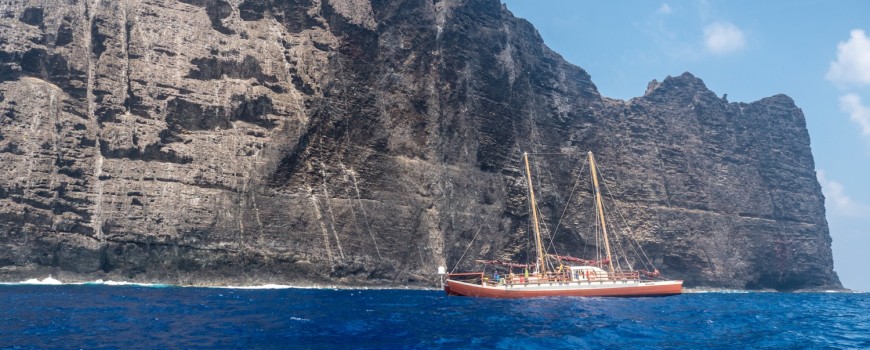
Aloha everyone, this is Brandon Zunin on board Hōkūleʻa on July 7, 2015. We are just about 48 hours outside of Darwin, Australia. We are coming to the end of our leg after Haunani Kane, our navigator, got us from Thursday Island. Yesterday, we heard on the radio another Hōkūleʻa, which was an interesting experience. She seemed to be captained by a Frenchman, and that Hōkūleʻa’s next port of call is also Darwin. So we are excited to catch up with them when we get there. We caught a fish two days ago, so everyone is in a good mood after that fish. Other than that, emotions are mixed as we come to the very end of our leg, but it has been a good one. Please continue to follow us at Hokulea.com. Aloha!


Please help keep us sailing for future generations. All contributions make a difference for our voyage. Mahalo nui loa!

Continue Reading

Hikianalia Update | July 3, 2015

The Polynesian voyaging canoe Hikianalia is on a journey to the Papahānaumokuākea Marine National Monument in the Northwestern Hawaiian Islands. Crewmembers will be sending frequent updates so that educators and students can track her progress in conjunction with the Worldwide Voyage Tracking Map


Aloha

We departed Nihoa late Friday night after conducting science experiments with NOAA and the Nature Conservancy including ʻopihi counting and fish surveys.

Last night we encountered the vessel Makani ʻOlu on the open sea, and they drove up to us so we could exchange oli and mele. 


Please help keep us sailing for future generations. All contributions make a difference for our voyage. Mahalo nui loa!

Hōkūleʻa PM Update | July 3, 2015

Aloha, this is Haunani Kane from the Hōkūleʻa crew. We are on our second day of voyaging through the Gulf of Carpentaria on the northern cost of Australia. Last night we had beautiful clear skies, and we were able to use the stars to guide us throughout the night. This morning, we were able to use the sunrise to get a bearing off the swell as well as the southeastern winds. Right now it’s sunset, and we are getting our bearing and direction of our course. We estimate that we went approximately 69 nautical miles traveling at 4-6 knots today. The wind was a little lighter than last night where we were able to sail at faster speeds. We are estimating that we have approximately 134 nautical miles to go before we sight the western side of the Gulf of Carpentaria. We are hoping that by tomorrow’s sunset, we will be able to make sighting of land. We are all really excited and want to continue on our voyage, and once we pass the cape, we will continue towards Darwin. So thank you for continuing to follow us, and if you want to keep updated on what we are doing visit Hokulea.com. Aloha!


Please help keep us sailing for future generations. All contributions make a difference for our voyage. Mahalo nui loa!

Hōkūleʻa AM Update | July 3, 2015

Aloha, this is Haunani Kane from the deck of Hōkūleʻa, and we are sailing across the Gulf of Carpentaria on the northern coast of Australia. Yesterday, we left the Torres Strait Islands and Thursday Island, and took a back sight on one of the smaller islands off shore called Booby Island. From there we sail 50 or so miles to an off-shore shoal with a lighthouse we had targeted. Now we are making our way to the western portion of the Gulf of Carpentaria. We have gone 100 miles, and we have about 200 miles more to go, and then we will continue on to the next portion of our navigation leg. We are heading almost due West, and the sun has just risen so we have been able to get our bearing on both the swell and the wind. Everyone is doing awesome here on the canoe working really hard to make sure that we make our course. So thank you for following us and continue to do so as Hokulea.com. Aloha!


Please help keep us sailing for future generations. All contributions make a difference for our voyage. Mahalo nui loa!