Crew Blog | Craig Thomas: Exploring Cocos Island

For almost a week, Hōkūleʻa and her crew have been safely separated from the lumpy seas of the Indian Ocean, enjoying Direction Island, a calm corner of Cocos Lagoon that functions as a park and marine reserve.  Surrounded by cruising sailboats hailing from Germany, Holland, U.S., and U.K. to name a few, we are all preparing for the 2,300 nautical mile crossing to the islands off the coast of Africa – seems like everyone is heading to Mauritius!

IMG_6723

This beautiful lagoon, due to its location between Australia, Malaysia and Africa, experienced a turbulent past century —  an undersea cable network dragged this tiny atoll into two world wars, and a copra (coconut meat) plantation added to the unrest. Now, both telegraph cable communications and plantations have passed into history, leaving behind the management and use of the islands to local wisdom.

The shire council made Direction Island a nature park occupied mostly by large red hermit crabs, and brown land crabs.  Despite being mostly coral the island is lush with huge naupaka and dense with coconut palms. Typical of barrier islands, the lagoon side is calm and sandy, but you can hear the surf crashing on the reef about 100 yards away; that side of the island is wild with jagged coral, aʻama (crabs) and slippers washed up from around the world.

IMG_6078

At the island’s eastern tip, a channel in the barrier reef funnels the water washing in from the southern swell into the lagoon. Appropriately named “The Rip,” this area is a marine reserve. Climbing in off the barrier reef, Kimo, Kalei and I snorkeled to the edge of the whitewater escorted by a black tip reef shark and a school of blue green uhu. We turned into the current stream and shot around the Island, flying over giant clams exhibiting iridescent blues, greens and browns, surrounded by large unicorn tangs. In a cave guarded by its smaller siblings we saw a grouper that was about 5 feet long, more black tips, and the largest kaku (barracuda) I’ve ever seen. All too soon the magic current slowed, so we got out and did it again, this time traversing a fish nursery.

The local school utilizes the park and marine reserve as part of its curriculum. Students created uhu replicas out of battered slippers collected from the reef. In addition to biology and ecology, the school curriculum includes lessons on ancient voyaging and traditional navigation.  Direction Island also serves as an educational camp for students from Perth, Western Australia. Every year middle school students fly 1,000 miles to experience life in a lagoon.

IMG_6316

This is not the only island of the Cocos (Keeling) group to be focused on natural resource management and education.  There are 26 other coral islands in the group, principal among them Home Island, with about 500 inhabitants of Malaysian descent; West Island, the commercial center of the group; and North Keeling Island, a national park of Parks Australia.

Established in 1995, Pulu Keeling National Park is composed of North Keeling Island and the surrounding 1.5 kilometers (0.93 miles) of water.  The island is home to the only surviving population of the Cocos buff-banded rail, an endemic and endangered species of bird, known in Cocos Malay as “ayum hutam” or “Chicken of the Forest”.  The Park is also home to the endemic Cocos angelfish, as well as large breeding colonies of seabirds and marine turtles.

Cocos Islanders preserve the magic elements of their world and set an example for us all through local resource management and education.


Please help keep us sailing for future generations. All contributions make a difference for our voyage. Mahalo nui loa!
Continue Reading

Hōkūleʻa Update | August 28, 2015

This is Bruce Blankenfeld from the deck of Hōkūleʻa anchored off of Direction Island and Coco’s Keeling out here on the Indian Ocean. We’re getting ready to depart and our destination is Mauritius, 2,300 miles away. Our expected course is going to be a little south of west. So it’s actually going to be Lā Kona, that’s the course that we’re going to hold for the next 16+ days until we get to Mauritius. The weather we’re expecting are like the south east trades, so looking at the wind, it’s probably from the east, south east, or the south east prevailing throughout this course. Probably when we start out of here, for the next week or so, probably get a nice breeze between 15 to 20 knots. That’s beautiful sailing: following seas, which is the ideal thing for sailors. Possibly along the line, it could weaken a bit, the wind, or strengthen, who knows, but the predominant direction would be from the east southeast to southeast. And that’s what we’re looking at so, thank you for following us and stay with us on Hokulea.com.


Please help keep us sailing for future generations. All contributions make a difference for our voyage. Mahalo nui loa!
Continue Reading

Hōkūleʻa Update | Crew Outreach on Cocos Island

Aloha, this is Kalei Velasco here on Hōkūleʻa anchored over here at Direction Island in the Coco’s Keeling Island group. It’s about time for us to get out of here and get on the move and start making our way over to MauritiusBut before we go, I just want to get a quick recap of what we got to do while we were here.

It’s a pretty awesome, beautiful place. Day 1, we got to go on Direction Island. No one lives there but we got to know the locals pretty good, all of the manō, the iʻa, the naiʻa so much life, all the papaʻi and all kinds of animals here. It was just good to see that some place is still real nice and healthy. And then, learned a little bit about the history of this place, the battles that happened here with the world wars and it was Australia’s first victory at sea right here outside Direction Island.

After that, we got a chance to head over to Home Island, which is where everybody lives, the majority of the people, about five hundred people or so. It’s a Muslim community so we got to learn a little bit about the Muslim culture while we were there, interact with some of the community members and learn about how they came here and how they live, how they sustain themselves.

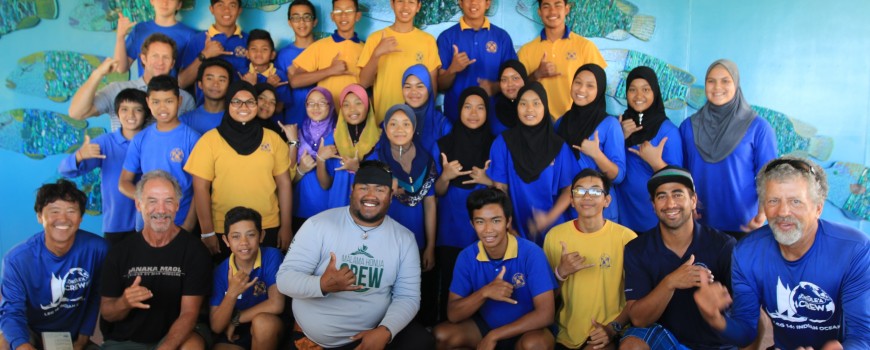
After that we hooked up with the local high school over on West Island. We got on the ferry and went across to the lagoon to West Island and got to meet with children at Coco’s Island District High School, and we had a great exchange with them, talked story, did some dances, did the haʻa and they had a blast. We had a blast getting to know them as well. So I wanted to say aloha to them, mahalo to them for having us, it was great to be in their home islands and be able to enjoy it.

IMG_6660

Finally, today, we hung our sign up, over there, there’s a little pavilion, where all the boats that come to this area, they hang signs up that they’ve been here and we carved out a sign with Hōkūleʻa on it, along with Gershon II our escort, and hung it up under that pavilion. Also next to the pavilion, we planted some coconut trees, in the shape of a star compass, relative to this area, and also, left a pōhaku there from Noalolokai on Kauaʻi so pretty awesome, I think we’re ready to get going now and get on the move. Everyone is ready, spiritually, mentally, physically. The canoe is ready. We made a bunch of little repairs, especially to some of our safety gear, that we needed to make use of over this past leg and time to go. So check us out on hokulea.com, and keep following us, keep sending us your aloha and your prayers, a hui hou.


Please help keep us sailing for future generations. All contributions make a difference for our voyage. Mahalo nui loa!

Continue Reading

Hōkūleʻa Update | August 27, 2015

I was writing at my edit station last night when I was compelled to stop and listen to everything going on around me. The tone of the crew’s conversation had shifted. Some were in quiet song strumming a guitar looking for chords that might be found on a ‘ukulele, others were recounting stories of epic surf trips around Hawaiʻi.  And few were huddled at the stern remembering close friends who stood on this very deck in years past who are now gone.  

IMG_6392

But it wasn’t so much what they were saying that stopped me, it was the way they were interacting with each other. Words came easily, without stress in their voice.  The hesitancy that would show in cadence and body language is now gone. This crew has come together and become a family. On the eve of a trip that is about the same length as Hawaiʻi to Tahiti,knowing that this collective will operate as an ʻohana is probably the most important quality that has come from the last 1,000 miles of sailing. Yes, there are plenty of lessons learned from each earned mile in the last couple of weeks. But looking back at it all, it is the pilina that will see us through this next leg of our voyage.   

IMG_6411

We are also looking back at the last few weeks and making small adjustments to the way we approach the next target. It looks like the winds will be up past 20 knots for the bulk of the 2,300 miles to Mauritius. That means smaller sail area. The veteran crewmembers have described the seas here as “lumpy”  and never settling down or becoming rhythmic. We are anticipating that the rest of the journey will be lumpy as well.  This means that the crew will have to work that much harder to hold a precise direction.

IMG_6024

While we are sure the Indian Ocean will bring many more lessons and challenges over then next weeks, this crew will be ready to overcome those challenges to find our destination and turn this canoe over to the Leg 15 crew with the kuleana to bring Hōkūleʻa into new waters. 


Please help keep us sailing for future generations. All contributions make a difference for our voyage. Mahalo nui loa!
Continue Reading

Hōkūleʻa Update | August 26, 2015

Leave it better than you found it.

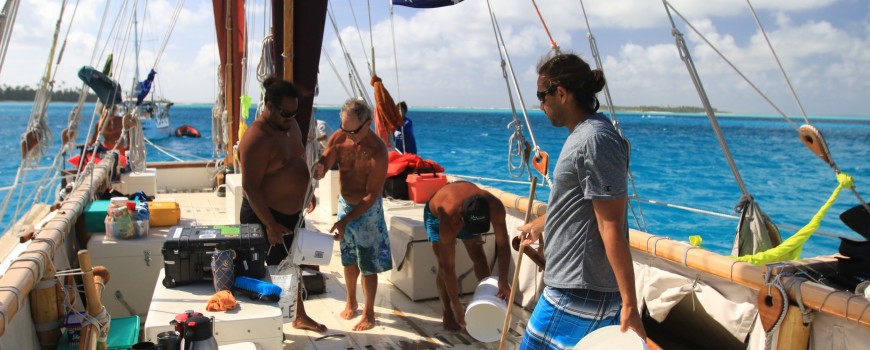
Today we all stayed on board Hōkūleʻa to take care of minor maintenance such as dropping our rig to check the anchor light and washing the deck of the canoe so we can leave Cocos with a clean house. There is always some work to be done on lines and sails, and it’s an ongoing process to keep the ship in shape. Any of these things could have been done later, but we had a day to spare and there is a genuine commitment by this crew to leave the canoe better than we found her.

IMG_6405

We consider Hōkūleʻa to be our home while we voyage. But we also know that we are guests here, and this vessel will be the home for another 11 individuals in a month. That said, we have a responsibility to keep the canoe in the best working order not only for ourselves, but also for those who come after. The Leg 13: Darwin to Bali crew is a great example of that perspective. When the majority of our crew had to wait in Australia because of volcanic activity, the Leg 13 crew, who were still in Bali, made sure that Hōkūleʻa was ready for our crew to arrive and get underway as soon as possible. They loaded all the food and water for us as well as preparing all the communications and safety gear. They even repainted portions of the deck where the nonskid had worn down. They did all of this because they are all committed to leaving the canoe better than they found it.

IMG_6416

The same translates to our visits on land during the voyage.  You’ll see crew lending a hand to fix something at a host church or school, or we’ll clean the beach where we moor the canoe. Simple thoughtful actions for others are sometimes the most impactful. Other times it’s just showing some aloha to our hosts by cooking the meal to say thank you. This kind of thoughtful action is mālama honua, and it’s what we practice while aboard Hōkūleʻa to say thank you to her and to leadership for allowing us to be here. We recognize that every seat on each of these legs is precious, and in turn we have the kuleana to do everything we can to simply leave it better than we found it. Not just on the canoe, but everyday.


Please help keep us sailing for future generations. All contributions make a difference for our voyage. Mahalo nui loa!

Hōkūleʻa Update | August 25, 2015

みなさん、こんにちは。ホクレアクルーの奥知樹と言います。 我々は、16日インドネシアのバリ島を出港して、ここインド洋の島、ココスキーリングに昨日の朝、錨をいれました。クリスマス島という島を経由してきましたが、クリスマス島を過ぎた後、4メートルを越えるようなうねりの中、激しい動揺で航海をしてきましたが、パワフルで心優しい、心強いハワイアンのクルー達と一緒に力をあわせてここまで航海を続けてきています。本日は、クルーのみんなで、この地元の人たちが暮らすホームアイランドという島と、ウェストアイランドという島、ここに少しの時間上陸して、 地元の方々と触れ合う時間を持って、少しですが、ここの文化に触れることができました。僕たちは明日、ここを再び出港し、この14レグの目的地であるモーリシャスに向かって、2200マイルの航海に再び出発します。今後の航海の様子、詳しい情報、また美しい写真は、hokulea.comをフォローしてください。


Aloha, Konnichiwa. I am a Hōkūleʻa crewmember Tomoki Oku from the Japan National Institute of Sea Training. Today, we are anchoring in Cocos Keeling, a very beautiful island. Today, I want to send a message to people in Japan. We departed Bali on August 16th, and anchored at Cocos (Keeling) Island yesterday morning. After passing Christmas Island, we saw large 4-meter (13 feet) swells that made us roll and pitch heavily. However, we have continued sailing with the kind-hearted and reassuring Hawaiian crew. Today, we visited Home Island and West Island briefly. We had time to interact with local people, and were able to experience the culture here. We are leaving here tomorrow, weather permitting, for the next 2,200-mile voyage for the next destination – Mauritius. For the current status, updates, and beautiful photos, please follow Hokulea.com.


Please help keep us sailing for future generations. All contributions make a difference for our voyage. Mahalo nui loa!

Continue Reading

Hōkūleʻa Update | Arrival at Cocos Island

We are now anchored in Cocos (Keeling) Island, approximately 500 miles west-south west of Christmas Island. Cocos is a territory of Australia, and the small, isolated atoll resembles many we have seen throughout the Pacific. The lagoon is on the lee side of the atoll, but the 20+ knot wind has found its way through the brush and trees. 

IMG_6067

The crew has just finished dinner after a pretty easy day of exploring Destination Island. It is a great feeling to take a break and relax after more than a week of hard sailing in excess of 1,000 miles. I don’t think the crew has really let down their guard and allowed themselves to enjoy land too much. The looming thought is of the approaching 2,300 mile journey across open ocean with no stop until Mauritius.

IMG_6085

We intend to be in Cocos only for a few days while we tidy up a few small details and dry out wet clothes from the recent weather. Fortunately, we have access to non-potable water to wash clothes and the canoe. For the past 9 days, we have been washing our clothes and bathing with salt water. Fresh water is a luxury that cannot be missed! We have all our gear out that needs drying. At least the strong wind is good for that. 

IMG_6070

I don’t think I’ve written about the swamp yet, but my towel fell in it last night and would not be the same until I could find fresh water on land. Luckily that was today. The swamp, as it is affectionately known, is actually the wet deck of the canoe that keeps the water out of the hulls. We sleep about 12 inches off the wet deck on a piece of plywood and mat. A mere foot away from where you sleeping, water is washing through the swamp constantly. I do everything I can to keep personal articles from becoming one with the swamp. First, because there are a multitude of scuppers – holes above the wet deck to let the water in and out back into the sea – that are large enough for small items such as iPods, phones, and eyeglasses to be swept out to sea.  The other and equally vexing reason is that once you let something touch the swamp, it will not be the same until you find some fresh water. The classic swamp story that every crewmember faces at some point is that in the middle of the night you will turn over in your bunk and pull your blanket over you, and the corner has just come from the swamp. Needless to say, it’s very hard to go back to sleep with the swamp water on you just after you bathed.

IMG_6078

Tomorrow brings new adventures. We head off to Home Island and West Island in search of provisions as well as other small souvenirs that will remind us of this place that most of us will probably never visit again as it is one of the places that is really off the beaten path. 


Please help keep us sailing for future generations. All contributions make a difference for our voyage. Mahalo nui loa!

Continue Reading

Hōkūleʻa Update | August 23, 2015

The last 24-36 hours have all been about the weather.  We went into yesterday morning with a sunrise that showed us a few squalls on the horizon.  In anticipation of challenging weather conditions, Bruce reviewed what sails we had up and made the call to reduce the sail size on the crab claw sails.  From that point on the weather turned for the worse.

DCIM100GOPROGOPR5827.

The sea state increased by a consistent 4 feet with the occasional 8 foot swell. With the waves also came the wind – a steady 18 knots growing in intensity with the passing squalls that brought plenty of rain. Cloud cover quickly went to 100%, to the point where we could not tell where the sun was setting and diminishing light indicating another night. Coming off watch at 6pm, we went to get rest as the whole day beginning at 2am had been action packed from sail changes to more sail reducing as the wind came up higher and higher.

Foul weather gear was required for the day watch as the rain was coming in buckets. The night watch brought a whole new set of lessons. Wind was way up in the squall with 35+ knot gusts. Even after putting up a 60 sq.ft. jib and 70 sq.ft. mizzen staysail, we were still doing 7+ knots in the pitch black with no moon or stars to speak amid a constantly-changing sea state with large waves on our port stern quarter. These conditions made steering very hard as each swell pushed the canoe into the wind. The only reference we had to steer by was a small red head lamp clipped to the lashing illuminating a telltale tied to the stays. This little orange ribbon tells us the wind direction when all other clues are hidden from view, and we can use that to steer by. The darkness in nights like this allows our vision to pick up even small visual clues.  At about 4am we saw a big black cloud, darker than the rest of the horizon, up wind from us. It found its way to us with a pretty good amount of pressure in wind and wave. Steering was next to impossible, and we could only press forward in the general direction of west.  Our crew stood watch until sunrise but we had no way to tell when the sun actually rose except that the canopy of gray and black became brighter.

IMG_5994

One of the risks we have trained extensively for prior to embarking on this voyage is a man overboard situation. Our safety training and protocols proved their value when one of our crew went into the sea. He had just ended his watch and was moving across the canoe with a pump used to clear compartments of water. Within seconds, emergency procedures were put into action and the man-over-board safety pole, line, and life ring being deployed into the water within feet of the crewmember. According to safety protocols, the crewmember was wearing an inflatable life vest and it inflated properly. Our escort vessel Gershon II, trailing behind Hokuleʻa, was notified and performed its safety role exceptionally. Even with the challenging sea conditions, the crewmember was safely and successfully pulled aboard within 10 minutes. The possibility of a man overboard incident was an identified risk during the planning and preparation of the Worldwide Voyage. We prepared for this possibility with increased safety protocols, equipment, and training. These proved to be effective and the crew successfully executed what we had been trained to do.

After sunrise we thought we had broken through the worst of it.  Steering became easier because of the ability to see and anticipate waves.  By the time I came back up for watch the swell had increased to 15-20 feet, some of it breaking around us as the wind was strong enough to push it over to make white wash.  The good news is that this canoe handles very well in these conditions. The two hulls makes Hōkūleʻa more stable than our mono-hulled escort vessel. Hōkūleʻa slips past the bulk of the really big waves and slides down swells to give us confidence that we are still within the scope of the type of weather conditions that this crew and canoe can handle.  That said, this crew works extremely well together as seen when they all come up on deck, without anyone asking, to help take care of the canoe as the weather turned stronger. We have shifted to 6-hour watches to give more hands on deck at all times and everyone is happy to put forth the extra effort.  The previous watch always makes sure there is hot water and coffee for the following watch, knowing that it’s a long haul to wait for sunrise to come. We are all thankful for how hard each other works and that everyone is here for the common goal of finding our destination.

IMG_5960

Current conditions allow me to write this, but just barely. The rain has subsided but the risk to electronic gear is the breaking wave over the canoe. I can’t see out because of the brightness of this screen but I can hear the breaking wave coming and then feel the pitch of the canoe, which gives me just enough time to slide this laptop into the waterproof box and slam the cover. Not the best method but were still waiting on Lifeproof to make a waterproof case for an Apple MacBook Pro. The gift tonight is the moon overhead.

A.M. Update: We arrived in Cocos this morning and are awaiting clearing customs at Destination Island. The crew is happy for a little rest at anchor before departing Cocos for the 2300-mile journey to Mauritius.

Mahalo nui,

Na’alehu


Please help keep us sailing for future generations. All contributions make a difference for our voyage. Mahalo nui loa!
Continue Reading