Crew Blog | Kālepa Baybayan: The Far Side of the World

Bordering the Tropic of Capricorn at Latitude 20˚30’ South and Longitude 57˚30’ East, Mauritius sits as a jewel in the Indian Ocean. Along with sister islands Saint Brandon, Reunion, and Rodrigues, Mauritius is part of the Mascarene island group. Mauritius has a large population of over 1.2 million inhabitants of mostly Hindu, Christian, and Muslim descent. Noonish prayer call summons those of the Islamic faith to prostrate themselves in the direction of Mecca. Homes are made of brick and motar to withstand local hurricanes, something that threatens all tropical islands.

IMG_1562

Our crew is housed at the beautiful Outrigger Mauritius; a white sand beach fronts the hotel, and the surf crashes along the exterior reef a hundred yards offshore.  1.5 hours away by car, Hōkūleʻa and Gershon are moored.  We are finished with our food packing, and are transporting both the food boxes as well as our personal gear to the canoe.  The time until we leave will be spent preparing our personal compartments on the canoe, and double- and triple-checking our supplies.

IMG_0872

As every crew for every leg of this voyage, we begin with a daily breakfast meeting to lay out the days plans, and wrap with a daily evening meeting assessing the work accomplished during the day.

Another part of our daily routine is the unwind time, the time on land between canoe work and dinner.  Here, on land in Mauritius, we gather on the beach fronting the Outrigger, unwinding before heading to the buffet dinner at the hotel.

IMG_1131

As I sit here on this beach, my gaze is focused on the southwestern horizon. The Southern Cross is dipping into the southern horizon and I can identify the south celestial pole.  I imagine the distant South African coastline some 1,250 nautical miles away. Navigation will not be a problem on this leg as the South African target looms large, but negotiating weather and the southward flowing Agullahas current in the Mozambique Channel will pose a formidable challenge.

My home in Kona seems very distant.   Soon we will be crossing a line that is a 180˚ opposite from the longitude of Hawai’i, marking our halfway point in this epic and impossible journey. But it is not just the distance – it is also the time.  It is not quite October,  and the crew will not be returning to Hawai’i until the end of November… two full months away from familiar lands and faces.

IMG_1546

To be a good sailor one needs patience and endurance, something I, and many of my fellow crewmembers, have developed over time. Nonetheless, I look forward with anticipation to my return home, reuniting with my wife, mother, children, and grand children.

But first – eyes towards Cape Town.
Kālepa


Please help keep us sailing for future generations. All contributions make a difference for our voyage. Mahalo nui loa!

Reef Conservation Snorkeling Trails

“Reef conservation is a local marine environmental NGO. We started up in 2004 and our projects were based around education and sensitization of the Mauritian public and school children,” explained Kathy Young, Project Manager at Reef Conservation Mauritius.

“Our projects then kept evolving with our programs and we were approached to set up a marine resource center. In 2004 when we started, there was definitely a lack of awareness of anything to do with the marine environment. This is how we started up, by trying to protect coral reefs, especially the shallow reef areas, and also then looking more at sensitization for the public in general. We had set-up a project on voluntary marine conservation areas where we are looking at working out with communities what are viable areas to protect and what are important areas for the rest of the ecosystem,” said Young.

Céline Miternique, a Marine Biologist at Reef Conservation Mauritius, revealed the condition of the coral reefs in parts of Mauritius, “On this part of the island we did mapping, ecosystem mapping at the lagoon and we see that we donʻt have a lot of living coral. So thatʻs why we need to protect it, because if we donʻt have living coral we will have less fish and other things will soon disappear. So we try to implicate all of the community with us, and not only community but hotels too.”

Project Coordinator at Reef Conservation Mauritius, Natalie Summers, said, “The hotels, they depend on the marine ecosystem for the tourism, for the economy. So the hotel staff knowing more about what is found in the lagoon, itʻs beneficial for the hotel and for the visitors.”

Young said, “We did see quite a lot of lack of, again, knowledge and awareness, from the tourism center as to what they were showing tourist and the general public. So we wanted to bridge that gap.”

 Miternique explained their attempt to bridge the gap,”We put a snorkeling trail in this area, so itʻs the first snorkeling trail in Mauritius. So the snorkeling trail is about 250 meters. Itʻs a really good tool for education because people can see what kinds of fish we can find, the types of corals, and why itʻs important to protect these corals.”

Young reflected, “One of the end goals is to work with communities, not just to identify, but they actually become stewards of their environment, that they really learn how to manage it, and to be able to find solutions amongst themselves as to how to continue protecting it and ensuring that these systems are viable.”


Please help keep us sailing for future generations. All contributions make a difference for our voyage. Mahalo nui loa!
Hikianalia Update | September 29, 2015 – Haleʻiwa Waʻa Talks

Hikianalia, sister canoe to Hōkūle’a, is journeying around our Hawaiian Islands in search of stories of hope here at home that are making a positive change for Hawai‘i’s future, inspired by Hōkūle’a’s legacy. To find more about upcoming events, visit our Hikianalia Statewide Sail page. 


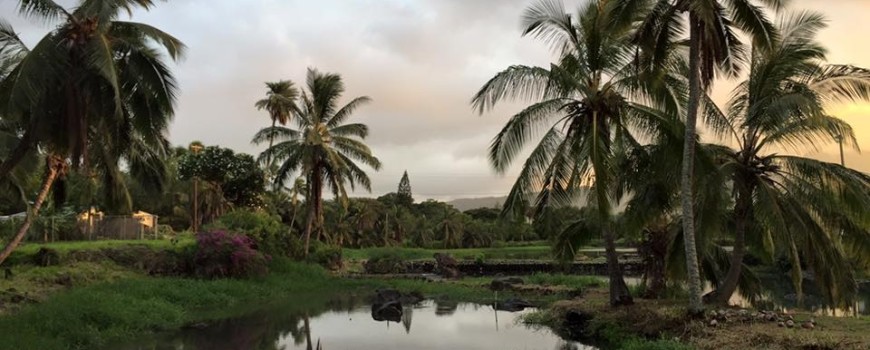
Community members and educators gathered at Loko Ea Fishpond last night for Waʻa Talks, a time for people to talk about the Worldwide Voyage, and share ways that we can all be inspired to mālama honua, in and out of classrooms. Featured presenters were Mālama Loko Ea, Kokua Hawaii Foundation, Ka Hei, Hoʻala School, Kamehameha Schools, Kahi Kai, and Polynesian Voyaging Society. Thank you Mālama Loko Ea for hosting us last night, and for your wonderful lessons about place, sustenance, and sustainability!

Photos by Austin Kino, Aunschka Faucci, and Megan Kawatachi.

This event marked the first in Hikianalia’s North Shore Community Outreach.  Join us on Tuesday, September 29 for a talk story at Patagonia Haleiwa, and Thursday, October 1 at Waimea Valley Farmers Market.

PVS NS Flyer - Fall 2015


Please help keep us sailing for future generations. All contributions make a difference for our voyage. Mahalo nui loa!

Vehicles of Knowledge

Hōkūleʻaʻs latest destination, Mauritius, is a small island nation about 1,200 miles off the South East Coast of Africa. Much like our island homes in the Pacific, Mauritius has also faced the harsh consequences of environmental decline over the past decades.

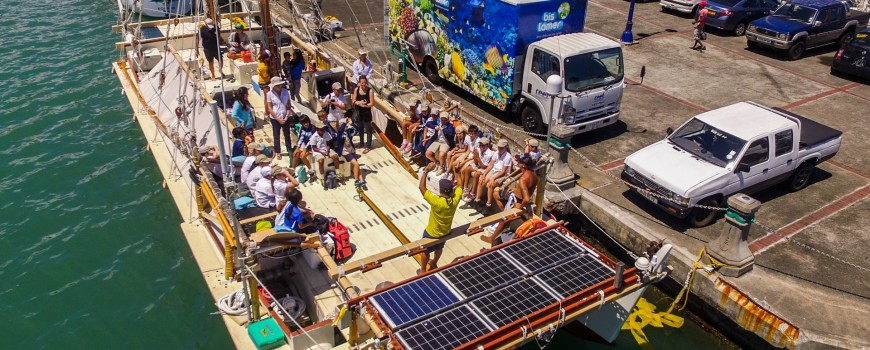
One of the missions of the Worldwide Voyage is to exchange with the world’s citizens about how to best protects our island Earth. Most recently the crew teamed up with reef conservation to showcase their vehicles of education, the traditional voyaging canoe, Hōkūleʻa, and the mobile marine science station wagon, Bis Lamer.

IMG_0893

Sameer Kudeer, Education Coordinator at Reef Conservation, explained, “We are here today with Reef Conservation with our bus, Bis Lamer. From the invitation we received from the Hōkūleʻa team to try also to exchange what they are doing and what we are doing in terms of knowledge about the marine ecosystems.“

Kālepa Baybayan, Master Navigator aboard Hōkūleʻa, said, “Today we have two schools visiting us from a local intermediate school, 12 year olds. So we will be engaging them, taking them on board, sharing our star compass with them, telling them about our project Mālama Honua, and giving them a tour of the canoe.“

IMG_0929Kudeer said, “We also received kids from two schools. They’ve been visiting the boat, talking with the team on the boat, but we also have them on the bus to see, look into the microscopes to know what really is in the seawater and why it is important to protect these ecosystems. The aim of this bus is to try and bring reef and try to bring different issues of climate change and also coastal environmental issues to schools. We try to make them discover coastal marine habitats we have around the country, around Mauritius. And also to talk about the impacts. What are the daily impacts they can have on the environment and coastal zones and how they could change their habits to reduce these impacts. Many of them start asking questions about where they are living and also the impacts they have even if they don’t live near the coastal zones. Mauritians understand that if we don’t start changing the habits we are going to lose many places where they use to have recreational activities. It’s time now to take actions and see how we can work together to find solutions. It’s time now to take actions and see how we can work together to find solutions.”


Please help keep us sailing for future generations. All contributions make a difference for our voyage. Mahalo nui loa!
Hōkūleʻa Update | Outrigger Founders Day

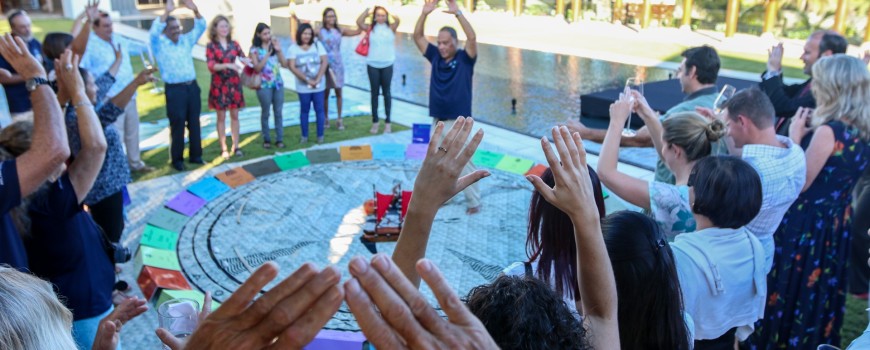
“It is the 68th anniversary of Outrigger. And to be able to celebrate our deep values and aloha spirit and the hospitality, that connects perfectly with what Hōkūleʻa is all about,” said Bitsy Kelley, vice president of corporate communications at Outrigger Enterprises Group. 

Worldwide Voyage crewmembers joined the leadership and staff of the Outrigger Beach Resort Mauritius to celebrate the legacy of Outrigger founders Roy and Estelle Kelley. The Outrigger Beach Resort Mauritius has graciously hosted crewmembers and assisted with provisioning Hōkūleʻa for the upcoming leg of the Worldwide Voyage. Master navigator Kālepa Baybayan also conducted a navigation and star compass lesson. 


Please help keep us sailing for future generations. All contributions make a difference for our voyage. Mahalo nui loa!

Continue Reading

Crew Blog | Billy Richards: Reflections in Flight

So, where do I start? At the beginning I suppose.

Forty years ago this past July, I boarded Hōkūle‘a for the first time. I was in my twenty’s, a Vietnam combat veteran, and a college student earning a living playing music nightly as one-third of a trio.

Then one summer day in 1975, I find myself at Honaunau on the island of Hawai’i. And, anchored in the bay just off of Hale o Keawe at the City of Refuge was the voyaging canoe Hōkūle‘a, who together with its surroundings created a living mural from out of the past.

BillyEPIC

Manaiakalani ~ Bite the Hook

On the day that the canoe was to depart, Hōkūle‘a’s crew came to the shoreline, many dressed in malo, and wearing leis of maile and ti-leaf, which added to the visual that recalled another time, when we were “we”.

I was standing on the rocky shoreline watching them with my friend Andrew who paddled for the then newly formed Keoua Canoe Club, when Hōkūle‘a’s captain, whose name I later learned to be Herb Kane, approached and asked if we would help take the crew out. “Shoot, of course” we said, and commenced to shuttle the crew from shore to vessel.

BoysWCanoe

When all were aboard, including two kupuna from the area, Aunty Clara Manisse and Papa Moses, they formed a circle at the stern, and bowed their heads as Aunty started to pray. Out of respect Andrew and I waited in our koa outrigger racer until they finished before heading back to shore.

“Amene”… At one point during their pule, a crew member looks down at me from Hōkūle‘a’s deck as we’re sitting along side in the outrigger. When the prayer ends, he jumps down into the hull of the large canoe and says, “I think you belong on this boat”. Confused at first, I say “what?” And he holds his hand out as if to invite me aboard and says again “I think you belong on this boat.”

LookoutAtLand

I grasp his hand, he pulls me aboard and I enter the making of a whole new world of responsibility, enlightenment, and change… There occurred at that moment for me, a shift in the axis of time, and it was from that point on that I have existed in two worlds, with one foot planted in the past, and the other in the present.

An elder I have known named Hale Makua, who has since passed but who I continue to respect and admire once said, “Sometimes the Gods will send down a hook. And when you see it, bite it. Bite that hook as hard as you can so it will set, and you will find yourself being pulled up and then be amazed at what you will see…”

Out of Africa

It is forty years later, and my cell phone buzz’s. I check the caller ID to see who it is… Nainoa Thompson. I smile a bit, because you can never reach Nainoa on his cell, but he can reach you. I answer, hello?!

“Hey Billy, this is Nainoa. You wanna go to Africa?”

WSGuitar

So here I am, along with other members of the Leg 15 crew, aboard a Hawaiian Airlines plane called Heiheionakeiki, the Hawaiian name for the constellation Orion. We are making our way to the island nation of Mauritius to rendezvous with Hōkūle‘a, which is something that more than a few of us have been doing for three or four decades.

The crew consists of long time veterans, next generation voyagers, and a first timer. They are both male and female, of all ages, from different backgrounds and locations, and all walks of life. But they have one thing in common. They all bit the hook…

B~>>>  *  \)\)_


Please help keep us sailing for future generations. All contributions make a difference for our voyage. Mahalo nui loa!

Continue Reading

Crew Blog | Nāʻālehu Anthony: Senses

As I try to make this transition to land, away from the ocean and canoe, I am reminded that I was asked by someone before this leg began to try to describe the surroundings out on the ocean using all of my senses.  I tend to rely primarily on sight, but the cues provided as we voyage are equally powerful for other senses, so I’ll try my best to describe what it’s like out there using some of those.

IMG_5371

The first few days of the voyage are difficult; I try to hide it, but I feel uneasy and unsteady.  It takes a while to find my balance, but when it comes I know I can trust it. Beyond that core feeling of stability, other parts of your body have to acclimate too.  The sun was raging the first few days of this leg, as it often does on these voyages – no matter the sunscreen, my face and legs burnt; after 3 weeks in, my chapped lips finally begin to heal, but my legs and hands also start to peel.  

My feet also get pretty beat up.  I can’t wear shoes on the canoe because I need my toes for balance. But the deck – it has to be coarse so it remains sure to the step even on wet nights, but it’s like a pumice stone,  tearing off layers of skin faster than I can regenerate. Last trip my toes started to bleed from trying to hang on to the pitch of the canoe.  This time I tried what I think is more of a gecko feet approach, but they hurt nonetheless.  Besides the coarse texture of the deck itself, we spend hours each day in the steering pitch, that part of the deck which is centered on and therefore lashed to one of the cross beams that hold the hulls together. The lashing that holds the deck on the beam starts to be an irritant to the toes and heels, and now during my watch I find myself trying to avoid the lashing as I dance with the steering blade, in hopes of lessening the pain.  Walking on carpet once we got to land has been excruciating.

IMG_7331

My body reacts quickly to dehydration; I wake up for every watch parched, riddled with the backaches and sore neck that come to me as a sign from my body of not drinking enough water.  I try to drink as much water as I can – but it tastes like it came from a hose (which it probably did), that taste made stronger by temperature. Its definitely drinkable, and I am grateful for it, but warm hose water is hard for me to drink sometimes, no matter how much I know I need it.

IMG_8769

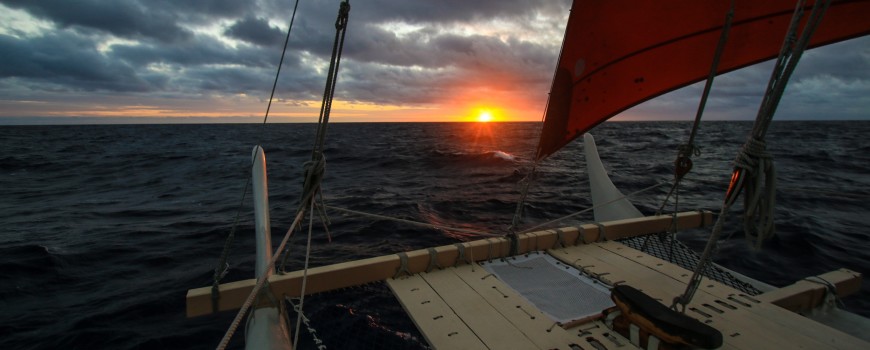
But now, let me tell you about the sounds.  The sounds are probably the most interesting. You can hear the steering blade fight against the restraining ropes that hold it in position and keep the canoe on course, creaking with the pressure against the waves. Often as I sit in the hull and write, I think about how much you can actually tell about the vessel speed and direction by the sound.  When we are going about 7 knots, you can hear the water rushing by as you rest in the hull.  The water sounds almost angry, moving with such speed that the hulls are actually humming on the small waves that the canoe surfs on. The sound of a flapping sail can give you direction; at least relative to the wind.  If the jib flaps uncontrollably it’s usually because the steersman has gone too high and the wind got around the back of the sail. When the wind howls, you can hear the waves breaking around the canoe.

IMG_9035

All of these descriptions I offer to you, faithful readers, to help bring you one step closer to standing on the deck of the canoe.  This is about life on the edge of what is possible, a 60-foot canoe and a dedicated crew that sail in the wake of the ancestors.  Some of what we learn on this journey can only be learned out on the ocean, living like those that came so many generations before us. So rather than complain about the scorching sun or the cold wind or the bleeding feet, we are thankful to feel that sun, wind and tender skin, because it shows us that we are alive, and present in this space of this journey.  

And it makes all the ice cream, cold drinks, and dry socks that much better when we get to port.
SB 71
Nāʻālehu


Please help keep us sailing for future generations. All contributions make a difference for our voyage. Mahalo nui loa!

Continue Reading

Photovoices: Indonesia

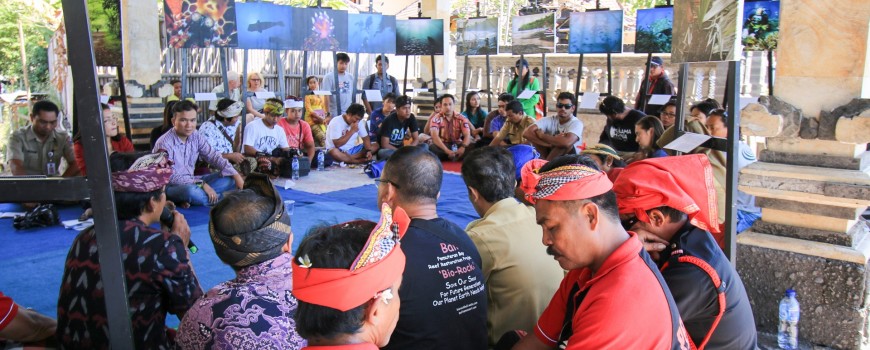
Worldwide Voyage crewmembers visited the small fishing village of Amed along the eastern shore of Bali to learn how community members are protecting their natural resources through photography amid an influx of tourism.

“Our foundation, Lensa Masyarakat Nusantara, strengthens and mentors the community. One way is through photography. They are documenting important things such as the development of tourism in their area as well as the social-economic condition,” said Saraswati Sangayu, Indonesia Program Coordinator of Photovoices Indonesia.

IMG_4000

“For us, this photography program, Photovoices, really helps. In our culture, it is difficult to convey a meaning through words. By not saying much, but by showing through photos, people will have a better understanding the situation that we are trying to convey,” said Made Wektu, a community member and photographer.

IMG_4060

“In a place like Indonesia, where we don’t speak the language, sometimes things get lost in translation. And so when you see beautiful images of pristine coral reefs juxtaposed with plastic bags in the ocean or a major flooding event, it’ll grab the eyes of the tourist or someone who doesn’t quite connect with a place, or even locals who never realized those issues before. And that starts the conversation,” said Worldwide Voyage crewmember Jenna Ishii.

IMG_4041

“From the process they are able to map out important things such as economic potential, which can be developed in the future and about the environmental impacts, which may come out of tourism. These are interesting points that are starting to be documented which the community can work on together for the future,” said Saraswati.

“Through taking many pictures, it enabled me to see my environmental conditions. It enabled me to focus on the small details in my environment. Things that require improvement, or the good things that can be shown to the public to see what’s bad, what’s lacking, what’s being destroyed and what needs improvement. It enabled us to convey those messages better,” said Made.

IMG_4031

“Today we have an amazing opportunity to bring together, traditional fishermen, the government, some NGOs and even photographers who are coming together for the first time welcoming us as guest to share with us how they deal with some of the major issues that we all deal with in ocean protection,” said Jenna.

“Having the community producing their own photos means information and material for community partners that are working in conservation. The community now has an equal position rather than being objects to be interviewed since they can create their own information. “These are my photos, this is my situation, and I am thinking to do something in the future about this condition” said Saraswati.

IMG_3981

“My initial understanding was that a camera is used only to take pictures; there was nothing more to it than that. But after the photos I took were printed and displayed, it enabled me to see the power of my photos,” said Made.

“When we look at these photos, it’s like looking back to what used to be , what is currently happening, and what can be done for the future,” said Saraswati.

“I feel like everything is easier through photos. If we look a
t things only with our eyes, the attention is dispersed and lacks focus. But through the camera, we see things clearly,” said Made.


Please help keep us sailing for future generations. All contributions make a difference for our voyage. Mahalo nui loa!