Crew Blog | Nāʻālehu Anthony: Reflections from the Leg 14 Crew

The Indian Ocean is a different place, the crossing strange and unfamiliar – the sea life was not as plentiful, and the weather changed faster in intensity and cloud cover than most of the other places this canoe has travelled. A month into the voyage, and still the fluctuations of the Ocean continued to awe and surprise us.   That the unpredictability became the most predictable feature of this leg voyage in itself says a lot.

IMG_9023

Before we leave Hōkūleʻa – our island home in the middle of the sea for the past month – and the beautiful island of Mauritius, to return to our home islands, we want to share a list put together by the crew titled: How you can tell you have a great crew on Hōkūleʻa. Some of the entries might be a little repetitive in manaʻo, but we wanted to make sure that all on board had an opportunity to share and contribute. These 20 are just the start of what describes the way that crews collaborate and become one, a beginning peek at the way we interact with one another in any type of situation.  It’s a great reminder just how well we can all live together if we share common goals and respect each other.  That collective spirit is summed up in number 12 on the list, not just because of what it says but because of who said it – one of our Japan nationals on board offered that as his contribution to the list.

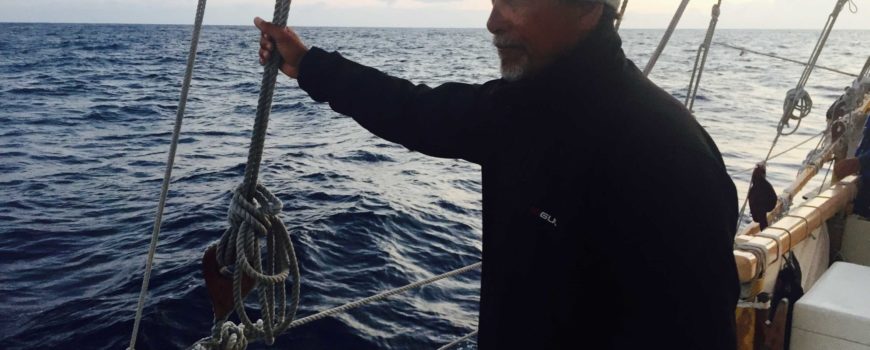
He can feel the ancestors around us too.
SB 71
Nā’ālehu

IMG_9035

How you can tell you have a great crew on Hōkūle’a:

  1. There are no “perfect crews” as all have their follies. But the great crews all come together with a collective set of skills that can accomplish any task given to them on board.
  2. Each member of the crew fights for the privilege to do the dishes after every meal.
  3. Everyone shows up whenever there is a sail change, and they don’t all head for the sheet lines.
  4. No matter how many times you sail on Hōkūleʻa there’s always someone here to learn from.
  5. A quiet confidence builds as we sail.
  6. The crew knows how to enjoy a moment without any sound except for what nature provides as the soundtrack.
  7. There is a total respect and confidence for our captain and navigator.
  8. You never have to ask to be relieved in your steering.
  9. People are anticipatory in their actions. Common tasks “just happen” without anyone having to say anything.
  10. Everyone subscribes to the collective goal – finding land.
  11. Everyone has a servant’s heart and mind.
  12. Everyone comes into this with the respect and perspective from the ancestors.
  13. Crew holds their watches in a professional manner and tries to improve their skills every day.
  14. Crew are good at talking story; it builds the team and camaraderie
  15. The Chef is excellent
  16. A’ohe hana nui ke ‘alu ‘ia
  17. There’s no stress in all the operations.
  18. There is a respect for everyone’s space.
  19. The crew is a cheerful one
  20. There is a recognition that the crew has similarities and differences, and there is a mutual respect for both.

Please help keep us sailing for future generations. All contributions make a difference for our voyage. Mahalo nui loa!
Continue Reading

Hōkūleʻa Update | September 14, 2015

Aloha and good morning from beautiful Mauritius, an island in the middle of the Indian Ocean. This is Bruce Blankenfeld on board Hōkūleʻa. We spotted the lights of Mauritius last night around 8pm or 9pm. The weather was really lousy for the last two or three days out here as we were trying to find the island and shifting all over the place. The weather would get weak, strengthen a little, pushing us south, cloudy. But we had fun. So this is the last day of sailing on this voyage across the Indian Ocean. The crew is healthy and doing well. The waʻa kaulua ʻo Hōkūleʻa is doing well, she’s healthy also. And our companion vessel the Gershon II and her crew are also doing fine. So thank you for following us, and now we are getting ready to transition and turn over the canoe to the next leg where they will leave Mauritius in the latter part of September or early October, depending on weather, and head off to Capetown, South Africa. So please keep following us on Hokulea.com. Aloha.

20150914_Tracking Map


Please help keep us sailing for future generations. All contributions make a difference for our voyage. Mahalo nui loa!

Continue Reading

Hōkūleʻa Update | September 13, 2015

Aloha all,

Patience.  That’s the word of the day.

This morning at 2 am when we came up for watch Hōkūleʻa was still steering herself.  We knew we were south of our course line from the time we left Rodrigues a couple of days ago, as the weather has forced us to have to steer in less than favorable directions.  

Before dawn our whole watch started looking for signs of an island, mainly the glow of lights in the black of night. To the north, there seemed to be some light deep on the horizon but it was too faint to call.  We watched it, but could not make a determination as to whether it was an actual target or just something lighter in the weather in that portion of the horizon.   Bruce marked it as something of interest, but did not head towards it, mainly because the wind was now coming out of that general direction.

IMG_0231

We sailed into sunrise, a time of the day that can show islands on the horizon.   Nothing.   We did not see any shadows or other sign of something disrupting the light pouring through the horizon.  We sailed on, albeit slowly.  The morning hours brought everyone on the deck, scanning, searching the horizon for anything that might point to a land target.  In the early morning we saw land birds coming from the north looking for food, a really Important clue in looking for land.  We also knew we were south of the target because of the way we had to steer and sail with the wind and weather.  We were within the range of potentially being able to sight something but we didn’t know how far south we might be. The biggest challenge is that we wanted to get more north but could not, as the wind was coming from that direction.  

SubstandardFullSizeRender-4

The hours from after breakfast through late afternoon were a blur.   We tacked trying to climb north, which barely worked.  Lots of searching, lots of hot weather, very little wind.  At some point in the early afternoon, it became clear that even if we saw the island right at that moment, we would still not make it into port today.   Forecasts called for rain and thundershowers, so that was on our minds as well as we watched the clouds start to fill in in the south and west.

SubstandardFullSizeRender-3

In the late afternoon, the wind all but died and we had a choice to make.  We could sit and wait, pushing the arrival out at least another day; or we could take a tow and set the direction we want to go. In this day and age, voyaging in this way, one of the largest challenges we face is one of logistics.  Decisions have to also be based on things like moving crew in and out of ports, the time available to complete the ton of work needed to make the canoe ready for the next long haul towards Capetown… and there are potentially bad storms coming our way.  

SubstandardFullSizeRender

We took the tow from our escort boat Gershon II, asking her to take us farther north to see if that early morning light was something.  We towed north west for a couple of hours as the weather started to roll in.   Clouds built a pretty hard line of thick soup on the horizon. The sun was obscured, we couldn’t even see it setting.   The crew scanned the horizon, looking, getting impatient, maybe even worried.

How is it that 2000 miles of sailing gave up the landmass so easily just days ago, yet this 300 mile jog is being so difficult? Hōkūleʻa was sailing so beautiful last night and yet not even the mana of Hōkū can sail with no wind.   The weather is the weather.

SubstandardFullSizeRender-7

I was on the steering sweep as darkness started to creep in, scanning the socked in horizon like many others, still no way for the sun to tell us she had set.  I was looking at this dark cloud, thinking it was just another one of a series of clouds in this area at my 2:30.  But the more I looked, the more this mass seemed to have a sharp set of edges. I called out for everyone to look in that direction on the horizon to see what that mass was.   Tomo scanned, I pointed.  Was it a ship? Was it the island? Whatever it was, it now showed a stack of hard edges.  

But darkness came quick, too quick to make a positive ID.  In the darkness, rain squalls now encompass our universe, the window of great weather now closed.

We still aren’t sure if it is the island, potentially somewhere to our northeast.  The rest of you probably know just by taking one look at our tracking map.  But the 11 of us in this bubble of limited technology, we’re here in the rain and the dark, waiting for the visual confirmation that may not come til morning light.   

Either way it’s a lesson in patience.   

Until then mahalo to you all for following along with our crew on board Hōkūleʻa, almost to the island of Mauritius.   

More soon,
SB 71
Nā’ālehu


Please help keep us sailing for future generations. All contributions make a difference for our voyage. Mahalo nui loa!
Continue Reading

Crew Blog | Nāʻālehu Anthony: The Mana of Hōkūleʻa

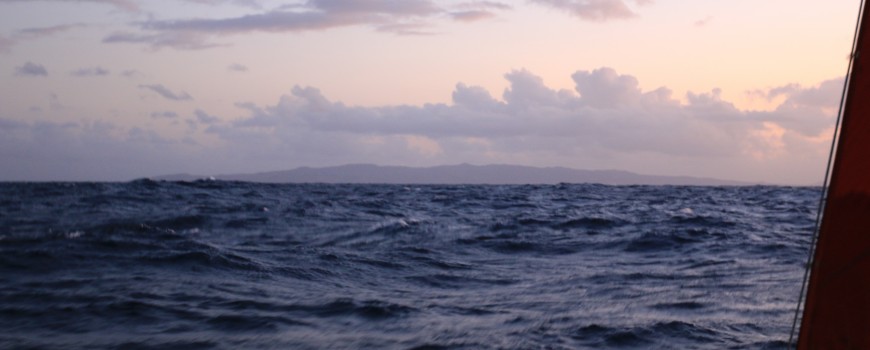
Itʻs sunset.  We have about 100 miles to go, thinking we’ll be sighting Mauritius by morning, bringing this segment of the Worldwide Voyage to a close.  For reference, we have recalibrated the number of miles traveled on course since sighting Rodrigues – sighting land allows the navigator to use this as a known waypoint, allowing him to clear all the previous voyage data from his calculations.  So in effect, today was a whole new leg of the voyage, 300 miles from Rodrigues to Mauritius.

IMG_9016

We’re blessed with hōʻailona – signs – that tell us that Hōkūleʻa wants us to find the island we seek in the old way, without any aid from the “stuff” from the Western world.  We have worked hard to get this far, some 3,300 miles across an ocean that has not seen a vessel like this in centuries. For the first time in the last 28 days, the sweep is down, meaning no one is steering the canoe – we did our work to trim the sails, but it is clear that Hōkūleʻa knows the way. She sails her course, Noio Hoʻolua on the star compass; the star directly in front of us is Arcturus, our beloved Hōkūleʻa. Again, she knows the way.  

IMG_9062

Everyone expected for the wind to lighten today.  We saw at sunrise, as the she pushed through the gray into a brilliant set of red fingers stretching through to the heavens, that the wind would turn variable waiting for the dominant system to fill in. We too searched for a straight path; we put up our big sails and kept at it all day taking any wind we could find.

Around 5 pm the wind diminished; the bubbles next to the canoe suggested we might be even sailing backwards.  We called for a tow to carry us on, as we know that there are timetables to keep, expectations to be met. But still, we took our time to get our sails closed and the tow bridle out of storage, waiting for a sign… And there, stretched across the sky from one end to the other, anuenue – a rainbow. The wind scratched the surface of the water, the sails puffed.  Bruce cancelled the tow for the moment, waiting to see what might happen, to see if our fortunes would change.  The warmer North Easterly winds gripped the sails, lifting us – lifting too our hopes that we would have the opportunity to close out this land sighting without the aid of anything but what nature provides, in the way of the ancestors.  The sails filled with the exact wind we needed to set our course, the steering became lighter and lighter, until finally we put the blade down and she held the course through the last moments of the day.

IMG_3001

The sun set in a flash of green, and the wind grew in intensity. We let her run – sailing on her own, carrying us through that beautiful time, as the last glow of the sun gave way to the jewels of the night.  The star Hōkūle’a appeared to the front of the bow, to guide us our last night.  That familiar hook is still above us and the cross is spinning slowly along side of us, but it is Hōkūle’a here with us tonight that makes this such a special closing to an amazing journey.  

The mana of this canoe is undeniable. She sparked a cultural revolution, she reconnected the great nation of Polynesia, and she raised a proud generation of people who will never, ever, be lost again.

As always,
SB 71
Nāʻālehu


Please help keep us sailing for future generations. All contributions make a difference for our voyage. Mahalo nui loa!

Continue Reading

Hōkūleʻa Update | September 10, 2015

Aloha, this is Bruce Blankenfeld from the deck of Hōkūleʻa in the Indian Ocean. Right now is close to the end of Day 13 on our voyage from Cocos Keeling Island to Mauritius. Just a few hours ago, we sighted the island of Rodrigues, which is a waypoint on the way to Mauritius. It was 1,940 miles from Cocos Keeling to this point. Part of the significance of today at this point in time is that one of the key messages of the Worldwide Voyage is culture and celebrating native wisdom. Hōkūleʻa, from the onset, sought to rediscover traditional Pacific Island navigation. As we all well know through the generosity of sharing knowledge, Mau Piailug became our teacher. So to carry that on, we honor him and we honor all ancestors who were part of living the culture. But this landfall also represents everything on this voyage that started more than six years ago when we were getting ready for the Worldwide Voyage. But this has been part and parcel of everything that has gone on prior to this, all the other landfalls in Tahiti being the first one to this one. A big part of it, of course, is a very good, trained crew and the belief in what their contributions to this effort is. It’s something special. So from here we have 300 or so miles to Mauritius, our final destination for this leg. Thank you for all of your support, belief in what we do, and keep following us on Hokulea.com. Aloha!


Aloha e nā hoa,

The big news for today is that at about 645 PM Hōkūleʻa Standard Time, crewmember Kealoha Hoe sighted the island of Rodrigues to the South of us, the small isolated target that Captain and navigator Bruce Blankenfeld guided his Leg 14 crew and Hōkūleʻa to.

This came after sailing 13 days and 1,940 miles unaided by modern instruments. This crew only used what was available to us as observational clues in nature – stars, wind, waves and other elements that the navigator could read. Led by Bruce, the rest of us 10 crewmembers worked hard and diligently throughout the near 2 weeks to be able to sum each of those days into a course that led us to the island today. This brings this legs total miles to about 3,000 since leaving Bali 26 days ago.

The most difficult part of this task was the almost 4 days of near 100% cloud cover, that, at times, obscured even the sun and the moon from view.  This made for a good lesson in steering by the wind; in Captain Bruce’s words, even the wind “still allowed us to be confident in the course and speed during that time.” This confidence is critical to the process of deep ocean crossing, as each mile is built on the previous to equal the whole, both physically and on the course line held in the navigator’s head – every decision made in changing course, in estimating speed, they sum to the crossing.  Bruce has an uncanny way of estimating speed with great accuracy, and is at a point in his navigational career where his internal sense of direction is apparent.  He is constantly checking direction, not only those times when we see him measure stars for orientation, but also by feel, even when he is sitting on the deck in the middle of conversation.  I heard him more than once pause mid-sentence and say to the steersman, “you gotta come up” –  which translates to “let the canoe sail up into the wind” – and then jump right back in to the conversation.  Direction, speed, course line – these are all part of his constantly running internal mechanisms, honed after decades of training.

There was no cheering today when land was sighted, just some tears and a quiet moment to thank the generations upon generations of people who practiced this craft in order to keep navigation alive to this day.  Even though we have about 300 more miles to go, everyone recognized that the time we have here on this little floating island, with this waʻa family, will be over soon.  Yes, we have jobs and family to get back to. And a whole world of obligations beyond this little waʻa world, which for me at least, I see lingering just on the other side of this email inbox on a daily basis.  But for now, for the past 26 days and the handful of days left, we have also come to know Hōkūleʻa as our home. For those of us who have sailed on this canoe before, the feeling is familiar; we settle in to her rhythm, and she accepts us.  For those who are new, they will feel a longing to come back the minute they step on to the dock to head back to the place they called home before this journey… perhaps that is part of what gives Hōkūleʻa her incredible mana, that we all leave a piece of our hearts here with her when our time with her is over.  I suspect it has been this way since voyaging started, worlds split in two as we headed out into the unknown, trying to make better sense of the world we left behind, searching for new islands in the sea of our futures; living for a time in this little waʻa world in the middle of the deep blue, sailing in a sea of endless possibility.

On behalf of the entire Leg 14 crew – captain and navigator Bruce, watch captains Wally, Kealoha, and Kimo, and crewmembers Tomo, Kazu, Craig, Gary, Kalei, Kaina and myself, thank you all for coming on this voyage with us and helping to make these thousands of miles well worth it.  Please stay tuned for more as we near Mauritius, our next port stop.

Naʻu me ka haʻahaʻa,
Still SB71
Nāʻālehu


Please help keep us sailing for future generations. All contributions make a difference for our voyage. Mahalo nui loa!

Continue Reading

Hōkūleʻa Update | September 9, 2015

Aloha all,

This will be a short update tonight. 

It’s Day 25 of Leg 14 of the Worldwide Voyage, and we approximate we are a little over 1800 miles in on the course line from Mauritius, which means just about 500 miles left to go.  We’re still several miles off our plotted course line, but are taking the wind shifts as an opportunity to make some of that up.  Last night, for example, we sailed a house higher than our course line to do just that.

IMG_8439

Captain Bruce has compressed the watches into 6 hours each at night – this means instead of 2-6, 6-10 and 10-2, we are now on 12-6 and 6-12. The swell and wind have been up – big swells of 20+ feet rolling by us, and bursts of 25+ knots for the wind.  We’re currently using all three sweeps for steering, as the big water sloshes us around.  We made good progress today, even with the conservative sail set we’re currently running.  We were still going too fast with the storm sails, so we are now running just the mizzen storm sail with a 70 square-foot mizzen staysail and a 60 square-foot jib. With that sail set, and the now moderate seas, we’re able to hold at a steady 5.5 knots that puts us closer to our escort.

IMG_8491

Everyone is in good health and well fed.  We went back to the basics tonight – miso saimin and spam musubi. Garnish included dried shrimp, spam, tofu and vienna sausage. The hot meal did everyone good, and all those not on watch are resting.

Stars are up and the night shift is settling into the groove as we transition into the next watch.  Mahalo to you all for following, we’ll have more tomorrow as the weather starts to diminish a bit and everything settles down.

Standing by, as always, channel 71.

Nāʻālehu


Please help keep us sailing for future generations. All contributions make a difference for our voyage. Mahalo nui loa!

Continue Reading

Hōkūleʻa Navigation Update | September 6, 2015

Aloha, this is Bruce Blankenfeld from the deck of Hōkūleʻa on the Indian Ocean. This is our update for Sunday, September 6th 2015. Here is our estimated position in the Indian Ocean: from a reference course that started in Cocos Keeling our last stop, all the way to Mauritius, our destination. We had a reference course of Lā Kona or 11 and a quarter degrees south of west. Based on our estimates, we’re 1,387 miles along the reference course, but about 49 miles south of it, based on the winds that we’re getting. Our biggest challenge now is changing weather. The last three nights have been 100% overcast, so for the most part, we’re steering by the wind and the swells. But the swells have been hard to read so mostly by the wind. In the morning, we’ve been seeing some wind shifts. So it forced us to recalculate and estimate, but we feel we’re doing well. So with the estimate of 1,387 miles, we’re less than 1,000 miles from our destination. Currently doing really well, we got the wind out of the south a little bit and so it’s going to be another night of sailing by the wind, unless we’re blessed with a few stars. So that’s our challenge and our crew is doing exceptionally well, they’ve been really focused and steering well, all throughout the day and throughout the night, when they’re on watch. That’s been a huge benefit to the voyage and our effort. So just want to thank you guys for following us on Hokulea.com Mahalo nui!


Please help keep us sailing for future generations. All contributions make a difference for our voyage. Mahalo nui loa!

Crew Blog | Craig Thomas: Attuning Ourselves to Nature

Life on Hōkūleʻa is unlike any other I have ever imagined.  Splashing along at 6 knots through the bumpy and lumpy Indian Ocean, this 12 ft wide and 42 ft long open deck is our entire community.  Our escort vessel Gershon II in the distance, a far-off plane, and occasional floating debris are our only signs that we aren’t the only humans on the planet. But we aren’t alone – all around us the ocean and sky embrace us.

IMG_7447

Though we may be isolated from other people, we do have our fair share of visitors.  Malolo (flying fish) and muheʻe (squid) fly onto our deck, occasionally hitting us mid-flight; some days, mahimahi take our lure in time for dinner. Dark ʻuaʻu kani (shearwaters) skim just above the waves in small flocks, and koaʻe kea (white-tailed tropic birds) circle the mast overhead. They appear to be discussing Hōkūleʻa’s presence in foreign waters.

We’ve become attuned to the subtle variations in our physical surroundings. Wind strength and direction cause the sea to become rougher, and call to us to change our sails. Distant storms, south of Africa, produce huge swells that are indifferent to local wind and waves – I’m glad I’m not sailing where these mighty waves were born. Rain squalls pass through, causing temporarily gusty winds, teasing us with the possibility of the freshwater showers we all look forward to.

IMG_7628

Night has its own rhythms. On clear nights, we steer by the stars as they rise in the east and arc through the sky. Each hour of the night has different prominent stars and constellations, including the Magellanic Clouds, the Milky Way and the namesake of our voyaging canoe, Hōkūleʻa. Satellites, shooting stars and what might have been a comet enliven the night sky. Some nights, bioluminescent organisms in the inky water cause our shimmering wake to glow blue-green, and the white caps to look ghostly.  On full moon nights, only the brightest stars are visible and whitecaps gleam brightly; the ocean, sky and canoe are a complex vision of silver and gray, like an Ansel Adams photo. Sail changes are far easier on these nights, but part of me misses the dark sky and glowing water.

Overnight the wind lightened, sea smoothed, and we opened more sail – the rhythm has changed, bringing with it the excitement of new sights and sounds.  The wonders of this voyage never cease to amaze.  


Please help keep us sailing for future generations. All contributions make a difference for our voyage. Mahalo nui loa!