Borobudur Temple: Images of Reconnection

“Walking up and seeing this massive temple just slowly rise out of the earth as you’re coming up the hill, and then to find out that it’s two million separate blocks of stone that were put together to hold this temple together, and you find out that it was made in the eighth century and that over the last forty years, there’s this massive effort to rebuild it. It was something that unlike anything I had ever seen before,” said Worldwide Voyage crewmember Nāʻālehu Anthony.

IMG_4802

“The panels of Borobudur are largely from the stories in the Holy Book of Buddha, and they reflect the living conditions of the time. We believe that the stories from the Holy Book depicted on the reliefs also reflect the actual conditions during the time of carving. We know that Nusantara is largely composed of sea or water, and we believe that boats are the means of connecting between the islands,” said Iskandar Siregar, the Head of the Conservation Service Section at Borobudur Temple.

“The ships are embedded in these long plates of all these different things, and they’re really documentation of what happened. In all of the carvings, there are these expressions of these different emotions. There’s these different interactions that are happening. What was so striking about it was that these people on the ships were still wrought with emotion. You could see the fear in some of the people’s eyes. You could see, in some cases, their elation. You could see their ability to almost be a reflection of the emotions that I’ve seen while sailing on board Hōkūleʻa. And this is in these stone carvings that are over one thousand years old. There’s still this emotion packed into these faces.

IMG_4470

“And the mast and the sails are clearly laid out. It doesn’t necessarily look like a canoe; it looks like a ship. But the pieces that are there are all intact. There’s a mast, there’s sails, there’s a keel, there’s a tiller or a stearing blade. They had taken those carvings and actually lifted plans for an actual ship to actually voyage somewhere. But it would be built in and around that idea that this is from this very old model, and for us that sounded a lot like what would have happened with Hōkūleʻa in the 1970s,” said Nā’ālehu.

IMG_4721

“The Samudra Raksa ship is very interesting. Inspired from the reliefs in Borobudur, it was manifested in the form of a ship replica named Samudra Raksa. From a long discussion during President Megawati’s time, there was a desire to give pride to the nation, that we were able to do that in the past and we can do this now too,” said Iskandar.

“Part of this rebuilding of the temple and wanting to build an actual ship rather than just stare at the one that’s a relief carving in the temple is the same thing that Hawaiians and Polynesians wanted to do back in the 70s with the creation of these canoes. That whatever the modern anthropological thought that had become our reflection for us, we needed to create it and recreate it for ourselves so that we knew the truth of what it was–and it was very clear that the intent for the building of the ship was the same thing. You have this group of people who maybe didn’t know all the answers and didn’t know if this was actually going to be possible. But they did it anyway, and they did it in a way and retraced a route that gave them, certainly pride. Probably more than that being this immense amount of realization that brought more than just that ship relief carving to life, but just that whole temple to life,” said Nāʻālehu.

IMG_4716

“We sailed the ship all the way to Madagascar and stopped at several ports. We had several meetings with those in the localities and we found similar cultures from the languages, the agriculture, and the food. We found many similarities,” said Iskandar.

“It’s well within the realm of knowledge that these guys went on these journeys, and they did it a thousand years before all these other things that make voyaging easier–we have this luxury of having that they didn’t have. And more importantly they had the wisdom and the skill to do so,” said Nāʻālehu.

“Borobudur is very important. It is a symbol of the greatness of our past. We should continue to preserve and maintain what our ancestors left us. We should reconstruct and renovate,” said Iskandar.

“There are those who see it as this life-work to make sure that this temple is in as good condition as it can be to pass it down for the next and the next. And that it’s not something that’s static that you’re done and you leave it and it goes down to the next, but it’s actually something that you have to engage in and that you have to mālama through time,” said Nāʻālehu.

IMG_4849

“I feel like I was born in Borobudur, even more so because this is a legacy from our ancestors, and I feel a calling to return. I often sit alone thinking, observing the reliefs or the carvings, and I often say quietly to myself our ancestors then were not like we are now. What I mean is that back then, things were not as advanced as it is now. Yet how were they able to carve like this? How did they do it? What were the tools they used? I am amazed at our ancestors who were already as smart to do these,” said Werdi, a master mason who is restoring Borobudur.

“We say that in the Pacific, we’re sailing in the wake of ancestors. All of these migratory paths had been well-traveled between all these Pacific Islands, but I feel like because of this story and because of this quick visit to this temple, we are also sailing in the wake of their ancestors, and that gives me comfort,” said Nā’ālehu.


Please help keep us sailing for future generations. All contributions make a difference for our voyage. Mahalo nui loa!
Crew Blog | Nā’ālehu Anthony: A Day in the Life

“Whatʻs it like to live on the canoe?”

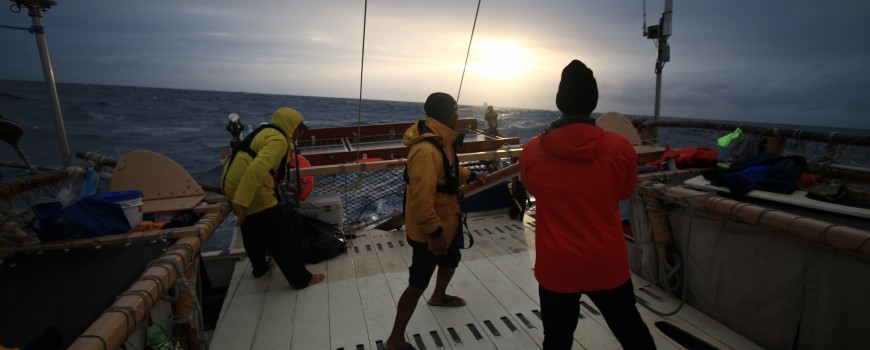
We often hear this question from people we meet, in port, at home, and now over video and satellite phone calls with students around the world.   Everyone has a hard time imagining when we explain our watch system, what we do on- and off-watch, and the rhythm of daily life on the canoe.  Today I share with you what today was like, a typical day on the canoe where every day is the same and yet completely different than the day before.

IMG_7499

WAKING UP

“Time to get up, your watch.”

Itʻs somewhere around 2 a.m. I guess, but this time of day is a fog of dream blending with reality.  (The last long leg I sailed, I came up for watch after hearing the same call, only to find that I had dreamt it and was two hours early on deck.)  I unclip my Patagonia jacket and pants from the line strung through my bunk, contemplating the act of getting up and out, reluctant to leave the relative dryness and warmth of my bunk.  Itʻs only a 4 hour watch, how tough can it be, right?  I only laid down to rest 3 hour ago, but 4 hours doesnʻt seem that long… until I crawl up out of my bunk.

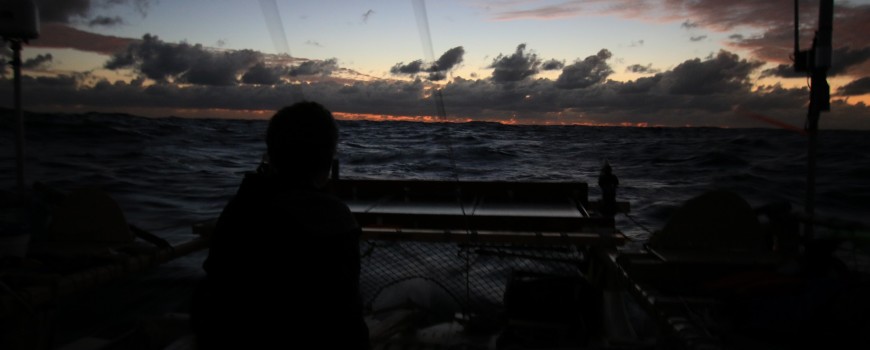
The cobalt blue sea is roaring, unfriendly, sending mists and spray to meet me, brought on by waves breaking all around us.   Weʻre pushing along at 7+ knots, with a 20 knot wind making the mast howl a little.  The moon lights the sky enough to give some bearing of whatʻs around me as I cross the deck, but not enough to break through the thick clouds that blanket the sky.

A.M. WATCH

The first question I ask the 10-2 watch captain is  “What you steering with?”  His response?  ”Wind and swell brah, gonna be a long one.” Great, I think, no stars and moon.  The next 5 hours brought more of the same – steering the canoe to keep her in the trough as we scooted along, avoiding really big swells; not one usable star visible, no moon either, and when the sun rose we did not get a good look at her until about 9am.  

This is one of the hardest parts of voyaging.  Our success and failure hangs in the decision made in the dark at 3 am, dead tired.  Too much deviation from our course, which may literally goes unseen and therefore uncalculated on a night like this, can put us outside of our range of target to find the island. 15 days of good steering could get blown on a night like tonight. Luckily, we are all aware of this, and do our best to be present and not let the mind wander – we are constantly looking for clues that can solidify our direction.

IMG_7525

OFF WATCH – DAY TIME

By 7am, I was off the watch, shooting as much of this confused sea and horizon as time would allow. By 7:30, itʻs time to open that Pandora’s box – this laptop – which pulls me back into this other reality that is so distanced from the one around me; a dozen logistics emails from three different committees dealing with the Voyage, all answering and asking the myriad of questions that keeps it all moving, urgent in tone else it would not be sent to us out here to contemplate and try to assess from the middle of the unpredictable sea. The staff for this Worldwide Voyage are some of the most committed people I know – some of them even match our sleep schedules to catch us between watches, when we can talk on the sat phone for a few precious and expensive minutes to clarify logistics and rapid-fire answers.  Moorings, provisions, clean water, places for hot, fresh-water showers, transportation, and flights to switch crews – all arranged for ports we have never visited before, managed from desks and computers at home in Hawaii. Without the work of this support team at home, this voyage could not happen.  

By 8am, all of the emails have to be answered, and the real test of all of the communications gear begins.  It rests on the availability of bandwidth, 1000 miles from the nearest land, out in the middle very lumpy Indian Ocean. Jenna and Miki from our Education Team coordinated a live video conference via Google Hangout with a school in Japan for our apprentice navigator, Tomo – which requires aligning 3 different time zones, school schedules, and canoe daylight hours.  At 8 am, I begin testing the video connection – holding my breath in that precarious moment where we wait for the signal to go through. The thick cloud cover and looming rain clouds can have an effect on the satellite signal as well.  After a few tense moments the window pops up, and Bryson greets me from ‘Ōiwi TV, where he coordinates the daily communications flow from the canoe.  Bryson patches us in to the video call, which is being moderated by Miyako and Tamiko, both native Japanese speakers and sailors, who are standing by to help host but also to step in and answer questions if our video connection fails.  

IMG_8168

Because many of these schools only have one shot to talk to the crew, our teams work really hard to make sure they have a quality experience with live crewmembers, even if the canoe connection fails.  But this time – the connection is strong and clear; Tomo has a great time talking to the kids, bringing Captain Bruce in for a few questions as well. This is the single coolest thing we have been able to do with the technological leaps we have made on recent legs– bringing a group of kids to the canoe, live, to hear the excitement and see the smiling face of one of their own, sailing across the vast Ocean.  Tomo brought the reality of the canoe to them, even if less than an hour, to “set the hook”, as our mentors would say.  They will certainly follow the voyage, and learn how people around the world are both amazingly different and shockingly similar.

IMG_7719

After the video call, I typed this, desperately trying to get ahead in this essay before my mind shuts down and forces me to sleep, surrounded by the smells of Garyʻs amazing creations. As Gary finished preparing the meal, he began thinking about what he needed for the coming days – it turns out the food for tomorrow is in my part of the hull under my bunk.  I have to unpack the bed, fold it over, open the hatch, remove all my equipment piled up to the top of the hatch and get 4 green provision boxes labeled 29A, 29B, 30A and 30B. This will be all the food for us the next two days.  I repack everything in the reverse order and take the opportunity to grab a few snacks out of my dry bag – the dehydrated bananas, a gift from an aunty who lovingly prepares each batch, are now famous and immediately consumed by the crew when I bring them up.  

The watch changed a while back, which signals only about four hours left before I have to be back on watch. Time to rest.

IMG_7743

P.M. WATCH

I get up to the howl of the wind, and pitch and yaw of waves tossing us about.  I feel so much better having slept a few hours. Watch is just starting, and we have the biggest gift of gifts – the sun has found the energy to push past the bleak, gray clouds and show herself.  Bruce sets the line, and asks me to spot for a few hours.  He, much more exhausted than I, can now sleep, knowing we can hold a straight course.  The next two hours are mostly overcast, but the sun is a frequent visitor and comfort;  more certainty about direction brings relief to all.  We have an uneventful afternoon watch with speeds of 6 and some times 7 kts as we push through. Gary comes up to make the dinner – fried rice with spam and tofu, a winner.  Our watch is always on at dinnertime, so the three of us –  Doc, myself and Wally, our watch captain – take turns eating while one of us steers.  Its always a battle of trying allow the others to eat first.  Tonight, Doc relents and gets off the steering sweep to allow me to steer while he eats first; I had to guilt him into it because he made me eat first yesterday.

IMG_7787

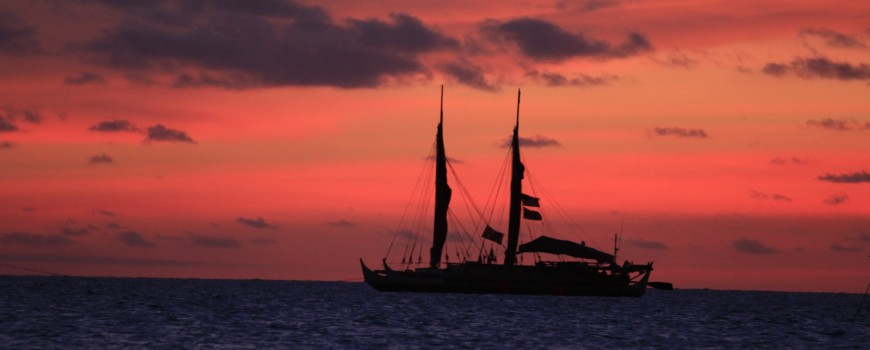
Watch finishes in a lackluster show of a non-sunset. The sun is unable to fight against the might of the clouds on the horizon, who stand firm and in solidarity, carrying in them the wealth of fresh water.  After checking for water in the hulls, we three are free to do what we like for the next 8 hours before our watch begins again at 2 am.

OFF WATCH – NIGHT TIME

My routine is pretty set now. Get off watch and try to shower before it gets too dark and cold.  Most days that’s a sound strategy. Directly after washing off all the sunscreen, I head back to clear email for the last time, begin to process the dayʻs shooting, finish off the to-do list from the boss (my role also includes administrative assistant duties to the Captain), and then finish this writing.  Tonight is a bit more complicated – its about to rain, so I’m writing this in my bunk which is relatively dry, but am constantly peeking over at the salt water swamp a mere 12 inches away from the computer. I push my leg out of the bunk to check for rain.  It’s not actively raining but itʻs waaay colder than it was 20 mins ago when I came in here. The wind is gusting, and big wind-born waves broadside us as we go, causing the hulls of this canoe to shudder in unison. The steering is hard, I can hear it.  The jib luffs as the wind clocks around us forward of the forward sail, losing foil and cracking about.  I’m certain the steersmen are pulling on the sweep to try to drive the canoe back down off the wind.

IMG_8184

And so the process goes. Our turn to battle the squalls and elements will now be here in 6 hours.  Time to end this day in the life story; closing with how thankful I am to be here. These raw elements are gifts – this canoe will not travel this path again in my lifetime, of that I am sure. We 11 have been gathered here, now, meant to share this gift with all of you through the methods we have access to. Today we were able to do it live via satellite; the pictures captured today will be avail on the web soon, and this writing, through the magic of the interwebs, will be waiting for you when you wake in your different time zones all over the world. And another more ancient method, the path that this canoe carves through the sea, is one that may easily be forgotten by the ocean and sky who witness us today, but will never be forgotten by the crew and those who follow us.  This canoe, this crew, and those still on board from time past, will reverberate this story and lessons learned here. And one day, many days from now, people will be back here, on a canoe – to sail in our wake, the wake of the ancestors. The journey continues.

Me ka ha’aha’a,
SB71
Nāʻālehu


Please help keep us sailing for future generations. All contributions make a difference for our voyage. Mahalo nui loa!

Crew Blog | Nā’ālehu Anthony: Rhythm

Is it day four or five since we left Cocos Keeling Island? I forget as the days start to blend. This is the way it’s supposed to be, I think. Our days are marked by our watch system that is in place 24/7. We stand watch for four hours with eight hours off in between. At sunrise or 6 a.m., the first watch comes up to stay on until 10 a.m., then the 10 a.m. to 2 p.m. watch steps in and finally the 2 p.m. to 6 p.m. comes up to stand guard as the sun goes to sleep and the canopy of stars opens. And in the night the same structure exists, 6 p.m. – 10 p.m., 10 p.m. – 2 a.m. and 2 a.m. – 6am.  Life goes on in this system for as many days as it takes for us to get “there,” wherever that destination may be.

IMG_7462

And so a rhythm develops. One has to sleep in a pattern defined by the watch they are on (I’m on the 2-6 watch; it’s the best one) and your watch also defines the work you want to get done.  Ironically, we’re not allowed wrist watches while on watch, so we only know what time it really is at sunrise and sunset. The rest of the time, the navigator calculates and calls when watches change. Some days we stand a little longer watch and other days it may be a bit shorter, but none of us mind the variation. We all feel privileged to be on board and allowed to participate in this Worldwide Voyage, all working in unison to reach our goal.

The first few days for me are always the hardest–my body is not used to the schedule, my mind is still trying to make sense of the all the movement on the horizon. I usually have to force myself to pick up a camera and shoot something, and it’s usually not very good. There is also the lack of being able to anticipate the movement of the canoe. Later everyone gets their “sea legs”, but I think its more than that–our bodies begin sensing and anticipating subtle changes in the movement of the canoe. That split second of anticipation allows some of us to counter the steering to minimize the correction that is needed as each swell passes. This is a very important thing to be able to do if you are going to steer in big seas for long periods of time. And that’s all we’ve had so far–pretty big seas, surfing this canoe all around. It’s tiring work, but it can be really fun as well.  The danger is turning too far in any direction: too far up and you stall, too far down and you can jibe and break stuff.

IMG_7488

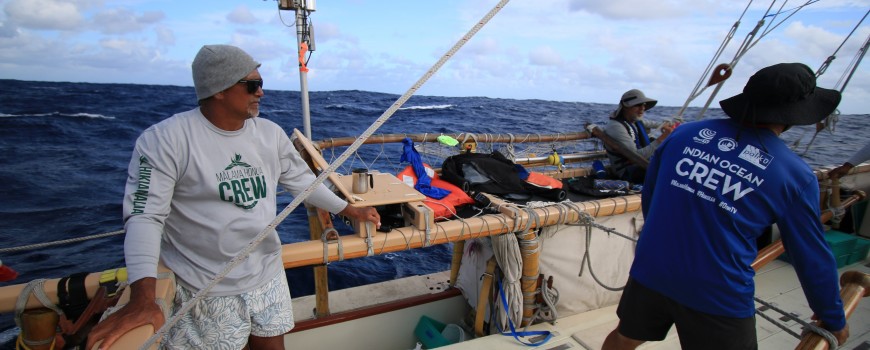
While on the watch, everything is canoe-centric. The three or four of us, led by a watch captain, are responsible for steering the canoe and addressing any and all issues that may come about while sailing.  The biggest thing at this point is making sail changes to adjust speed. We are tasked with keeping the two vessels (Hōkūleʻa and escort Gershon II) together. This is no easy task as both vessels have an entirely different set of sailing characteristics. Both the canoe and the monohull are in communications and collaboration to try to stay within 2 miles of each other at all times. Besides that, we make sure the hulls are dry and we bring up drinking water and dry goods for the day as needed.  But the hardest part about it is the steering when there are no visual clues except the swell and wind to steer by.  Sometimes the clouds are so thick that the sun is completely covered in the daytime, or the stars are covered at night.  In these circumstances, we have to keep the swells and/or wind position relative to the canoe the same while sailing along in big swells.  It takes a lot of time to be able to do that well–like years of sailing.  But those who do it well make it look effortless. Just a touch here and there keeps her going straight, anticipating the canoe movement before she gets too far off the mark.  That’s the rhythm that makes the work go easier; the connection to vessel stronger.

IMG_7525

We are lucky too that the weather is settling down as well.  Both Kanaloa and the canoe realizing that we still have about 1,700 miles to go on our journey, and rhythm for everyone’s sake is needed. That rhythm extending into the heavens exists too.  We come up at 2 a.m. every morning to meet who are now old friends: Orion on the horizon rising out of the sea behind us, and Sirius or A’a not far behind. Makali’i guards us to the North and Puana rising later below the belt of Orion. All of this is the rhythm of our night. Venus is now rising up astern in the morning right before sunrises too. This learned rhythm of the heavens, albeit many of us are novices, still allows us to anticipate where stars should be, even when clouds obscure them.  This allows us to imagine the placement of the others even when we can only see one or two in the region. All of these rhythmic clues point us in our direction: steady, holding just South of West for 1,700 more miles and another 6 degrees of latitude.

Me ka ha’aha’a,
SB71
Nāʻālehu


Please help keep us sailing for future generations. All contributions make a difference for our voyage. Mahalo nui loa!

Crew Blog | Nā’ālehu Anthony: Transformation

“Iʻm the best version of myself when Iʻm out here.”

Almost two decades ago, when I began voyaging, I first heard those words spoken by another.  So many times over the years, Iʻve reflected on how much Iʻve come to know and live that sentiment.

Tonight, I paused in typing to dim the computer screen and look up, seeing the stars appear out of the black of the night as my eyes adjusted.  We have good wind, a steady rhythm, and clear skies with a full canopy of stars from which to choose our guide – tonight, we follow Hikianalia, the namesake of our younger sister canoe, and sister star to Hōkūleʻa at our home latitude.  

IMG_7813

This simple act of looking up, letting myself adjust so I could actually see those markers in the heavens, hits a chord for me.  These same stars, some of which we can still call by their ancient names, were used by our ancestors to find their way.   Following in their wake, sailing Hōkūleʻa transforms us and our surroundings to something beyond time, something deeply connected to the wisdom of those who came before us.   Those who knew to live simply, in balance with nature, to care for each other.  As our ancestors transformed raw materials into voyaging canoes that could carry them safely for thousands of miles, we too are transformed by this vessel and what she represents.

To be sure, we are not as daring as the first to sail here were.  Our brave, tenacious ancestors sailed and settled the entire Pacific centuries before Europeans dared to leave the sight of land, using the wisdom and record they could read from the natural world to guide their travels over the greatest expanse of ocean known to man.  We sail today knowing that there is land out there bearing one house South of West, La Kona, for about 1500 more miles, because we study maps and other information to chart our intended course lines before we leave the dock.  We also sail with the aid of other modern materials, to keep us dry and warm, to keep us fed – perhaps our ancestors would have laughed at our softness, our need to hang on to some of the comforts of the modern.

IMG_7866

But I know for myself, I am transformed, becoming the best version of myself that I know.  As many of my fellow voyagers will agree, we are who we are today because of the long trips we have done, because of the act of voyaging.  The process that occurs on these long legs, the shedding of layer after layer of our everyday modern, hectic lives, like the skin that peels from us after exposure to sun, rain, and salt – it is humbling and frightening, as we are forced to reach into our inner unknown and look back at ourselves in a very real and honest way.  We become leaner, more attuned to what our body needs to survive and be strong, rather than the over-consumption and high calorie counts of fast-food and modern convenience.  Our senses begin to sync with the natural world, and we fall in rhythm with the movement of the heavens and the sea.

Perhaps one of the greatest gifts a voyage like this brings for someone like me is the gift of time to reflect.  At home, I’m constantly running at breakneck speed, trying to meet the demands of life, to fulfill all the responsibilities that never seem to relent.  And while some of this is by my design, much of it is set by the expectations and culture of our modern world – we live in the imbalance of what those who know me well hear me refer to as “what you gotta do versus what you wanna do.”

IMG_7991

Here, traveling at 7 knots, or just under 8 miles per hour, is about as fast as we want to go.  You can feel the canoe rocking gently, sails full, and crew happy.  Imagine traveling this slow in H-1 traffic as 6pm, as I do daily in my commute – itʻs painful, and fills our lives with anxiety and frustration.  Or the frustration of losing your phone for even an hour or two – out here, I went a couple of days before I even looked for my phone, and only because it is my camera with a lifeproof case for pictures in the pouring rain.  If not for the weather, that phone would probably still be in my bag, and stay there til we touch land again.  That phone which on land, at home, never leaves my side, even as I sleep.

Those of us who are selected to sail on these voyages are blessed in so many ways.  We are given the privilege to sail in the ways of the ancients, to bring the power and wisdom of our people into this modern age.  I cannot think of another place where I can practice Hawaiian culture with such intensity, such depth – me, who demands that those who work for me speak and live Hawaiian language and culture daily, I find my deepest engagement in my own practice out here, on the deck of Hōkūleʻa.  But perhaps the greatest gift Hōkūleʻa gives me is that she demands that I reassess my life, providing me the opportunity to stare deep and hard at all that limits my view plane at home, and think about the kind of person I want to be and the life I want to lead.  She has given me the opportunity of a lifetime – a brief moment in time where I am transported to a place where I have a real chance to fundamentally recalibrate, to change my ways.

The most difficult task I face on this voyage is not the screaming winds, the pelting rain, the scorching sun, or the confused seas and skies – the most difficult task I face on this voyage is letting myself be permanently transformed to the me I really want to be.

Aloha all,
SB71
Nā’ālehu


Please help keep us sailing for future generations. All contributions make a difference for our voyage. Mahalo nui loa!

Bali Green School

“We are looking at this issue about mālama honua, taking care of the earth, [and] we don’t fully know how to do that. That’s why we sail. We’re on this voyage of trying to find how to become those values. And so when you come to the Green School it’s one of those extraordinary moments in time in a particular place that helps you see it. That helps you see the possibilities and believe that you can make it happen,” said master navigator Nainoa Thompson.

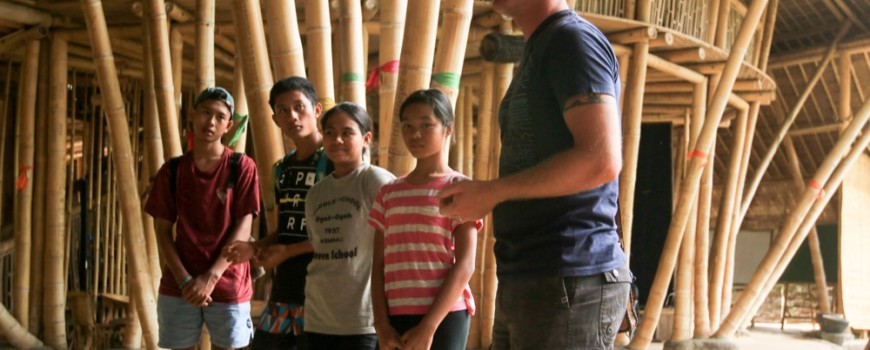
“The Green School sits kind of in the middle of Bali in Indonesia. Our school’s purpose is making our world sustainable,” said teacher Aaron Eden.

“We have people come to enroll their kids in school here from all over the planet not because we can guarantee their kids can get the best future and be able to go to the best universities. Rather we’re prepping these students with a new vision of more a sustainable lifestyle,” said Noan Fesnoux, a teacher at the Green School.

“Not having walls and having the air, the natural air flowing through and seeing the natural world around us, I think that thatʻs important and that it does help us make sure that when we’re learning things in a classroom that we realize that it has impact outside,” said Aaron.

“We can take the kids out of class without even having to open the door. You can be discussing metamorphosis and a butterfly floats into the room. Teaching in a really dynamic space like this, it is definitely non-linear and you find all of these incredible points where the kids become more engaged and more inspired by what’s around them,” said Noan.

“In normal schooling we hide the thinking process, our thinking process, our training process, and how we work together as adults and the relationship with the students is we give you directions and you follow them. If we want a sustainable world it’s not sustainable to teach people to only follow directions,” said Aaron.

“You need a place that helps children believe that they can really move and get to a future that they deserve by themselves. This is a school for leaders. This is a school for innovators. This is a school for the kind of future, the kind of thinking that we need today. So this place starts with dreams and it turns into realities, and it’s really that simple,” said Nainoa.


Please help keep us sailing for future generations. All contributions make a difference for our voyage. Mahalo nui loa!

Crew Blog | Nā’ālehu Anthony: Going Digital in the Analog Age

In the black of night, when we’re steering by the stars and counting the miles with bubbles racing by our speeding canoe, we are reminded how truly analog voyaging was for centuries. What we call “art” now, a bundle of sennit hanging on the wall or a woven piece of sail weaved to perfection, were all integral parts of a canoe. Ancient societies possessed all the technology necessary to create a vessel that could sail purposefully to other islands. Today, one could argue that our society is not as resourceful. The great trees are gone, along with many of the tradesmen and tradeswomen who knew how to build a canoe. Only a few who cling to the craft remain. So we sail on a hybrid vessel, a performance accurate replica of what most likely once was. She sails the same speed and points the same way her predecessors would have done more than 600 years ago. By the time PVS founders built their canoe in the 1970s, they had to use some modern materials to make it all go – fiberglass, Dacron, and a little plywood to fill the gaps of missing knowledge.  But the intent is still very much the same: using only the clues and observational tools that the ancients had, we raise islands from the sea thousands of miles from where we started.

IMG_7488

One thing that has stayed analog (until very recently) has been our communications structure.  In the old days, (circa 1970s) there wasn’t much to speak of in terms of communications equipment except for a single sideband radio that would be used only in emergencies. It remained that way for more than a generation with the intent to protect the “experiment” and purity of traditional navigation. So no outside information was allowed, no modern navigational clues to make the task easier for the ones with the enormous kuleana of way finding.

IMG_5315

Over the years, our mission has shifted a bit. We proved that the gift of navigation passed down from the unbroken line of masters works even today. Now we are turning our attention to education and sharing the values that comes with visiting ports around the world. The lessons in port are now starting to sound familiar: native perspective and knowledge may have a place in solving some of Island Earth’s most serious problems. So we use technology and tools available today to amplify these stories. And so the communications job surrounding this voyage becomes more critical than it did before where we are now dealing with audiences who want to know what just happened aboard the canoe while it is thousands of miles from land, and we are forced to compete in a 24-hour news cycle.

IMG_6454

Today, even onboard this ancient vessel, we have been forced into the digital age, albeit begrudgingly, like a wondering monk forced to carry an iPhone on her journey.  But alas, as I type this log on a MacBook Pro, using Inmarsat satellites to move massive amounts of data everyday, we are careful to keep the crew in the bubble of the past. Our website is updated daily and our Facebook and Instagram fans (@hokuleawwv) have an insatiable appetite for content, but the 11 of us sailing do not get to see any of the posts or comments until we get home. Part of it is the absurd cost of satellite time. The other is that in order to participate in the lessons that are embedded in this process of voyaging, we must leave the land stuff on the land and go to sea wholeheartedly. Without that commitment, all kinds of chaos can occur. But mostly, it’s the cost of the satellite time. 

IMG_7184

Our escort, the Gershon II, is always within sight and a VHF call away (by the way, that’s the reason for SB71 in my signature). However, she has a completely different view plane. They sail patiently behind us, knowing our exact position. They have AIS, GPS, and DSC for our PLB and bunch of other cool gadgets that sound cooler by acronym. They call us to let us know we have a slight edge, ¼ knots more than them, and are losing ground at 1.85 miles out. The technical knowledge is appreciated. After all, we’re 1/3 of the way around the planet from the comfort of home.

And that’s the paradigm: old has to embrace new, but new can also appreciate old, I think. Here’s the nīnau: Is navigation actually more important today than it was 2,000 years ago when navigators were pulling Hawaiki out of the sea for the first time in human history?

The simple answer is no. Those voyagers were unleashing the single biggest feat of exploration of their time.  But in this age of kids knowing how to swipe an iPhone before they can read, and their parents looking down at that same device to know exactly where they are to the last inch, traditional non-instrument navigation may be one of the last places where not knowing exactly where you are isn’t solved by a device but by looking up to the heavens where all the clues necessary to find your way are waiting.  That tangible connection to environment and self are lost to many in this influx of technology. But for us here, in this space, we embrace the analog, keeping the digital at bay as long as we can.

Me ka ha’aha’a,
SB71
Nāʻālehu


Please help keep us sailing for future generations. All contributions make a difference for our voyage. Mahalo nui loa!

Navigation Update | August 31, 2015

Aloha, this is Bruce Blankenfeld aboard Hōkūleʻa in the Indian Ocean with an update about where we are at now. We are enjoying steady south, south-east winds about 15 knots, sometimes up to 20 knots. The seas were a little bigger yesterday, and they were moderate today – so they are a lot more gentle. We are making steady speed, usually averaging about 6 knots, sometimes we are surfing up to 7 or 8 knots. Last night, we had a lot of stars available so it was a really good night, with a nice moon also. We are still holding our reference course, Lā Kona. We were able to do that given the wind direction. At sunset tonight, on the 31st of August, we are at 508 miles along our course from our last departure place which is Cocos Keeling Island. Everyone onboard is healthy. We caught two fish today, so thatʻs a good boon for us nutritionally. I also want to give a shoutout to Koio Tena, 8 years old, from Oakland, he’s been following us, thank you Koio. Also three year old Josiah from Boston, thank you too Josiah. Please continue to support mālama honua and tell your friends, you’re doing a great thing. Thank you for following us at Hokulea.com Aloha!

Learn why and how our master navigators use only stars and other natural elements to navigate: visit our Polynesian Wayfinding and Star Compass learning resources.


Please help keep us sailing for future generations. All contributions make a difference for our voyage. Mahalo nui loa!

Crew Blog | Nā’ālehu Anthony: Finding Meaning

On the cusp of a departure that will take us deeper into the unknown, the captains allow us all to come to Direction Island one last time.  While I hang back in a hammock, thinking about what to write, it dawns on me that what I should be writing about is unfolding right in front of me. I’m watching our crew scour the beach, some looking for shells across the sun bleached sand while others keep an eye out for that perfect piece of beach glass smoothed by time and tides. A few quietly search for a bit of solitude before getting on a vessel where solitude becomes more rare than cold drinks and hot showers.

IMG_2716

Maybe the broken shell or worn bottle turned into an artsy object when we come home will be the key to conveying the message or mana’o we wish to pass along and inspire those who have not been here to understand the beauty of this place in which simple words are insufficient. 

IMG_2717

Last night, we came to plant coconut trees under the moon light to leave our mark here.  Today, we came to plant more – the mana from our home. The well-placed pōhaku, adorned with ‘olena and ‘awa, being bathed in water from the birthplace of Hōkūleʻa and from the highest lake in our pae ʻāina thousands of miles away.  Surely the ring of niu planted by this crew that will grow around this pōhaku has meaning.

IMG_6820

Not only will it signify this voyage, but also the kuleana to come back some day that creates a very deep connection to this place and to the canoe. We strengthened this bond with these words: Iwi o kuʻu iwi / Koko o kuʻu koko / Pili ka moʻo / A mau loa. The mana in these words comes from the families where Hōkūleʻa was born and now cast about as these lines were chanted. It was time to go.

IMG_6823

Certainly as all of us seek to find meaning and connection whether it be to place, people, objects, or movements. We can all agree this canoe and this voyage has meaning.  It resonated with the kids we visited yesterday. It resonates with many of you who have never even seen the canoe in real life. But something about the canoe’s story captured you longer than a news cycle to cause you check back in on us from time to time.  

IMG_2734

But for us today – departure day – the meaning does not come from any of these amenities; It comes from the part of the journey that is just revealing itself. Past this horizon, we look to the next, farther than Kanaloa might have expected we would go.  The kai hohonu awaits us, and only there might we find the meaning some of us seek.

Me ka ha’aha’a,
SB71
Nāʻālehu


Please help keep us sailing for future generations. All contributions make a difference for our voyage. Mahalo nui loa!

Continue Reading