Update | November 8, 2014

Aloha nui kākou,

This will serve as your Saturday, November 8th voyage update.  We are currently sailing Manu Kona, at 6 kts in 15-20 kts of wind.  The wind is out of the ESE and has been somewhat stable since sunrise.  We stopped to change the rig around 2pm today to put the triangles and take advantage of being able to point higher into the wind.  Last night was a great night of sailing. We had really good winds and great seas. We made some pretty decent speeds as the moon lit the way for us as we went. A pod of dolphins came up and stayed with us for about 15 minutes.  Sunrise happened while the moon was still setting, and Hikianalia came up along side us.

We think we are currently 483 miles along our course line and 65 miles North of it.  The course we are taking is slowly walking us back down to the south against the course line that was originally plotted. That course has land at 560 along it so were looking at seeing land sometime tomorrow depending on the wind and the canoes speeds.

This morning was a great fishing day.  Sometime after sunrise, we landed three albacore in the span of about 7 minutes.  Add that to the two Aku yesterday and we had way too much fish on board.  Captain bruce was kind enough to share the fish with the Hikianalia crew and buoyed back two albacore on a bumper.  Iʻm sure it was enough for all the meals of the day. We had aku bone for breakfast and albacore curry for dinner.  Uncle Mel hit it out of the park tonight.

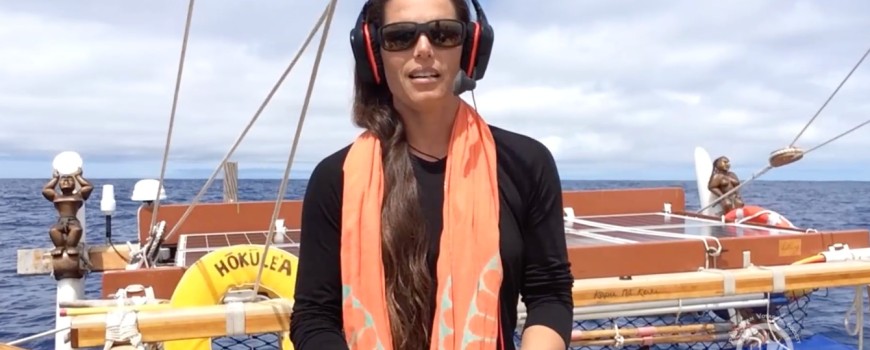
The excitement for the day came when both Hōkūleʻa and Hikianalia participated in our first virtual field trip using Google Hangouts. Kaʻiulani Murphy spent several minutes walking through the canoe on camera with three classes worth of kids watching.  At the end some of the questions  that were submitted were asked and Kaʻiulani answered them.  We stopped our connection at that point and then Hikianalia went and toured that canoe.  Kids got a taste of how similar and different both vessels are.  This was the first one and is a work in progress.  Well keep you all updated as it progresses and refines.

Well check in when we sight land, or around this time tomorro.

Me ka mahalo nui
Standing by 72
Nā’ālehu

Continue Reading

Science Update | Darienne Dey: Marine Life

Since departing Tongan waters, we have been fortunate to encounter and be guided by various marine organisms.  During our darkest (i.e., relatively moonless) nights, bioluminescent plankton was observed between 0 to 20 feet below the surface and most often off of our port side.   Some showcased their blue brilliance when the water was agitated by our hulls while others glowed when illuminated by bright white light.  During the daytime, their larger counterparts shared a similar blue hue and even sported their own sails, harnessing the power of both the wind and current.

As we sailed near the tectonically active Kermadec Trench, we anticipated observing pumice particles as the crew of Hikianalia’s maiden voyage did while traversing this part of the ocean back in October of 2012.  As the Pacific plate subducts below the Australian plate, some molten rock escapes, erupting from the trench and rapidly cooling with vesicles of trapped gases that allow it to float to the surface.  Appearing as speckled mini soccer balls ranging from thumb- to fist-size, these drifting rocks also carry passengers.  Crabs, anemones, and fire worms were the most common riders on these naturally-formed ocean-going vessels.

IMG_0161

But the most exciting marine life to observe is our fellow mammals:  dolphins and whales.  For traditional Pacific navigators, pods of such animals can sometimes serve as “sea marks” that help guide canoes in the absence of other viable navigational information.  During this time of year, humpback whales (especially mothers and calves) are known to travel from tropical waters to Antarctica for the southern hemisphere’s summer, tracing a pathway that very nearly aligns with the Kermadec Trench and that includes a pit stop at Rangitahua (Raoul Island), the northernmost of the Kermadec Islands.  Thus far dolphins have joined us during the day, and one pod of whales was observed paralleling our course line.

The sighting of marine organisms can be both exciting and reassuring.  Their lively activity stirs our imaginations and comforts us as we wistfully gaze across the seemingly endless expanse of sea and sky.  The ocean is truly theirs, and we feel grateful to be guests of their realm.


Continue to follow the Mālama Honua Worldwide Voyage by visiting us online and joining our global movement towards a more sustainable Island Earth.

Continue Reading

Update | November 7, 2014

Aloha all,

This will serve as your Nov 7th update.  Winds started off light and from an unfavorable direction this morning, Throughout the day we have gained ground more towards our intended course as the winds clocked more southeast.  We are anticipating seeing land late tomorrow or the glow from land in the evening.  The Maori crew are very excited to be sailing home.  I think Nick Marr said it best today:

I first touched the port manu of this canoe in 1985 when I was 12 as she came to my home in New Zealand. I had no idea how that would change my life. It’s an unreal experience to be sailing home now and to know that the last time that she was in New Zealand was that long ago.

Hōkūleʻa is like another love of my life. I got to take her home with my Maori brothers from Aotearoa and Hawaiians with which we have built a long history together.  Being in the canoe world has connected us all.

With that I will leave you with the dinner we ate tonight. We landed two aku within minutes of each other.  They were quickly made into panko crusted delight.  Rice and fried tofu on the side.  Canned peaches for dessert.  We are truly blessed

More soon,
Standing by 72
Nāʻālehu


Continue to follow the Mālama Honua Worldwide Voyage by visiting us online and joining our global movement towards a more sustainable Island Earth.

Continue Reading

Crew Blog | Nāʻālehu Anthony: A Select Few

IMG_3859The dawn light is just starting to settle in.  We’re drifting, sails closed and sweep out of the water. The canoe is still holding our course, South, in the chop and centered in the trough as we wait for dawn light to see if all the measuring and memorizing and miles and corrections and deviations are correct. The navigational staff agree that we are in the range to find islands; specifically, the first in the chain of the Kermadec Islands, Rangitahua (also known as Raoul Island).  It amazes me to think that this is what our ancestors figured out.  They took the time to memorize everything; their ability to observe and interpret was like nothing we have ever seen save Mau Piailug. He was one of the last who could observe in the way those who came before him did.  The chaff of all the “stuff” we have in our lives prevent us from doing so in our normal lives.  This computer at which I type, the red flashlight of the person next to me providing enough lumens to read, even the distant hum of the propane stove heating water can be a distraction when the crews senses are trying to tune in to what nature is trying to tell them.  For everything that can be seen and felt here, at this hugely important crux in this experiment is a clue. But only if you took the time to learn the signs and calm your heart to let them come to you in a way that makes sense.  Kaʻiulani Murphy and Kaleo Wong have taken that time and put forth the kind of effort to do just that – they come on board this trip as the eyes of the canoe and have put us in the right place and space for us to go and find islands.

The canoe deck is lit now. From the time I started crafting this to now, the sun has given us enough light to start to scan for anything that might break up our horizon. The island we seek measures only 1600 feet high and 11 square miles, and is alone. After 510 miles of sailing, our navigators have put us in a bubble of about a 40 mile radius, where the island would be visible. This is no easy task; typically, the islands we have sailed to in the past are part of a screen of islands that make up an archipelago that expands the cone of error that can be made while traveling all these miles.

Clouds have surrounded us, with the exception of a small space in the East where light is filtering through. This is not ideal for us to be enveloped in this cloudy bubble with no way to see outside of it, but nature and akua will not give up this lesson without the tenacity that the navigator must have.

6 are on deck now, scanning the horizon.  The waves brush against the canoe, gently swaying the rigging in a creaking rhythm. No one says anything, just watching, scanning for the answer we seek to one of the most complex math equations ever witnessed.

This story and the genealogy therein is now thousands of years old. The thought that crosses my mind as I trade my role as producer to voyager is that we may be the only people on the entire planet doing this in today’s world.  The thought is humbling that we are here representing all of those who chose this path to set out and expand the horizon farther and earlier than any other culture would do for the next 1000 years.

Captain Bruce Blankenfeld watches the horizon fill in with early orange light.   Clouds are still prominent in the bulk of the sky and the wind washes past us, unspent, as we are to wait and watch for just a few more minutes. Was our speed calculation correct? Are we in the zone of where this island is? The most important question is: Are we upwind or downwind of the target?  Captain calls the sails open and directs us to sail South, slowly, as we continue to scan all edges of the horizon. There are specks of black in the sunrise that two on the crew are watching intently.  Does it stay black? Or is it moving and changing shape? The former would be a land mass; the latter, merely an observation on top of the thousands already made that could take us all of course in search of something that isn’t even there. The entire crew is careful to watch.  Now crewmember Nick Kaipara Marr sees something on the Western horizon. Just a spec, maybe two.  Dark all around that side of the horizon provides a backdrop for these two tiny tiny blips to be even darker than what the clouds bring.  Nick watches with the seriousness that comes from sailing thousands of miles before this.  Nick brings the sighting to Captain Bruce, who asks him to keep watching it.

We steer the canoe down, to the West as we sail along.  Everyone is working all sides of the canoe searching the now fully sunlit sea.  Nick is still intent on the blips to the West, now off our starboard bow, as the answer we all seek. The clouds pull back just enough to show us a hard sloping edge that is unlike anything else on the horizon but very much something recognizable for those who have pulled land from the sea before.  No one says anything, no cheering, no clapping, just a quite satisfaction that these two new navigators, surrounded by a steadfast crew, have done what only a select few on this planet have been able to do.

Stay tuned as we write the next chapter, sailing in the wake of our ancestors….


Learn more about our crewmembers and the Mālama Honua Worldwide Voyage. Visit us and join our global movement towards a more sustainable Island Earth.

Continue Reading

ShoutOut | Pomai Bertelmann: Keaʻau and Pāhoa High Schools

Kakahiaka nō to the ʻohana at Pāhoa and Keaʻau High Schools! My name is Pomai Bertelmann, coming to you live from the voyaging canoe Hōkūleʻa enroute from Rangitahua in the Kermadec Islands to Aoteaora. Weʻd like to send our deepest aloha to all of you on this monumental day for the two schools coming together as the wake and legacy of our Tutu Pele is upon us. We on the canoe wish all of you the best, and are hopeful like we are that our journeyʻs end, which we will be looking forward to in the next day or so, will be pleasant and wonderful. We wish the same for you folks as well as you come together and work together in the same space. Mahalo nui for joining us, and we will continue to pule for you from the Moananuiakea as you continue to meld together as one ʻohana. Take care, and aloha aku to all of you folks and all of your ʻohana. Continue to follow us at Hokulea.com.

Mālama Honua: ʻOhana Hōkūleʻa, Episode 1

“You’re looking at a voyage that would take Hōkūleʻa from Hawaiʻi for three years. You’d be sailing for at least 45,000 nautical miles. It would be by far the most dangerous thing we would ever consider doing as a voyaging family. The risks are huge. But on the other side, the possibilities are enormous…We’re not going to change the world; we’re going to build a network of people around the Earth who are going to change it. And our job is to help them be successful.”

– Nainoa Thompson

ARVE error: Mode: lazyload not available (ARVE Pro not active?), switching to normal mode

Episode 1

Building on more than 30 years of learning and voyaging, Hōkūleʻa and her crew now prepare to circumnavigate the globe carrying a message of Mālama Honua – Caring for Our Island Earth. Join us as we look back to the inception of this renowned double-hulled voyaging canoe and the leaders that paved the way for this Worldwide Voyage. In this episode, we look into the physical, mental and spiritual training and preparation that both waʻa and crew endure to be ready for their most ambitious journey yet.

About the Series

Nearly 40 years ago, the founders of the Polynesian Voyaging Society dreamed of rebuilding a double-hulled canoe similar to those of our ancestors. What began as an effort to disprove critics who doubted Polynesians’ ability to sail purposefully and settle their vast nation unaided by navigational instruments has grown into a cultural reawakening, a new generation of leaders, and a living commitment to sustainability.

Hōkūleʻa originally sailed to rediscover and then to reconnect. Now she’s circling the globe carrying a message of Mālama Honua, or caring for Our Island Earth, as we struggle with the degradation of our land and oceans with the firm belief that our ancient wisdom will inspire contemporary solutions.

Join in this movement as we sail through the past, and venture into new waters of relationships and change!

Mālama Honua: ʻOhana Hōkūleʻa is a collaboration between the Polynesian Voyaging Society, ʻŌiwi TV, and Hawaii News Now.

Navigation Update | November 5, 2014

Aloha, this is Kaʻiulani from the deck of Hōkūleʻa. We left Rangitahua, the island also known as Raoul, the first of the Kermadec chain. We saw it two days ago, Monday, November 3. We took all day Monday to sail up to it. In the evening, we were sailing by it, and by sunrise we had just a faint sighting behind us. Since we left the island, we sailed about 150 miles in the direction of Aotearoa, which is Noio Kona, or just a few houses South of West. We have another 400 miles to go, so we are anticipating with good weather that could be there in four days or so. We did have some good winds since we left Rangitahua but we also had some lulls. Today, the wind is actually switching around on us, so we are hoping to have the good weather we’ve been having. We’ve been blessed with wonderful dry weather. Last night we had our first squall come through and got us a little cleaner with that fresh water rinse. We’re having another sunny day out here, and looking forward to continuing along with all your aloha! So continue to follow us at Hokulea.com


Continue to follow the Mālama Honua Worldwide Voyage by visiting us online and joining our global movement towards a more sustainable Island Earth.

Continue Reading

Science Update | November 2, 2014

Aloha everyone! This is Miki Tomita, one of the science and education specialists onboard Hikianalia. We are currently on our way from Tongatapu to Aotearoa (New Zealand). We’ve had some really exciting finds on our entire leg that started in Pago Pago, American Samoa and continues through to Waitangi, Aotearoa. We’ve caught a couple of fish and done fish dissections adn to keep some samples to do fish identifications. The pay couple days have been very exciting as we are sailing over the Kermadec Trench where there is a lot of underwater volcanic activity. Some of the things we’ve noticed is that some of the pumice floats, which are these huge floating colonies of animals and marine life that are on these pumice stones floating through the ocean. It has been really cool! We took a bunch of pictures, and we looked at some of the plankton and other microscopic organisms and took pictures of them. Some of the other things we’ve seen are whales and dolphins. We even saw one turtle outside of Tonga swimming by itself. We’ve seen some aku jumping around. Just recently we saw a bird, so we must be on the right course. So that’s our science update. There are some blogs coming that are written by some of our other science specialists that have more detail so please visit Hokulea.com. Aloha!

Continue Reading