Mālama Honua: ʻOhana Hōkūleʻa, Episode 2

“You’re looking at a voyage that would take Hōkūleʻa from Hawaiʻi for three years. You’d be sailing for at least 45,000 nautical miles. It would be by far the most dangerous thing we would ever consider doing as a voyaging family. The risks are huge. But on the other side, the possibilities are enormous…We’re not going to change the world; we’re going to build a network of people around the Earth who are going to change it. And our job is to help them be successful.”

– Nainoa Thompson

ARVE error: Mode: lazyload not available (ARVE Pro not active?), switching to normal mode

Episode 2

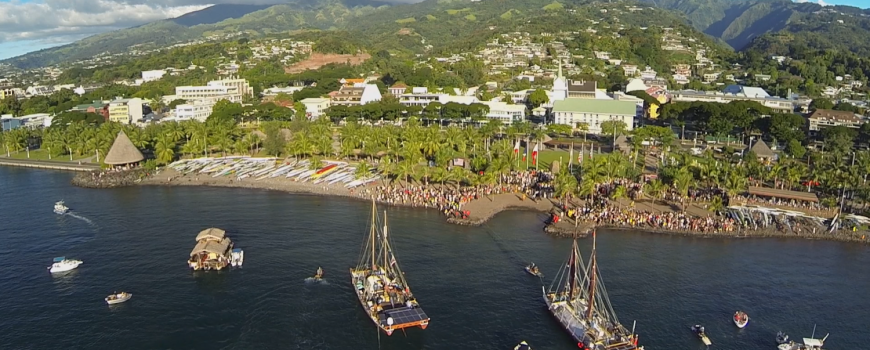
It had been 19 years since Hōkūle’a last made the 2500-mile journey from Hawaiʻi to Tahiti and for the first time ever there were seven apprentice navigators on-board, all younger than the canoe herself, most of whom have never sailed the deep sea. Join us for the second episode in our four-part series as these young navigators battle to overcome fatigue, the elements and their own anxieties to pull Tahiti from the sea. Following in the wake of their ancestors, these crews venture out to reconnect with people and place and confirm that these initial Polynesia legs of the journey are about bringing together Hōkūleʻa’s ʻOhana Waʻa to support this mission of Mālama Honua.

About the Series

Nearly 40 years ago, the founders of the Polynesian Voyaging Society dreamed of rebuilding a double-hulled canoe similar to those of our ancestors. What began as an effort to disprove critics who doubted Polynesians’ ability to sail purposefully and settle their vast nation unaided by navigational instruments has grown into a cultural reawakening, a new generation of leaders, and a living commitment to sustainability.

Hōkūleʻa originally sailed to rediscover and then to reconnect. Now she’s circling the globe carrying a message of Mālama Honua, or caring for Our Island Earth, as we struggle with the degradation of our land and oceans with the firm belief that our ancient wisdom will inspire contemporary solutions.

Join in this movement as we sail through the past, and venture into new waters of relationships and change!

Mālama Honua: ʻOhana Hōkūleʻa is a collaboration between the Polynesian Voyaging Society, ʻŌiwi TV, and Hawaii News Now.

Update | Hōkūleʻa and Hikianalia Arrive in Aotearoa

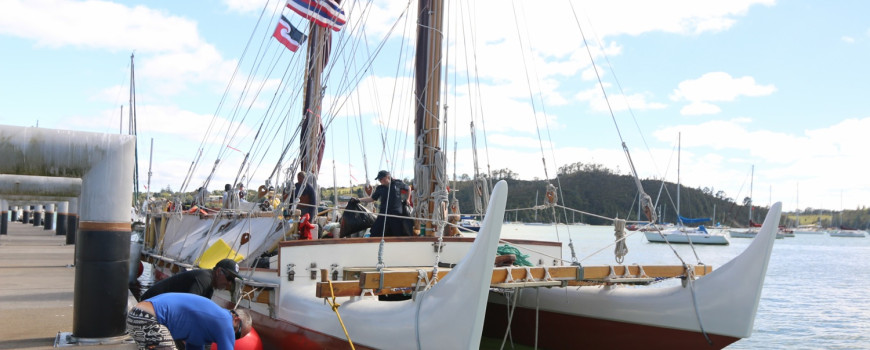
OPUA, NEW ZEALAND – Legendary Polynesian voyaging canoe Hōkūleʻa and her sister canoe Hikianalia today made landfall in Aotearoa (New Zealand) in Opua at 9:30 a.m. local time. The crew first sighted land from the deck of the Hōkūleʻa at approximately 6:30 a.m. on Nov. 9 while a pod of dolphins played around the historic canoe.

Hōkūleʻa and Hikianalia will dock in Opua to clear customs and prepare for their ceremonial arrival to Waitangi on Saturday, Nov. 15 at Te Tii Marae.

The voyaging canoes departed Pago Pago, American Samoa Oct. 16 to Aotearoa and have sailed approximately 1,500 nautical miles to reach the tip of North Island. Hōkūleʻa’s return to Aotearoa today is the first visit to the country since she sailed the Voyage of Rediscovery in 1985, retracing the routes of settlement used by Polynesian ancestors. As a celebration of that rich history, this leg of the Mālama Honua voyage has carried the theme, “Nā Waka: A Tribe Returning Home.”IMG_5526

“I first touched the port manu (bow) of this canoe in 1985 when I was twelve as she came to my home in New Zealand. I had no idea how that would change my life,” said Nick Marr, watch captain on the Hōkūleʻa. “It’s an unreal experience to be sailing home now.”

This leg of the voyage offered opportunities to test and strengthen Hōkūleʻa’s young navigators, under the guidance of the Pwo (master) navigators on board.

“This is another step to the future of voyaging,” said Bruce Blankenfeld, Pwo navigator. “This journey has been filled with lessons that have tested their skills; from 100 percent cloud cover all night to unfavorable winds to the biting cold, and through each challenge, they have proven themselves capable and ready to take on more kuleana (responsibility).”

The Hawaiian name for this journey, Mālama Honua, means “to care for our Island Earth” and is taking Hōkūleʻa and her sister canoe Hikianalia across Earth’s oceans to grow a global movement toward a more sustainable world. The Mālama Honua Worldwide Voyage, sponsored by Hawaiian Airlines, will cover 47,000 nautical miles, 85 ports, 26 nations, including 12 of UNESCO’s Marine World Heritage sites, through June 2017.

Continue Reading

Crew Blog | Toiora Hawira: Waka is a Connection, A Bridge that Binds Us All Together as One

Tena ra kautau e te hunga e whai nei I nga kupu whakamarama I runga I te wharangi ipurangi nei. Tenei au he mokai no runga ana mai o Te Wharetoka O Paerangi, he tai no uta e rere I runga I Te Wainuiarua ki tai, ko tahi tuu no Rauru Kii Tahi, tenei au ka mihi,  tihei mauriora ki a tatau katoa.

Greetings to the multitudes who follow the updates posted here.  I am a descendent from the House of Stone of Paerangi, a tide from inland which flows on my ancestral river to meet the tides of the sea. One of Rauru Kii Tahi, I greet tihei mauriora to one and all. 

IMG_1625He aha nga ahuatanga e rere nei,  te mea tutahi he honore nui ki a au ki te whai I nga ngaru marino o Hokulea ki te waa kainga, I runga I te whakaaro, ko ia te putake o enei ahuatanga e whakatere nei, nana I kukume nga taura hei putikitia nga korero, i whakatuu I te whare wananga hei mau ki te matauranga o nga ra o mua.

I feel honored to be sailing in the wake of Hōkūleʻa to my home land of Aotearoa with the thought in mind that she represents the revitalization of this art of wayfinding. It was she who binded together the lines of knowledge and established a house of learning to maintain this gift from the days of our ancestors, a gift that was almost lost. 

I also feel privileged to be part of the crew who return Hikianalia to her birth place on this first voyage home since her maiden voyage to join Hōkūleʻa in Hawaiʻi back in 2012.

Waka to me represents life, a native way of life.  It teaches one how to become one and live in harmony with the natural environment.
Waka symbolizes family, and oneness , no matter which walk of life youʻre from, if you live waka, the waka will unify each and every one of us.
Waka teaches respect, we respect and protect the waka as we would our mother; just as a mother would nurture her children, the waka will do the same.
Waka is a path into the future, a way for us to regain the ways we used to live.
Waka is a vessel of unlimited source of knowledge; it holds the teachings of the past, our history our genealogy, our stories.
Waka is a connection, a bridge that binds us all together as one.


Learn more about our crewmembers and the Mālama Honua Worldwide Voyage. Visit us and join our global movement towards a more sustainable Island Earth.

Continue Reading

Crew Blog | Pomai Bertelmann: We are Led by a Great Man

We come from a place that has some of the highest peaks on this planet. We just sailed over one of the deepest trenches that this planet has to offer as well. In that, there is a reciprocation that we feel, sense, and carry with us from Pago Pago to Vava’u and Tongatapu in the Kingdom of Tonga. It is profoundly deep to deep. Without even knowing it, we have transformed from a life of daily friendships into that of family for life. Once again, Hōkūleʻa has re-entered us into the watery womb that we once knew, and birthed us out into the world as brothers and sisters. A bond that we will share for the rest of time.IMG_2839

We are led by a great man. There are many thoughts that he owns that we will never know. But the ones that he does let us enterinto are the ones that sustain our life here on the open ocean. His intentions are pure and selfless; his work is seamless in fluidity and articulation. What he demands is commanded by the ease of his voice, not playful but not fearful. Just intentionally easy. Our debriefs of days events are meaningful: complete the cycle, be diligent in your work, keep it light, keep the energy flowing. His love for Hōkūleʻa can be seen as he has led us in quiet confidence to our destination. In many ways he is the kaula – the rope that binds, the man who possesses many intuitive skills. He is one of a few who can harness the energies of the ocean, land, and sky and center them all on the deck of the canoe. He is surrounded by kupuna both seen and unseen whispering in quiet reassurance. His hourly journey to the ihu, the bow of the canoe, is a solitary one. We do not follow. In our minds, it is enough to observe his ritual from afar. Whether he’s communing with the universe or having his own quiet conversations with our Hōkū, it is a dance that is imprinted in our minds in hopes that in time that we each might choose to learn the cadence too.IMG_5076

Birthed out of the darkness,
the child emerges and becomes the light.
Ensnared in a hei played out on the hands of great teachers,
he steps into their world effortlessly and transforms, becoming one of them.
The masters hands have willed into him the gift of sight even in the darkest of nights.
Build and take down.
Give life and take life.
Heal where healing is needed.
Mend where mending is needed.
Grow sustenance and medicine for your people.
Be the light in and through all the shades of obscurity.
The star paths are the map, the waves his companions, the deck of the canoe his home, the wa’a his best friend on this path of life chosen for him.


Learn more about our crewmembers and the Mālama Honua Worldwide Voyage. Visit us and join our global movement towards a more sustainable Island Earth.

Continue Reading

Update | November 9, 2014

Kia ora tatou,

We’ve been sailing off the coast of the tip of North Island all day and into the night.  We took a tow from Hikianalia for about 2 hours this evening to get around one of the points. We reset our sails and wind picked up a little around 11pm.  It looks like we are doing 2-3 kts down the coast to Karikari.  It’s 90 more miles to go, so this might take while.

ʻAwa was served tonight to give everyone a chance to reflect on the voyage. The words spoken were all very positive and pointed towards thanking the leadership style in Captain Bruce but to also mahalo the tremendous amount of effort that Kaʻiulani and Kaleo put forth to prepare for this successful endeavor.  Two-thirds of the way through the ceremony, as the skies cleared. a bright red moon slowly pierced the horizon and gave light across the sea.  The open canopy of points of light included Lehua Kona in the hook, both crosses, the beginning of the bailer starting to rise as well as Orion making an appearance just above the rising Moon.

More tomorrow when this keyboard warms up…

Continue Reading

Crew Blog | Jacko Thatcher: Rangitahua

Sunrise on November 2. When a watch change was called, and after a little contemplation, our navigator Kaleo Manuiwa calculated that today we should start looking for the island, Rangitahua. Earlier that morning I pointed out to him that the star Menkalinan was showing through the clouds; with its paired star it looked to be on the meridian, pointing down to true North. Kaleo was hoping to measure the starʻs height above the horizon to estimate our latitude.

Sixteen degrees above the horizon would indicate that we were in the vicinity of Rangitahua; unfortunately, the star disappeared into the clouds before Kaleo could measure its altitude accurately. I had already measured it and believed that it was around 16 degrees, although the accuracy was questionable with the weather conditions making it difficult to see the horizon, especially for my 54-year-old myopic eyes. With his younger vision, Kaleo would probably have gotten a moreaccurate estimate.IMG_2883

Based on my sighting, we were looking for the island. Many cloud formations on the horizon were doing great impressions of land, only to rise into the heavens. One such formation held its form for a long period of time and we came to accept that it was Rangitahua. We carried on sailing, and another island sighting, made by Ka‘iulani  Murphy, appeared ahead of us. This sighting looked like three islands, and although this seemed strange, we began to think that we were heading towards McCauley Island, Curtis Island, and close neighbor Cheeseman. As we approached these islands it soon became clear that they were in fact one big Island – that this was actually Rangitahua in front of us. So a poorly measured sighting of a meridian star masked what was a great piece of navigation by our two younger Hoʻokele, Ka‘iulani  and Kaleo, as they had unerringly lead us to our destination.

IMG_3160

The signs that we were on track were multiple visitations first by what I think were huge Bottlenose Porpoises, then a big pod of Pilot Whales and bigger whale blowholes being seen off or starboard beam and stern, these kaitiaki (guides) following us all the way to the Island.

Captain Bruce Blankenfeld informed us that we would sail close to the island, drop our gear, and have an ‘Ava Ceremony to celebrate our arrival in New Zealand Waters and to remember all those that have been involved with Hōkūleʻa and her missions in the past, those men and women that paved the way for our new mission of Mālama Honua.

IMG_2918

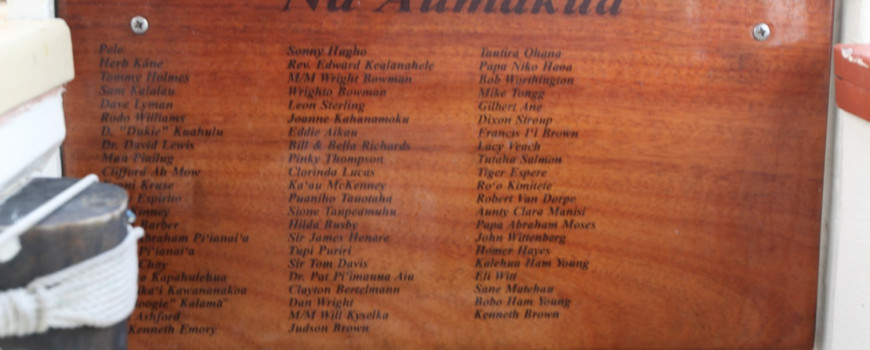
Bruce asked that we (the Maori contingent) open the ceremony with our thoughts and feelings for the voyage so far. Frank Kawe spoke first with a mihi to the crew and his observations of what we could expect once we arrive in Aoteraoa. Nick Marr spoke of his connections to his tupuna through whakapapa to his waka Te Arawa. I spoke last and my mihi was in appreciation of the closeness that was developing amongst our crew and how this is what I have always felt when sailing on Hōkūleʻa, even though my last voyage on her was in 1995, not counting the short excursions in the years since. My mihi took in all of the kupuna whose names are engraved on the plaque on the port stern of Hōkūleʻa, Sir James Henare and Tupi Puriri of Te Taitokerau being amongst the legends of Hōkūleʻa, David Lewis whom I sailed with at the end of our epic Na ‘Ohana Holo Moana voyage of 1995, Uncle Pinky Thompson the tiny wee giant of a man who looked after us in his home during that time, and of course, Mau Piailug, who so unselfishly shared with us his knowledge that has led us to where we are today, giving Hōkūleʻa and her crew a second viewing of Rangitahua.

IMG_2959I spoke to the crew of my aloha for one other whose name appears amongst the legends like Leon Sterling, Mike Tongg and my very dear friend Clayton Bertlemann. Amongst these was a young Hawaiian guy who became a great friend of all of us that refer to those endless summer days training on Hōkū—Kaʻau McKenny the first of the boys of summer. I have a tradition that I follow whenever I voyage to islands I haven’t been to before—I drop a small kohatu (stone) into the waters of those Islands to allow me and mine to connect with these places. The stone I dropped at Rangitahua was a tohu Maumaharatanga ki Kaʻau, a sign of remembrance and love that connects him to his ʻOhana in Aotearoa. I dropped a small piece of Green Stone into the waters, ahakoa iti he iti mapihi pounamu; although small, it is pounamu, and therefore most precious. Summer will never be as bright with out Kaʻau to smile and brighten even the darkest of days. Moe mai e hoa moe mai i to moengaroa.

The last part of my korero was in regards to the special nature of this place where some of our ancestral waka came. Te Kurahaupo ran aground here and Tupuna Waka, Mataatua, Te Arawa, Tainui, and others lent aid to the stricken waka. So Hōkūleʻa in recent times continues the legacy begun centuries before by returning to this place in the same way our ancestors would have.

Each of our crew were then given the time to talk story and express their feelings, enjoying each others company over a cup of ‘Ava before continuing on. My feeling of awe towards my tuakana Bruce for his humility in taking the lead to serve each of his crew members their cup, the respect for our skipper with his unique and engaging manner knows no bounds.

Jacko Thatcher
The Gecko
Continue Reading

Fixing on the Go

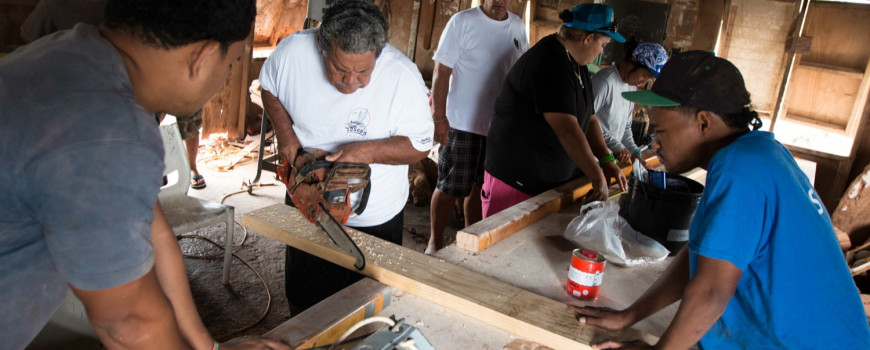
“We are at a carver’s shop who has graciously given his shop over to us so that we can fix the boom that was damaged on our way to Tongatapu. As I understand it, what happened is that Hōkūleʻa did an accidental jibe. When that happened, it put a lot of stress on the boom itself that the boom should have never seen. So the boom basically just snapped,” said Hikianalia captain Bob Perkins.

“We had my small workshop at Papua Village. I said to one of the government officials if anything happened on the way because there was a storm and wind encountered by the two canoes off of Pago Pago, American Samoa. They said to me there is something, and I said that they are welcome to my home for help,” said Sitiveni Fehoko.

“These people are absolutely unbelievable. Never a question was asked. They just said come on over. You can all of our tools, you can use our wood shop here. In fact, two of the master carvers came in and did most of the work for us. So you can’t ask for anything better than that.

“It doesn’t happen often, but it does happen. So I think the big thing is that the captain and the crew just kept working. They put up another sail and got the broken parts and pieces down so they could be repaired when we came into Tongatapu. So I think we are more the wise for it.

“We were very fortunate that we were able to have such nice people to help us out and very fortunate that we had skilled labor to help too. I think that the boom will last all the way to New Zealand and probably the rest of the way around the world. We’ll see, but I’m sure this will get us at least to the dry dock period in Aotearoa,” said Bob.


Continue to follow the Mālama Honua Worldwide Voyage by visiting us online and joining our global movement towards a more sustainable Island Earth.

Continue Reading

Crew Blog | Pomai Bertelmann: What Guides Us

The fullness of the Akua moon rises astern of Hōkūleʻa as the great arms of Kānehoalani, the sun, reach longingly for the watery depths of Kanaloa below. This vast liquid realm he governs has been our home for a number of days. As we meld into our time on the ocean, we deepen our personal relationships with our Mama Hōkūleʻa and the vast number of Kupuna who encircle us each day. Heiau and Te Ariki Tū, our kumuhonua,* are the center of our universe and enable our lā to stand in place like the great trees of the forest. They encase our peʻa who capture the wind that Laʻamaomao creates for us. Tumoanatane, Tommy, and the consistent Kawainui, whose work is never ending, guide us to our destination with each intentional dip into Kanaloa.

IMG_4254

At our ceremony at Rangitahua, Uncle Mel shared, “Being on the canoe is a way for me to be with my family and friends of the canoe again. I miss them, so it’s good to be here.”  These men and women who he speaks of are here  with us in spirit, they are with us in our dreams, they are with us as the stories of the experienced are retold and are given life once again.IMG_4562

A plaque sits in the aft hatch of the canoe and memorializes all those who committed themselves and their lives to the legacy of waʻa. These men and women sacrificed, so that we could be here today, sailing on this vast ocean of Moananuiākea in the wake of our predecessors.
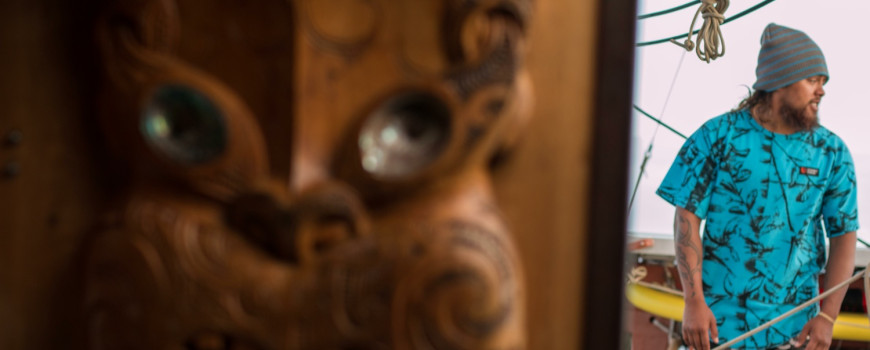
In the light of the moon full moon and the brilliance of the sun, the radiant eyes ofIMG_4262 Kiha Wahine o Ka Mao o Malu Ulu o Lele come to life.  She is the feminine, the Hina, the Haumea. She watches over us day in and out, subtly encouraging, vigorously reminding, and gently enmbracing our collective fluidity through her ancient stare. It is not by chance that on this leg of the voyage, a majority of our sustenance from Kanaloa is landed on the Hina side of the waʻa where she resides. It is as though she is calling out to the realm of the sea to feed the kanaka honua who are under her gaze. The wind lifts her hair and like tentacles of Faʻatupuitehau, the great heʻe of the Pacific whose arms stretch far and wide connecting people, she connects the kanaka honua of the waʻa to the nuances of the elements. She is the center of the great net that brings all the necessary elements together, enabling the canoe to rightfully take her place on the ocean. She is made of a native wood of our forests, becoming a representation of Lea, the goddess of canoe builders often times represented in the form of the ʻElepaio bird and the wife of Kūmokuhāliʻi. Her ties to the Honua and the Kanaloa encourage us as kanaka honua to achieve balance in our lives so that transitions in our life can happen seamlessly and with fluidity.

Kumuhonua –Mast Step
Lā – Standing Rigging, Mast, Spar, Boom
Peʻa – Sail
Tumoanatane – Side Sweep, Ama Hull
Tommy – Side Sweep, ʻAkea Hull
Kawainui – Center Sweep
Kanaka Honua – Canoe Member
Faʻatupuitehau –Heʻe of Moʻorea Tahiti, bringing genealogies of the Pacific together
Kūmokuhāliʻi – God of the forest, God of canoe builders
Lea/Leʻa – Goddess of canoe builders, ʻelepaio, wife of Kūmokuhāliʻi/Mokuhāliʻi
Hina/Haumea – Mother, Kupuna, Creator, Genesis

Continue Reading