Our ʻOhana Waʻa in the Pacific

Pwo Navigator, Kālepa Baybayan says that, “The crew make up for the second leg of the international Mālama Honua Voyage was made up of mostly members from ʻOhana Waʻa. We have ʻAha Pūnana Leo’s Hōkūalakaʻi crew, Kawaihae’s Makaliʻi of Nā Kālai Waʻa Moku o Hawaiʻi, Hui o Waʻa Kaulua of Maui’s Moʻokiha crew, Hawaiʻiloa, and then we had Kauaʻi’s voyaging society’s crew from Nāmāhoe.”

Since her launch in 1975, Hōkūleʻa has inspired these new waʻa communities, not only here in Hawaiʻi, but throughout all of Polynesia.

“When you match us up with our South Pacific cousins, the Tua Pittman’s and the Paiea Patai’s of the Cook Islands, Matahi Tutavae from Tahiti, and Jacko from Aotearoa, it’s been a godsend in that it’s created a much greater depth for us to pool our leadership resources from,” says Baybayan.

And we owe this growth and the revitalized tradition of Polynesian navigation to one source.

Billy Richards says that, “Hōkūleʻa, it’s the mom. Wherever you go, whatever canoe is out there, it’s mom.”

As her ʻohana continues to grow, they have formed an association, appropriately called ʻOhana Waʻa.

“ʻOhana Waʻa was meant to bring us together. Meant to bring us together. Make one strong family. Now that it’s expanded beyond Hawaiʻi. ʻOhana’s got a big reach,” says Baybayan.

Pwo Navigator, Peia Patai says that, “When Hōkūlea actually came it opened a lot of eyes and realized that we have to go back and take our knowledge and bring it back for our young ones.”

“That’s why I’m here now, Peia is here now, that’s why Jacko is here now. The Worldwide Voyage is a continuation of what’s already started years ago. It’s about being able to pass on the mantle to the younger generations that are going to be looking after these canoes,” says Pwo Navigator, Tua Pittman.

“We had always intended that the complexion of this voyage should reflect the nature of a, of a very large voyaging community coming together to support the mālama honua mission and vision. It was special because of this varied, varied audience of participants came together, basically met at the airport, arrived in Papeʻete as a bunch of individuals who really didn’t know each other, but they grew to, become this family. It’s amazing how the canoes can produce the magic of a collective, collaborative thinking. Getting everybody to come to agreement and to support a singular mission. It’s pretty awesome,” says Baybayan.

Pwo Navigator, Chadd Paishon, says that, “Hōkūleʻa has carried this mana, from the very beginning that has reconnected all of us again. Mālama honua allowed us to become clear about how we can assist and who we are as this voyaging ʻohana and everything that we do, we’re all on this waʻa together. We’re all on this voyage together. We continue to carry that message that the only way we are going to do this is if we do it together.”


Continue to follow the Mālama Honua Worldwide Voyage by visiting us online and joining our global movement towards a more sustainable Island Earth.

Continue Reading

Voyage with Us

“Our mission is to inspire all people to mālama honua, or to care for island earth. Our earth needs help, and so this voyage is really just a catalyst to get people to feel like they’re a part of a movement,” says Apprentice Navigator, Jenna Ishii.

Pwo Navigator, Nainoa Thompson, says, “If we want to have a world that’s going to be sustainable, you need to teach children sustainability. If you want a world that we’re going to protect our environment for their grandchildren, then you need to teach that.”

“We are encouraging people through stories of hope and stories of place to look for ways that we can mālama our earth that are linked to local, indigenous, ancestral, ecological wisdom and to share those stories with the world and really figure out a way to bring that into schools and have that help to inspire education to be better and to put students at the center of designing a better future, says Education Coordinator, Miki Tomita.

“So one requirement of every crewmember is that they reach out to their local school or organization, to really truly have like a face to face and a more deeper personal connection with this voyage. This voyage is a little different from previous voyages, where previous voyages might have been to find an island, to close the Polynesian Triangle, uh this voyage is all about bringing community with us,” says Ishii.

Satellite transmission of video updates and still photos happen in near real time. Allowing for unprecedented engagement with communities back home and across the globe.

“There’s been various variations of this over the years but we’re really pushing on the edge of what technology will allow us to do,” says CEO of ʻŌiwi Television, Nāʻālehu Anthony.

Maui Tauotaha is a video journalist working for ʻŌiwi TV. The Native Hawaiian television network has a crew member onboard to capture and chronicle the voyage as it unfolds.

“But my one contribution, I believe that I bring to the canoe, is to help tell its story, and I think it’s important because the message of mālama honua and the whole purpose of this voyage is to spread awareness about what’s happening in this world and to try and change perspectives and behaviors so that we make sure there’s still a healthy world for our moʻopuna to have,” says Tauotaha.

Apprentice Navigator and Educator, Austin Kino, agrees in saying that “That’s how large it needs to be of a network of people benefiting from this, otherwise, like if you’re not going to be able to measure the impact of what these canoes are going to do for our communities, why take the risk?”

“So one of the ways that we would like to include everyone on this voyage, is our third canoe, we call it hokulea.com. Everything you need to know about how to track the voyage, how to talk to our crewmembers by asking them questions, how to adopt the voyage, and share what your community is doing around the world is all through Hokulea.com. So that instantaneous feeling of, ʻWow, I’m with these crewmembers, and I’m voyaging with them, and now I can do something for my community.’ I think that’s what we need to drive action,” says Ishii.


Continue to follow the Mālama Honua Worldwide Voyage by visiting us online and joining our global movement towards a more sustainable Island Earth.

Continue Reading

Getting Ready to Go

In addition to the navigator and apprentice navigators… each of the other crewmembers carry specific roles on board – there is a captain, watch captains, a safety officer, quarter master and cook just to name a few – all of whom have been training long and hard for this voyage.

“This voyage has, raised the bar a little bit more. And it’s really in that sense of getting everyone to that point to accept that kuleana of being prepared, whether it’s, mentally, spiritually and physically,” says Pwo Navigator, Chadd Paishon.

And in addition to the physical training required onboard the canoe, all holokai must also pass a physical test that includes timed running, swimming and water treading in order to make the crewlist.

“This is the first time that I think it has been this intense in the sense of the physical requirements it’s making sure that when their time comes to be on the canoe, that they will be at their best,” says Paishon.

All those onboard have also gone through classroom instruction, medical screenings, and various safety trainings to ensure they are truly mākaukau, or ready, to be a part of the crew.

Watch Captain, Kealoha Hoe, says that “Everybody has to be accountable, not only for themselves but for the safety of the rest of the crew members.”

For every hard-working crewmember onboard the waʻa, there is a network of ʻohana on land 1,000s strong who help to prep and continually support the voyage.

Logistic Committee Chair, Lita Blankenfeld, says that, “After we pack it all then we inventory, have everybody check every package, then we weigh it, then we manifest it, and then the crew gets ready to load it on the canoes.”

More than 1500 pounds of food, and 300 gallons of water are methodically packed into the hulls of the canoes to prevision these mutli-leg long-distance voyages.

“For us guys on the canoes, on the waʻa, it’s all about balancing. So that when we are sailing you know she stay’s “sea kindly” and she’s not heavy to one side. It’s just part of staying organized. If we can put organization in then, we are heading in the right direction everything will flow really nicely, says Pwo Navigator, Bruce Blankenfeld.


Continue to follow the Mālama Honua Worldwide Voyage by visiting us online and joining our global movement towards a more sustainable Island Earth.

Continue Reading

Inception of the Worldwide Voyage

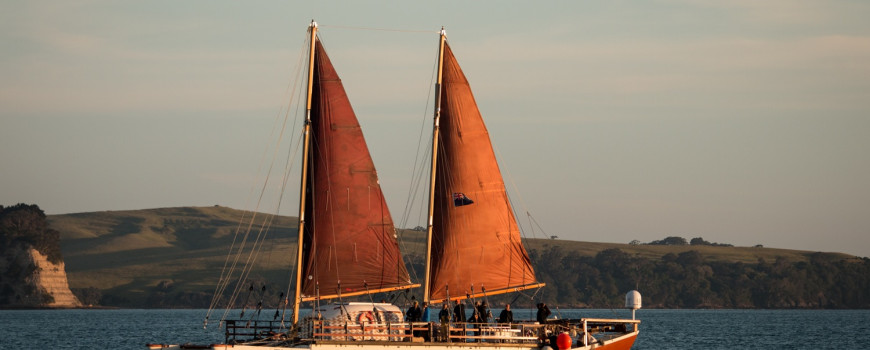
“This voyage launched over 2,000 years ago. This voyage is in the wake of the world’s greatest explorers and navigators of the time, of the whole earth and that is an argument that we can stand on. That first canoe that came here, 2400, 2500 miles from Kahikinui, was the most amazing feet in ocean exploration of all time. We are children in that wake and we respect that. The worldwide voyage in my mind, started with the dream of those who created the canoe in the first place. It’s remembering everything that we know from voyaging, that we were taught from extraordinary leaders, extraordinary mentors, extraordinary teachers,” says Pwo Navigator, Nainoa Thompson.

While she was a sight to behold, she wasn’t complete. She needed a leader, an ancestral connection, what Hōkūleʻa needed was a navigator. And she found him, a native of the remote atoll of Satawal in Microneisa. Pius Mau Piailug, was a Pwo Navigator. Pwo, meaning light, Mau commanded much more than the helm of sailing vessels, he was a mentor and guide for his community, charged with providing for the ‘ohana, immediate and extended.

Pwo Navigator, Chadd Paishon says that, “we all carry a part of him with us.”

“If I wanted to know anything about the stars, the ocean, about waves he would just like give me the answer right there. He’s like a living ancestor that you could—you could finally talk to,” says Pwo Navigator, Shorty Bertelmann.

“Here is one man from this tiny island that was able… to change the world,” says Paishon.

What began as an effort to disprove critics, who doubted Polynesians’ ability to sail purposefully and settle their vast nation unaided by navigational instruments, has grown into a cultural reawakening, a new generation of leaders, and a living commitment to sustainability.

Pwo Navigator, Bruce Blankenfeld says that, “She was built for one voyage in 1976 to go to Tahiti and come back. That was it, but the fact that here we are in 2014, she has been reenergized and rebuilt and she’s good for another 30, 40 years and she’s going to sail.”

She originally sailed to rediscover, then to reconnect. And now she’s circling the globe, carrying a message of Mālama Honua, or caring for Planet Earth, as we struggle with the degradation of our land and oceans with the firm belief that our ancient wisdom will inspire contemporary solutions.

Apprentice Navigator, Lehua Kamalu says that, “We wouldn’t be here today if our ancestors didn’t figure out how to live in balance with their environment and with these islands there is a lesson in going back to traditional practices or finding some way of bridging the gap between what is modern and ancient and making life livable and healthy and safe. The canoe is such a good representation of a family, or a community, or an island, or a planet and everything that happens on that small level of the canoe, it’s the same thing, it’s just on a much larger scale in the world.”

Hōkūleʻa to us, to go around the world, has this enormous potential to go to 40, 50 countries on the planet, to be with the great navigators on earth. I’m not talking about those on canoes. I’m talking about those who are doing things to give kindness and compassion to the earth and those who live on it, those navigators. Hōkūleʻa to me is not going to achieve that, people achieve that. Then Hawaii can give the world the greatest gift to the Earth and that is peace,” says Thomspon.


Continue to follow the Mālama Honua Worldwide Voyage by visiting us online and joining our global movement towards a more sustainable Island Earth.
Continue Reading

Mālama Waʻa in Aotearoa

As their mālama honua journey throughout the Pacific comes to a close the crews made time to mālama the waʻa that have sustained them – over 35 hundred miles thus far!

“The crews are working hard to look at all the fine details of both canoes. From the manu iho to the manu hope and everything in between. We have our captains, our watch captains, our sailmasters going over all of the details of the waʻa and itʻs their jobs as welll as ours. But theyʻre the leaders and the alakaʻi, so itʻs their kuleana to make sure that everything is runing smoothly. So our quartermasters and the crew do a major inventory, and update our manifest so that we know whatʻs on board…where everything is stored – especially when you need it,” says crewmember Pōmai Bertelmann.

“Part of organizing the waʻa is making sure we have all of our food organized which is our condiments, we’re going to go ahead and label our bucket and make sure everything we need for our meals is inside,” says crewmember, Kaʻohinani Kamalu.

“We have all of our carpenters all of our electricians making sure that all of their stations are, are neat and tidy and that they know where everything is in the event that we need anything when we’re on the way,” says Bertelmann.

“I am tasked with the kuleana of carpenter. I am changing the snaps that hold down our canvas thatʻs attached to the deck. So if we have broken loose ones, weʻre changing it out with brand new ones that we found at the store. So, simple fix but it needs to be done,” says crewmember, Moani Heimuli.

Other fixes are a bit higher- literally!

Crewmember Saki Uchida says, “Iʻm going go up on the mast and put the lubricant on the track to make the sail easier going up and down.”

All of these crew kuleana are a collective effort to mālama their honua, in this case the waʻa itself.

“So the canoe truly is a great metaphor but itʻs also a great tradition for ʻHe waʻa he moku, he moku he waʻa, Your canoe is your island, your island is your canoe.’ So our kuleana here is to mālama these islands and to take care of them and to ensure as kanaka that we do our earnest part to make sure that they’re ready to go,” says Bertelmann.

Both Hōkūleʻa and Hikianalia are cleaned, manifested and awaiting a new year at the Maritime Museum in Auckland, Aotearoa


Continue to follow the Mālama Honua Worldwide Voyage by visiting us online and joining our global movement towards a more sustainable Island Earth.
Continue Reading

Expanded 2015 Mālama Honua Sail Plan for Hikianalia: Hawaiʻi, Seattle, San Francisco, and Beyond

We are excited to share that beginning this spring, Hikianalia will add 16,000 miles to her sail, including 13 months in Hawaiʻi where she will bring the Worldwide Voyage closer to students, educators,  and future crew members.   She will then sail to ports along the west coast of the U.S. mainland, including Seattle and San Francisco, before rejoining with Hōkūleʻa in South America.

Hikianalia is an incredible sister vessel to Hōkūle’a and we are very proud of her. As Hōkūle‘a gathers examples of how people mālama honua–take care of our island earth–around the world, Hikianalia will bring these examples home to Hawaiʻi.  She will also gather examples of how kids and adults are practicing mālama honua in communities throughout our island chain.  When Hōkūleʻa and Hikianalia reunite in South America in 2016, they will connect these  children and communities around the globe as we work together towards a more sustainable Island Earth.  Visit our Mālama Honua Stories of Hope Map and add your own story to help build this global network.
We believe Hawai‘i can be a “laboratory of hope” for the world, in astronaut Lacy Veach’s words. Upon Hikianalia’s return to Hawai‘i, we will pay tribute to our special archipelago, and deepen our crew preparation and educational partnerships with training expeditions on 12 Hawaiian Islands.  These expeditions will help us to learn how to care for our incredible islands, and honor communities, classrooms and organizations that are planting seeds of hope for future generations.

We are inspired by the local and international education collaborations that have been established through this voyage, and wholeheartedly support our visionary education partners as they help all students gain the skills and values to be the navigators of a more sustainable future.

We look forward to continuing the journey and sharing updates right here on our website and via social media. Stay tuned as we embark on this new and exciting voyage towards a more sustainable Island Earth.

Continue Reading

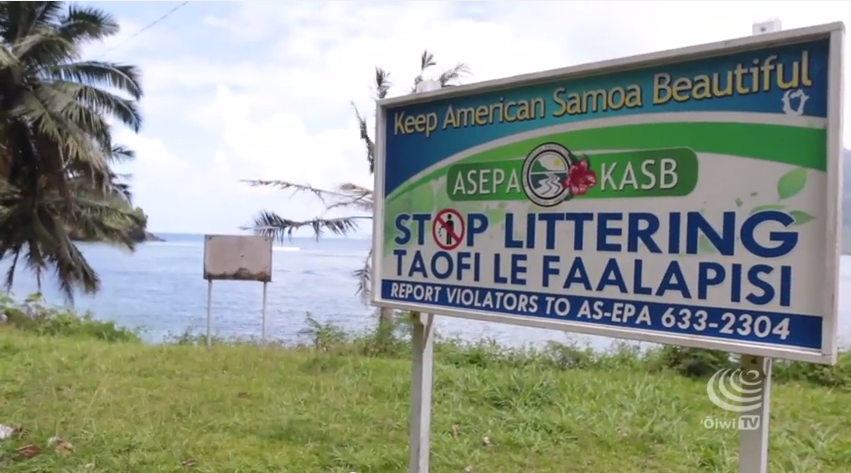
Keep American Sāmoa Beautiful

“You get into the harbor and see a bunch of rubbish floating around the wharf right next to the canoes, and then on the inside, a bunch of that rubbish floating around the area. As I am standing there is rubbish right around here too, with plastic forks, cigarette butts. It’s just heavy and all over the island,” said Hōkūleʻa crewmember Sam Kapoi.

“You see a lot of littering everywhere, inside the streams, along the roadsides, and it’s sad that our people are continuously throwing trash out of their vehicles and also just dumping trash here and there instead of putting it in the trash bins,” said Ioane Tumonogi, Chief of Solid Waste Officer and Brownfields Coordinator.

“I feel like the littering problem is a huge issue because of the “monkey see, monkey do mentality”. You see someone do it, and then you think it’s okay for yourself to do it,” said Kapoi.

To use this kind of mentality to their advantage, American Sāmoa’s Environmental Protection Agency has put together a campaign that educates and encourages the Sāmoan people to put trash where it belongs. This effort is called “Keep American Sāmoa Beautiful”.

“Keep American Sāmoa Beautiful started in 2012. That’s when I put together a program to address the problem that we have here in American Sāmoa. With this campaign, what we did was go out there in the community. We did ads on the paper asking schools, faith organizations, youth groups, and church companies to come out and adopt a roadside or a stream. And so basically we had them fill out an application to tell us the location of where they want to adopt, and then what EPA did was provide them with gloves and trash bags to do their cleanups. Also, we installed recognition signs and billboards here and there to show communities and the public what these individuals and what these groups are doing to make a difference here in American Sāmoa,” said Tumonogi.

With more ads, the Environmental Protection Agency hopes to draw in more committed participants, like ʻIolani Misipeka.

“The area that I adopted in this program is roughly five hundred yards on both sides of the streets. I heard of this adopt the stream or roadside program last year in October. It was advertised through the newspaper, so I felt that this was a good time for me to get involved, to clean up the environment and to clean up our island. It’s a small island. It’s our home. Let’s do something to make it beautiful and keep it the way it is for future generations,” said ʻIolani Misipeka, a resident of American Sāmoa.

“You see some place that you love, especially if you’re from a certain village, adopt the village, and clean up that area to show that you can contribute to society and lead by example by not littering and picking up. Not picking up your trash but handling your trash the right way,” said Kapoi.

“People are now putting their trash in the bins. It’s because they see these groups out there cleaning up. They see them picking up the trash and it’s wonderful that the public are appreciative of what people are trying to do.” said Tumonogi.

Update | The Worldwide Voyage Sails into Auckland

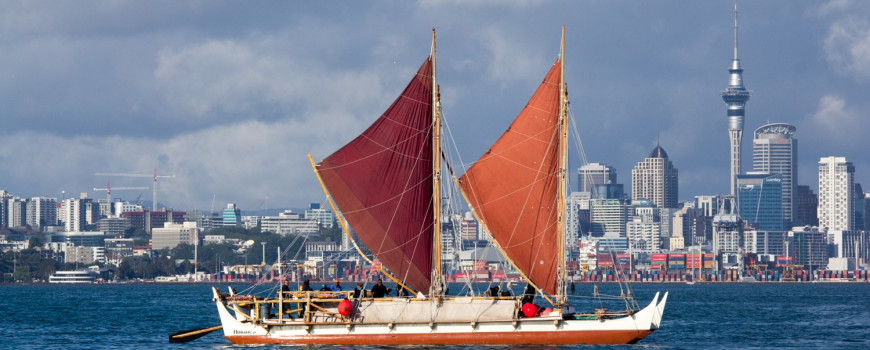
The Mālama Honua Worldwide Voyage sponsored by Hawaiian Airlines arrived in Auckland on December 7, 2014 (Hawaiʻi Standard Time). An event to welcome the traditional Polynesian voyaging canoes Hōkūle’a and Hikianalia took place at Karanga Plaza and featured warm greetings from Mayor Len Brown, leaders of the Maori voyaging community, representatives from the New Zealand Maritime Museum and from Auckland Tourism, Events and Economic Development (ATEED).

ATEED Chief Executive Brett O’Riley said the arrival of the fleet was a very unique and special sight which attracted spectators from Auckland’s strong and proud multicultural community. “Waka have been a significant part of Auckland’s history and the city is known in te reo Māori as Tāmaki Herenga Waka: Tāmaki, a place where many waka converge − representative of the hundreds of canoes that could be seen on Auckland’s harbors in the past.”

The voyaging canoes and their crew arrived in Okahu Bay for today’s welcome ceremony and will be docked at the New Zealand Maritime Museum through April, 2015. During their time in Aotearoa, Hōkūle’a and Hikianalia crew will engage with the community to share the education mission of Mālama Honua: working together to care for our Island Earth. Crew will build mālama honua collaborations between teachers and students in Hawai‘i and Aotearoa, and build on education and environment efforts throughout the Pacific that use traditional wisdom to safeguard the earth for future generations.

“Our arrival in Aotearoa has been a homecoming for Hōkūle’a and Hikianalia, a chance to renew our connection and the shared voyaging heritage of our people,” said navigator Bruce Blankenfeld. “We have much to learn from our family here, and it is a unique privilege to share the inspiring stories we have collected during these first legs of our voyage around the world.”

The current leg of the Mālama Honua Worldwide Voyage honors Hōkūle’a’s first voyage to Aotearoa nearly 30 years ago, retracing the routes of settlement used by her Polynesian ancestors. As a celebration of that rich history, this leg of the Mālama Honua voyage has carried the theme, “Nā Waka: A Tribe Returning Home.”

Continue Reading