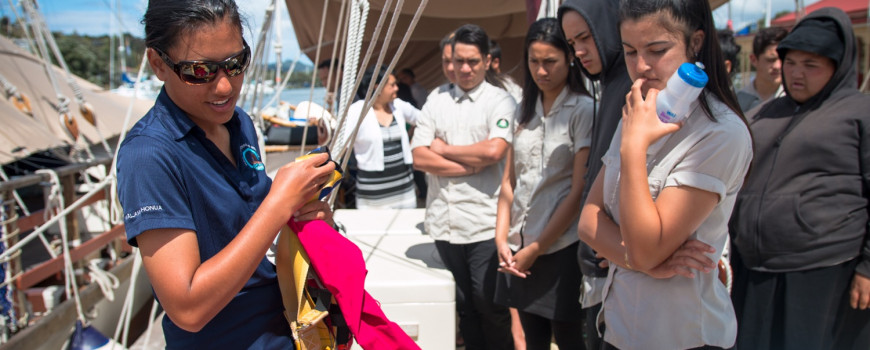
Good morning! Nakua Lind here in Napier Bay where we arrived this chilly morning. We are stopping for fresh produce and still heading down to Wellington. We have about 200 miles to Wellington. Other than that, we are enjoying the day here in Napier Bay and the cool breeze. Thank you for supporting us and follow us at Hokulea.com.
Nearly three decades ago, it was a sail of rediscovery. Now, Hōkūleʻa returned, carrying the message of Mālama Honua.
Pwo Navigator, Kālepa Baybayan says that, “Here we are in Whangarei. Weʻre going to be doing a number of outreach projects. We have an outreach program with the general community, and then we’ll be hosting schools groups. What we’re looking forward to over the next two weeks is really building and strengthening this relationship between us and the whanau here in Whangarei.
“We’ll have our stations out for science and education to talk more about the voyage and the mission, and then we’ll also have canoe tours,” says education specialist Daniel Lin.
Fellow crewmember, Kaʻohi Kamalu says that, “It’s very heartwarming to share the message of mālama honua with the people here in Whangarei, which is the port we are now at. I noticed that they have a lot of the same issues that theyʻre encountering with their own environment.”
“We want to hear about their stories of what theyʻre doing in terms about sustainability of the environment, of the ocean, of our ocean resources, and we just want to host this conversation, and record it, and collect it, so we can share it with the world,” says Baybayan.
And as can be expected, Hōkūleʻa attracted people from all walks of life, both young and old to the canoes. Some who are sailors themselves, as well as young learners who could very well be the next generation of wayfinders. By the end of the experience, the canoes were touched by over 700 people in Whangarei. In the coming months, the waʻa will visit more communities throughout Aotearoa. For the latest update on the Worldwide Voyage, visit Hokulea.com. This is Kuʻulei Bezilla with ʻŌiwiTV, home of the Worldwide Voyage. Aloha!
At 10am on the morning of January 8, 2014 (Hawaii Standard Time), the traditional voyaging canoe Hōkūleʻa departed Auckland Harbor to begin the next leg of the Worldwide Voyage. The canoe and crew now journey south along the eastern shores of New Zealand’s North Island to Wellington.
According to Dr. Nathan Wong, medical officer onboard Hōkūleʻa, the crew left under overcast skies but had been fortunate to receive fair weather in recent days as they provisioned the canoe. Crewmembers are in good spirits and excellent health.
If weather and sailing conditions are favorable, Hōkūleʻa will voyage to the South Island before continuing on to Wellington with arrival expected in late January.
It has been six months already, and it feels like we left Palekai, Hilo yesterday. But that was ages ago. I sailed with Hōkūle’a and Hikianalia from Hilo, Hawaiʻi to Auckland, Aotearoa. When we arrived in Aotearoa, I felt like I woke up from a long, long nap. I still can’t believe what has happened in the past six months of my life because it was just like a dream.
I realized people are the same on any island; how you look and what language you speak doesn’t really matter. We see more similarity than differences like Uncle Kealoha said through this Worldwide Voyage.
Life on the canoe, everything is so simple. It’s just the canoe, the ocean, and us. The moment when the canoe leaves the dock, everything changes like magic.
In any era, I believe kids are the only hope for the future. All the physical things will be gone someday, but our kids will be left along with natural environment that we are going to pass on. I want to leave it better than what we have right now.
After the canoes visited each place, I saw a picture in my mind of Hōkūle‘a and Hikianalia holding each island together like we hold hands. They have already connected Hawaiʻi to Aotearoa, and it will be all the way around the world in 2017. Every stop we made, we met a lot of people who became our “ʻohana” (family). I have been thinking what can I do for them? What can I give back? What is my responsibility? After thinking for a while, I ended up with “keiki” (children). Like people before us left all the gifts and shared everything with us. I want to share what I learned, what I saw, and what I felt on the canoe with kids. While on wa’a life, you see the most important things in your life so clearly.
The canoes will take us to a better world like how navigators take us to the next destination that we may not know but are full of hope.
This voyage is possible because we have an enormous amount of support by everyone. All the crew on board know that because of you and your support, we are here. I hope everyone knows that’s how much we appreciate you. A big arigatō goes to all my teachers, wa’a dads, sisters and brothers, and Hōkūleʻa and Hikianalia. Without you and all your help, I wouldn’t be here. Much Aloha!
In the end, mahalo to the Perkins ʻOhana for supporting Captain Bob, and congratulations to Kalā and her husband Daniel.
The voyaging canoe Hōkūleʻa is currently preparing for the next leg of the Mālama Honua Worldwide Voyage in Auckland, New Zealand. In recent days, crewmembers have been provisioning the canoe with food, water, safety equipment, and supplies for the journey that will take Hōkūleʻa from Auckland along the east coast of the North Island to Wellington. Departure is tentatively scheduled for January 7 (Hawaii Standard Time) / January 8 (New Zealand Standard Time) dependent on weather and sailing conditions.
After sailing more than 7,000 nautical miles in the last year, the crews of Hōkūleʻa and Hikianalia were fortunate to reconnect with countless communities throughout the Pacific to spread the message of Mālama Honua – Caring for our Island Earth. We extend our aloha and mahalo to our ʻohana throughout the Pacific and across the world who have voyaged with us.
“We have an enormous task in the issue of Mālama Honua I don’t believe that you’ll have people that will care for this earth if they don’t care. When is caring taught? When does that relationship to a place that you really understand a love for home, when does that happen?” says Pwo Navigator, Nainoa Thompson.
A love and respect for ʻāina or place is tied to an aloha for ʻohana… ties that are more than evident here in Waimea, home to the voyaging canoe Makaliʻi that was built by some of Hōkūleʻa’s original crewmembers. And now their own children are training even younger voyagers, who are well-connected to and care deeply for this place.
Pwo Navigator, Chadd Paishon says that, “They have been raised in that sense of being responsible. Being responsible in that overall sense that we contribute to the bigger community around us.”
Hōkūleʻa Crewmember, Leiʻohu Colburn says that, “Growing up in Waimea, not just your immediate family is raising you. I was raised by the whole Waimea community.”
Being raised by an extended family has its privilleges and to those whom much is given, much is expected.
“We want to do it, and not do it because we are told to do it, we want to do it because we know that’s what we have to do, what we want to do,” says Colburn.
“Because they come already with that value base, we can teach them all of the other things that they need to know,” says Paishon.
“This was my first voyage on a traditional double hulled canoe so I didn’t really know how it was going to be,” says Colburn.
This learning continued all throughout the voyage both on and off the canoe.
Hōkūleʻa Crewmember, Kaniela Anakalea-Buckley says that, “The voyage I thought would be just, you know, one big long sailing thing you know just about learning the wind and the waves, sailing, you know, you get from point A to point B but this voyage was a lot more than just sailing. You think about it the ocean doesn’t separate things, it connects it.”
Hōkūleʻa Crewmember, Pōmai Bertelmann, says, “I asked her I said you know Leiʻohu, what is it that you plan on doing um after you graduate? And she said waʻa. And so I told her I said well, you know, for every one tree that we put in the ground we have to, we take out of the ground, we have to plant more – So that our canoes can continue to be built and, it’s the forest that that allows us as kānaka to thrive. And from that conversation Leiʻohu eventually, chose her career path to be, Ag and Forestry.”
“I wanna be able to uh, put a Hawaiian forest on our mountain fill it back upand then from there, just expand,” says Colburn.
For these keiki who have grown up in and around the ʻohana waʻa, they see this experience through a whole new lens, one where the canoe and her values are almost innate.
“It’s something that can truly evolve because they already understand it at a very basic and very primal something that Mau had told the men after he had started to work with them in ‘75 and ‘76. You guys are too old, give me your sons,” says Bertelmann.
“If you wanna know the real deep essence and the real mana of navigation, you have got to be young enough to accept it,” says Thompson.
“When you are out there and only using the elements, um, and the navigators get you to your destination, going with their gut feeling. That was reassuring for all of us that we can depend on our naʻau and our kūpuna know, and we now know or are learning how to navigate that way,” says Colburn.
Paishon says that, “The next ones understand that do have a responsibility, you do have a purpose for being here.”
“Chaddy has lots of white hair now (laughs) so we are going to have to step up to the plate sooner or later,” says Colburn.
“There is gonna be a time where you know, we won’t be on the deck. Succession in leadership is where we are able to say at the end of our time, we did our job. It’s really beautiful to watch,” says Thompson.