Hawaiki Rising—A New Book by Sam Low, Scheduled for May Release

Honolulu, HI—

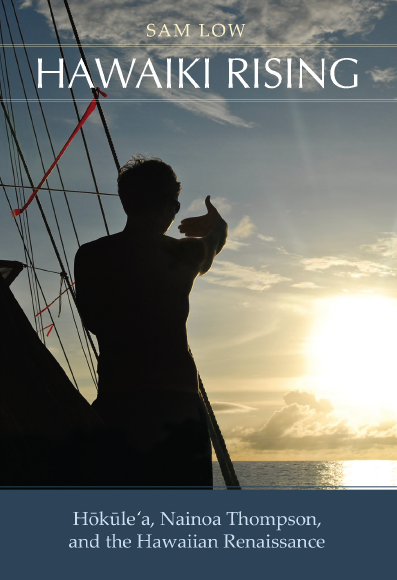
Hawaiki Rising: Hōkūleʻa, Nainoa Thompson, and the Hawaiian Renaissance, a new book by Hōkūleʻa crew member and documentor Sam Low, will be released in May, 2013. To read a synopsis and the forew0rd by Nainoa, go to Sam’s Hawaiki Rising web page. Low will be in Honolulu to present the book at the following events:

  • Hawaii Book and Music Festival (Sam, with Nainoa). Saturday, May 18, 2 PM.  at the Mission Memorial Auditorium
  • Hawaii Book and Music Festival. Saturday, May 18, Noon. Panel Discussion, “Hawai’i’s Story and Mine,” sponsored by Hawaii Council for the Humanities.
  • Na Mea Hawai’i/Native Books (at Ward Warehouse). Sunday, May 19,  3-5 PM.

hawaiki_rising_cover

What readers are saying about Hawaiki Rising:

The pacing is great. A good read. Fast, interesting… I adore the portraits of the various players, including minor ones – this is a huge strength of the book: your intimate knowledge of the people, the details of their own personal histories, how they came together to make this happen, what it meant to each of them. I think that is FANTASTIC and I haven’t seen it anywhere else…. I have got to tell you that I think this book is a classic. Really. There are a handful of books on this subject and every one of them is important, We the Navigators, East is a Big Bird, An Ocean in Mind etc., but your book is absolutely one of this group of four or five. It’s amazing. –Christina Thompson – author of the Come On shore and We Will Kill and Eat You All

It is a wonderful book: graceful, exciting, informative, well paced with lively action. You succeeded in the most difficult task. You put me right on the canoe. The education of Nainoa, with all its complications was a delight. I am with him in his doubts and worries and follow him in joy as he learns to trust himself. Mau comes across as a fully developed character and the difference and similarities with Nainoa made for an interesting story. All in all, a really fine job. I raced along, ran upstairs and printed out 50 pages at a time and ran back downstairs to “get back to sea…” –Michael J. Ambrosino, creator and executive producer  of PBS series Nova, Odyssey and The Ring of Truth

About the Author:

Sam Low served in the U.S. Navy in the Pacific from 1964 to 1966 and earned a Ph.D. degree from Harvard (in anthropology) in 1975. In 1983, after traveling throughout Polynesia, Sam produced his award winning film, The Navigators – Pathfinders of the Pacific, which told the story of the Polynesian settlement of the Pacific on PBS nationally and internationally on television venues throughout the world. He has sailed aboard Hokule’a on three voyages, from 1999 to 2007, and is the author of many articles on the canoe and her meaning to Polynesians.

Continue Reading

Hau‘oli lā piha makahiki, Hōkūle‘a! Happy Birthday, Hōkūle‘a!

METC, Honolulu, Hawai‘i—

Hau‘oli lā piha makahiki, Hōkūle‘a!

At 38 years young, Hōkūle‘a is at her strongest, fastest, lightest and most watertight she has ever been.  She is back in the water and, with her sister canoe Hikianalia, is sailing every week in preparation for the upcoming Worldwide Voyage.

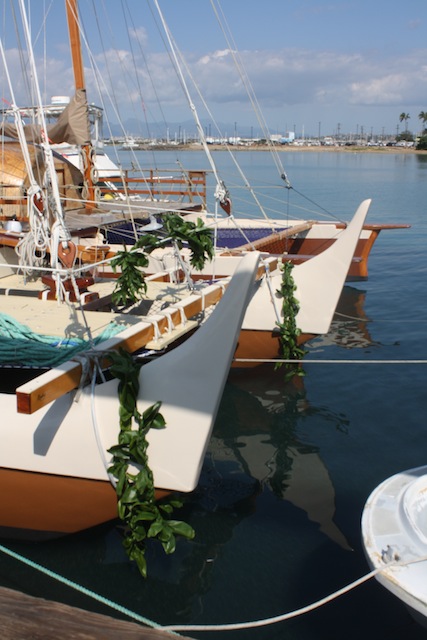
Hōkūle‘a was launched at Kualoa on March 8, 1975.  Since then she has logged more than 130,000 nautical miles.  She links us to our culture, the wisdom of our ancestors, our heritage of navigation and wayfinding.

Mahalo to Michelle Kapana-Baird and her ‘ohana for creating this exquisite lei for Hōkūle‘a’s birthday.

Hōkūle‘a is Hawai‘i’s canoe.  Come see her.

Continue Reading

Maui Training Sail

Maui, Hawai’i—

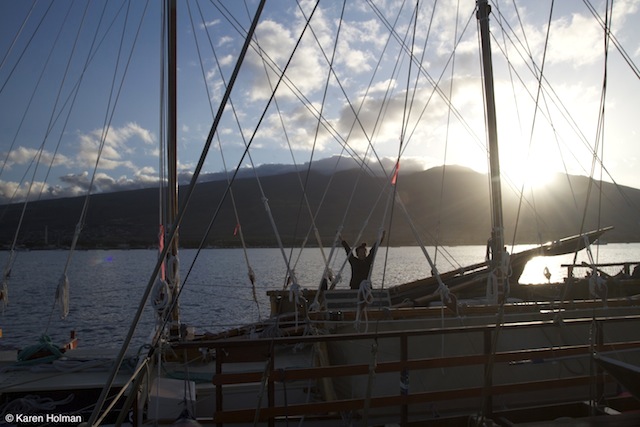
During our recent training sail to Maui, students from the University Lab School were able to virtually visit us aboard in a live Skype video call. In the calm waters off Lahaina, two very inspiring high school groups, actively involved in global initiatives, joined us from afar and provided an ideal scenario to pilot the Worldwide Voyage Education at Sea Program.

Our first group of students are part of the Global Leadership elective at University  Lab School. Currently, the students are researching organizations at each of the ports for year one of the voyage that Hokule’a and Hikianalia will soon embark on. They are highlighting and connecting with groups engaged in the core themes of the Worldwide Voyage, which include Culture, Leadership, Ocean, Voyaging, and Education (CLOVE), on both local and global levels. At the moment, they are researching Kiribati and how the local community is responding to threats associated with climate change, such as sea level rise.

Our second group of students are involved in an environmental stewardship and service learning program titled “Project Pono”.  They have started a project called Ma Ka ‘Aina Ka ‘Ike which fosters awareness and appreciating of our land and ocean through community restoration. They are also part of the International School Peace Garden Network, and are seeking to create a WWV peace garden mission on project N.O.A.H. Sponsored by National Geographic, project N.O.A.H (insert link http://www.projectnoah.org) is an online forum where people can post images of plants and animals in a unique from of global citizen science to document, explore and share wildlife sightings around the world. UH Lab students have created an online profile, documenting images of native and non-native species found in their school peace garden. They are sharing mo’olelo or stories of these organisms to highlight their relationship to Hawaii’s environment and culture. These students are inviting other Peace Garden schools around the world to create a Project N.O.A.H account as a platform to share native and culturally important species, as well as ways to promote peace and sustainability. Focusing on the ports Hokule’a and Hikianalia will visit, they are inviting students in these areas to become Peace Garden schools so that they can become a part of the Worldwide Voyage and the over-arching mission of Malama Honua, or care for the Earth. This is their vision:

Our dream is that schools around the world will do the same – start a Project N.O.A.H. mission for their school peace gardens, document and share about the organisms in their local environment, and help all of us learn more about the world we all live in.  We are all part of this “island Earth”, and information is part of the key to our efforts toward living peacefully and sustainably as a global community.

These students are doing incredible work with far-reaching impacts and it was truly a privilege to bring them on board with us virtually!

Prior to our sail, the UH Laboratory students researched a variety of topics about humpback whales. They watched a moving video about people disentangling a humpback whale, listened to whale song, engaged in an interactive activity simulating what it is like to be entangled and how difficult it can be to extricate oneself, and investigated whale behavior, migration patterns, and the current challenges facing humpback whales as an endangered species.

As a part of our education at sea, we also reached out to local whale experts, and interviewed Ka’au Abraham the Maui, Moloka’i, and Lanai Island Coordinator for the National Marine Humpback Whale Sanctuary. He shared with us the encouraging news that the population of North Pacific Humpback whales is on the increase, from an estimated 18,000 – 20,000 in 2004 – 2006 to an estimated 21,000 in 2011. He spoke about scientist theories about the behavior of breaching as a way of sloughing off skin to remove parasites, as a form of communication, or simply for play, or as one insightful student pointed out, “because they can.” He also discussed theories about whale song, which predominantly, have been thought to be a means of attracting females. More recent research has shown males singing in waters where females are not present, suggesting that it could also be a way to share information amongst male whales. Interestingly, males never sing the same song as it changes each season and can even be influenced by visits with other sub populations. Ka’au highlighted the fact that so much remains unknown, and that perhaps some of our local keiki might be inspired to become researchers themselves and help to uncover some of the mysteries surrounding humpback whales!

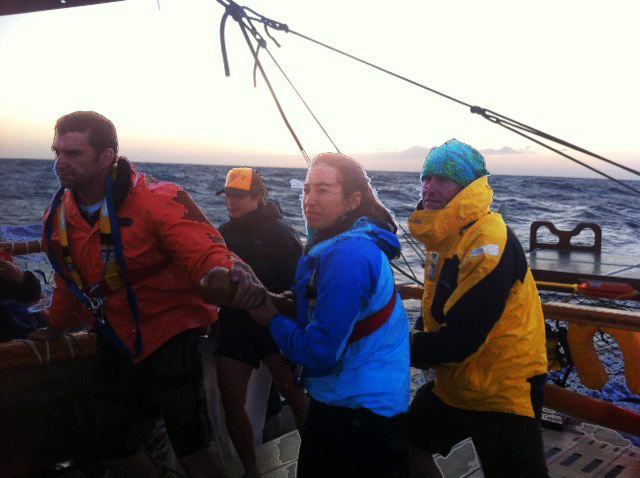
On board, we were able to give the students a tour of the canoe and share our daily activities, such as raising sails, steering the canoe, and preparing lunch. The students were able to see our sleeping and cooking areas, how we tether ourselves to the canoe in rough weather, and the sophisticated solar powered motors on Hikianalia that allow us to capture the energy of the sun through solar panels and power a small, quiet engine without harming the environment or generating fossil fuel emissions. We were able to share life on the canoe in a very immediate way and how the values of voyaging such as cooperation, aloha, kindness, and caring for our limited resources exist in parallel on the canoe and on land, informing life on our island Earth.

One student, inspired by seeing crew member Kealoha Hoe dressed in a malo, raised an interesting question about the cultural protocols on board. Kealoha shared his feelings about being on board as an opportunity to sail in the wake of our ancestors and connect with their experience. For Kealoha, the Worldwide Voyage is an opportunity to share Hawaiian culture with the world, but also to recognize that we are all one people, dependent on one ocean to sustain us. He spoke about proper protocol as originating from the heart, embodying what we feel.

Our ‘virtual video’ also provided us with an opportunity to share our science at sea, and one particular device we are testing called the plankton tow. The word ‘plankton’ is Greek for “drifter”, organisms that drift with the ocean currents, including plants (phytoplankton) and animals (zooplankton) that are the base of the food chain and are critical to marine food webs. A mesh net is attached to a collection chamber and trailed through the water.

We experimented with attaching the net to the canoe and also trailing it behind a snorkeler to see what we can find.

Both the mesh size of the net and the depth of sampling will determine the species collected. Anyone can search for plankton in both near and offshore waters. Homemade nets can even be home made from nylon stockings and metal coat hangers!

The exercise showed us that the ocean is full of life, from majestic whales to minute life forms invisible to the naked eye. Various forms of zooplankton and jellies are visible in the collection container and even more amplified under the microscope.

During the Worldwide Voyage, Hokule’a will represent our culture, heritage, and connection to our ancestors. She will be navigated using ancestral knowledge of star patterns, ocean movement, marine life, weather patterns, and other signs from nature. Hikianalia, her sister vessel will be a modern platform for science. As they sail together, merging the best of modern technology and ancestral wisdom, they will share stories from around the world as a catalyst for positive change. To connect with the inspiring students of the UH Laboratory school in our home islands, and learn how they are networking with global communities, was an exciting window into what awaits. The dreams of our youth are a vision of change for today and for a future of sustainability and peace for generations to come.

Posted by Karen Holman; Photos by Karen Holman and Keli Takenaga
Continue Reading

Hōkūle‘a & Hikianalia: First WWV Training Sail Together

Blog by Karen Holman—

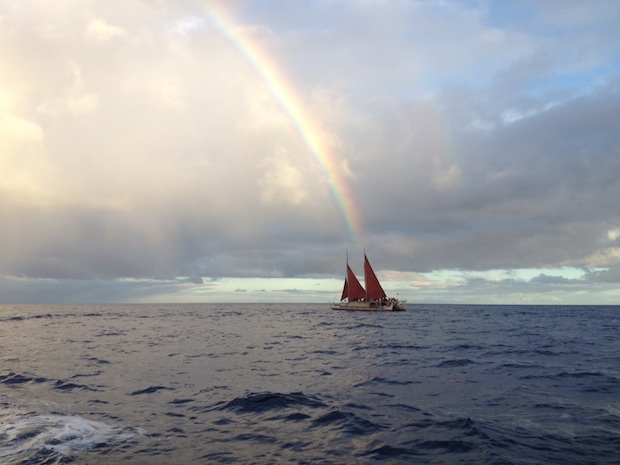
Hōkūle’a is infinitely surrounded by nature’s wonders, at times in the form of subtle whispers, and at others, in the fierce, jolting beauty of the open sea. At each significant moment, as she enters or leaves the water for dry dock, expansive rainbows have stretched across the sky.

Today, March 4th, 2013 is her first sail with her sister vessel Hikianalia. Just as the two stars, Hikianalia and Hōkūle’a rise and set together across the sphere of the night sky, so too do the two canoes parallel each other as they sail across the curvature of the Earth.

hokulea_training_sail_03-01-2013

A seemingly parallel lifetime also unfolds at sea, seeped in new perspectives… the crevassed storylines of the Ko’olau range, the silver, luminous light that creates pathways across the ocean in the late afternoon, the momentum and power of the ocean swells, and the unimaginable blue green color of icebergs that appear at the tip of a breaking wave.

hokulea1_brightened

Witnessing Hōkūle’a as a speck amidst the vast blue reminds us of why we sail. The Worldwide Voyage carries the message of Mālama Honua, to care for the Earth, our precious island floating in the vastness of space, and deeply in need of our care now as never before.

On this occasion, we sail to join the humpback whales, nomadic and majestic animals that, as voyagers of the sea, share many parallels with us.

In the Pailolo channel, between Maui and Molokai, Barbara and Greg MacGillivray of “One World, One Ocean” will be filming Hōkūle’a amongst the whales, as near natural companions, both gliding seamlessly through the sea and leaving a powerful mana in their wake.

Simultaneously, this sail is an ideal opportunity for crew training. Captain Bruce reminded us that every knot we tie, every sail we raise, and indeed every experience we have on the canoe deepens our knowledge of the sea.

We will also use this opportunity to test communication between the two vessels and pilot the education at sea program for the upcoming Worldwide Voyage. Students at Kamaile Academy have spent the week researching a myriad of topics related to humpback whales, such as their migration patterns, behaviors, song, cultural significance, and the threats and challenges humpback whales face as an endangered species.

We will test out a Skype video call from canoe to classroom and interview the staff at the National Marine Humpback Whale Sanctuary.

Several scientists are offering proposals for research to be carried out as the canoes circumnavigate the planet. One is a simple but fascinating set up that allows us to trail a ‘sock’ made of a fine mesh in the water to gather plankton. We can then examine the findings under a microscope and find a variety of tiny organisms! It is as though we are watching the ocean from a microscopic level of all that is invisible to the naked eye, to the macro world of large whales; beckoning us to consider the interconnectedness of all life.

It is a special gift to sail Hikianalia and Hōkūle’a together for the first time alongside our remarkable cousins, and to be immersed in whales as teachers while the crew trains for the worldwide voyage. To witness a whale breaching enables us to see through the eyes of a child again, to be completely present in this moment here and now, a focus so necessary for a journey as momentous as the Worldwide Voyage

The sun has just descended below the horizon and just as we spoke of the humpback whale or kohalā as being the kinolau or animal manifestation of the canoe, whale and her calf surfaced 5 feet from our bow, so close that we could feel her breath dissipate into the air around us. First came the feeling of magic and awe, then came a sense of responsibility for the future.

Continue Reading

Hōkūle‘a to Join Hikianalia in Sea Trials and Crew Training for the WWV

Mokauea, O‘ahu, Hawai‘i—

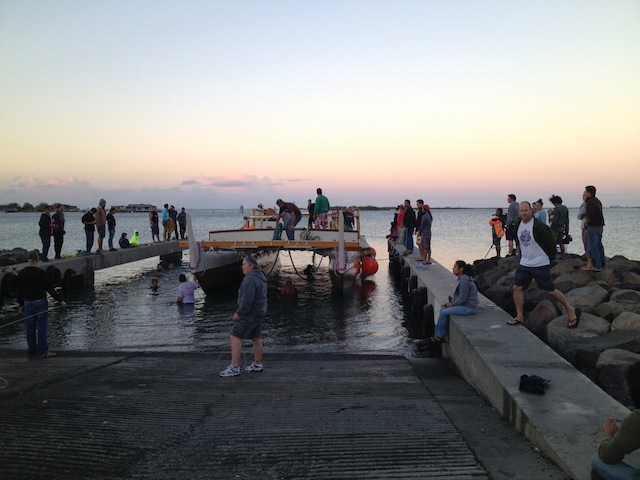
The Polynesian canoe Hōkūle‘a will return to the water this Saturday, February 23, at the Marine Education & Training Center, Sand Island Parkway, beginning final sea trials for the upcoming Worldwide Voyage.

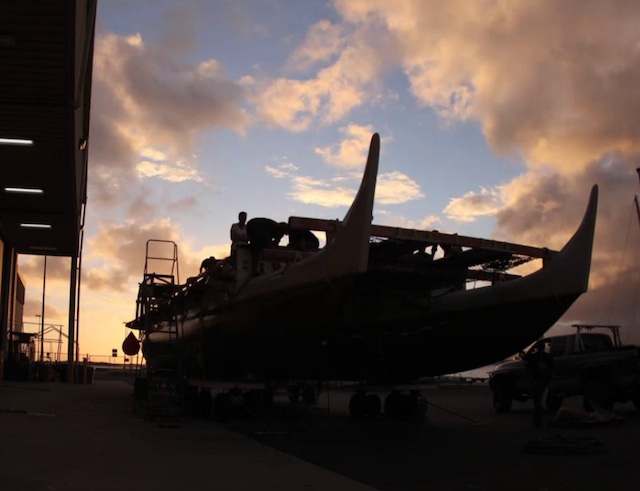
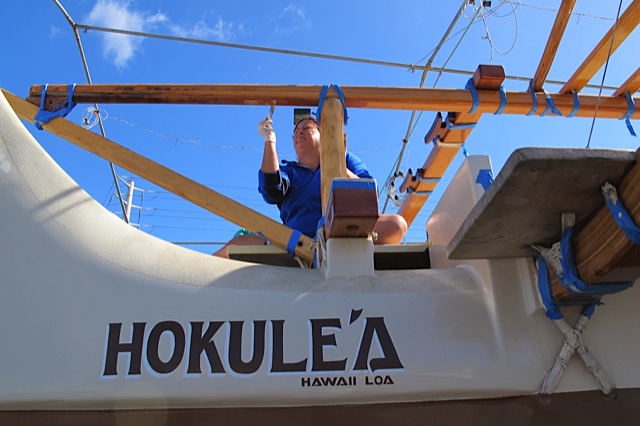
Hōkūle‘a came out of the water on September 5, 2012 for some cleaning and tightening.  One of the first tasks was to clean and prepare the hulls for a final painting.  Her solar panels have been repositioned, deck boxes have been refined, rigging has be re-lashed, below deck shelving and bunk boards have been rebuilt, and she’s been repainted.  More than 3,000 feet of rope, safety netting and more than 20 gallons of paint have gone into this tune-up. In addition, more than 2,200 volunteer hours, professional services and labor, have been put in at dry dock since September. (For photos of dry dock work, see the previous blog.)

“We spent these past few months taking care of a few fine adjustments,” explained Pwo Navigator and Dry Dock Coordinator Bruce Blankenfeld.  Hōkūle‘a, originally launched in 1975, was completely overhauled recently, splashing back into the water on March 8, 2012.  “During that time Hōkūle‘a was taken apart completely, cleaned and rebuilt piece by piece, making her stronger, lighter and faster—ready to sail for another 37 years.”

Hōkūle‘a will join with the Society’s new canoe, Hikianalia, in the water for the first time.  Together they will undergo sea trials—testing the vessels and training crewmembers—in preparation for the monumental Worldwide Voyage (WWV), which is being planned to start in June 2013.

“We are looking forward to sailing together, Hōkūle‘a and Hikianalia – sister stars, sister canoes,” says PVS President and Pwo Navigator Nainoa Thompson.

Planning to depart in early June of this year, WWV will spend the first year in the Pacific.  Over three years, WWV will visit more than 60 ports in more than 20 countries.

Thompson looks to the future, “We are ready to embark on a voyage that will share ancestral wisdom, messages of peace, and hope for our children.  The canoe is like planet Earth.  As we care for the wa‘a and each other, we will carry those values that inspire us all to care for planet Earth and all her resources.”

The community is welcome to support the re-launch of Hōkūle‘a this weekend at the Marine Education & Training Center, Sand Island Parkway:

Friday, February 22, evening

  • Hōkūle‘a  will be prepped and loaded onto dollies

Saturday, February 23, 5:00 AM

  • Gathering and blessings
  • Hōkūle‘a splashdown

“Hōkūle‘a has always been Hawai‘is canoe,” asserts Blankenfeld.  “She belongs to Hawai‘i.  We encourage everyone to come out and see her.”

Continue Reading

Ready to Sail Again: Re-Launching Hōkūle‘a

Mahalo nui to the crew and community volunteers for preparing Hōkūle‘a for the Worldwide Voyage (WWV)!

After over six months in drydock for modifications, fixes, and finishes before the start of the WWV, Hōkūle‘a is set for re-launching on Saturday, Feb. 23, at dawn at Honolulu Community College’s  Marine Education and Training Center (METC).

The public is welcome to attend the launching.

Working on Hōkūleʻa: 24 Photos from Keli Takenaga (Click on any photo to activate a slide show.)

2013_drydock1

2013_drydock2

2013_drydock3

2013_drydock4

2013_drydock5

2013_drydock6

2013_drydock7

2013_drydock8

2013_drydock9

2013_drydock10

2013_drydock11

2013_drydock12

2013_drydock13

2013_drydock14

2013_drydock15

2013_drydock16

2013_drydock17

2013_drydock18

2013_drydock19

2013_drydock20

2013_drydock21

2013_drydock22

2013_drydock23

2013_drydock24

Continue Reading