Hōkūleʻa Update | December 24, 2015 Hōkūleʻa Departs Cape Town

CAPE TOWN, SOUTH AFRICA

IMG_9896

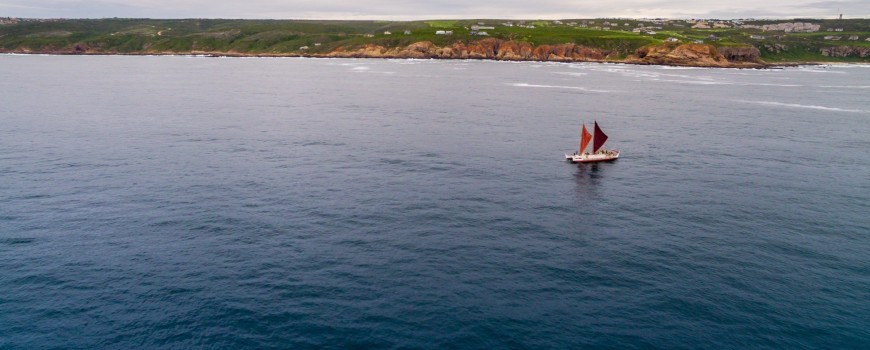
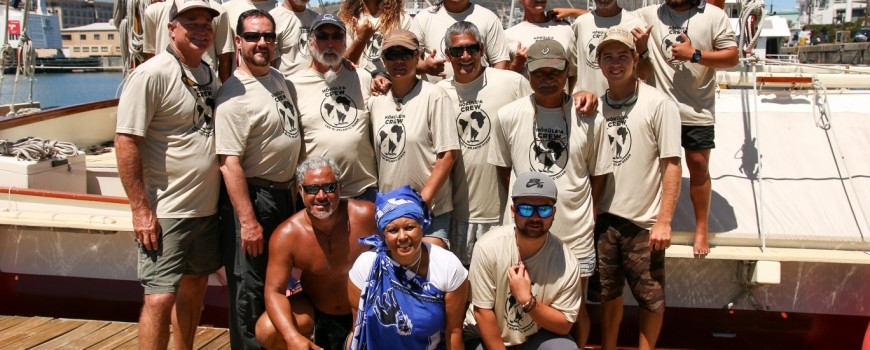
 Legendary voyaging canoe Hokulea, which is now almost exactly halfway around the world from the starting point of Honolulu, Hawaii, set sail today for Brazil, South America’s largest country both geographically and in terms of its population. Hōkūleʻa and her escort vessel Gershon II depart South Africa, which welcomed crewmembers and the Hawaiʻi delegation to the region for more than two months.  Crews had the opportunity to share Hōkūleʻa’s story of inspiration, discover stories of hope from the diverse cultures of South Africa, visit the point of origin of modern thinking man and honor Archbishop Desmond Tutu-one of the great navigators of Island Earth.

Now on the midway point of the epic Malama Honua Worldwide Voyage, Hōkūleʻa will be venturing into the Atlantic Ocean for the first time in her 40-year history. This current sail will be the longest leg of the voyage at approximately 4,200 nautical miles. Hōkūleʻa will be on Atlantic Ocean waters during Christmas and over the holidays.

Hōkūleʻa’s most current sail plans after departing Cape Town include a stop in January at the island of St. Helena, located in a British Overseas Territory in the southern Atlantic Ocean midway between Africa and South America (approximately 1,400 miles from Brazil).  The canoe also will spot the island of Ascension, which is also part of the Territory.  After a few days of provisioning and other preparations, Hōkūleʻa’s crew will continue to voyage across the Atlantic Ocean and is expected to stop at Ilha Fernando de Noronha, Brazil, an archipelago and UNESCO Marine World Heritage site, where the crew will engage in cultural and educational exchange.  The crew of Hōkūleʻa is planning to make landfall in South America at the coastal city of Natal, Rio Grande do Norte, located in northeastern Brazil, in late January.

After stopping in Brazil, Hōkūleʻa will continue the Malama Honua Worldwide Voyage and stop in ports in the Caribbean before sailing up and visiting cities along the East Coast of the United States.  She is scheduled to arrive in New York City by June 8, 2016, for World Oceans Day.


Please help keep us sailing for future generations. All contributions make a difference for our voyage. Mahalo nui loa!
Continue Reading

Hōkūleʻa Update | Preparing for the Longest Leg of the Worldwide Voyage

After undergoing ten days of dry dock maintenance and other preparations in Cape Town, South Africa, Hōkūleʻa is ready to continue the Mālama Honua Worldwide Voyage and set sail across the Atlantic Ocean for the first time in history. Scheduled to depart South Africa for South America on December 23, 2015 (South Africa time), weather permitting, Hōkūleʻa will be in prime condition to sail the longest leg of the voyage. 

IMG_9464

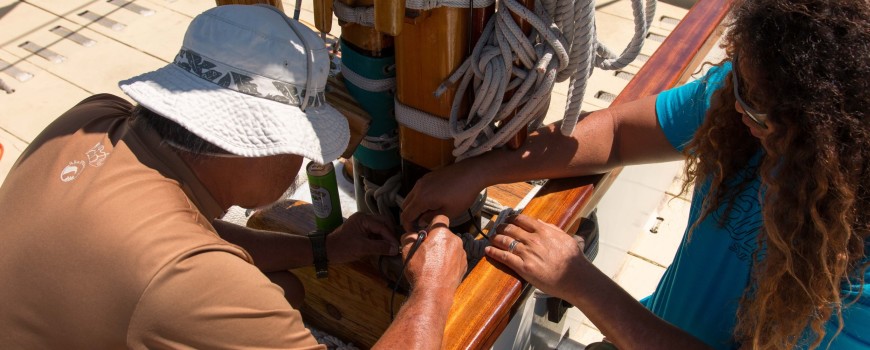
Led by Captain Bruce Blankenfeld and navigator Kaleo Wong, the crew members who will be sailing Hōkūleʻa to Brazil have been spending the last few days loading the canoe with provisions and water for the voyage as well as reloading everything that was taken off and stored during dry dock. The crew has also been undergoing additional training and has been testing and fine tuning all supplies and equipment in preparation for departure.

Last month, nine crewmembers from Hawaii went to Cape Town and spent a week and a half inspecting and conducting annual maintenance work on the deck, steering paddles, catwalks, railings, mast and the bottom of the canoe.

IMG_9548

“After sailing more than 6,000 nautical miles from Indonesia to South Africa through the treacherous conditions of the Indian Ocean, Hōkūleʻa endured some minor damage and wear and tear that required repair before her next journey to South America,” said Blankenfeld. “After 10 long days of work by our dry dock crew, she is looking good and ready to set sail again,” he added.

IMG_9208

After departing Cape Town, Hōkūleʻa’s crew will sail for approximately two weeks until they make landfall at St. Helena, a British Overseas Territory in the Atlantic Ocean, on the way to Brazil. The estimated distance between South Africa and Brazil is 4,200 nautical miles. The crew also plans to stop at the UNESCO Marine World Heritage site in Ilha Fernando de Noronha for cultural and educational exchange en route to Natal. Weather and safety permitting, Hokulea is expected to arrive in mainland Brazil at the end of January.


Please help keep us sailing for future generations. All contributions make a difference for our voyage. Mahalo nui loa!

Hōkūleʻa Update | Visit to Table Mountain

“The sight of Table Mountain pulls you to nature, you want to be a part of it.”

As the crew of Hōkūleʻa prepares for departure from Cape Town, the Leg 16 crew retraced the route of many (including our own Leg 15 crew, Hawaiʻi Cape Town Delegation, and the Dry Dock crew) in visiting Table Mountain, the most recognized landmark in the Cape Town area.

IMG_0908

Truly one of the natural wonders of the world, the name given to the mountain by the Khoi, the ancestral people of the region, “Hoerikwaggo” means “Mountain of the Sea.” A centurion of the seas, Table Mountain towers over the mixing currents of the Indian Ocean and the Atlantic Ocean. Just off the coast at the Cape of Good Hope, the cold Benguela current from the Atlantic Ocean converges with the warm tropical Agulhas current creating an unparalleled, rich marine ecosystem. Table Mountain is also home to an incredible diversity of endemic species including the Cape Floral Kingdom.  The Cape Floral Kingdom is the smallest of the worldʻs six plant kingdoms, but it is the richest for it size with over 8500 distinct species, many of which grow nowhere else (just like our home Hawaiʻi, which is also known for its unique species and biodiversity).  The top of the mountain is glazed with beautiful rocks and plant life. This granite and sandstone plateau, was formed and shaped by the greatest powers on earth – volcanic and glacial action – 520 million years ago.  It is six times older than the Himalayas and one of the world’s oldest mountains; in comparison, our majestic Mauna Kea is the youngest of the world’s mountains.

IMG_0927

This Mountain of the Sea also looked over Nelson Mandela as the freedom fighter was imprisoned on Robben Island, a powerful reminder to him that freedom stands strong.   Similarly, as Hōkūleʻa and her crew prepare to continue our sail around the world to care for, protect and celebrate the inspiration of our Island Earth, we float under the protective watch of Hoerikwaggo, comforted by its strength and resilience.


Please help keep us sailing for future generations. All contributions make a difference for our voyage. Mahalo nui loa!
Continue Reading

2015 Worldwide Voyage Recap

Forty years after launching from the sacred shores of Kualoa, Hawaiʻi on March 8, 1975, our Polynesian voyaging canoe Hōkūleʻa continues to make history.

In the second year of the Mālama Honua Worldwide Voyage, we left our home waters of the Pacific and ventured into the Tasman Sea and Indian Ocean. In communities across Aotearoa (New Zealand), Australia, Indonesia, Mauritius, and South Africa, our crews on board Hōkūleʻa and her escort vessel Gershon II found strong commonality with the people and stories we met.

Now at the end of 2015, Hōkūleʻa arrived on the eastern shore of Africa, marking the return of the youngest culture on earth to the origin of humanity. With Cape Town, South Africa, as the halfway point of the Mālama Honua Worldwide Voyage, every mile we sail from now on is a mile closer to home.


Help us make history

As the mainstay of support to PVS, our members are allowing us to voyage beyond the boundaries of Polynesia to inspire a global movement to care for our earth.

Crew Blog | Michelle Knoetgen: Carry These Islands to Africa

“It was after I went to South Africa that I became what I am now.” — Mohandas K. Gandhi

When crossing the tumultuous Mozambique Channel and rounding Africa’s treacherous Cape of Good Hope, Hōkūle’a needed a light crew of seasoned watermen and women to safely guide her. Those talented sailors were accompanied along the coast by numerous “land crew” members: a Hawaiian delegation of students, educators, and documentarians who researched and planned for months to help make the education mission of the Mālama Honua Worldwide Voyage successful. Supported by ‘Iolani through my 2015-16 sabbatical, I was fortunate to be part of this delegation.

A small group of us planned to arrive early, ahead of the larger crew, so that we could visit schools in Durban and Richards Bay, Kwa-Zulu Natal. It was important to us to make this journey because these were places where Hōkūle’a had docked, but not the main site of planned educational engagement, which was the mother city of Cape Town.

After four days of flying on six different planes alongside Megan Kawatachi ‘93, my invaluable traveling companion, we woke up halfway around the world in Durban and got ready for our first school visits. Soon after breakfast, we were honored to be picked up (or “fetched” as they say in South Africa) by Ela Gandhi, peace activist, former Member of the South African Parliament, and granddaughter of Mohandas K. Gandhi. Elaji arranged two school visits for us just north of Durban in Inanda on the Phoenix Settlement, over 100 acres of communal land established by Mohandas K. Gandhi in 1904.

Elaji escorted us in her unassuming, standard transmission Toyota Corolla and navigated the busy streets of Durban while telling us about the fifteen non-profit organizations that she serves, including the Gandhi Development Trust whose primary focus is on promoting peace, and supporting economic sustainability through development and empowerment. She is 75 years old. Elaji is just one of the many inspirational people we met in South Africa who lives to serve and improve the world around her.

At the Phoenix Settlement we were warmly welcomed by the principal and students of Kasturba Gandhi Primary School, named in honor of Elaji’s grandmother, Gandhiji’s wife and an unsung heroine of history who served six years in prison for leading peaceful protests in the name of racial equality, women’s rights, and worker’s compensation. We learned more about Kasturba and Gandhiji’s role in the struggle for liberation in South Africa and India from Elaji when she took us through the Gandhi museum on the settlement. It was an incredible experience to have her as our guide of the museum that she helped to envision and curate, which was also the house in which she spent her youth: Gandhi’s original house that was reconstructed after being razed to the ground in 1985 by Apartheid violence. Perhaps not coincidentally, Elaji was born in the bedroom that is now the “inspiration room,” which pays homage to the sources of Gandhi’s transformation, notably including Leo Tolstoy, John Ruskin, and the Sermon on the Mount.

 “The highest reward for man’s toil is not what he gets for it, but what he becomes by it.” –John Ruskin

For our next stop in Richards Bay, we were graciously hosted by Zululand Hospice who arranged our school visits at Mzingazi Primary and Kati Primary in semi-rural areas of Kwa-Zulu Natal. In a powerful moment that brought me to tears, the Hospice employees shared their morning songs and prayers with us, their voices reverberating through the room as they praised God and asked for the strength and compassion that their job requires.

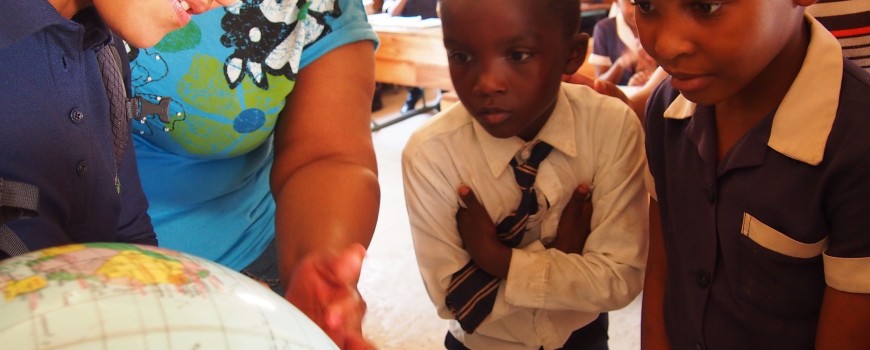
At the schools, we realized that not everyone has electricity in their classrooms, and not everyone has roofs over their administrative offices. We also realized that some students had heard of Hawai’i, though many had not. In a sixth grade social studies class, we used an inflatable globe to show Hawai’i as Africa’s antipode. We told the story of Hōkūle’a and of Eddie Aikau. We taught the students to sing songs in Hawaiian and to perform a Hawaiian haka, which they picked up really quickly. Most students speak at least three languages: English, Afrikaans, and Zulu.

Our visit with the preschool children was brief, but tender. We told them a story and sang songs with them in Hawaiian, including “‘Imo ‘Imo Hōkū iki” (“Twinkle, Twinkle Little Star”). For the older students we answered their many questions about Hawai’i and voyaging and discussed the similarities between the Hawaiian concept of “aloha” and the Zulu word “sawubona” (a greeting with multiple meanings including “I see you”). We also taught them the meaning of “mālama honua” (to care for the earth) which a few girls wrote in pen on their arms to help them remember.

After four days in Kwa-Zulu Natal, we returned to Cape Town to join the larger delegation, including the twelve students who formed Ke Kā O Makali’i, the name given to the group of eight Kamehameha Schools Kapālama and four Hālau Kū Māna Charter School students who were chosen for the trip. Ke Kā O Makali’i (The Canoe Bailer of Makaliʻi) is the name of a star line that is about to rise in the night sky above Hawaiʻi as well as South Africa.

Traveling and visiting schools with the students of Hawai’i enhanced the experience for everyone. Their gift of hula and mele made it possible for us to carry these islands to Africa. While we were hosted by Archbishop Emeritus Desmond Tutu, the students presented a mele inoa (name song) to him. What a meaningful and lasting gift to honor this man and his legacy!

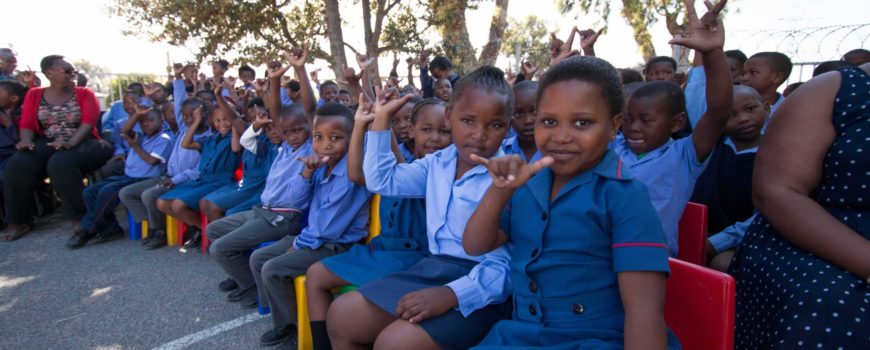
Another poignant exchange was the Tutudesk Ceremony at St. Mary’s Catholic Primary School near Cape Town. Tutudesks are lap desks that students are able to take home which enable them to take pride in their work. The Polynesian Voyaging Society gifted 1,000 Mālama Honua-inspired Tutudesks to township schools in Durban, and fifty desks to St. Mary’s. At the ceremony, Ke Kā O Makali’i performed hula, then a group of students from St. Mary’s shared their traditional Zulu songs and dances, using the Hawaiian pahu (drum) that Ke Kā O Makali’i brought. The local dance group arrived with a bucket they were going to use as their instrument but as Tehani McLean (Kamehameha student) remembered, “there was a girl that asked to use the pahu for their dance…it felt like there was a wall between us and them, and when they used the pahu it helped to bridge the gap.” The African dancers then invited Ke Kā O Makali’i to dance with them. As I watched all of the students dancing together, a blend of Hawaiian and African movements, time seemed to stand still and the world felt smaller.

This unforgettable journey helped students and teachers to appreciate what we have and reminded us to mālama our resources. The warm reception from our African brothers and sisters reiterated that we are all one people, and it strengthened our partnership in the community of being.

To read more about my experiences while on sabbatical with the Worldwide Voyage, please visit my blog: www.shellkanoe.wordpress.com. Twitter and Instagram: @shellknoets.


Please help keep us sailing for future generations. All contributions make a difference for our voyage. Mahalo nui loa!

Tutudesks

Following Hōkūleʻa’s momentous arrival in Cape Town, South Africa, crewmembers and a delegation of Hawaii students, teachers and families visited St. Mary’s Catholic Primary School to present 50 Tutudesks featuring artwork inspired by the Mālama Honua Worldwide Voyage.

A shortage of over 95 million school desks has hindered literacy development in Sub-saharan Africa. The Tutudesk initiative aims to provide 20 million lap desks to students across Sub-saharan Africa by 2020.

IMG_6141Vuyiswa Lebenya, Principal at St. Mary’s Catholic Primary School, said, “Education is very important. So this lap desk will help them, because they are going to have space at home to do their homework. Even in the classroom, it’s going to help the teacher to do individual work with each child.”

 After the presentation, students from Hawaiʻi and the student’s of St. Mary’s Catholic Primary School shared in a cultural exchange.

IMG_6343Nainoa Thompson, President of the Polynesian Voyaging Society, said, “To have this celebration half way around the world with South Africa’s children, it’s our children and so I just think I’m very, feel very humbled and honored to have a chance to be here in the moment. What was so amazing was our children joined their children and they danced together. That’s what world peace is about. This was a very deep, powerful experience for me and I think for everybody and it’s a precious moment precious time, lucky to be here.”

IMG_6086Lebenya said, “It was inspiring, it was inspiring for the children. And they enjoyed it and what I like most in this is children will learn how important education is. They enjoyed it, they enjoyed. I feel blessed.”  

An additional 1,000 mālama honua inspired desks will be delivered to township schools in the Durban, South Africa area in early 2016. 


Please help keep us sailing for future generations. All contributions make a difference for our voyage. Mahalo nui loa!

The Surfer Kids

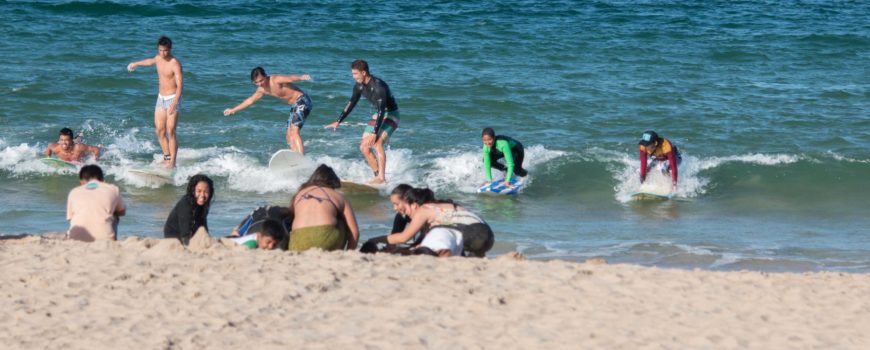
The Surfer Kids, a non-profit organization founded in South Africa, encourages local youth to overcome fear and explore the wonders of the ocean through surfing.

Hermann Vivier, Chairman of The Surfer Kids, said, “Well the idea is to to teach the kids to do something that that they donʻt generally do, that theyʻre not generally exposed to. So the kids we work with come from a community where water is a very unfamiliar playground. Well itʻs not a playground at all, itʻs something to be feared. So we teach them surfing as a way to get over that, get over that fear and itʻs a very empowering process. Our mission statement is the empowerment of youth from marginalized communities through surfing.”

IMG_7980

While in Mossel Bay, the Hōkūleʻa crew along with students from the Kamehameha Schools and Hālau Kū Māna spent a day connecting with these kids.

Hōkūleʻa Crewmember Jenna Ishii said, “At first they were a little fearful about surfing and they just wanted to hold on to you. I think once you gain the trust from them, they just love it. So it was the best way to just get to know the kids. We had our Hawaiian kids out there and then we had the kids from here, from Mossel bay and so weʻre just trying to let them interact with each other and just let them love the ocean and show them how much we love it and make them feel like itʻs really awesome out there, nothing to be scared about.”

IMG_8074

Vivier said, “Itʻs cool to see the kids connect with somebody that they donʻt speak the same language, they donʻt know each otherʻs names, they’ve never met before, but then you’ve got this playground, you got the ocean and itʻs just this connection. Itʻs really cool to see people connect like that, not everyday you see that.To see that connection, makes me feel warm inside, but on the outside Iʻm still quite chilly.”


Please help keep us sailing for future generations. All contributions make a difference for our voyage. Mahalo nui loa!

Hōkūleʻa Update | Cape Agulhas

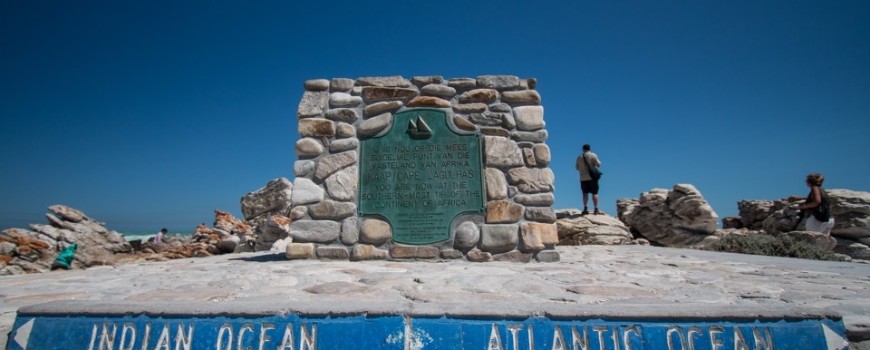
Worldwide Voyage crewmembers and students of Ke Kā o Makaliʻi visit Cape Agulhas, South Africa, the meeting point of the Indian and Atlantic Oceans. Hōkūleʻa had sailed past this point en route to Cape Town.

About Cape Agulhas

Geographical extremes capture the imagination. From ancient mariners to contemporary mankind, the quest has always been to reach the poles, sail around the tips of continents, conquer the highest peaks and dive to the ultimate depths.

IMG_8512This is the same spirit that captivated the explorers of yesteryear who braved one of the most challenging sea crossings of their time: the Atlantic-Indian Ocean crossing via Cape Agulhas. As the southern-most tip of Africa, it has always had its mysteries and adventure, and still captures the imagination of contemporary explorers.

IMG_8390Amongst the mysteries associated with this region, is the legendary ‘Cape of Storms’ which wrecked many ships en route to the east via Cape Agulhas. Ancient people also left their mark on the landscape. For example, archaeological middens remind contemporary man of a successful hunter-gathering culture that was in harmony with its natural environment; and a cultural heritage that dates back thousands of years to when the Khoi-Khoi people trapped fish using ingeniously constructed tidal traps.

IMG_8380This windswept, ruggedly beautiful coastal plain at the southernmost tip of Africa, with its rich cultural and natural heritage, was proclaimed as the Agulhas National Park on the 23rd of September 1999. The park started as a 4 hectare portion of land at the southern tip and has grown through the additions of 36 portions, bringing the area of the Park to nearly 22,000 hectares. (South African National Parks)


Please help keep us sailing for future generations. All contributions make a difference for our voyage. Mahalo nui loa!