Voyage of Wisdom

World renowned oceanographer Dr. Sylvia Earle reflected, “I had an opportunity to go to Midway Island, way out there at the outermost part of this beautiful island.  I met a lot of wild creatures there, including a bird.  This bird, named Wisdom, was banded in the 1950s, so we know how old she is, so we know that she’s flown thousands of miles voyaging over the sea. And surely in that time she has seen changes. The way those of us who’ve lived a few decades have witnessed changes, more change than during all preceding human history.”

Susan White, Superintendent of Operations for the Pacific Marine National Monument stated, “Wisdom is a story of hope for, for all of the environmental problems in the world, Wisdom is alive and thriving, as old as she is and itʻs a testament to the health of Papahanaumokuakea and the health of that system and the work thatʻs gone on to protect and conserve that, and to understand that place for generations and millennia.”

Beth Flint, a Wildlife Biologist for the Pacific Marine National Monument added, “Albatrosses are particularly good at giving you a sense of the health of the ocean on a global scale because they fly so far. So every season Wisdom goes out foraging, and can fly about 10,000 miles in a shopping trip. She goes all the way up to Bering Sea, she goes way over to the Western Tropic, the Western North Pacific. She’s flying tens of thousands of miles every year and sampling the prey, the food in the ocean, from this huge area. So we get information about what kind of contaminants are out there affecting the food. So there’s a lot of ways that an albatross is sampling and telling us about the entire North Pacific.”

After traveling thousands of miles each year, Wisdom, the oldest documented bird in the wild, returns to Midway Atoll National Wildlife Refuge with a belly full of food for her newly hatched chick.

Ann Bell, Outreach Specialist for the Pacific Marine National Monument, USFWS, announced, “We have some super exciting news to announce. Wisdom, the worldʻs oldest known bird in the wild, who is at least 65 years old, she might be older, her egg just hatched on Febuary 1st. It was an egg she laid at the end of November, just right after Thanksgiving and for the last two weeks, sitting on the egg has been Wisdomʻs mate. Once the egg hatched just last week on Febuary 1st, he continued to try to feed the chick although there wasnʻt much left in his stomach for him to feed the chick with so we were anxiously waiting for Wisdom to return and she showed up last night with her belly full.”

Her healthy offspring will aid a new generation of navigators to find distant shores beyond the horizon.

Dr. Earle said, “Now I think of Wisdom and her voyages out every year coming back to the same place and I think of the voyagers taking off on this worldwide expedition, this mission. And there’s some kind of element here of synergy. This is a moment in time as never before and maybe as never again to take this knowledge, take this wisdom and change the way we do things. We have to. We have to shift our consumption of the natural world into making peace with nature making peace among ourselves.  This is the moment to secure for the kids coming along whether they are the young birds who are taking off on their own voyages or whether they its our own children.  We have a chance to get it right.”

Wisdom’s chick has been named Kūkini, meaning messenger, and her mate has been named Akeakamai, or “lover of Wisdom.” Kūkini is healthy as both parents are working hard to forage for food at sea and bring it back to the nest.


Crossing North

After a 20-month sojourn in oceans south of the equator, Hōkūleʻa has returned to the northern hemisphere in the blue waters of the Atlantic. Please, help celebrate our crew by supporting their journey.
Hōkūleʻa Update | February 16, 2016

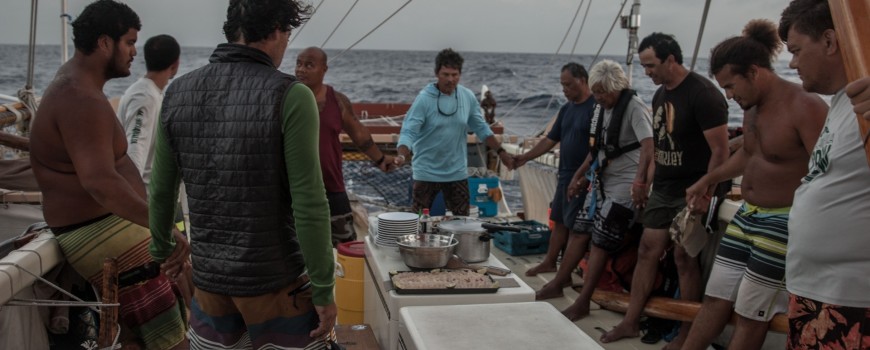
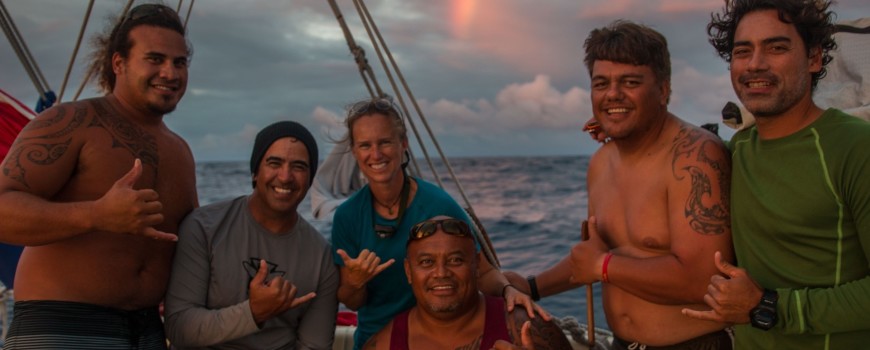
I woke up  to the early morning sounds of Hōkūleʻa’s hulls slicing through rising swells, which flowed from three different houses – Haka, Manu and Lā, all out of the Koʻolau quadrant of the star compass.  The 2-6 watch, led by Uncle Snake Ah Hee of Lahaina, Maui, was still on, sailing the waʻa at about 6 knots. Puaita on the hoe uli and Justyn standing by to kōkua while the winds howled through the sails.  I crawled out of my bunk pondering what to cook for breakfast and ready to start another beautiful day in the realm of Kanaloa.  Uncle Snake called out “Okay, huli!,” letting everyone know the watches were changing. So the 6-10 watch led by David Komine of Kāneʻohe, Oʻahu took charge of the waʻa for the next four hours.  Heidi is the first to the hoe uli, beginning the steering rotation of 20 minutes between three people, who each share the responsibility of keeping the canoe on course.

IMG_2536

On the breakfast menu is fried rice with a little left over ono from last night’s dinner. So I called it “Da most ono fried rice.” As the rising sun slowly warmed up the deck of the waʻa, the wind begins to slow down as it flows out of the house of Noio Koʻolau, blowing at about 10-15 knots, sometimes 20 knots at its max.

IMG_2581

As our watch slowly comes to an end, we see a few rain clouds in the distance, which on Hōkūleʻa is something we look forward to. When we see a rain cloud, instead of suiting up to stay dry, we welcome the greatest feeling ever – a fresh water rinse.  The crew scrambles throughout the deck gathering their body wash, conditioner for the long-haired folk, and shampoo for the short-haired folk.

IMG_2544

Our initial thoughts of a passing shower quickly turns into a rain storm for almost the entire 10-2 watch, led by Kawika Crivello of Molokaʻi.  Throughout this non-stop blessing of rain from Ke Akua, Captain Kalepa calls the meal for lunch and shouts to me from the stern of Hōkūleʻa – “Brah!!…Saimin!!”  I give my double thumbs up and reply with a simple “Rajah dat!”  

IMG_2705

As the rain continues to fall, I open up my box of tricks to the magnificent two burner stove and start boiling water to whip up some saimin.  With my sous chef Kawika prepping green onions to add in and other fancy toppings, we begin the process of our wet ‘n wild lunch.  The crew stands in the rain, licking their chops, waiting to dig into some hot saimin noodles. Needless to say, lunch was a success. The crew had massive smiles and filled opus while we wash the dishes and clean up as an ʻohana. With a big wet bearded smile, I tell them all “mahalo.”  With big smiles and many shakas Kawika goes “Braddah Kua, it’s a kākou thing!”

To our pleasant surprise, the afternoon ended with a beautiful warm sunset and a fragment of a rainbow off of our starboard hull. 


Crossing North

After a 20-month sojourn in oceans south of the equator, Hōkūleʻa has returned to the northern hemisphere in the blue waters of the Atlantic. Please, help celebrate our crew by supporting their journey.

Hōkūleʻa Update | February 15, 2016

At 1700 hours local time (10am HST) and pacing at 6 knots, Hōkūleʻa entered the blue waters of the North Atlantic after a 20-month sojourn in oceans south of the equator. She was greeted by clear skies after skirting the Intertropical Convergence Zone (ITCZ ) and a warm 12 knot breeze as she danced her way across the equator. The crew will celebrate the crossing by sharing a cup of awa this evening.

IMG_2442

Nakua Konohia Lind dipped our stone koʻi (adze) in the deep blue ocean at the equator to commemorate the occasion. All 12 crew members of the Hōkūleʻa and 6 crew members of the Gershon II are doing well and have comfortably adjusted to life on board sea going vessels. We are settling in for a dinner of fried fish of ono after hauling in two 18 pounders on a simultaneous strike. The crew continue to look forward to growing as a family as we journey together.


Help us make history

As the mainstay of support to PVS, our members are allowing us to voyage beyond the boundaries of Polynesia to inspire a global movement to care for our earth.

Hōkūleʻa Update | February 14, 2016

Happy Valentines Day from Hōkūleʻa!

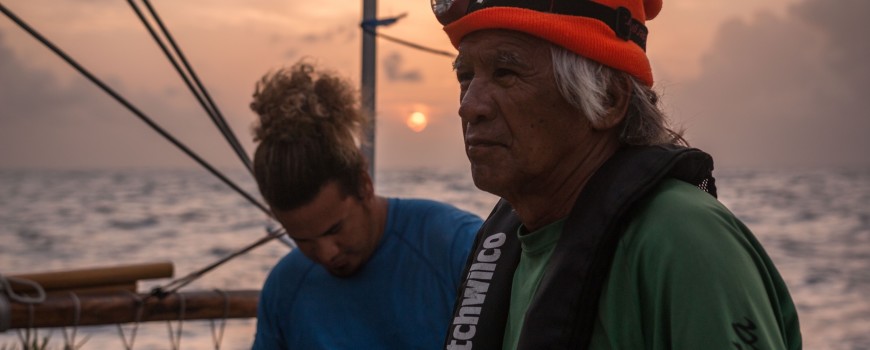
There is something about the morning sunrise when you’re out at sea on Hōkūleʻa that simply takes your breath away. But when looking into today’s early morning horizon this Valentine’s Day, there is definitely something much different. Our hearts and thoughts drift back home to our loved ones hoping our silent words are carried on today’s winds from Manu Ko’olau and delivered to their doorsteps back home in Hawaiʻi.

IMG_2054

When listening to crew mates speak of loved ones while miles out at sea, there is one word that is most commonly used: Aloha. Though we miss our loved ones, we have one that we cherish and aloha. She is our wa’a kaulua, our double hull canoe. Her name is Hōkūleʻa. She travels around the world sharing her message of love and aloha. Whether it be mālama honua (to care for Mother Earth)  or aloha ʻāina (love of the land) and many other messages, yet the very core of it is aloha. So, as we near the equator and sail through a squall today, we stay focused on our destination knowing that once again Hōkūleʻa will change many lives on different shores with a simple yet so very powerful message of aloha As we all know, our Mother Earth needs it more then ever. So, as the sun sets in Komohana (west), we as crewmembers on Hōkūleʻa want wish you all a Happy Valentine’s Day and yes, let your aloha be your light!  Eo Hōkūleʻa!


Help us make history

As the mainstay of support to PVS, our members are allowing us to voyage beyond the boundaries of Polynesia to inspire a global movement to care for our earth.

Hōkūleʻa Update | February 13, 2016 PM

What a blessed day! As light winds and calm seas followed us, they gave us time to celebrate one of our crew mates’ day of birth. Puaita Pulotu was serenaded with a happy birthday song as well as given a Hōkūleʻa birthday cake made by chef extraordinaire Nakua Konohia-Lind. It seemed that we were not the only ones who wanted to wish him a happy birthday as a pod of dolphins swam alongside Hōkūleʻa for a while, greeting us playfully around and under our waʻa, It also reminded us how precious our ocean marine life is.

DSCF2097

To cap the night off, we gathered in a circle to partake in a little awa as stories,  smiles and constant laughter was shared by all. When asked of him to make a wish, Puaita humbly responded, “spending my birthday sailing on Hōkuleʻa is a wish come true already. I am thankful.” Well said my friend. Hau´oli lā hānau e Puaita!


Help us make history

As the mainstay of support to PVS, our members are allowing us to voyage beyond the boundaries of Polynesia to inspire a global movement to care for our earth.

Hōkūleʻa Update | February 13, 2016

We started our day with a pule, a prayer, by our navigator Kālepa Baybayan, giving thanks for the abundance of blessings and opportunities that have been given to us.  Scrambled eggs are on the breakfast menu this morning as well as many different stories shared by each crewmember. Both fishing lines are in the water; but no fish yet.

IMG_1620

Each watch is split into 4-hour increments of 6-10, 10-2, and 2-6.  I have the honor and kuleana to be the watch captain for the 10-2 watch.  Our main responsibility, other than steering, has been to fix our eyes on the horizon for ships and boats since we are making our way through a heavy shipping traffic lane.  Winds and the ocean have been very calm, which has been a blessing so that we have time to get our sea legs under us and also get to know one another at a deeper level.

IMG_1539

Last night, our apprentice navigator gave an impromptu stargazing class as he pointed out many stars, their names, and their purposes.  Since departure yesterday from Natal, Brazil, we estimate to have travelled about 130 nautical miles, moving at an average of 6 to 7 knots in the direction of Manu Hoʻolua.  The crew is in good spirits and good health. A hui hou.


Help us make history

As the mainstay of support to PVS, our members are allowing us to voyage beyond the boundaries of Polynesia to inspire a global movement to care for our earth.

Hōkūleʻa Update | February 12, 2016

Hōkūleʻa departed Natal on Friday, February 12, 2016, at 10:00am Brazil time (3:00am HST) and set sail for St. John U.S. Virgin Islands. During the 10-day stop in Natal, a new crew arrived from Honolulu to relieve the 12 crew members who just completed the 3,000 nautical-mile journey from Cape Town, South Africa to Brazil.

IMG_1269

While in Natal, Hōkūleʻa crew members focused on provisioning the vessel with food, water, and equipment for the 2,400 mile voyage to St. John.

Weather permitting, Hōkūleʻa is expected to arrive at St. John, US Virgin Islands on March 1, and is also expected to visit the British Virgin Islands. While in the Caribbean, Hōkūleʻa crew hope to learn more about how the Caribbean islands are working together to find solutions for a healthier planet. After the Caribbean, Hōkūleʻa will sail north and visit cities along the East Coast of the United States. She is scheduled to arrive in New York City by June 8, 2016 to participate in World Oceans Day.


Help us make history

As the mainstay of support to PVS, our members are allowing us to voyage beyond the boundaries of Polynesia to inspire a global movement to care for our earth.

Crew Blog | Kawika Crivello: The Voyage Continues

As Leg 16 of the Mālama Honua Worldwide Voyage from South Africa to Brazil comes to a close, the Leg 17 crew begins preparing Hōkūleʻa for her next journey – 2,100 nautical miles up the coast of South America to St. John’s in the U.S. Virgin Islands.  Today begins the collective effort of the crew to prepare for this journey.  We’ve been spending our days provisioning food supplies, water, changing sails, and handing over kuleana (responsibilities) from one crew to the next – all things that comes with the end of one voyage and the start of a new.

Each leg has its own moʻolelo, its story.  With master navigator Bruce Blankenfeld and navigator Kaleo Wong leading the way to Brazil, crewmembers had many stories to share with us, the ones preparing for the next journey.  What an amazing voyage it was indeed, sharing and learning throughout the Atlantic the stories of Mālama Honua.  Sailing just over 4,000 miles and celebrating Christmas and New Years Day on Hōkūleʻa, it is time for them to go home to their loving ʻohana and share with their friends and loved ones all that they have witnessed and learned.  Today as both crews exchange hugs of safe journeys – one heading home, the other continuing the sail – we say not goodbye, but a hui hou.  Until we meet again. Eō Hōkūleʻa!


Help us make history

As the mainstay of support to PVS, our members are allowing us to voyage beyond the boundaries of Polynesia to inspire a global movement to care for our earth.