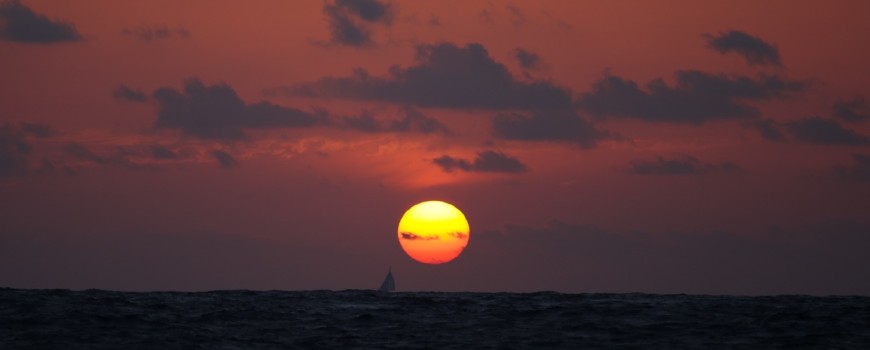
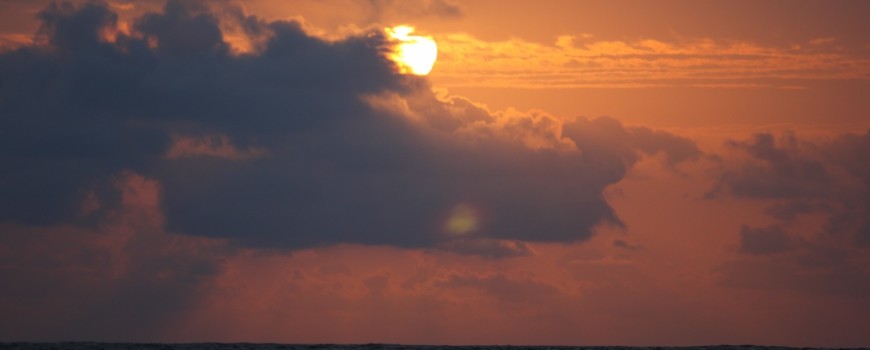
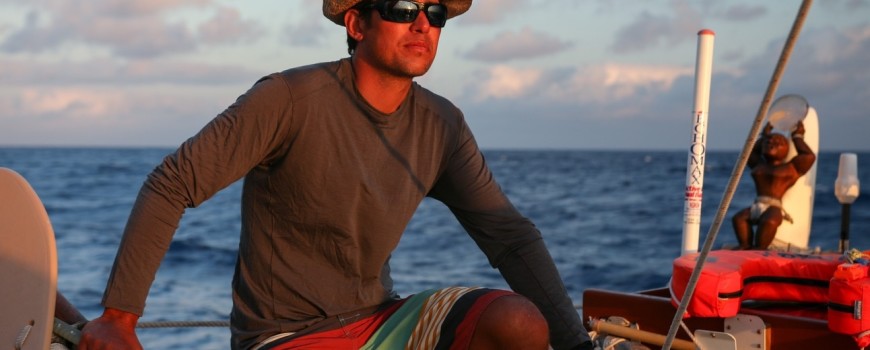
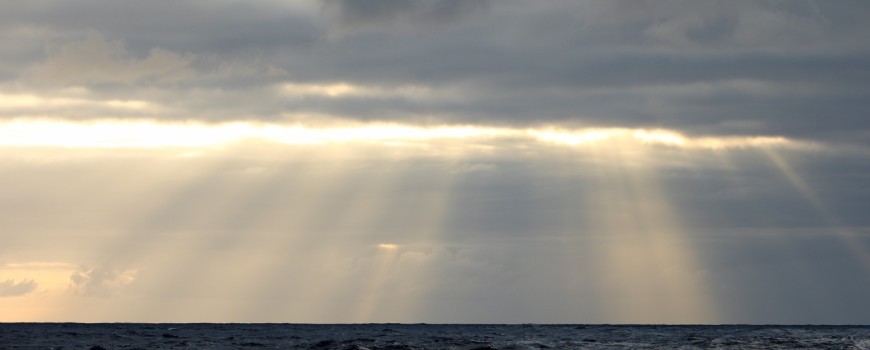
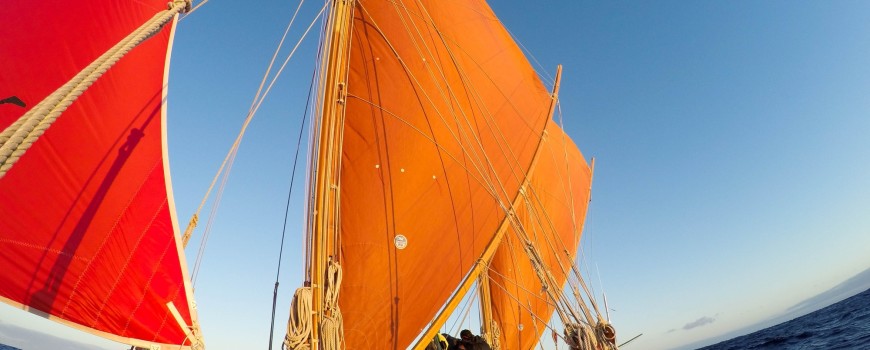
“Red sky in the morning, sailor heed warning.” We have a huge red cloud coming up behind us with the sun, which was a perfect red ball and seemed to stare back at us. The seas have big cross swells swinging us around, and it is challenging to keep the canoe straight. We do our best to hold our line by using the two side-sweeps. The winds are about 18 mph and, we are making fairly good time, maybe 6+ knots.
After an overcast morning, the sky cleared and we had a not nice hot day of sailing. The wind was solid into the afternoon and we ran a big spinnaker, 17 jib, then back to a smaller spinnaker. At noon we got another double mahimahi strike. That is our 11th fish this trip. We are all very thankful.
It was Lohiao’s dad birthday, the late great crew member Melvin Paoa, known to many as Uncle Mel. To celebrate the day, Gary baked him a cake. What made the day even more special was that Uncle Mel was with us. His amazing presence was witnessed by the whole crew. A noio bird was flying around last night when we came on watch. We were whistling at it, and it sang back. This afternoon it returned and Lohiao walked to the back of the canoe and raised his hand and it landed on his hand as if visiting an old friend. We were all blown away. It hung with us for a while, checked us all out and then took off. Thanks for coming by and checking in on us Mel! It was a special day, indeed.
Help us make history
As the mainstay of support to PVS, our members are allowing us to voyage beyond the boundaries of Polynesia to inspire a global movement to care for our earth.
We had steady sailing last night after a long hot day of coasting down wind. The sky has gray scattered clouds with the possibility of rain showers., and winds are 15 mph. Luckily, the swells are no larger than two feet, making for comfortable sailing. For breakfast, Gary made mahimahi omelets for breakfast, which the crew enjoyed under a gray cloud sunrise.
Since Hōkūleʻa’s deck is exposed to the element, we are often asked “What do you do on a hot day?” Our answer: You dump cool water on yourself and the waʻa and scrub the deck. We always like to work in the elements.
Between our kuleana, everyone is finding time to read and write. It is nice to take a few moments to reflect on our voyage so far.
Our escort vessel Gershon II is keeping a close eye on us. For dinner, we had mahimahi sashimi; mahimahi with coconut milk, tomato, and onion salad; fried mahimahi and cream carper sauce;, and miso mahi soup. For desert, Kealoha busted out some chocolate…life is good!
Help us make history
As the mainstay of support to PVS, our members are allowing us to voyage beyond the boundaries of Polynesia to inspire a global movement to care for our earth.
Auhea wale ʻoe e na hoa makamaka o kēia huakaʻi holopuni honua o Hōkūleʻa, ka mālama honua no hoʻi. Eia nō ko ʻoukou hoakipa, ʻo Kaleomanuiwa Wong. He wahi hoʻokele kēia a he haumana na Kealiʻinui, ke kanaka waʻa nui ʻo ʻAnakala Bruce Blankenfeld. He welina iā ʻoukou. Eia nō mākou ma ka waʻa kaulua ma ka Atalanakila nei. Ua hōʻea mai he ʻāina ʻo Ascension. Ua loaʻa mākou i ia ʻāina, ʻaʻole loaʻa ka ʻāina iā mākou e like me ka moʻolelo a Pele. Ua ʻōlelo ʻia, ua hōʻea he ʻāina, eia nō mākou kekahi. Ua hōʻea nō he ʻāina, a ʻike ʻia nō e mākou. Ke haʻalele nei mākou iā Ascension, kēia wahi moku liʻiliʻi ma ka Atalanakila. Ke holo nei i Fernando, i kekahi moku liʻiliʻi nui loa. Nui loa ka liʻiliʻi o kēia wahi moku. A ke noʻonoʻo nei, ma kahi o ʻumi paha lā, hoʻokahi anahulu, e pae aku ai i Fernando. No laila, he mea noke aku i ka hahai, i ka ʻeʻe pū ana mai i kēia wahi huakaʻi a kākou ʻo ka mālama honua. E kūkala hou ana i kekahi wā aʻe. He wahi leo aloha nō iā ʻoukou e nā kānaka kūpaʻa i ke aloha ʻāina a me nā wahine uʻi o Maunawili. Ke aloha nui, a noke aku i ka nānā ana mai, a hahai mau ma Hokulea.com. Ke aloha nui iā ʻoukou. Aloha!
English
Good morning and aloha kakahiaka, this is Kaleo Wong reporting on board Hōkūleʻa as we continue to make our way across the Atlantic. Yesterday evening, Ascension revealed herself to us. And we knew we were close a couple days ago as we started to see manu o Kū birds. Yesterday, we saw many birds including iwa, ʻā, noio, koaʻe and manu o Kū. So we knew we were getting close. And about an hour before sunset, there she was right in front of our waʻa. So did a little ceremony last night where we left a pōhaku. Meheiwa was the name of that pōhaku, and here we are continuing on our voyage to Fernando, a tiny island about 200 miles off the coast of Brazil. Continue to follow us on our voyage as we make our way across the Atlantic and weʻll be reporting to you guys again in a couple days. Aloha!
Help us make history
As the mainstay of support to PVS, our members are allowing us to voyage beyond the boundaries of Polynesia to inspire a global movement to care for our earth.
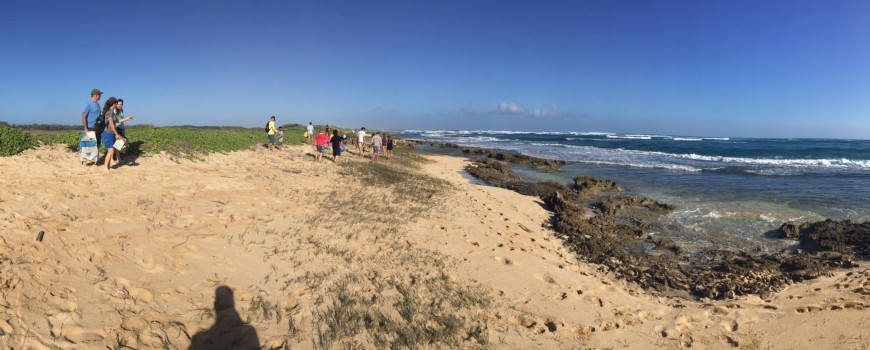
The Polynesian Voyaging Society (PVS) has teamed up with the United States Forest Service and Kōkua Hawaii Foundation to encourage fourth grade students in Hawaii and across the United States to go outside and explore public lands and waters. The three organizations came together today for a beach clean up hosted by Kōkua Hawaii Foundation’s Plastic Free Hawaii program at the James Campbell National Wildlife Refuge in celebration of Martin Luther King, Jr. Day of Service. Also participating in the cleanup was Sustainable Coastlines Hawaii, who along with Plastics Free Hawaii works to bring about public awareness and action to reduce the amount of waste we produce every day, which in turn reduces the amount of plastics and other trash found in our oceans and on our coastlines.
The beach cleanup and habitat restoration today included 225 volunteers who removed almost 850 pounds of marine debris from the shoreline and outplanted 40 akulikuli and pohuehue which are native to the area. Of the 848 pounds of marine debris collected, 643 pounds will be included in the Method Ocean Plastic “beach to bottle” initiative, which creates recycles plastic debris from beach cleanups into new bottles for Method products.
In addition to celebrating mālama honua actions and initiatives focused on plastic and waste reduction, marine debris issues, and recycling, a major focus of the event was to promote the Every Kid in a Park program, and to encourage local educators to participate in EKIP via Kōkua Hawaii Foundation’s field trip funding and educational resources.
“The Every Kid in a Park program supports PVS’ Malama Honua mission to care for the land and to use the outdoors as a classroom for our children,” said Miki Tomita, director of the Polynesian Voyaging Society’s Learning Center. “Getting kids outside and into our public lands and waters is a first step to making them future leaders and stewards of the land,” she added.
Nationally, Every Kid in a Park was started by the White House to encourage fourth grade students to visit national parks and other federal lands and waters for free with their families and classes. Students and educators across the nation can go to https://www.everykidinapark.gov/ to download a free pass to hundreds of parks, lands, and waters for an entire year. Recently, world-renowned musician and conservationist Jack Johnson and his wife Kim made a commitment via their Kōkua Hawaii Foundation to fund $100,000 worth of field trip grants to Hawaii teachers, with the goal of reaching 17,000 fourth-grade students in the state to help them defer the cost of transportation and other supports for visiting sites like those involved in Every Kid in a Park. Applications for fieldtrip grants are available at http://kokuahawaiifoundation.org/fieldtrips; the deadline for applications is March 1, 2016.
“We hope Hawaii’s educators will take advantage of the field trip grants available through the Kōkua Hawaii Foundation, and take our kids out to visit our public lands and waters” said Tomita. “Our outdoor environments offer so many opportunities for our children and communities to learn why and how we can malama honua.”
Partner organizations included U.S. Fish & Wildlife Service, Sustainable Coastlines Hawaii, Johnson Ohana Charitable Foundation, Surfrider Foundation, Kanu Hawaii, US Navy, US Forest Service, and many more!
Help us make history
As the mainstay of support to PVS, our members are allowing us to voyage beyond the boundaries of Polynesia to inspire a global movement to care for our earth.
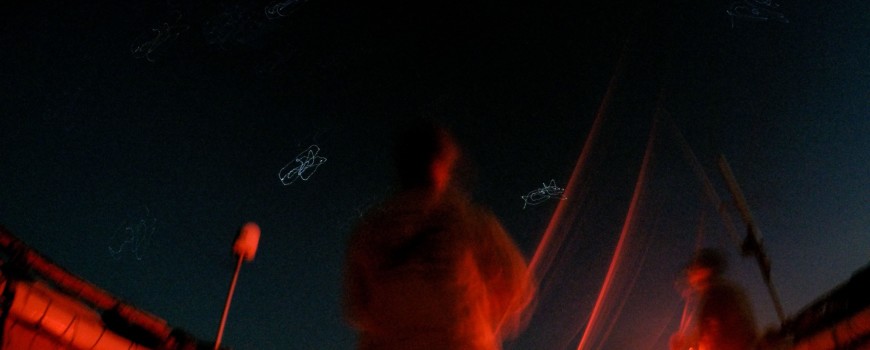
The stars were spectacular last night – 180 degrees above by 360 degrees around. Captain Bruce used his laser pointer to point out the constellations and the star paths across the sky. We could easily follow the Milky Way from the Southern Cross to Orionʻs Belt, and shooting stars were a common occurrence. We decided to pick up a tow at 2am in the morning. We dropped the tow at dawn and raised the sails. It looks like another great day for sailing with light winds of 15 mph, allowing us to reach five knots with three sails running. We are five days since departing St. Helena, and should be approaching Accession Island in a few days. The crew keeps a constant lookout for land birds, a sign that an island is near. Bruce and Kaleo have been making minor adjustments as conditions change.
We have been talking football and making bets, but we have no idea whatʻs going on. Last night we had pot roast pork, mashed potatoes, yams, with gravy all over! The meals have been winner the whole trip…we are blessed to have Gary with us!
At 10am, a big school of aku started running with our canoe, chasing smaller prey that are probably hiding under the hulls. We can see them swimming on either side, 3-5 pounders, but they are not taking our lures….we are making adjustments to smaller lures. The birds are here looking for a meal also. The fish did not bite all day even though we could see them swimming around the canoe. Fortunately, a nice breeze and clouds all day make for good sailing weather through the night. We could not be happier.
Help us make history
As the mainstay of support to PVS, our members are allowing us to voyage beyond the boundaries of Polynesia to inspire a global movement to care for our earth.
Aloha ahiahi kākou, eia nō mākou ma Hōkūleʻa from the middle of the Atlantic Ocean as we continue on our journey from Cape Town, South Africa to St. Helena, and now we are on the portion from St. Helena to Ascension, two small islands in the middle of the Atlantic. We left St. Helena about three days ago, and we estimate our current position about halfway between St. Helena and Ascension, a little over 300 miles in this route. We are expecting manu o Kū (white tern) either tomorrow or the day after that will confirm our location in the ocean as we get close to our next target island of Ascension. Navigation has been a little difficult, as it has been for the entire trip. We have these following seas and light winds coming from straight behind us making it difficult to steer the course we want to be steering. We are going north then south. So if you are following us on the tracking map, and we are going north and south, that is why. It is all being done on purpose. We are having constantly shifting wind patterns and clouds that come in that block the stars, moon, and sun. This makes it difficult to navigate, but here we are continuing on our voyage and having faith in our ʻaumakua and kupuna who are traveling with us and helping guide our waʻa to these tiny islands across the Atlantic Ocean. Today, we had rain for the first time in our trip. But right now, you can see blue skies and nice clouds showing us that we’ll have steady winds for a while. I think that’s it for now, and we’ll get back to you in a few days, hopefully with Ascension Island right in front of us. Mahalo for following our voyage at Hokulea.com. Aloha!
ʻŌlelo Hawaiʻi
Auhea wale ʻoe e ka pua lililehua a me nā pua makame ʻe aʻe ma Hawaiʻi la a me ka honua holoʻokoʻa e hahai ana iā mākou ma kēia huakaʻi holopuni honua ʻo Mālama Honua. Eia nō hoʻi kēia kahi kipa leo iā ʻoukou ʻo Kaleomanuiwa Wong. Ke kipa aku nei iā ʻoukou mai kēia waʻa mai ma ka Atalanakila aku i ko ʻoukou home pumehana. Eia nō mākou ke noke aku nei ka holo i Ascension, he moku liʻiliʻi nō ia ma ka Atalanakila. Ua haʻalele mākou iā St. Helena ʻekolu lā aku nei, a eia nō mākou i waena konu o kēia māhele o ka huakaʻi mai St. Helena a i Ascension. Aia mākou makahi o ʻekolu haneli mau mile mai Ascension a i St. Helena. No laila, ʻelua aiʻole ʻekolu lā paha e ʻike aku ai i Ascension. Ke noʻonoʻo nei mākou ʻapōpō paha a ia lā aku e ʻike ʻia ana nō ka manu o Kū a kekahi mau manu ʻe aʻe e hoʻōia ana mai iā mākou i kahi o ka waʻa ma kēia moananuiākea. Ua ʻike ʻia nō kekahi manu iwa, he hōʻailona maikaʻi nō ia, ʻo ia nō ka maka mua ka ʻike ana kekahi iwa ma kēia huakaʻi holoʻokoʻa. Ua mahalo nui nō ia. ʻO ka hoʻokele ʻana i kēia wahi waʻa, ua ʻano paʻakīkī ʻoiai ua ke ao o ka lewa, he mea maʻamau ʻikeʻole i ana o nā hōkū, ka lā, a me ka mahina. A wili mau ka makani, ʻaʻole e pā mai ka makani mai kahi wā like no ka wā lōʻihi. Ua paʻakīkī nō ana, eia nō ke holo nei me ka mahalo ʻana i nā akua, nā ʻaumakau, a me nā kūpuna o kākou. E alakaʻi mai ana i kēia waʻa i Ascension, he moku liʻiliʻi. A ʻo ia wale nō no kēia waʻa, e hui hou kākou ma kekahi wē ʻe aʻe. E leo aloha iā ʻoukou e nā kānaka kūpaʻa i ke aloha ʻāina ma ka waʻa mai ʻo Hōkūleʻa, he waʻa kaulua ma ka Atalanakila. He wahi leo aloha iā ʻoukou apau. Aloha!
The night sky was dotted with stars as few shooting stars streaked overhead. Dark clouds behind are approaching, but they have not caught us yet. In the far distance, the sun is breaking through as winds are beginning to pick back up from 5 mph to 10 mph in front of the rain. In a few hours, the rain has finally enveloped us in a light drizzle, and the sun has disappeared along with the wind. We drop all the sails and hook up for a tow. It has stopped raining but the wind has not returned, creating extremely humid and muggy conditions. A cold bucket shower sounds great. We dropped the tow in the afternoon with some good wind and sailed into the night with a clear sky.
Yesterday, we participated in a Google Hangout with students at Mid-Pacific Institute in Hawaiʻi. One question came from Dr. Turnbull on how can celestial navigational knowledge be used by others around the world. My answer was straight forward: the stars have a designated line of travel across the heavens no matter where you are on Earth. Learn those lines and you can explore new lands and find your way home. I will add to that when I see him next time, that celestial navigation, though thousands of years old, is still in its infancy. We understand how to guide ourselves around Earth using the stars, but it will not be long before we use the stars to guide ourselves among them. Our star compass we use at sea is set on a 180 degrees of rotating sky. The star compass of the future will be four-dimensional, and we will not be floating on the ocean, but floating through space and time. It is a blessing that the Hōkūleʻa has reignited the fire of future celestial navigation and exploration. The indigenous wisdom of our ancestors hold this knowledge. We see it in the artifacts they have left behind – the Mayan Calendar, Stonehenge, and others from past civilizations. Who knows how many other links to the future we will discover. It is not a stretch they say we must go “Back to the Future!”
Help us make history
As the mainstay of support to PVS, our members are allowing us to voyage beyond the boundaries of Polynesia to inspire a global movement to care for our earth.
Aloha everyone, this is Kekaulike Mar from the deck of Hōkūleʻa. So far, we are about halfway done with Leg 16 of the Worldwide Voyage. We just left St. Helena a few days ago, and are on our way to Ascension Island. Right now, we are averaging 4-5 knots, and Ascension Island is about 685 miles away. Right now, the crew is doing well. Everyone’s in high spirits and good health. Weather has been pretty good too. We’ve had some nice seas and some nice wind with some cloud cover at night. When the stars do come out, we can get our bearings. But for the most part Kaleo is doing an awesome job of navigating. Bruce is doing an awesome job of captaining. And Gary is the best cook ever! Please continue to follow us at Hokulea.com. Aloha!
We have had a full day of sailing with good winds through last night. In the morning, we put up the spinnaker as the winds dropped to 15 mph. Our escort vessel Gershon II also has their big spinnaker flying in the distance.
We have not seen any birds since departing St. Helena. But the sky has cleared from last night’s light rain squalls that have since passed. We decided to forgo fishing today because we have more than enough from the mahimahi we caught shortly after departing St. Helena. For dinner, we had fried mahimahi with wasabi mayo and capers, and green mahimahi curry over rice. We also had some tasty banana bread given to us by the St. Helena Port Security. Everyone is in good spirits and healthy. Everyone is sailing well, and we are back to our voyaging routine – eating together and talking story, reading books, playing music, taking in the beautiful sunrises and sunsets, and enjoying Hōkūleʻaʻs ride.
Help us make history
As the mainstay of support to PVS, our members are allowing us to voyage beyond the boundaries of Polynesia to inspire a global movement to care for our earth.
After a five-day stop for canoe reprovisioning and preparations, Hōkūleʻa departed the island of St. Helena this morning at 11 a.m. St. Helena time (1 a.m. HST) to continue her journey across the Atlantic Ocean to Brazil. Approximately six days after departure, Hōkūleʻa is expected to pass and sight Ascension Island, which was just declared a marine protected area. The island is also part of the St. Helena British Overseas Territory.
While in St. Helena, the Hōkūleʻa crew met with the acting governor of St. Helena and the St. Helena National Trust, a non-profit that promotes the awareness and protection of the island’s environment and cultural heritage. They had an opportunity to discuss similarities between the island of St. Helena and the Hawaiian Islands. The crew also participated in a clean-up project and sponsored the planting of a tree in the Millennium Forest, a reforestation project to recreate the Great Wood, which at one time covered the eastern part of St. Helena, but was destroyed as settlers cleared the forest for timber and grazing land. While on the island, the crew also explored Jamestown and toured the house where Napoleon Bonaparte was exiled until his death.
The canoe’s next stop will be at Ilha Fernando de Noronha, Brazil, an archipelago and UNESCO Marine World Heritage site, where the crew will engage in cultural and educational exchange. Hōkūleʻa is expected to make landfall in South America at the coastal city of Natal, Rio Grande do Norte, located in northeastern Brazil, in early February. The crew will seek stories of hope about efforts to malama the sacred natural resources and indigenous cultures of the Amazon Rainforest.
After stopping in Brazil, Hōkūleʻa will continue the Mālama Honua Worldwide Voyage and stop in a few ports in the Caribbean before sailing up and visiting cities along the East Coast of the United States. She is scheduled to arrive in New York City by June 8, 2016, for World Oceans Day.
Help us make history
As the mainstay of support to PVS, our members are allowing us to voyage beyond the boundaries of Polynesia to inspire a global movement to care for our earth.