Crew Blog | Kālepa Baybayan: 5˚47’ South/35˚12’ West – Last Moments in Natal

Nestled on the southern bank of the Potengi river, Hōkūleʻa sways on the tide and river current, at rest now after a 3,000 nautical mile passage from Cape Town, South Africa.

IMG_0727

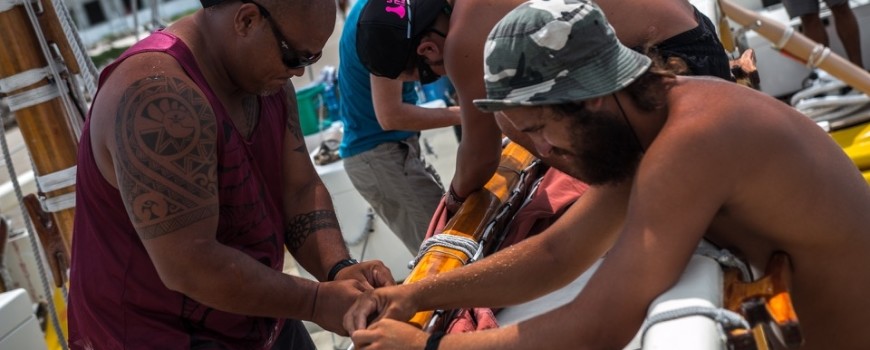
The new crew of Hōkūleʻa is in Natal (Portuguese for Christmas), Brazil, preparing the canoe for an early morning departure tomorrow, Friday, February 12th. We arrived here seven days ago at the start of Carnival, a five-day holiday of dancing, music, parades, and food. While the celebration has made for a very entertaining stay, canoe preparations were slowed as city offices and stores shut down for the five days and just reopened today. We were able to clear Customs, Immigration, the Harbor Master, and Port Authority in 4 short hours as our driver whisked us around the city from office to office all morning long.  

IMG_0789

At 360 nautical south of the equator, Natal sits in the heart of the tropics; it is a very sunny and relatively dry environment. It is a tourist Mecca of sorts; close to 3 million tourists visited Natal’s white sandy beaches last year. Over the past two weeks, Hōkūleʻa’s crew has been blessed by the hospitality and kindess of a number of organizations and individuals.  We have been hosted here in Natal at Brazilian Army Base, 17˚ Grupo de Arthilhari de Campanha-Grupo Jeronimo de Albuquerque; the base Commander, Ricardo, has been tremendously generous of his facilities and staff, providing security and support for the crew and vessel, including meals and housing near the canoe.  Alexy Borges, a Brazilian who once lived in Hawaiʻi and paddled for Hui Nalu Canoe Club, has served as Hōkūleʻa’s official Portuguese translator, guide, and ground handler, making our stay here very accommodating. We owe Alexy a lot for his service to the canoe and the Mālama Honua mission.

IMG_0940

I am incredibly fortunate and privileged to have the opportunity to serve as Captain and Lead Navigator on this sail aboard Hōkūleʻa from Natal, Brazil to St. John in the U.S. Virgin Islands. This crew of 11 men and 1 woman will work hard to represent and preserve Hōkūleʻa’s iconic legacy as we continue this journey around our planet to Mālama Honua:

1. Kālepa Baybayan, Captain
2. Brad Wong, Apprentice Navigator
3. Kalani Kahalioumi, Apprentice Navigator
4. Snake Ah Hee, Watch Captain
5. Kawika Crivello, Watch Captain
6. David Komine, Watch Captain
7. Kelly Tam Sing
8. Heidi Guth
9. Ben Dumaran
10. Puaita Pulotu
11. Nakua Konohia-Lind
12. Justyn Ah Chong

For details on the crew roster and leg of the Caribbean voyage click here.


Help us make history

As the mainstay of support to PVS, our members are allowing us to voyage beyond the boundaries of Polynesia to inspire a global movement to care for our earth.

Hōkūleʻa Update | February 6, 2016

Aloha, this is Kālepa Baybayan, we are in Natal, Brazil. The Leg 16 crew that sailed from Cape Town, South Africa to Natal, Brazil just handed over the kuleana to Leg 17, which is taking the canoe from Natal, Brazil to St. John, U.S. Virgin Islands. We are preparing the canoe by packing up the food, and will begin loading operations now. We got the food going on today, and the water going on tomorrow and Monday, and propane being delivered on Wednesday. We should be able to depart either Wednesday afternoon or Thursday morning if we stay on task. We are looking forward to a great sail. We are in the trade wind fields now between 5 and 6 degrees south latitude, and we’ll be sailing up to between 18 degrees, 30 minutes north latitude, which keeps up smack dab in the middle of the trade wind field. So we are looking for following winds and seas, and hopefully a quick passage. Maybe 18 days to St. John, USVI. Our crew is ready, our crew is prepared for the sail , and we’re just looking forward to a great experience. This is Kālepa Baybayan signing off from Natal, Brazil. Have a good day and follow us on Hokulea.com. Aloha!

IMG_0392

Crew members for the next leg of the Mālama Honua Worldwide Voyage have arrived in Natal, Brazil to prepare Hōkūleʻa for the sail to St. John, US Virgin Islands (USVI). Weather permitting, Hōkūleʻa is scheduled to depart Natal for the Caribbean on Thursday morning, Feb. 11, 2016.

“Captain Bruce has handed the kuleana to our crew to prepare Hōkūleʻa for this next leg of the journey,” said pwo navigator and Hōkūleʻa captain Kālepa Baybayan. “We are working hard because it’s our responsibility to ensure she is ready-ready to bring the stories of hope we’ve witnessed so far on the Worldwide Voyage to the shores of the US Virgin Islands as we continue around the world.” 

IMG_0425

Joining Kālepa on this leg will be apprentice navigators Brad Wong and Kalani Kahalioumi; watch captains Snake Ah Hee, Kawika Crivello and David Komine as well as PVS Chief Operating Officer and veteran crew member Heidi Guth. Raised in the US Virgin Islands, Guth’s homecoming aboard Hōkūleʻa will be a remarkable moment for both the Worldwide Voyage and for her personally.  Guth’s fellow crew members are Nakua Lind, Justyn Ah Chong, Kelly Tam-Sing, Puaita Pulotu and Ben Dumaran.

Hōkūleʻa’s arrival to the coastal city of Natal marked Hōkūleʻa’s  first visit to the South America continent. While in the Caribbean, Hōkūleʻa is scheduled to make stops in St. John, USVI and Virgin Gorda, British Virgin Islands before sailing north and visiting cities along the East Coast of the United States.  She is scheduled to arrive in New York City by June 8, 2016 to celebrate World Oceans Day.


Help us make history

As the mainstay of support to PVS, our members are allowing us to voyage beyond the boundaries of Polynesia to inspire a global movement to care for our earth.

Crew Blog | Kekaulike Mar: The Stories We Carry

When considering the 1,200 square foot of real estate that twelve men will share for a little over a month, in my humble opinion, the most important thing to pack for such a long voyage is a quiver full of stories.  Our crew came well armed.

IMG_1590Whether comical or serious, each story is an opportunity for us to honor a loved one, relearn a tough lesson, laugh at a funny or share of our ‘ohana.  The mo’olelo help to lift our spirits and pass the time, especially in the long hours of the night watch and in the later weeks of the voyage.  Through telling our stories, we reconfirm the subtle connections that we share, and smile at the slivers of degrees that separates us.

Only days into the journey, I’ve discovered that Kaleo and I wear the markings of the same kakau (tattoo) practitioner, that Doc knows my midwife, that Ah Lun’s brother-in-law is my grandma’s neighbor, and that Uncle Mel did NOT lose his finger in a fishing accident (thanks Lohiao for clearing that up).

Although much has been shared, I look forward to unearthing more gems in the weeks to come.

Pili ka mo’o, a mau loa…

Kekaulike


Help us make history

As the mainstay of support to PVS, our members are allowing us to voyage beyond the boundaries of Polynesia to inspire a global movement to care for our earth.

Crew Blog | Kimo Lyman: Hōkūleʻa Haiku

Creating Haiku
A new passion on Hoku
Mahalo Gary

And so begins another chapter, another voyage, another experience aboard Hōkūleʻa. Typically for me, I’m a week plus getting started on my journal –  enjoying the surroundings, reflecting on the port of departure, getting my sea legs always seem to trump writing. But once the routine gets routine, it’s easy to carve out time for a few words. The benefits of the discipline are well worth it when relived years later – memories rekindled causing stories to be retold resulting in lessons learned from going to sea.

IMG_0227

An early teaching on this leg has been provided by a frequent and favorite shipmate – Gary Yuen has worked us all into haiku hysteria! Learning the 5-7-5 syllable and specific time mention rules has the crew staring off into space while counting on their fingers creating some sublime poetry and lots of laughs. Gary’s real forte, though is in “Hop Sings Kitchen,” where on a two burner camp stove he churns out masterpieces on a daily basis – sweet chili sauce mahi mahi served with a fish soup filled with wakame, tofu and fish, rice, sashimi and fresh tomatoes; fresh andagi (malasadas) made from pancake mix and coconut milk: the occasional cake baked in a frying pan and tonight, roast pork with carrots and potatoes! Always the hardest working man on the vessel, we are truly blessed to have Gary aboard.

DCIM100GOPROGOPR6586.

Blessings abound on this leg of Mālama Honua. Our weather has been incredible with the classic ʻfair winds and following seas,ʻ 10-15 knots on our port quarter after we steered away from the coast of Namibia. Leaving Cape Town, South Africa and paralleling the west coast to Walvis Bay was interesting with lots of sea life in all forms from tiny krill to seals to birds, dolphins and whales. After making the “left turn” away from Africa we did encounter a strange weather phenomenon – three or so days of cold, thick sea fog with just enough wind to ghost along at 3-4 knots. Navigation was challenging with occasional glimpses of the sun and moon but the wind was a reliable direction indicator. It seemed as if we were passing through a time portal into the Atlantic, the sailing became fast and easy and Kanaloa was very generous with some tasty fish – a big eye tuna, rainbow runners, mahi and ahi.

At day break on Day 16, we were greeted with an electrical storm off the starboard bow. The pervious watch said they saw flashes throughout the night, and as we approached the system thunder started getting louder. Since we were going to gybe over anyway, now seemed like a good time. By the time we changed tacks the gods were cracking pretty loudly. But as we bore off the system settled away, the wind was perfect and the day was beautiful. About three hours later St. Helena was spotted dead ahead. Talk about hōʻailona!

IMG_1461

Indeed, we had gone through a time tunnel. After securing Hōkūleʻa on a mooring off Jamestown, we had a nice celebration aboard Gershon, a recon party went ashore to replenish some liquid refreshment and brought back tales of friendly natives. Morning revealed a very quaint, colorful British colony complete with cobbled streets, castles and forts built in the nineteenth century and a very happy, engaging people. Known for being the isle of exile for Napoleon Bonaparte and his eventual death site, we found much more at St. Helena – a gorgeous green interior covered with pine and eucalyptus forest, flax covered slopes from a now defunct plantation, fascinating rock formations, and an almost completed new airport.

IMG_4269

A community of around 4,000, St. Helenan’s call themselves Saints and certainly seem that way – one can’t pass a car without a wave and smile. All we met were polite to a fault and very intrigued with the canoe, the voyage and particularly the navigation. After a braie, or BBQ, Bruce gave a talk about Hōkūleʻa’s history and our purpose and received a lot of questions about wayfinding. Not surprising considering they are all seafarers. The only way to the island is by ship or yacht – the mail ship comes every other week on a Cape Town-St. Helena-Ascension circuit. With the advent of air travel, the general consensus seems to be mixed with some welcoming the modernization it’ll bring and some not so sure. Having seen “progress” in my time, I’ll opt for keeping her how she is.

IMG_1514

One of the amazing features of Jamestown is Jacob’s Ladder, a grueling set of 699 stairs going from the narrow valley floor to the ridge directly above our mooring. Built for the workers and soldiers to access the fort that overlooks the town, it has been restored and maintained so anyone can struggle up or down. The crew did just that – my legs hurt for days after…

IMG_5563

We’re now a day or so, out of Ascension and the birds are getting more frequent – first Manu o Kū yesterday, more today along with boobies and Koaʻe Kea’s. This is day five from St. Helena with 150 miles to go, so we’re right on schedule albeit a little slow. The weather has been wonderful – some cloud cover earlier but good stars now, warm water for showers, dry decks with minimal rainfall. Early on we caught a nice 19 lb. mahi that fed us for two days but haven’t hooked up since. Yesterday we got teased for hours with aku swimming alongside feeding on small malolo but not at all interested in our lures. This morning a large pod of dolphins crossed our bow, more intent on their breakfast than playing with us – we were going too slow anyhow. And just now we watched an ʻiwa bird (another close to land sign) hassle an honest working bird until he gave up his catch, the ʻiwa scooped it out of the water, climbed and shook himself dry.

IMG_0641

Ascension was spotted at sunset two days ago and passed in the night. Congrats to navigator Kaleo and sensei Bruce for drawing another island up from the horizon. Abeam of the island a pōhaku from Hauʻula, ʻMeheiwi,ʻ was dropped to the ocean floor, accompanied by haunting pū harmonies, forever tying our island to this one.

IMG_3980

Our seemingly slow pace has been enhanced by a favorable current so distance estimates were a little too conservative. The line was spot on, though, with Kaleo’s call for gybes to get back to his reference course spot on. We’re all here to learn, and the lessons keep on coming. Which is why, of course, we continue to sail and are so grateful that Hōkūleʻa continues to carry us – we discover so much out here away from land’s distractions about the ocean, about our planet, about ourselves: how to live with limited resources, how to give thanks and praises for our gifts of good weather, clean air, fresh fish and how to truly work together.

IMG_5573

One of the best times of the day is just before supper. Gary has presented another fantastic feed (two mahi yesterday after no fish for a week), we gather around the galley and Bruce asks one to say grace. This moment of reflection and gratitude is always profound and powerful. We give thanks for the many small blessings of the day – the miles covered, the incredible things we see, the beautiful places we’ve been and are approaching. We give thanks to our leadership and our amazing staff back home for giving us this opportunity. We give thanks to our families and loved ones for enabling us to be here and believing in our mission of spreading aloha around the globe. And we’re always grateful to all the people of Hawaii who inspire us, support us and mālama us. Mālama Honua, eo Hōkūleʻa!

Most sublime. This. Now
The seas allows all to breathe
Praise Kanaloa


Help us make history

As the mainstay of support to PVS, our members are allowing us to voyage beyond the boundaries of Polynesia to inspire a global movement to care for our earth.

Crew Blog | Ira Zunin: Mahalo to Patagonia

Patagonia gets it. Beginning in 1999, this manufacturer of outdoor clothing and equipment has been a dedicated partner of the Polynesian Voyaging Society and Hōkūleʻa’s many voyages to distant lands. Because Patagonia understands the importance of preserving, protecting and perpetuating indigenous peoples, its leadership readily appreciates Hōkūleʻa’s role in helping to catalyze the Hawaiian renaissance, which has also stimulated a resurgence of traditional Polynesian voyaging cultures throughout the Pacific. The mission and core values of both organizations are also closely aligned with respect to the importance of caring for our fragile planet and making it safe for future generations.
IMG_0290

Throughout PVS’s Mālama Honua Worldwide Voyage, many crewmembers who have sailed to date on Hōkūleʻa and Hikianalia have gratefully worn Patagonia’s swimwear, long underwear, fleeces, and waterproof gear.

IMG_1440

The gear not only keeps us warm and dry but also cool and comfortable and protects us from the sun. Since the summer of 2015, Hōkūleʻa crewmembers have also been kept healthy by Patagonia’s fruit bars, smoked salmon and Tsampa soup, which Patagonia reports was inspired by an indigenous Tibetan recipe.

Too often these days, companies focus on profits derived from exploiting the peoples of the earth and our environment, and utilize sponsorships to “green-wash” their more dubious occupations. Not Patagonia. In fact, the company is named after a vast and awe-inspiring mountain range between Argentina and Chile that Patagonia has invested heavily in order to help keep it pristine.

IMG_4702

The crews and staff of the Polynesian Voyaging Society are grateful for Patagonia’s collaboration with us and deeply honored to be aligned with them in the mission of Mālama Honua.


Help us make history

As the mainstay of support to PVS, our members are allowing us to voyage beyond the boundaries of Polynesia to inspire a global movement to care for our earth.

Continue Reading

Hōkūleʻa Update | Fernando de Noronha Sighted

ʻŌlelo Hawaiʻi

ʻAuhea ʻoe e nā makamaka o kēia wahi huakaʻi kaʻapuni honua ʻo ia nō hoʻi ʻo ka mālama honua. Eia nō hoʻi mākou ma kēia ʻāina ʻo Fernando a he ʻo ia ʻiʻo kā nō kā hoʻi. Ua pae maila kēia wahi waʻa ma kēia moku liʻiliʻi o ka Atalanakila nei a ua hala 31 mau lā i ka holo ʻia ana mai iā Cape Town aku a i St. Helena, i Assention a eia nō mākou ma Fernando nei. Ma kahi ʻo 4 kaukani mile ka holo ʻia ana o kēia wahi waʻa a eia nō ke kū nei. Ua maikaʻi nō ka holo ʻia ana. Ka hapa nui o ka manawa ua maikaʻi nō ka makani no ka pā ʻana mai i ʻaneʻi, no ka pā ʻana mai nō hoʻi o ke ʻale o ka moana a me ka alakaʻi kūpono ʻana o kēia waʻa i ka moku liʻiliʻi wale nō i kēia moana nui ākea o ka Atalanakila. He wahi mahalo kēia iā ʻoukou no ka hahai mau ana i kēia wahi huakaʻi no ka eʻe pū ʻana mai me mākou no ka pae kūpono ʻana mai kēia wahi waʻa i kēlā me kēia moku o ka honua holoʻokoʻa. He wahi leo aloha iā ʻoukou e ke kanaka kūpaʻa i ke aloha ʻāina, ʻo ke koʻikoʻi iā ʻoe e ka wahine uʻi o Maunawili. Aloha nui kākou, aloha.

English

Aloha mai kākou, this is Kaleomanuiwa Wong reporting to you guys again from the deck of Hōkūleʻa. This time off shore from Fernando de Noronha, 31 days out of Cape Town, South Africa with a couple of different stops including St. Helena and sighting Ascension Island. Now we’re here at Fernando de Noronha. About 4,000 total miles from Cape Town to here. For the trip, we had pretty good weather with winds following us the entire way, which made it difficult at times but bringing us the islands we needed to get to and the swells constantly  pushing us closer to the lands we are trying to navigate to. Lots of hōʻailona (signs) from Ascension to here including a pod of orcas. Today lots of birds – manu o Kū and noio – and an ānuenue (rainbow) right above us. Good signs that we are about to land. And bango! Here we are at Fernando de Noronha. Thank you for following us and continue to follow us at Hokulea.com. Aloha!

Aloha, my name is Bruce Blankenfeld, and I am the captain on board Hōkūleʻa on this Leg 16 across the Atlantic Ocean. Behind me here is Fernando de Noronha Island, it’s a territory and province of Brazil. It’s a UNESCO World Heritage Site, and we just arrived here today, January 27, 2016. This voyage has been quite an amazing little voyage. We left Cape Town, South Africa on Christmas Eve (December 24, 2015) then sailed up the western coast of Africa along Namibia. Then we left Walvis Bay, Namibia for a 1,260 mile journey to St. Helena, which took us about 10 days. We stayed in St. Helena a few days, then we took off and the next landfall was Ascension Island after 700 miles. We never stayed at Ascension Island, we just used it as a landmark to roll into the next 1,200 miles to this is spot right here, Fernando de Noronha. From here, we have about 200 miles to go to Natal on the Brazilian mainland. It was a wonderful voyage, mostly downwind with fair winds and following seas. The crew was exceptional in so many ways, working together, caring for the canoe and one another. Each of them developed into their own as competent sailors and handling the sails, lines, steering, and everything else on board. This leg is just one part of a larger Mālama Honua Worldwide Voyage. We are learning a lot of good things and wanting to share them by meeting with a lot of wonderful people. So thank you for supporting us and continuing to follow us on Hokulea.com. Aloha!


Help us make history

As the mainstay of support to PVS, our members are allowing us to voyage beyond the boundaries of Polynesia to inspire a global movement to care for our earth.

Hōkūleʻa Update | January 22, 2016

Another orange ball sunrise with 15mph winds, small seas, and scattered clouds that all make for nice sailing conditions.  Our noio friend stayed with us last night on the back rail of the canoe. Lohiao has been offering it food and water, but it is not interested at this time.

IMG_5843

Last night the moon was almost full, providing a lot of light to sail by. We did see a big fishing vessel moving along with us on the horizon before disappearing. Captain Bruce provided more star training as the sun came up, which has been very interesting and useful for navigation and steering. Knowing how stars reference other stars is very useful when the clouds roll in.


Help us make history

As the mainstay of support to PVS, our members are allowing us to voyage beyond the boundaries of Polynesia to inspire a global movement to care for our earth.