Update | February 21, 2015

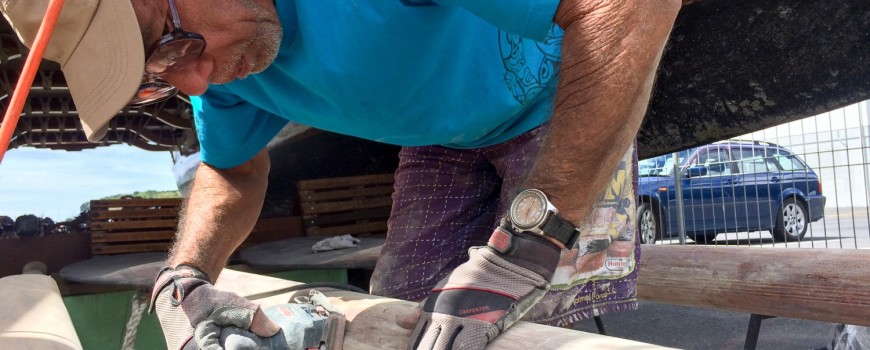
Led by master navigator and captain Bruce Blankenfeld, Moani Hemuli is part of a dry dock team caring for the traditional voyaging canoe Hōkuleʻa in Auckland, Aotearoa (New Zealand). Hōkūleʻa will venture outside of the Pacific Ocean for the first time in April 2015 as the Mālama Honua Worldwide Voyage continues with the message of Mālama Honua – Caring for Island Earth. 

At the end of every day as we sit in our crew van just before leaving the Hōkūleʻa, Uncle Bruce runs down our day’s to-do list. We check off what we accomplished and what we are still working on. As a new day arrives we have breakfast together and run down the day’s to-do list; some things carry over from the day before and new things added. The famous yellow paper divided by light blue lines that Uncle Bruce uses to write the lists always gets crumpled at the end of the day. We all smile when the list gets crumpled because we know we are slowly but surely moving along. Smiles for knowing we are taking care of our kuleana to our waʻa Hōkūleʻa.

Today was a different day, wind switched to on shore and clouds just kept rolling in. The sky was grey with light drizzles here and there. The crew kept working on despite the weather: Uncle Bruce scraping the bottom paint to make ready for a new coat for the hulls; Uncle Kalau sanding the three hoe so they can apply fresh epoxy; Naiʻa with his headphones in rocking out to the Eagles as he sands away on the forward spreaders; Jason, Nakua and our two Maori for the day, Hoki and Kate, sanding every piece of exposed wood top side from the second ʻiako forward. I was taking care of some hull damage and some cosmetic flaws to the famous Hōkūleʻa brown color.

Tomorrow will be a new day, and I can’t wait to watch Uncle Bruce crumple that famous yellow paper.

Mālama,
Moani H.


Continue to follow the Mālama Honua Worldwide Voyage by visiting us online and joining our global movement towards a more sustainable Island Earth.

Continue Reading

Update | February 13, 2015

Aloha mai kākou,

Tauranga is the second largest port in New Zealand and its fastest growing city. Logs and cruise ships line the docks, 40’ containers are neatly stacked on the wharf, and a mountain of salt is stockpiled nearby awaiting export. The crew was treated to a visit to Te Puia Hot Springs in Rotorua on Tuesday. We have been conducting school outreach for language immersion programs, hosting hands-on activities at the marae, and driving students to the dock for canoe tours. Tonight we will be hosted to a final night dinner and be doing a Mālama Honua presentation and a star compass demonstration. The Aotearoa voyaging brain trust of Hoturoa Kerr, Jack Thatcher, and Frank Kawe will be here for the event.

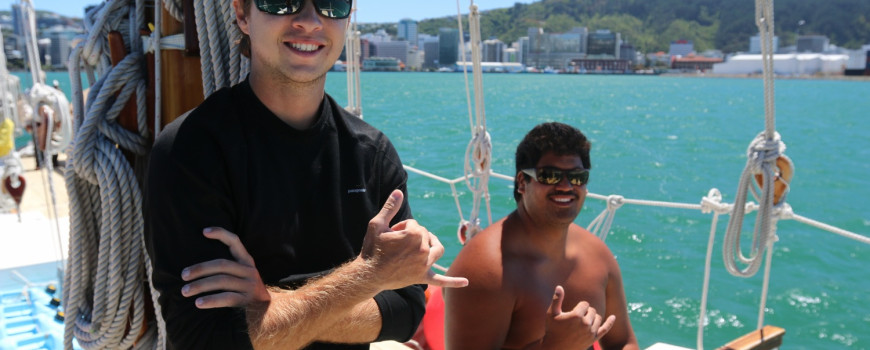
We depart Friday morning (NZT) for Auckland and should be in to the New Zealand Maritime Museum early Saturday. The winds will be from the south and lightening up in the afternoon, but I hope to get in some sailing in the morning. To round out the crew I have invited several Māori on board for the sail, in particular, I’d like to welcome back Wati Forbes, Hōkūle’a crew member from the early 2000 state wide sails.

We will be preparing Hōkūle’a for drydock once we are dockside in Auckland and awaiting the arrival of Captain Bruce Blankenfeld and the crew that will be performing annual maintenance. This trip is quickly coming to an end and I would like to thank all our supporters for this leg of the Mālama Honua journey. It has been a pleasure meeting and getting to know you and your communities. E Ō Ka Moana Nui a Kiwa!!!


Continue to follow the Mālama Honua Worldwide Voyage by visiting us online and joining our global movement towards a more sustainable Island Earth.

Continue Reading

Te Kāpehu Whetū: Inspirational Education

With the art of wayfinding as the guide and the waʻa kaulua as their platform, the crews of Hōkūle’a and Hikianalia are inspiring new educational strategies in communities around the world.

“So when we frame our thinking around the voyage, we have our two canoes, Hōkūleʻa and Hikianalia, voyaging around the world. Our goal is to see what the voyage inspires in terms of a worldwide movement.” says Learning Center Director for the Polynesian Voyaging Society, Miki Tomita.

Named for the star compass used by Maori navigators, Te Kāpehu Whetu, is exploring a new model of education centered on the principles of traditional wayfinding.

Education Specialist, Daniel Lin says that, “This school was given its name by uncle Hector and their theme is navigation – idea of voyaging. Itʻs really this idea of exploration, of personal exploration, but also connecting to a global community of global exploration.”

The crews of Hōkūleʻa and Hikianalia visited the school to share with the students their experiences aboard the waʻa thus far.

“It was probably more of an honor for us to have crewmembers from Hikianalia and Hōkūleʻa at our kura today. We have a big philosophy around our sailing waka, around the philosophies of what they bring for us. So it was really a honor.” says Ralph Ruka, a teacher at Te Kāpehu Whetū.

“These students have been seeing a lot of the footage that weʻve been putting out and a lot of the information. Theyʻve tracked our voyage ever since we left Hawaiʻi. They expressed this keen interest in not only what weʻre doing on a base level, but really to kind of get deeper. And so, in a way, this is the culmination of a long inquiry throughout what weʻre trying to do. I think theyʻll get to see and touch all things that theyʻve been learning about, and this will solidify to them that it is real.” says Lin.

“To come down here and talk to our uncles and to see what actually happens on the waka will definitely inspire them. Hopefully give them a bigger picture of our of our waka voyaging world.” says Ruka.


Continue to follow the Mālama Honua Worldwide Voyage by visiting us online and joining our global movement towards a more sustainable Island Earth.

Update | February 8, 2015

Kia ora koutou! My name is Kate Souness. I’m from a little town called Nelson at the top of Te Wai Pounamu on the South Island.  And I’ve come aboard Hōkūleʻa to crew from Wellington down to Golden Bay up to Napier to Gisborne, and now we’re on our way to Tauranga. We left Gisborne last night in a small weather window opportunity so that we could get good weather coming around east cape, and we are just coming around east cape now. It was forcast for twenty-five to thirty knot winds and as you can see, it’s a beautiful day today. We’ve been successful in having the right opportunity to get this great weather. In Gisborne, we did a lot of education outreach there. One of the schools that we went to was a school in Whangara, and we were welcomed into a marae there where Whale Rider was filmed. Kālepa Baybayan delivered an education outreach there, on the star compass and that was received really well by the community and by the students and teachers at Whangara. We have been able to give education tours on board Hōkūleʻa in Gisborne, and we were able to visit a community um through the north of Gisborne called Tolaga Bay, and we exchanged ideas about mālama honua, water safety, education of our rangatahi, our young people, and also we exchanged ideas about navigation. Now we are on our way to Tauranga, and we are going to be hosted by Jack Thatcher there. And there, we expect to do more education outreach. Thank you very much for following us on Hokulea.com. Kia ora koutou!


Continue to follow the Mālama Honua Worldwide Voyage by visiting us online and joining our global movement towards a more sustainable Island Earth.

Continue Reading

Update | February 2, 2015

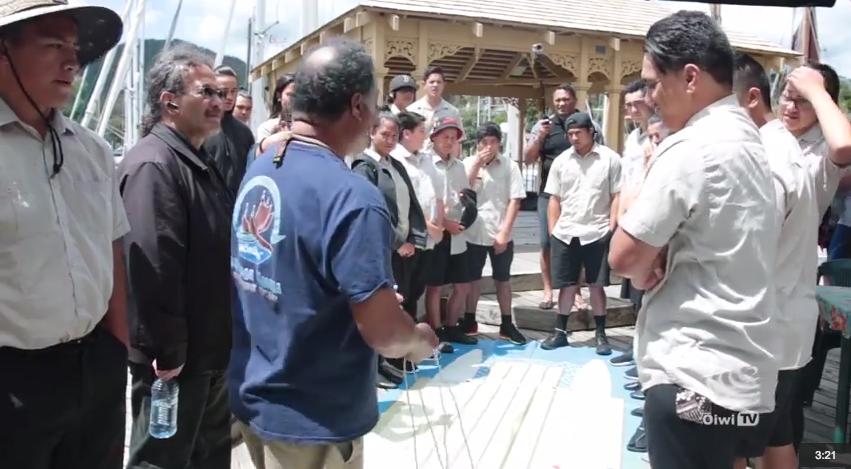
Kia ora! This is Tawhana reporting live from Hōkūleʻa at Gisborne on February 2, 2015. So we just came in yesterday, on the waka after an overnight sail from Napier into Gisborne, and got towed into this beautiful harbor here. And docked up and straight into a powhiri with a wero, which is a challenge from the local people. They send their best warriors out to intimidate the crew and see if they come in peace. Then we walked up to greet the kaumatua of the pae and had a powhiri. After the powhiri, we had a kai where we had a barbeque at his house and a good swim at his pool and then we settled at the marae, which is an iwi health organization. And then today we on the waka again cleaning and preparing for the next sail to Tauranga, just after Waitangi Bay. Kia ora! Don’t forget to follow the voyage on Hokulea.com and we’ll be sending out more of these posts later on. Mahalo and aloha!


Continue to follow the Mālama Honua Worldwide Voyage by visiting us online and joining our global movement towards a more sustainable Island Earth.
Continue Reading

Update | February 3, 2015

Aloha mai kākou

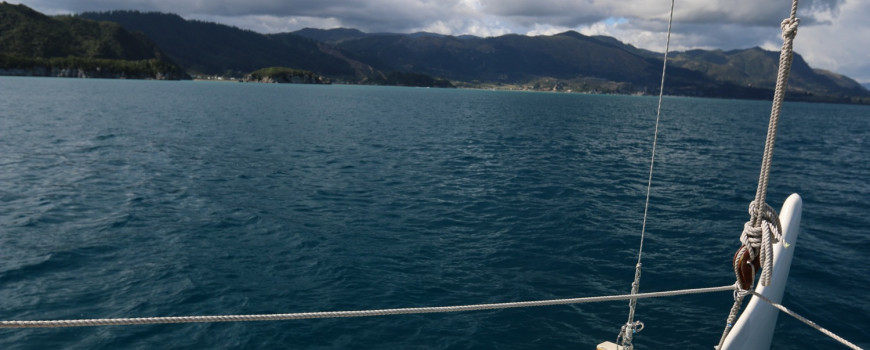
Otatara Pā sits on a bluff of what was once a great bay, Te Whanganui a Orotu. A is a fortified enclosure with an exterior stockade built for defensive purposes. A second , Hikurangi, is located higher on the bluff. The entire complex spans some 40 hectares and was favored by Māoris for its strategic location, expansive views, and access to marine resources. Throughout the area are terraces used for dwelling sites and kumura, sweet potato, storage pits. In 1931, a devastating 7.9 magnitude earthquake shook the area and forever changed the landscape, raising the bay. What once were shellfish beds is now dry farmland.

We departed Napier for Gisborne at 1900 hours on Saturday evening arriving in port 21 hours later on February 1st (February 2nd HST).

Tūranga a Nui a Kiwa, The Great Standing Place of Kiwa, renamed Gisborne in 1870 is a large coastal port that exports logs for construction timbers. It sits on the shores of Poverty Bay. Captain Cook, who first set foot here in 1769, named this bay so after a skirmish with natives where he killed two Māori warriors, and the people then refused to trade with him.  We were welcomed into the community with a traditional Māori powhiri at the docks, and the crew is being housed at Tūranga Ararau, a iwi tertiary education provider.

Monday was a clean up day and the crew watched the Super Bowl in the afternoon. Aotearoa is a day ahead of the U.S. Today, we visited Whangarā and Whitireia Marae, most famous for the 2002 movie Whale Rider. Up on the roof sat a carving of Paikea on the back of a whale. He is the discoverer of Whangara. Students from the Whangara School greeted the crews of Hōkūle’a and the escort boat Tranquility on to the marae.

We spent the day with the students and the teachers and did a star compass demonstration. We ended the afternoon with horseback rides in the ocean while some of the crew surfed the beach break.

Tomorrow we will have students visiting the crew from 10a-6p. Thursday we are visiting another school in Uawa, Tolaga Bay, and then hosting an evening Mālama Honua presentation. Friday is Waitangi Day, a national holiday in New Zealand, and we will be opening up the canoe for tours throughout the day.

Nga Mihi,
Kālepa


Continue to follow the Mālama Honua Worldwide Voyage by visiting us online and joining our global movement towards a more sustainable Island Earth.
Continue Reading

Hōkūleʻa Ventures Furthest from the Equator in Her History

HONOLULU – Traditional Polynesian voyaging canoe Hōkūle’a achieved a new milestone in her voyage around the world this week. Her arrival in Golden Bay, New Zealand marks the furthest into the southern hemisphere Hōkūleʻa has sailed in nearly four decades of voyaging.

“On March 8th, 1975, Hōkūle’a was launched with the vision of one voyage to Tahiti and back,” said Bruce Blankenfeld, Pwo (master) navigator with the Polynesian Voyaging Society. “She has been restored and reenergized through the aloha and good mana of our large voyaging community, young and old, from near and far. In 2015, 40 years later, she continues to afford us the opportunity to explore new horizons.”

Designed to replicate the voyaging routes of her Polynesian ancestors, Hōkūle’a has voyaged extensively throughout the warm waters of the Pacific, beginning with her first voyage to Tahiti in 1976. The current leg of the Worldwide Voyage is an ambitious journey, taking Hōkūle’a far beyond her native waters. The harsh sea and weather conditions along New Zealand’s South Island and beyond will continue to push the boundaries of contemporary Polynesian voyaging as Hōkūleʻa continues around the world.

“South Island is an extraordinary arrival. This is the farthest south we have ever gone to a part of the world that is notoriously rough,” said Nainoa Thompson, Pwo navigator and president of the Polynesian Voyaging Society. “It was accomplished today because of unprecedented collaborations and support, and Captain Kalepa Baybayan’s good planning, training and leadership. Doing a voyage like this that is extensive, exceptional and honors other places on the earth is foundational to our ability to do well as we prepare to depart Polynesia.”

While in South Island, crew had the opportunity to visit and honor the site where a 600-year-old voyaging canoe was recently rediscovered. This connection between Hōkūle’a and her ancient predecessor speaks to Polynesians’ ability to explore the ocean world, proving the strength and vitality of these voyaging vessels.

The Hawaiian name for this journey, Mālama Honua, means “to care for our Island Earth” and is taking Hōkūleʻa and her sister canoe Hikianalia across Earth’s oceans to grow a global movement toward a more sustainable world. The Mālama Honua Worldwide Voyage, sponsored by Hawaiian Airlines, will cover 47,000 nautical miles, 85 ports, 26 nations, including 12 of UNESCO’s Marine World Heritage sites, through June 2017.


Continue to follow the Mālama Honua Worldwide Voyage by visiting us online and joining our global movement towards a more sustainable Island Earth.

Continue Reading

Update | January 20, 2015

Aloha! ʻO Noelani Kamalu kēia, a ʻo ka lā ʻiwakālua o Ianuali ma ka makahiki 2015. This afternoon, Hōkūleʻa is departing Wellington, Aotearoa, and we are going to attempt to cross the Cook Strait hoping to go to Golden Bay. What we are actually going to do is ironic to the way the islands are situated. We are going to head further north to get to Golden Bay. So we are going to head across the Cook Strait through the French Pass, through the Tasman Sea and hopefully hit Golden Bay sometime tomorrow. When we get there, we are hoping to pay respect to the island itself and have the opportunity to see a 600 year old waka. As we are leaving Wellington, I just want to give an amazing mahalo to people who hosted us here. It has been a wonderful time here in Wellington and all the opportunities we’ve had. We even had dolphins off the port bow as we are leaving. Continue to follow us at Hokulea.com.


Continue to follow the Mālama Honua Worldwide Voyage by visiting us online and joining our global movement towards a more sustainable Island Earth.

Continue Reading