October 4: Lastest Hikianalia Crew Postings

Oct 2 (HST 8:25 PM) (from Crew Member Heidi Guth): The crew is hoping to leave on Oct. 8 (Oct. 7 Hawaii Time) … but the weather looks like it will stay quite chilly, damp and grey. Replacement engines were delivered today and are going to be installed tomorrow, then tested.

Oct. 3 (HST 5:48 PM) (from Crew Member Kaleo Wong): For the crew list, see “Hikianalia Crew List: Aotearoa To Tahiti, 2012,” under the Hikianalia: Aotearoa To Hawai‘i tab in the top menu.

Welina mai ke aloha maia Aotearoa mai. The bright kulu moon illuminated the clouds and the ocean below us as the last of us left the comforts of our home in Hawai‘i and the familiarities of our everyday lives. Accompanying me on the flight were Chris Baird, Heidi Guth, and our Kapena/Ho’okele uncle Bruce Blankenfeld. After landing and acquiring all of our checked baggage, the cool air greeted us as the airport doors opened to the outside world. We loaded into two vehicles and headed off to make a quick stop at the home base, the Takapuna Oaks hotel, before we continued on down the road about 15 minutes to join the rest of our hoa holo wa‘a (sailing companions) and ike maka (set eyes upon/fully experience) Hikianalia, our mother that will be carrying us across the ocean to Tahiti.

We arrived at the site of the canoe, and as we began exiting the vehicles, a loud “Tsua” rang out from down the pier where Hikianalia was tied up. The familiar sound brought smiles to our faces. It felt good to be with the rest of our crew, some whom have been tirelessly working on Hikianalia for the past month. We walked around the Salthouse buildings to get to the exposed pier leading to Hikianalia. Hu ka makani huihui! (The chilly wind was ripping!). Howling through the boats and canoes tied up in the area, the relentless winds and the regular, but occasional cold showers that pass through are somewhat shocking, but really allowing us to ike maka what it may be like as we sail east to Tahiti.

Kealoha Hoe and Gary Yuen, some of our hoa holo waa who have been working and living on the canoe, gave us a tour and showed us the workings of the all the amenities on board. What a different wa‘a Hikianalia is compared to Hokule‘a! Besides being of a different shape, length, and width, the living quarters are downstairs in the hull, fully dry and plush; and there is a toilet, a hale on top for the kapena, and inboard motors, just to name a few differences. There is a good feeling amongst the crew as we are all finally together. We still have some work to attend to before the canoe is ready to go. However, as individuals and as a crew, we have all prepared ourselves spiritually, mentally, and physically, and are all ready to begin our life out on the open ocean as the wa kupono (right time) arises.

Continue Reading

September 28: PVS at the Blue Ocean Film Festival, Monterey, CA

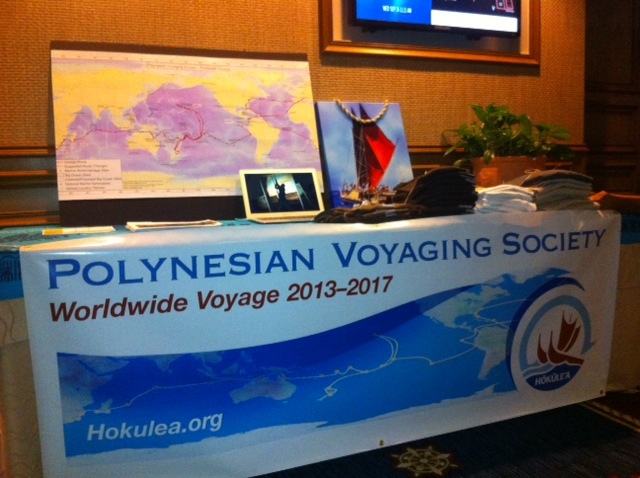
PVS Booth at Blue Ocean Film Festival (Mahalo to Honolulu Community College for the PVS banner!)

At a special Leaders and Legends luncheon today, at the Blue Ocean Film Festival and Conservation Event in Monterey, CA, PVS navigator Nainoa Thompson was one of eight individuals honored with an award as a key leader in the ocean community making a lasting and positive impact on our oceans.

In an interview with Oceanslive.org, Nainoa said, “The most important environmental challenge of our time is to protect the oceans.” Watch the interview at oceanslive.org on Saturday, Sept. 29, at NOON PDT (9 AM HST).

Over 1,000 people from all over the world have come together at the festival, from September 24-30, to network and share films about the most pressing ocean issues. PVS is meeting with some top visionaries, scientists, explorers, community leaders and filmmakers who are helping to guide our sail plan and bring clarity to the purpose of Hōkūle‘a’s Worldwide Voyage – to protect our oceans. It has been an eye-opening event to meet such incredible individuals who are taking action to protect our oceans.

The Pacific Voyagers Foundation generously sponsored a booth for PVS to share information about the history of Hōkūle‘a and her upcoming Worldwide Voyage.

Continue Reading

September 27: Anchor Watches on Hikianalia

By Hikianalia Watch Captain Mike Taylor

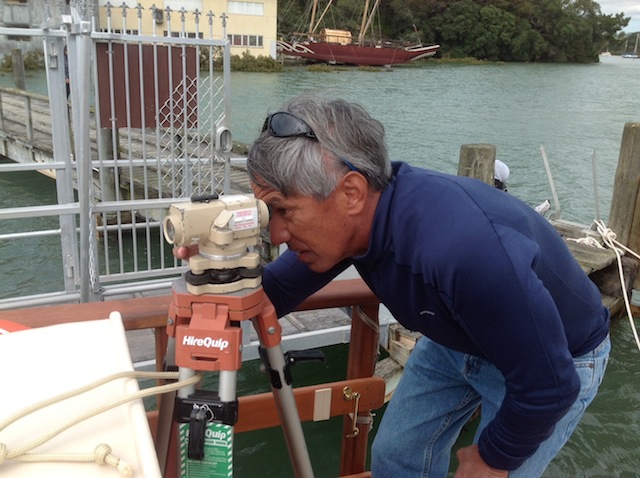
Two additional crew members, Gary Yuen and Saki Uchida, arrived a couple of days ago. We got them settled then headed for Hikianalia to train them on what we have learned about this terrific canoe.

We began anchor watches, with Kealoha Hoe’s watch having the honor of first ever to sleep aboard.

The next night was Maka’s gang and, finally, my turn came.

I had a great evening learning my way around at night. The best part was uninterrupted time to tend to some of my kuleana:  mounting the EPIRB, GPS and other electronics; installing a rain/splash protector for the batteries; etc.  I was really happy and feeling good around midnight and unrolled my sleeping bag against the cold night air.  If only I hadn’t decided to make a check of the electrical system!  All the red lights and the large black (empty) battery icon for the starboard system was not good!


After an hour and a half of checking the system from A to Z, shutting everything down and rebooting, etc. – and many emails back and forth with the designer in the Netherlands – we found another electrician had left some sensors unplugged and others misrouted.  At last we saw what we were looking for.  So all is well on Hikianalia and we are enjoying many learning experiences with Hokule’a’s sophisticated younger sister.

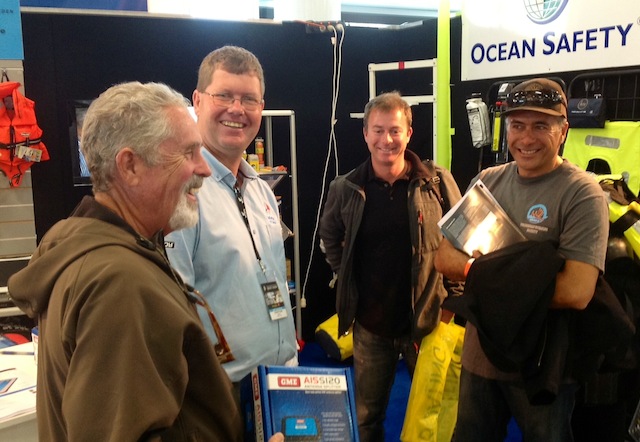
Magnus Danbolt, Frank Kane, and I were able to fill Hikianalia’s last electronic need, the Automated Identification System (AIS), which helps vessels at sea to see each other and communicate.

We went to the Auckland Boat Show and our friend, Jonathan Gravit (second from left) Managing Director of Safety at Sea, which has provided all our safety gear, helped guide us to the right system.

Continue Reading

September 24: Visit to Waitangi and Aurere

By Brad Wong, Crew member for the Hikianalia voyage from Aotearoa to Tahiti

On Monday September 18, 2012 a group of 15 crew members headed north to visit the towns of Waitangi and Aurere to learn about the history of canoes and the first voyage of Hōkūle‘a to Aotearoa. Maori tahunga tarai waka Uncle Hector Busby, arranged for our group to go to Waitangi to learn about the famous waka taua (Maori war canoe) Ngatokimatawhaorua, which was built for the centennial of the Treaty of Waitangi. The waka is 116 ft. long (almost twice the length of Hōkūle‘a!) and is paddled by over 80 people. Its bow and stern are made from one giant kauri tree.

Nainoa showed us where Hōkūle‘a first arrived in Waitangi (Bay of Islands) in 1985 and talked about the incredible moment in history when the Maori people welcomed Hōkūle‘a to become a part of their tribe.

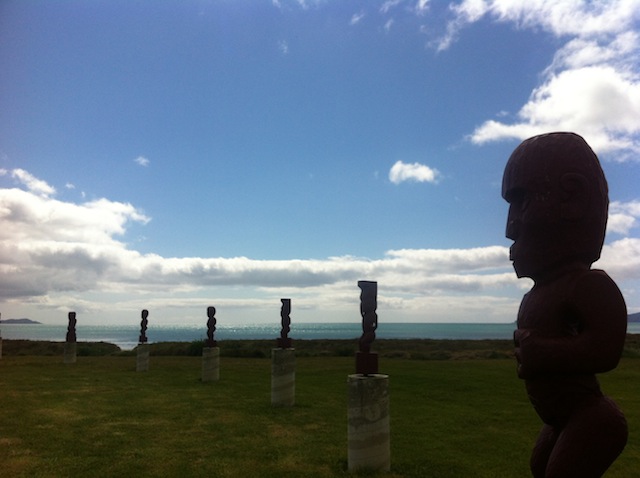
Continuing on our journey to Aurere, we stayed with Uncle Hector at his home. Nainoa showed us the stars in the southern sky as we stood in the middle of a large star compass. Each house of the star compass is marked by a different kiʻi and if you sit directly in the middle, each kiʻi is aligned with the horizon.

Over the years, Uncle Hector has built countless waka of all sorts, including the double hulled sailing canoes Te Aurere and Ngahiraka-mai-tawhiti currently sailing on their way to Rapa Nui. Uncle Hector talked to us about how to select kauri logs for carving and describing that one side of the tree is denser than the other, making it perfect for making large waka taua needing a dense bottom to keep it upright in the water.

Uncle Hector even took us to the Waipoua Forest to see where these giant kauri trees come from. We visited Tane Mahuta which is over 2,000 years old, and it takes 28 people to hold each other’s hands around the base of the tree.

For me, as a person who has been around canoes for most of my life, to see, listen, and learn from any kalai wa‘a is priceless. The skill that all these people have at finding logs to carve and working with the wood to make a living canoe is extremely impressive and inspiring. The craftsmanship on the canoes we saw especially the inlay carvings was amazing and an incredible work of art definitely giving life to every waka.

Continue Reading

September 22: Fine-tuning Hikianalia, Preparing the Crew for the Voyage (Updated Sept. 23 with Graphics)

On Friday and Saturday, the emphasis was on crew training, especially regarding safety aboard Hikianalia. Both days, Captain Bruce Blankenfeld led the crew and the kokua team from stem to stern, discussing each aspect of the rigging and many safety and efficiency procedures we have learned from the Pacific Voyagers, based on their many sea miles aboard similar vessels. On Saturday, Mike Taylor also trained the crew on the electrical system aboard Hikianalia.

The reference marks on the railings are used in conjunction with the star compass to guide the canoe by the rising and setting points of celestial bodies (sun, moon and stars) (Click on any image to enlarge it):

The reference points are aligned with the houses on the star compass:

See “Holding a Course” and “On Wayfinding” at for an explanation of the star compass and traditional navigation without instruments.

Continue Reading

September 20: Work Day, Kokua from Home

The highlight of the day was getting back into the water and doing sea trials for the performance of the motors with the new pitch of the props. Results were excellent — good speed at efficient energy usage levels.

But, what I would like to showcase today is the outstanding kokua of the PVS crew pool members who are here, but not scheduled to sail home as crew.

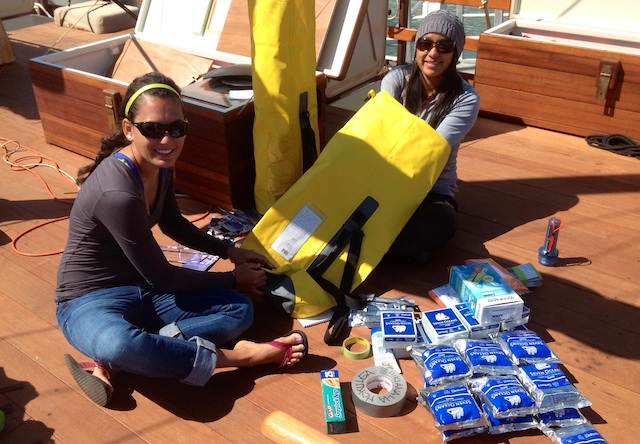
The gang pitched in to assist in preparing Hikianalia for our trip home. We wouldn’t accomplish what we are nearly as effectively and efficiently without them. Mahalo to them all – and to everyone who supports us in so many individual ways.

Continue Reading