October 23: Blog from Kealoha Hoe

“This Child”: Aloha from onboard Hikianalia. I was one of the three fortunate ones – with Attwood Makanani and Mike Taylor – to fly down to Aotearoa to get Hikianalia ready for her maiden voyage. When we arrived at the Salthouse Boatyard, she was sitting in the hale, covered with dust and just looking like she was in need of some TLC.  The weather was very cold and windy: nothing that we are familiar with.

We spent the next few days cleaning her and finishing small jobs to get her ready.  She began to feel like she was coming to life.  A few days later, we were preparing to move her out of the hale and into the light of day.  You could feel she was getting excited too.  The workers started moving with a sense of urgency; the buzz around the boatyard was starting to get louder.

Like contractions a wahine hapai has before giving birth, the day arrives to move her out of the hale.  It is still cold outside, something we had never gotten accustomed to since we had arrived.  The excitement is growing around the boatyard, and as a father, emotions start to build within myself in not knowing what this child will bring to this world.  As she slides down the track on her sled, it is like witnessing the birth of a new child as she leaves the womb of her mother and enters into this new and strange world.

Suddenly, the skies clear and the warmth of the sun embraces her like the arms of a proud and happy mother.  This is followed by a light rain, as if she was receiving her first bath.  She is such a beautiful child to see, I couldn’t stop myself from giving her a honi and sharing her first breath with her.  As we continue to make ready, we start to groom her with the Spirit of Aloha, and she begins to take on an identity of her own.

As we make our way to Tahiti and then on to Hawaii, she is being guided by a very proud and humble crew, led by pwo navigator and captain Bruce Blankenfeld.  As we start this Worldwide Voyage, the messages of Aloha and Lokahi are evident, as we take this child Hikianalia to her home in Hawaii and get her ready to share with the world.

  • I would like to dedicate this blog to my parents, Herbert and Julia Hoe.  Mahalo for your unconditional love and support.
  • Hauoli La Hanau, Dad!! Your child, Kealoha Hoe

P.S.: Early this morning, about 4 miles to our starboard, we passed the island of Rurutu in the Australs.

Continue Reading

Hikianalia Report: October 22, 6:00 PM: bumpy ride, gusting ESE trades, approaching Rurutu (Austral Islands)

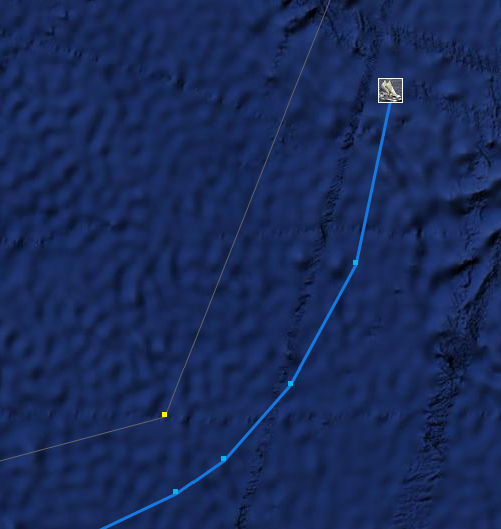
We are traveling fast despite using only the storm jib, double-reefed main and single-reefed mizzen.  We are experiencing a bumpy ride and more demanding steering due to the confused seas becoming more developed.  Many large splashes are coming over the rail washing down the decks and all the sailors in their path. Nautical Miles to Tahiti: 396 ; see Tracking Map.

Sail Data

  • time:  2012-10-23 04:00 UTC/GMT (18:00 HST Oct 22)
  • position: 23 degrees 51.0 minutes S 151 degrees 40.2 minutes W
  • course: 005 degrees True
  • speed: 8 knots
  • weather: mostly cloudy, low-level cumulus, 75% cloud cover, will have a few stars to steer by
  • wind: ESE 20 to 30 knots with a steady pulse of gusts
  • sea state: ESE 10 to 15 feet and choppy, SSE swells 8 to 10 feet, wind chop, confused seas
  • vessel and crew condition:  all ok (Faafaite also)

Education Data

  • Celestial Observations, Navigation Stars, Planets and Moon Phases:  sun only.  Today, we again steered principally by the wind and swells.
  • Animal Life: None observed today.
  • Sea Birds and Sea Life: Almost none observed today.
  • Marine Debris: None observed today.

Resources

Wayfinding and Astronomy

Weather

Sea Life/Canoe Life

Continue Reading

Blog from Brad Wong (Oct. 22): It’s getting warmer! …

After a week and a half at sea getting splashed with the coldest water I’ve ever felt, the ocean and weather is finally getting warm!  As we make our final approach to Tahiti, hopefully within the next few days, foul weather gear and multiple layers of clothing are beginning to be replaced with board shorts, rash guards, and in Kealoha’s case, a malo.

We had been staying south of 30 degrees until a couple days ago, when we began reaching up towards the Australs and finally Tahiti to avoid having to tack east within the tropics.  Water temperature and clothing aren’t the only changes we have been noticing.

More and more mālolo (flying fish) have appeared gracefully gliding across the surface of the ocean, with one unfortunate fish smacking right into the hale on deck.

Stars are another noticeable change, as the southern cross can no longer be seen upside down as it appeared in Aotearoa; it now dips below the horizon.  Northern stars like Vega and Deneb can be seen longer throughout the night, and Makalii doesn’t rise at such a steep angle any more.

With all the changes to our surroundings, crew morale continues to remain solid with jokes of a bear foraging all of our pudding and peanuts, and our bellies full with Uncle Gary’s cooking .(He somehow made malasadas this morning and chicken pot pie the other night.  Don’t ask how, because we’re all still trying to figure it out).

This has so far been the most awesome 2 weeks on the ocean as we all get the opportunity to travel and sail like our ‘aumākua on the same seas and sky as they did.  Every day brings new challenges and learning opportunities from those same ‘aumākua, Kanaloa and the other akua, Hikianalia, and of course Uncle Bruce.  Let’s hope for another couple days of great sailing to complete the first leg of Hikianalia’s maiden voyage and to get to the nice warm lagoons of Tahiti.

–Brad Wong

Hikianalia Report: October 22, 6:00 PM 

We are traveling fast despite using only the storm jib, double-reefed main and single-reefed mizzen.  We are experiencing a bumpy ride and more demanding steering due to the confused seas becoming more developed.  Many large splashes are coming over the rail washing down the decks and all the sailors in their path.

Sail Data

  • time:  2012-10-23 04:00 UTC/GMT (18:00 HST Oct 22)
  • position: 23 degrees 51.0 minutes S 151 degrees 40.2 minutes W
  • course: 005 degrees True
  • speed: 8 knots
  • weather: mostly cloudy, low-level cumulus, 75% cloud cover, will have a few stars to steer by
  • wind: ESE 20 to 30 knots with a steady pulse of gusts
  • sea state: ESE 10 to 15 feet and choppy, SSE swells 8 to 10 feet, wind chop, confused seas
  • vessel and crew condition:  all ok (Faafaite also)

Education Data

  • Celestial Observations, Navigation Stars, Planets and Moon Phases:  sun only.  Today, we again steered principally by the wind and swells.
  • Animal Life: None observed today.
  • Sea Birds and Sea Life: Almost none observed today.
  • Marine Debris: None observed today.
Continue Reading

Hikianalia Report: October 21, 6:00 PM HST: traveling at ten knots on a great course toward Tahiti

We are traveling fast on a great course with reefed main and mizzen and the full working jib.  We are enjoying a relatively gentle ride and steering despite confused seas due to wind shifts. Nautical miles to Tahiti:  587.34

Sail Data

  • time:  2012-10-22 04:00 UTC/GMT (18:00 HST Oct 21)
  • position: 26 degrees 58.3 minutes S 152 degrees 31.2 minutes W
  • course: 025 degrees True
  • speed: 10 knots
  • weather: clearing skies with low-level cumulus, 75% cloud cover, will have stars to steer by
  • wind: SSE 15 to 25 knots
  • sea state: SSW swells 10 to 15 feet, SE swells 6 to 8 feet, SW swells 6 to 8 feet (diminishing), wind chop, confused but moderate seas
  • vessel and crew condition:  all ok (Faafaite also)

Education Data

  • Celestial Observations, Navigation Stars, Planets and Moon Phases:  sun only.  Today, we again steered principally by the wind and swells.
  • Animal Life: None observed today.
  • Sea Birds and Sea Life: Almost none observed today.
  • Marine Debris: None observed today.

Resources

Wayfinding and Astronomy

Weather

Sea Life/Canoe Life

Continue Reading

Hikianalia Report: October 21, 6:03 AM HST: surfing on following seas, heading NNE toward Tahiti

Following seas giving us surfing speeds of 13 to 16 knots. Steering is a bit more involved right now, because we have three swells pushing us along, but the wa’a finds her balance point like all good surfers.  The steersmen are much more capable now that we are at this point of the voyage, so we are all finding our balance points. [Distance from Tahiti: 686 nautical miles.]

Click on Map to Enlarge It.

Sail Data

  • time:  2012-10-21 16:03 UTC/GMT (06:03 HST Oct 21)
  • position: 28 degrees 32.6 minutes S 152 degrees 54.0 minutes W
  • course: 025 degrees True
  • speed: average 9.0 knots
  • weather: 95 percent cloud cover with mid-level sheet and low-level cumulus; air is dry and cool
  • wind: SSE 20-25 knots
  • sea state: moderate, with a following sea: SW swell (10-15 feet), with a SSE swell of 6-8 feet, and a S swell of 6-8 feet
  • vessel and crew condition:  all ok (Faafaite also)

Education Data

  • Celestial Observations, Navigation Stars, Planets and Moon Phases:  During the 6 pm to 10 pm watch, we steered by the wind and with the sails.   Again, due to complete overcast, there were no stars to steer by and only occasional glimpses of the moon through the cloud cover. The same was true for the 10 pm to 2 am watch. During the 2 am to 6 am watch, some stars came through, like Orion, Jupiter and Sirius, but not for long periods.
  • Animal Life: None noted.
  • Sea Birds and Sea Life: None observed.
  • Marine Debris: None observed overnight.

Resources

Wayfinding and Astronomy

Weather

Sea Life/Canoe Life

Continue Reading

October 20: Blog from Magnus Danbolt

The wind is changing every day. System after system of Lows and Highs are passing above us and below us, spinning the wind around from port tack to starboard tack and back to port.  So far we have been lucky with more or less favourable wind directions. We are coming up to the trade wind latitudes and finally today we start to have some east in the wind. We have also reached the latitudes where the ocean has turned deep blue instead of green. This means that we are in warmer waters and that we can have our bucket showers without losing our breath and turning frozen blue.

On deck, our captain Bruce is constantly experimenting with the sails. Up goes the Drifter, down the Genoa, up with a spinnaker, down with the Jib. Then we start again. We are testing and trying everything on Hikianalia. She is the youngest member of Ohana Va’a and the ever- expanding family of canoes in the Pacific. Her job is to take care of Hokulea, the mother to all the voyaging canoes in Polynesia. So we need to test her thoroughly to make sure that she is up for her task.

Hikianalia is coming from the Vaka Moana family. Her closest sisters are the seven canoes that just finished the Te Mana o Te Moana voyage. They covered more than 140,000 nautical miles together without using any fossil fuel, only using their sails and their solar powered electrical motors.

Hikianalia has the experience of all those miles built into her, and so far she has proved herself well. She is stronger, faster, wider and more powerful than her younger sisters. Compared to the old voyaging canoes, she is luxury. She has a galley in the port stern, a rest room in the starboard and a big deckhouse between the masts. It has taken some time for the crew to get used to how Hikianalia works and likes to be handled but now our confidence in Hikianalia is solid.

Kealoha is gybing and changing sails like there is no tomorrow, Maka knows where every line on the canoe is, Mike is handling the electrical system like he built it himself, and Gary is loving his little galley and fantastic meals keep coming out from there (maybe he likes it also because it is the warmest place on the canoe too!).  And Captain Bruce can sleep a little bit more than when we started.

So, now 800 nautical miles to go, still a bit of chill in the wind. Kealoha is wrapping an extra turn on his malo, and Hikianalia is marching on a starboard tack behind Faafaite. All sails up, whiskers on the Genoa, and we, the crew, are all gathering around the galley hatch close to the heat and smell of warm food that Gary and Saki are about to serve up.

Mahalo nui,

Magnus Danbolt

For More on Magnus and the Crew, Click Here: Hikianalia Crew Listr, Aotearoa to Tahiti, 2012

Continue Reading

Hikianalia Report: October 20, 6:00 PM HST: in shifting winds, heading NE by N

Wind shifts have allowed us to adjust to a more northerly course closer to the bearing to the Australs enroute to Tahiti.  Shifting winds provided us training opportunities today, as we adjusted the sails we flew several times to efficiently use what wind was available.

Click on Map to Enlarge It.

Sail Data

  • time:  2012-10-21 04:00 UTC/GMT (18:00 HST Oct 20)
  • position: 29 degrees 42.3 minutes S 153 degrees 37.1 minutes W
  • course: 035 degrees True
  • speed: 6 knots
  • weather: overcast, cool
  • wind: South 10 to 15 knots
  • sea state: SW swells 6 to 8 feet, W wind swells 2 to 4 feet, seas mellow and comfortable
  • vessel and crew condition:  all ok (Faafaite also)

Education Data

  • Celestial Observations, Navigation Stars, Planets and Moon Phases:  sun only.  Today, we again steered principally by the wind and swells.
  • Animal Life: When we scooped a bucket of seawater to wash dishes, we caught the smallest fish you can imagine – too small to identify.  We returned him to the sea.
  • Sea Birds and Sea Life: Few today.
  • Marine Debris: A plastic milk carton with some monofilament fishing line attached floated by the canoe.

Resources

Wayfinding and Astronomy

Weather

Sea Life/Canoe Life

Continue Reading

Questions from ‘Iolani School 7th grade World Geography Class

Answers to Questions by crew member Chris Baird:

1. Do you get to swim or is the water too cold?

The water is VERY cold! No we haven’t gone swimming. When the sun comes out we try to take a bucket bath of saltwater. We prep ourselves for that first body shock of cold water and then the next bucket isn’t as bad. When you are done you feel great, but it’s cold while you are bathing. As we sail further from New Zealand and get closer to Tahiti, the water will begin to get warmer, just like in Hawaii.

2. What is the hardest experience that you’ve been through so far?

We have been very fortunate so far on this sail not to have any big problems. We have had great wind and seas. I guess the hardest thing is being away from your family. You miss your family but you know you will see them soon. Plus, we all have to take time off from work and that can be hard sometimes.

3. Were you scared of the Baleen whale when you saw it?

Actually it was a big fin whale — one of the most beautiful and speediest of the Baleen whales — that we saw. We weren’t scared, but instead rather surprised and excited to see it surface right next to us. It is an amazing sight to see such a huge and beautiful creature. After it surfaced at the front of the canoe, it swam to the other side and surfaced a few more times. We tried to grab our cameras to get pictures. Hopefully, we will get to see more whales before we finish our sail.

Fin Whale. From True Wild Life.
Continue Reading