Kamaile Academy Blog: Hōkūle‘a and Hikianalia in Wai‘anae

Wai‘anae, O‘ahu —

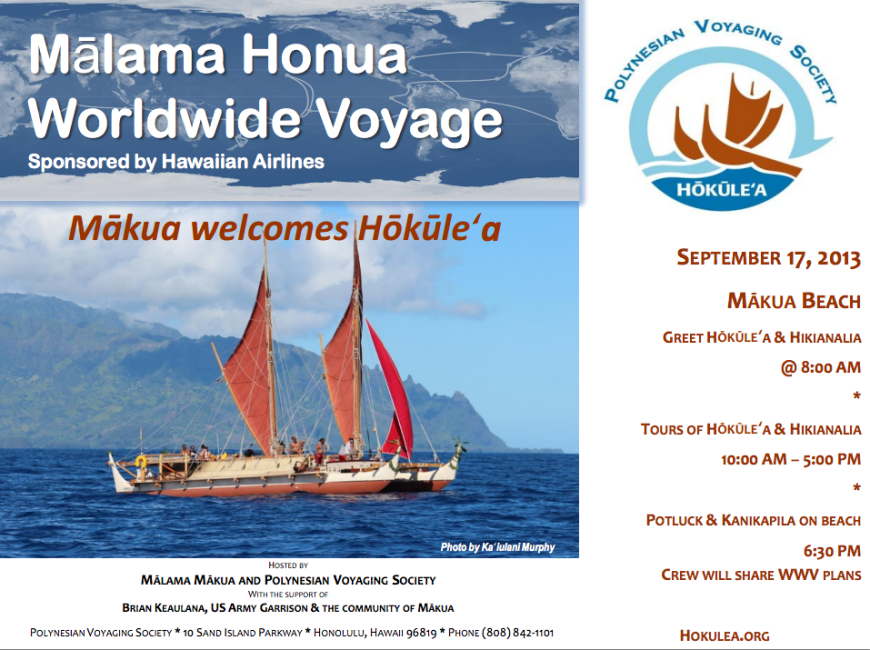
By Kamaile Academy Future Navigators. In late September, high school students from Kamaile Academy PCS in Wai‘anae took part in the welcoming of Hōkūle‘a and Hikianalia to their coast. After years of involvement with the Polynesian Voyaging Society, this week allowed the students to continue their personal crew training, share their experiences with their community, and pass on their knowledge to the next generations of voyagers. The reflections below provide some insight into what the events meant to the students and their community in their own words.

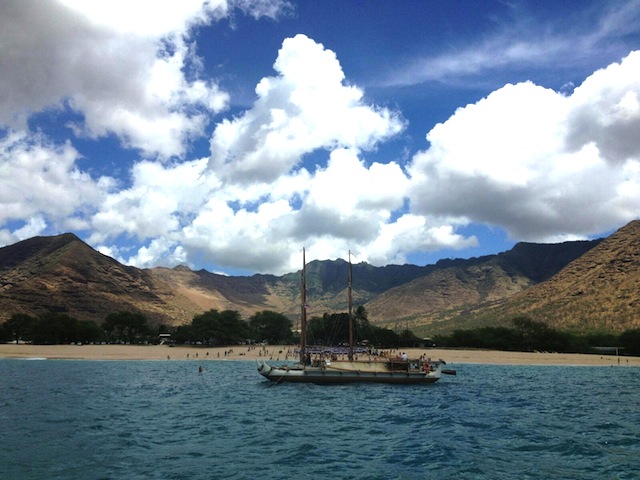
Being able to sail from Nānākuli to Wai‘anae was a great opportunity for me. I was able to bring and introduce Hōkūle‘a to my home. I am from Wai‘anae, and I am proud of where I am from. It was an honor to be able to sail with other crew members into Pōkaʻi Bay. Opportunities such as this always leave me with great learning, whether it be a new knot to tie, new people, or new life lessons.

Although the journey from Nānākuli to Wai‘anae was short, it was a leg of a much longer journey of sailing around the world. I was enriched with joy and happiness when I saw my community come out to experience what Hōkūle‘a and the Polynesian Voyaging Society are all about — to learn the mission of PVS, to Mālama Honua, and to reconnect back to our past, because without the past how are we able to progress in the future? Hōkūle‘a is capable of filling a hole in every Hawaiian’s life. For them, she can be the way to reconnect back with their past and to mālama honua to care for themselves, their land, and others. The past generation has taught us these values, and it is my generation’s duty to teach the next generations those values. A simple sail from Nānākuli to Wai‘anae is capable of making a huge difference in someone’s life, and in the end, every moment was a gift.

Back in 2009, I sailed for the first time on both Hōkūle‘a (for training) and E Ala. It was an amazing and breathtaking experience, and I instantly fell in love with PVS. In honor of that experience, I wrote a poem entitled “E Pua ana ‘O Kamaile.” Within the poem reads the words,

“E Pua ana ‘O Kamaile,
Ku la‘i ho‘okele Na Alaka‘i,
ka na‘au loko maika‘i,
E lupua ana ia Hawai‘i.”

E pua ana ‘O Kamaile translates to “Blossoming is Kamaile.” We are continuously learning all that PVS has to offer, we are blossoming to crew members, and we are growing more and more educated. Ku la‘i ho‘okele Na Alaka‘i (leaders in voyaging), we are on our way to becoming leaders in voyaging.
On September 23, 2013, our Kamaile ‘Ohana had the opportunity to become those leaders. We had keiki from Kamaile Academy come down to Pōkaʻi Bay to tour Hōkūle‘a. Within this time, we high school students set up and ran multiple stations. Throughout the morning, we led more than 200 younger students through activities including making peace flags for the voyage, physical training, knot tying, basic navigation, and tours of Hōkūle‘a. For the younger students from grades 3 and 6, we became the voyaging leaders, guiding them, answering their questions, and becoming the teachers.

Reflecting upon my growth from my sail back in seventh grade to now, my knowledge of Hōkūle‘a and PVS has grown dramatically. To see that we could apply this knowledge and teach the next generation brought tears to our eyes. I think it is a magical thing when we can apply what my family in PVS has taught me and then pass that knowledge to next generation. Ka na‘au loko maika‘i, E lupua ana ia Hawai‘i — with a gracious heart, benefiting all of Hawaii. In PVS, we learn to give aloha, and to mālama everyone. We certainly did that as we allowed our Kamaile ‘Ohana to come down to Pōkaʻi Bay and teach that what we know without a grumble. As we partook in this wonderful event, we served the people of Hawai‘i one student at a time. We gave back to our community by sharing our knowledge, and we will continue to do this for as long as we live. Everything we learn from our elders, we will pass down to the keiki, and keep that going. When this poem was written it was a foreshadowing to what the haumana from Kamaile will be doing, and we are certainly living up to the standards set.

Eo Kamaile, Eo Hōkūle‘a, TSUA!

Continue Reading

South Florida students make their own Hawaiian star compass

Boca Raton, Florida —

By Elizabeth Eubanks, Pope John Paul II High School. I am a science teacher from South Florida. This summer I attended an EARTH (Education and Research: Testing Hypothesis) workshop in Honolulu, HI, hosted by the Monterey Bay Aquarium Research Institute (MBARI), C-MORE (Center for Microbial Oceanography: Research and Education) and C-DEBI (Center for Dark Energy Biosphere Investigation). During the workshop, I had the pleasure of learning from Jenna Ishii who is a wonderful educator associated with the Polynesian Voyaging Society.

She taught us about Hōkūle‘a and also demonstrated how to create a Polynesian Star Compass. I was instantly enamored by her grounded style and incredible knowledge.

I acquired some video of her demonstration and had the pleasure of interviewing her.

This fall I put a video together and shared it with my Marine Science classes and with my 8th grade integrated science class. http://www.youtube.com/watch?v=1i3eH7-iXAU

After watching the video, we made a Polynesian Star Compass with my 8th graders. We used “sea beans or drift seeds” that I found from our beaches here in Florida. Drift seeds travel the current and often come to our beaches from places like South America. They are a personal connection in our lives that connect us to those faraway places.

http://youtu.be/EEz1Ry_IotM  created for this blog

It was a great lesson and here are a few things my students had to say about it:

The star compass is an age old method to navigate using the moon and the stars. Jenna taught me that the stars never cross the equator. When we made it in class, I learned that the stars are in line with each other. Nick L

The star compass is the traditional way of navigating. It is split up in 32 different sections called houses. The sun, moon and stars all rise and set in the same house. They [the stars] never cross the equator and they stay parallel to the equator. Only wind, birds, and canoes can cross the equator. They first set north, south, east and west. North is called Akau, south is called Hema, east is called Hikina, and west is called Komohana. The compass teaches kids and adults how to make a compass using your surroundings. It also helps if you are sailing.

I thought it was a cool way to make a compass out of your surroundings. That way you can’t get lost anywhere as long as you know where the sun rises and sets. My thoughts on making it was that it was fun and interesting to hear the different names and actually see how to create it. Katrina Y

Continue Reading

Learning Journey: Kamaile Academy, Wai‘anae / Sept. 23

Wai‘anae, Hawai‘i —

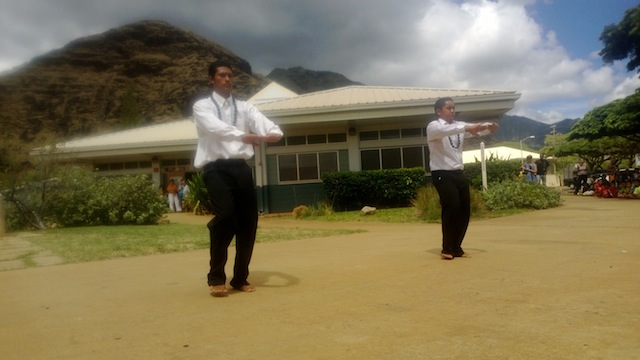
By Lehua Kamalu. On Monday afternoon, the crew were hosted by the Kamaile Academy Navigators at their school in Wai‘anae, Hawai‘i.  The Polynesian Voyaging Society has a special connection to this school as a number of these students have actively participated in training and preparation activities for the Worldwide Voyage.  The students presented a beautiful welcome of ‘oli (chant) and hula (dance) to begin our journey through their school.

WP_20130923_006

The fourth grade students were eager and excited to share the various ways they used their values of kuleana (responsibility) and laulima (cooperation) to build a lovely garden that included kalo (taro), pineapples, aloe, and the “Dr. Seuss” tree, which inspires images from the famous Dr. Seuss tale of the Lorax.  Their ha‘aheo (pride) in their work was clearly evident in the careful detail they used to describe the process of preparing the garden and the various uses of each plant of the garden.

WP_20130923_014

The secondary students exhibited their dedication to the arts through some heartfelt poetry about who they are and where they come from.   Following this was a presentation of Portfolio Defenses, where students defend the reasons why they think they should be allowed to advance to the next grade-level, based on what they have learned about academic subjects, but more interestingly about themselves and their approach to taking charge of their own educational goals and success.  As Kaina Holomalia put it, “The students became the teachers, and the teachers became the students,” as we sat in a row of desks looking up at these incredible presentations.

We ended the day talking with the after-school program, and spending time in The Navigators’ Center.  This is the campus hub for students, parents, and community supporters to conduct meetings and activities that strengthen the connection of the school to the strong Wai‘anae community that surrounds it.

The crew were inspired by the leadership and motivation of each of the students we met and are excited to see these future Navigators as they graduate their first class this year.

WP_20130923_018

Continue Reading

Learning Journey: Kauai Jr. Lifeguards with Hōkūle’a crew John Kruse and Billy Richards / Sept. 15

Nawiliwili, Kauaʻi —

By Steve Soltysik. For a moment, step back in time to the first voyage of the Hōkūle’a to Tahiti in 1976.  Two of the original crew, John Kruse and Billy Richards,  were once again aboard the Hōkūle’a in Nawiliwili Harbor on Sept. 15, 2013.

Hokulea_visit.003

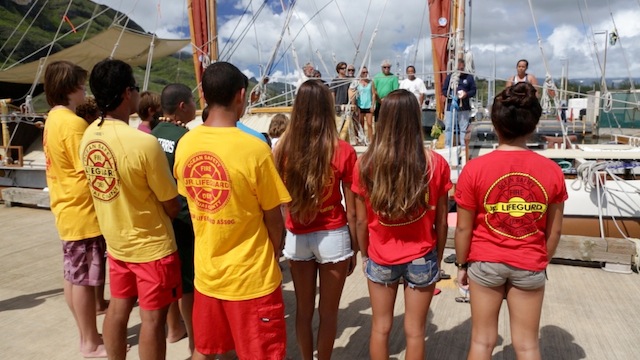
The young crew and visitors, Jr. Life Guards from Kaua’i, had the honor of a very special and rare day — the sharing of thoughts, memories, and feelings from voyaging 36 years ago.

Hokulea_visit.001

The future life guards of Kauai found themselves spell bound with true, first hand stories about the early voyaging days, the challenges, stress, joy, jubilation and overwhelming experience of taking part in the rebirth of Hawaiian identity and pride.

John Kruse was also aboard the 1978 voyage that ended in the Hōkūle’a  swamping one hull, and turning up side down, adrift and  the tragic loss of Eddie Aikau.  Emotions and connect ran deep on the deck of Hōkūle’a , in Nawiliwili Harbor — with the older generation passing on their experience to like minded, young skilled water rescue life guards.

Hokulea_visit.004

After an extraordinary hour aboard Hōkūle’a , Jr. Life Guards were introduced to the Hawaiian canvas star compass, dock side next to the Hōkūle’a. Kalei Velasco taught the basic lesson, having voyaged many thousands of miles through the Pacific, his skill of communication and off shore experience was much appreciated by the life guards.

Hokulea_visit.007

The second half of the day was in Kalapaki Bay, aboard the escort canoe, Hikianalia.  Anchored out 200 yards, all the life guards swam out, “in training”  no faster than the slowest swimmer, no one left behind.  Demonstration of man overboard procedures, and life saving techniques were shared in the calm waters of Kalapaki Bay.  The Jr. Life Guards were shown the Hikianalia stem to stern, by crew members Kalei, Zane and Steve  Soltysik.

Hokulea_visit.010

The Jr. Lifeguards swam the distance to shore, with a rare and special experience that is certain to influence their compass course in life.

Hokulea_visit.012

Continue Reading

Learning Journey to Kapa’a High School / Sept. 6

Kapa‘a, Kaua‘i —

By Kimberlee Stuart.

On September 6, the Hōkūle'a and Hikianalia crew visited Kapa’a High where upper classmen were anxious to ‘get in on the action’ after hearing great reports from the freshmen about their visits to the wa’a in Hanalei.  Crew introduced themselves and shared a bit about voyaging to the enrapt crowd who listened intently and then responded with lots of questions about the voyaging canoes and the World Wide Voyage. After watching the video “Hōkūle'a: Her Farthest Journey”, students were even more stimulated, made obvious by the pointed questions.  More than one student wanted to know, “How can I become a voyager?”

Over a ‘talk story’ session at lunch, Kapa’a teachers and crew discussed a bit about planning curriculum around the World Wide Voyage. Miki Tomita gave the group a glimpse into an online meeting between her UH Lab School students and crew members on the Hikianalia- a technology being tested for the World Wide Voyage.

Following lunch an Environmental Science and Physics class walked down with the crew to a planned “Malama Honua” garden area. On campus Officer Deblake met the crowd and using a novel radar gun technology rigged to measure and map the nearly one acre plot.  After a blessing the first plant, an ohia seedling, was lovingly planted by the class and crew under special guidance from crew member and agriculture guru Matt Kunimoto.

noname8

Kapa'a High Students plant their first seedling for the Malama Honua Garden

Kapa’a High students and staff plan to work on this garden with interdisciplinary lessons over the four year journey of the World Wide Voyage.  Their goal is for the school to do their part to malama honua and increase sustainability for both the school and the community.

Continue Reading