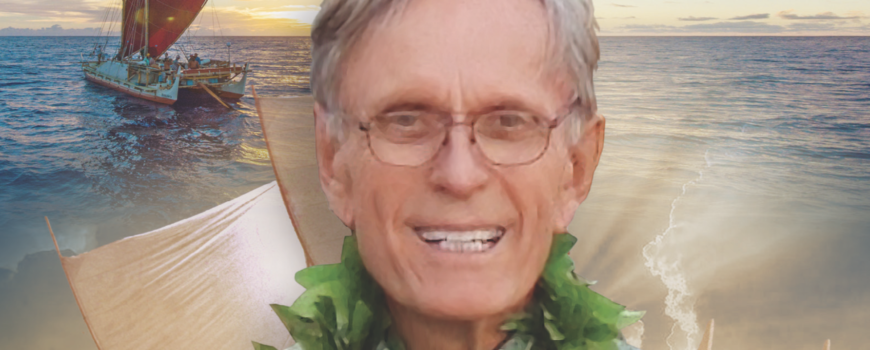
Bid Aloha to PVS Founder Ben Finney
The family of Ben Finney, along with the Polynesian Voyaging Society (PVS), invites friends, colleagues and the public to celebrate his life. Finney co-founded PVS to build the Hōkūle‘a and show how the first people reached Hawaii and other islands.
“Ben provided the vision and mission and the leadership to set the foundation for all that we would do in voyaging since 1976. We owe so much to him. Hawai‘i, the Pacific and the world is indebted to the work of Ben Finney,” said Nainoa Thompson, the president of PVS.
Please join us on the morning of Saturday, March 3rd to mark his life before his family takes him on a final sail aboard Hōkūle‘a.
 WHAT: Celebration of Ben Finney’s Life
WHEN: Saturday, March 3, 2018, 9 a.m. to 11 a.m.
WHERE: Marine Education Training Center (METC) at Sand Island
About Ben Finney:
An anthropologist and pioneer in the reconstruction and sailing of Polynesian voyaging canoes, Finney first began dreaming about building a canoe and sailing it to Tahiti while studying at the University of Hawai‘i in 1958. In the mid-1960s, he built Nalehia, a replica of a Hawaiian double canoe that provided the basic information on sailing performance that went into planning Hōkūle‘a’s initial voyage to Tahiti. Finney co-founded PVS in 1973 with Herb Kawainui Kane and Tommy Holmes and served as its first president. Together with countless volunteers, they built Hōkūle‘a, the first Polynesian voyaging canoe in 600 years and launched her in 1975.
“Ben provided the vision and mission and the leadership to set the foundation for all that we would do in voyaging since 1976. We owe so much to him. Hawai‘i, the Pacific and the world is indebted to the work of Ben Finney,” said Nainoa Thompson, the president of PVS and scheduled speaker at the celebration.
Finney set out to show that Hawaiians could intentionally sail long-distances without modern instruments. He sailed on Hōkūle‘a’s first voyage to Tahiti in 1976, and chronicled that voyage in his book Hokule’a: The Way to Tahiti. He also sailed on the 1985 voyage to Aotearoa, the 1992 voyage to Rarotonga, and also covered the 1995 voyage from the Marquesas to Hawai‘i from Hōkūle‘a’s escort vessel.
During his career, Finney held faculty appointments at the University of California, Santa Barbara, the Australian National University, the University of French Polynesia, and the International Space University. From 1970 through 2000 he was a professor of anthropology at the University of Hawai‘i at Manoa, where his courses included Human Adaptation to the Sea and Human Adaptation to Living in Space. From 1994 through 2003 he was the co-chair of the department of Space and Society at the International Space University. He is the author of over eight books and scores of articles on the history of voyaging and wayfaring in the Pacific, as well as studies comparing the exploration of ocean space to outer space.
 “We want to celebrate this place and the movement taking place by the Puʻuloa community and the Navy to restore the Native Hawaiian history, sites and cultural identity of Pearl Harbor,” said Nainoa Thompson, president of the Polynesian Voyaging Society. “We hope Hōkūleʻa’s visit will open the doors for our young people to learn about the extraordinary history and culture of this very special, sacred place,” he added.
 “We welcome the navigators of Hōkūleʻa. Many are military veterans or have strong family ties to our armed forces,” said Rear Adm. Brian Fort, commander of Navy Region Hawaii and Naval Surface Group Middle Pacific. “I have great respect for the courageous navigators of the Polynesian Voyaging Society and for the values they live by: love of the ocean, care for a sustainable environment, appreciation of history and heritage, and commitment to educating the next generation. And I join with the rest of our community in thanking the navigators for sharing their time, talents and wisdom with us and our neighbors at Joint Base Pearl Harbor-Hickam.”

 As part of


 The Sail On Moana Song Kit can be used virtually everywhere by schools, community groups, home study, families and others. It is designed to help teachers share with their students not only values and voyaging traditions out of the past, but through this unusual cultural connection, to instill among our children a sense of responsibility in caring for the Earth for the future.

