Worldwide Voyage | May 16: Tahiti Departure Update

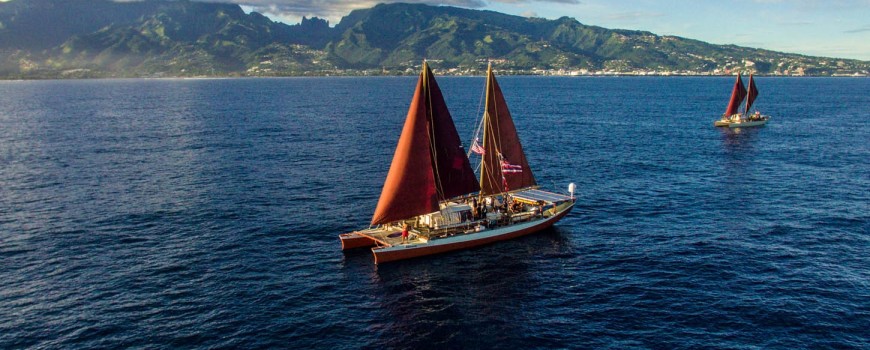
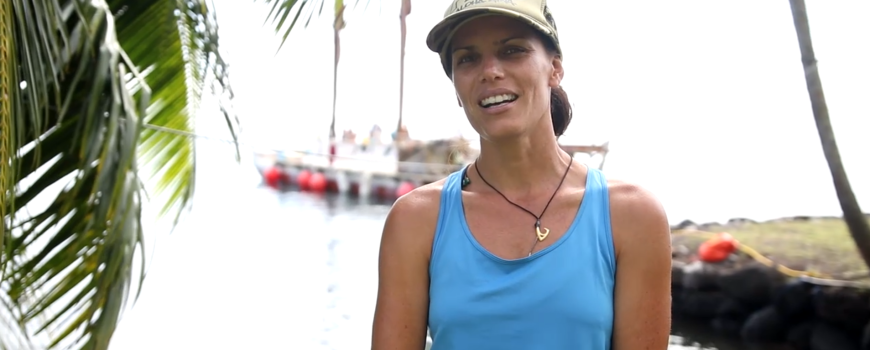
Hōkūleʻa navigator Kaʻiulani Murphy discusses how the winds today are less than ideal for crewmembers to depart from Tahiti to the Tuamotus, en route to Hawaiʻi. Southeast winds, anticipated tomorrow, should allow for a favorable departure, according to Murphy.

For more, view the clip above or photos from the day before below. And remember you can tracks Hōkūleʻa’s progress in real time from the Mālama Honua Tracking Map.


Homecoming - Save the Date - Banner Feb 17 Update

Hōkūle‘a Homecoming:
Event registration is live!

Join thousands of supporters and fans to welcome Hōkūleʻa home to Hawaiʻi in June 2017! Register now for the Mālama Honua Summit, reserve your tour aboard Hōkūleʻa, and RSVP for the Polynesian Voyaging Society benefit dinner.

Continue Reading

Crew Blog | Kālepa Baybayan: Follow the Wind

Kalepa_Baybayan

By Kālepa Baybayan

It seems that the Maraʻamu Wind that is typical in July and August, Tahiti’s winter, is starting a little early this season. This particular condition occurs when a strong high-pressure system passes to the south of the island, the pressure gradient is then compressed and a stronger than normal easterly trade winds field is created. For the past 48-hours these windy conditions have filled our eastern horizon, something that was not present last week as we slowly made our way into Papeʻete Harbor.

After leaving Cape Kumukahi, the easternmost point of our Islands, we sailed our 2,200 nautical mile track in just 16 days, making for the fastest trip ever by a traditionally navigated voyaging canoe. In 2014, Hōkūleʻa and Hikianalia made landfall on the Tuamotu atoll of Aratua in 16 days, we found the same atoll in 14 days. The 16-crew members of Hikianalia sailed down the route we call Ke Ala I Kahiki, The Pathway to Ancestral Homelands, through the southeastern Malanai quadrant on our star compass. Guided by a full moon, we saw the outline of Aratua atoll in the early morning hours and sailed around its western edge on a very light northeasterly wind. Two tacks and two days later, we rounded the famous Matavai Bay and Point Venus, arriving at 3 a.m. to a quiet dock with no one around to welcome us. Sleep was impossible the rest of the early morning until sunrise when we were welcomed to Tahiti by crew member Puaita Raihau Pulotu’s Tahitian family with lei, drinks, and food.

On this passage the crew simply followed the wind to Tahiti; this trip was all about optimizing the sailing angles to keep the canoe moving fast on the water. If the wind was from the east-northeast, we sailed southeast. If the wind was from the east, we sailed south-southeast. If the wind was from the east-southeast, we sailed south. We simply kept the canoe moving towards the southern horizon on the fastest sailing angle the wind provided, sailing a zigzag course line to landfall. If you can do that the wind will take you to the Tuamotus and on to Tahiti.

A sail such as this requires and involves a number of people that go beyond the 16 who have the privilege to sail onboard the canoe. First, I would like to thank Bob Perkins, Kekaimalu Lee, Keli Takenaga, and Darienne Dey and the crew of the Hikianalia Tahiti to Hawaiʻi leg for assisting with preparing the canoe for the voyage. Next there is Lita Blankenfeld and her team for gathering all the food from a local vendor. Our fantastic administrative staff of Heidi Guth, Ka’iulani Murphy, Mikiala Akiona, and Ramona Ontiveros for helping with all logistical matters. A huge thanks goes to Hans Rosendahl and Commanders Weather for providing weather forecasting services. We need to thank the Kukio Beach Boys from Kona and Young from Hilo for their assistance with tows from Oluwalu to Keoneʻoiʻo and Mahukona to Hilo. Lastly, I would like to thank all of our PVS network and families for supporting us on this journey.

Of special note, mahalo to Watch Captains Snake AhHee, Kalani Kahalioumi, and Gary Yuen for providing the leadership to keep the canoe safe. To my old friend Teikiheepotauvitava Taupu, it was good to be at sea with you for this last and final voyage of your career. Lastly, my daughter did a fantastic job captaining Hikianalia for her first time as the leader of the voyage and the primary navigator. She is very disciplined, good-natured, an effective communicator, and cares deeply about each of her crew members. All I can say is that I am proud to be her father.

The crew of the Hikianalia, 2017, Hawaiʻi to Tahiti Leg:

Kalā Tanaka, Captain, Primary Navigator
Kālepa Baybayan, Sail Master
Snake AhHee, Watch Captain
Kalani Kahalioumi, Watch Captain, Apprentice Navigator
Gary Yuen, Watch Captain, PM Cook
Miriam Chang, Ship Doctor
Tava Taupu, Senior Crew
Kawika Crivello, Education Coordinator, Apprentice Navigator
Kaipo Kiaha, Media Specialist, Apprentice Navigator
Kalau Spencer, Power System
Nikki Kamalu, Technology Specialist, Apprentice Navigator
Liz Zeiger, Quarter Master
Jackie Meggs, Quarter Master
Lohiao Paoa, Sails, Apprentice Navigator
Ben Dumaran, Sails
Puaita Purotu, AM Cook

Mahalo a nui loa,
Kālepa


Homecoming - Save the Date - Banner Feb 17 Update

Hōkūle‘a Homecoming:
Event registration is live!

Join thousands of supporters and fans to welcome Hōkūleʻa home to Hawaiʻi in June 2017! Register now for the Mālama Honua Summit, reserve your tour aboard Hōkūleʻa, and RSVP for the Polynesian Voyaging Society benefit dinner.

Hōkūleʻa Update | April 11, 2017: Tahiti Day 35

Tahiti sited! Moku Puulei-Chandler is here with us to announce that Leg 29 crewmembers have successfully sighted Tahiti on day 35 of their voyage from Rapa Nui!

For more, view the clip above or photos from the day before below. And remember you can tracks Hōkūleʻa’s progress in real time from the Mālama Honua Tracking Map.


Homecoming - Save the Date - Banner Feb 17 Update

Hōkūle‘a Homecoming:
Event registration is live!

Join thousands of supporters and fans to welcome Hōkūleʻa home to Hawaiʻi in June 2017! Register now for the Mālama Honua Summit, reserve your tour aboard Hōkūleʻa, and RSVP for the Polynesian Voyaging Society benefit dinner.

Hōkūleʻa’s Voyage of Hope: Part 5, from Patagonia Books

Coming this Fall 2017, Patagonia and the Polynesian Voyaging Society have partnered to release Mālama Honua: Hokule’a – A Voyage of Hope written by Jennifer Allen with photos by John Bilderback.  followed by additional information about this exciting book. Photo above by John Bilderback.


Long Live Hōkūleʻa

By Jennifer Allen & John Bilderback

The wind is quiet. The waters, still. The only ripples are those following children on paddleboards making large, awestruck circles around the double-hulled sailing canoe Hōkūleʻa. Ti-leaf garlands drape the bows. Sails remain wrapped and tied around the masts. In full wind, those sails will billow into a 50-foot spray of crimson, the color of a Hawaiian king’s cloak.

Hōkūleʻa has been harbored here in Palekai, a spring-fed cove near Hilo, for nearly a week now. Merchant ships, cargo containers and petroleum tanks surround this lava rock-girded bay. Hōkūleʻa seems like an island unto herself—undaunted, anchored, awaiting the winds to sail.

It has been a big-sun day, with a sharp horizon and no sight of clouds. Her captain is barefoot in blue jeans, adjusting the lines that swing the boom. His name is Charles Nainoa Thompson. He’s known as Nainoa. He has been navigating Hōkūleʻa for 35 years now, more than half his lifetime.

“You do not tell the winds what to do,” Nainoa has told his crew. “The winds tell you what to do.”

Right now, the winds say, wait.

Continue reading the excerpt by visiting our friends at Patagonia!


COMING FALL 2017

Mālama Honua: Hokule’a – A Voyage of Hope

This beautiful hardcover book chronicles Hōkūleʻa’s epic mission to nurture worldwide sustainability. Interwoven with descriptions of Hōkūleʻa’s experiences in port are the voices of the master navigators and crew members, who guide the ship along the ocean’s trackless path, and the local pioneers—scientists, teachers, and children touched by Hōkūleʻa—who work tirelessly to weather the many environmental challenges of our modern lives. 320 pages, with full-color photographs throughout.

Author Profile – Jennifer Allen & John Bilderback

Jennifer Allen, the author of two previously published books, has been a journalist for over twenty years. Her reporting has appeared in various publications including Rolling Stone, The New Republic and The New York Times Magazine. She has also been an on-air reporter for the NFL Network and NFL Films. Jennifer feels deeply honored and humbled to witness and document the Worldwide Voyage of Hōkūle‘a.

———

John Bilderback is an internationally recognized ocean sports photographer. As a SURFER Magazine Senior Staff photographer for twenty years on the infamous North Shore of Oʻahu, his photographs have been on dozens of covers and hundreds of magazine pages. Now a member of the board of directors of the North Shore Community Land Trust, his lifelong love for the ocean has led him to care deeply about stewardship of the land as well. When Hōkūleʻa came to Haleʻiwa in 2013, he became deeply captivated by the Mālama Honua Worldwide Voyage, and the mission ultimately drew him in. Describing it as “the greatest group of people” and “the most meaningful thing” he’s ever been part of, he is now traveling extensively to shoot a book about the voyage, which will be published by Patagonia in the fall of 2017. He has just completed his training to become a core crew member.

Continue Reading

Hōkūleʻa Nav Report | April 5, 2017: Tahiti Day 29

Hōkūleʻa’s crew is on the move towards Tahiti and in search of Rangiroa. Here’s Kaleo Wong with a navigation report.

For more, view the clip above or photos of the day below. And remember you can tracks Hōkūleʻa’s progress in real time from the Mālama Honua Tracking Map.


American English translation:
Aloha to you all following us along this journey. Here we are on our way from Rapa Nui down to Tahiti. We have just completed the first half of this voyage. We left Ua Pou in the Marquesas and are on our way to the tiny island of Rangiroa. It is evening here and as you can see behind me our crew is setting up for dinner. Our course to Rangiroa is set in the direction of Manu, Kona, however the prevailing winds wonʻt allow us to head directly in that direction, so we are headed in Nālani, Kona. So if you are tracking us and wondering why we are a little off course, we are adjusting to the winds and enjoying this nice breeze and sail aboard māmā Hōkūleʻa. Thank you all for following us. Head on over to www.hokulea.com. Shoutout to our hoa over at ke ala ʻūlili.

ʻŌlelo Hawaiʻi
ʻAuhea wale ʻoe e nā hoa o ke ala ʻūlili a me ke ala nihinihi a mākou e hele aku ai a hiki i ka mole. Eia nō mākou ma kēia wahi huakaʻi o mākou mai iā Rapa Nui a hiki i Tahiti. Ua pau kahi hapa mua o kēia wahi huakaʻi ʻoiai ua haʻalele mākou iā Ua Pou a ke hele nei i kahi ʻāina liʻiliʻi ʻo Rangiroa lā. ʻO ke ano ahiahi kēia, hiki ke ʻike ʻia nā hoa waʻa ma hope oʻu ke hoʻomākaukau nei i ka pāʻina ahiahi. Ke holo nei mākou ma kā mākou ala e hele ai i Rangiroa, ʻo ia hoʻi ʻo Manu, Kona, eia naʻe ma muli o kēia pā aheahe a ka makani, ʻaʻole hiki ke hele pololei ma ia wahi hale, ma ia wahi lua ma ka pānānā. No laila e hele ana i ka Nālani, Kona. No laila ke noʻonoʻo nei paha ʻoukou, ah pehea lā kēia mau wahi waʻa, a ʻo ia ke kumu. Ma muli o ke pā aheahe mai o kēia ʻano makani, makani ʻoluʻolu a eia nō mākou e nānea nei i ka holu mālie ʻana o kēia waʻa o mākou o ka māmā ʻo Hōkūleʻa. A ʻo ia wale iho nō o ko mākou holo ʻana. Mahalo ka hāhai mau ʻana iā mākou, noke aku i ka nānā ʻana iā www.hokulea.com. He wahi leo aloha kēia iā ʻoukou e nā hoa o ke ala ʻūlili.


Homecoming - Save the Date - Banner Feb 17 Update

Hōkūle‘a Homecoming – Save the Date

We’ve got more details for you regarding Hōkūleʻa’s historic homecoming in June 2017! Click below to find out more:

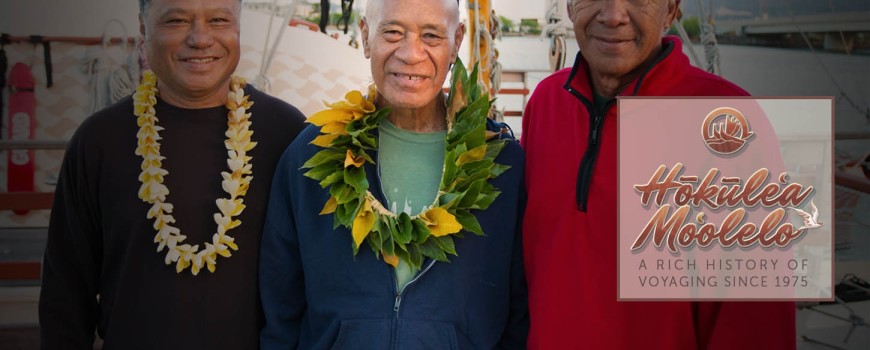
Hōkūleʻa Moʻolelo: Tava Taupu

sam_lowAs Hōkūleʻa re-enters the Polynesian Triangle on the last legs of her Worldwide Voyage, we take a moment to celebrate earlier voyages and the crew who helped her find her way. Hōkūleʻa is currently in Nuku Hiva, the birthplace of veteran voyager Tava Taupu. The original version of this profile was written by crewmember and documenter Sam Low as he voyaged with Tava from Hawaiʻi to Tahiti in 2000.


Hokulea Moolelo GraphicOn April 6, 1945, Tava was born in Taiohaʻe on Nuku Hiva, Marquesas Islands. His father tended cattle in the mountains above his home and he captained an interisland trading vessel. He also built canoes for fishing and sailing, and he taught Tava the art of seafaring and carving.

As a young man, Tava went to Tahiti to learn to carve wooden tiʻi (sculpted figures called kiʻi in Hawaii) from his uncle Joseph Kimitete. Papeʻete, the capital, was a place where young Tahitians liked to rough up boys from the outlying islands, so Tava learned to box.

Boxing changed his physical habits – when others his age would turn to drinking and smoking, Tava turned to training. “When I went boxing, I got proud,” he recalls. “I was amateur, six rounds. I exercise, forget kid stuff.” What Tava doesn’t tell you is that he boxed so well he earned the title of lightweight champion of French Polynesia.

IMG_4228“I first learned about Tava’s boxing when I was on a voyage with him in 1980,” recalls Kālepa Baybayan. “We were going to go out on the town and Tava began to get dressed up. Then he stood in front of the mirror and began shadowboxing. It was scary. I always knew him as an extremely gentle person, and now I was seeing his wild side. Wherever we went, he was like a superstar. People came up to talk to him. I was surprised how many people knew him in Papeʻete.”

In 1970 Tava came to Hawaiʻi on a visa arranged by Kimitete’s son. He worked at the Polynesian Cultural Center in Lāʻie, building traditional houses and carving tiʻi – in general, carrying on the traditional arts of the Marquesas. In 1975, he saw Hōkūleʻa for the first time.

“When I saw Hōkūleʻa, I think ‘what is this big canoe?’ I never see big canoe like this in the Marquesas. We have 30-foot canoes with outriggers, single canoe, not double canoes. I am excited. It all comes back to me – my ancestors. I feel my ancestors all around me. I wonder how they sail this canoe? How they survive on the ocean? Right after seeing her, I began to work on her. I work at my job all week and go spend weekends working on the canoe.”

In 1975, Tava sailed on Hōkūleʻa interisland. Later he learned from Mau Piailug how to build canoes in the traditional Satawal Island way, with sennit for lashing and coconut husk and breadfruit sap for caulking. At about the same time, he met Nainoa, who was just beginning to study the stars.

IMG_4208“I met Nainoa at Ala Wai. He is a very quiet guy because there is something he is learning by himself – the stars. I see him looking at the sky. I never know what he is looking at. ‘What you looking?’ I ask. He say, ‘I looking at stars. I learning navigation, to be a navigator.’

Since meeting Nainoa and beginning to voyage aboard Hōkūleʻa, Tava has sailed tens of thousands of miles aboard the canoe. “I always ask Tava to come with me,” Nainoa says. “Tava loves the canoe and what it stands for. He gives the canoe his life, and the canoe gives him her life. Tava takes care of me while I am at sea and he provides a net of security around the entire crew. He makes it comfortable for me to concentrate on navigation.”

During one voyage, an important piece of equipment went overboard, and Nainoa impulsively went in after it. When he finally got back on board, he was shivering uncontrollably – near hypothermia. “I was just sitting there on deck unable to get warm and Tava came up from behind me and hugged me,” Nainoa recalls. “He shared his warmth so his friend would not be cold.”

It was surely the warm, caring side of Tava that his wife Cheryl saw in 1980 when they first met. Tava and Cheryl have two children – Rio and Helena. Tava worked many years for the National Park Service at Puʻuhonua o Hōnaunau, as a cultural expert, demonstrating woodcarving and canoe making. Today he is retired from the Park but continues to carve.

Tava Taupu Hokule'aIn 2000, when I interviewed Tava on the canoe as we voyaged from Tahiti to Hawaii he told me “It’s time for retirement. I am 55 years old. I like to see my wife on the land. I like to build my house now. I am excited.”

Over the years, Tava had become so integral to Hōkūleʻa that to see her without him standing on her deck at the forward manu, dressed in his bright red malo would be like seeing the canoe with only one mast – or with some other key part of her missing.

“I come on the canoe when I am young,” he told me, “and now I am looking – ʻMaybe some of the young people are like me?’. It’s time to leave the canoe, so the young people can learn. You have to learn to sail by hand – how to steer, how to trice, how to look at other people, how to behave. The canoe’s mana means all the crew take care of the canoe and the canoe take care of the crew. The canoe take you all the way home.”

For a number of years Tava did stay ashore, but the lure of the Mālama Honua voyage called him out of retirement to sail aboard Hōkūle’a’s sister canoe, Hikianalia, from Hawaii to Tahiti and on to Samoa in 2014. And now, at the age of 72, he is aboard Hikianalia on the way to Tahiti to greet Hōkūleʻa when she arrives there prior to setting out for her return to Hawaii.

Will he retire after that? All bets are off!


HawaikidustjacketrightcoverThe above moʻolelo was adapted by Hōkūleʻa crewmember and documenter Sam Low from his book – Hawaiki Rising, Hokule’a, Nainoa Thompson and the Hawaiian Renaissance.
Crew Blog | Kālepa Baybayan: North of the Equator

Hokulea Moolelo Graphic

By Kālepa BaybayanKalepa_Baybayan

It’s exactly as I recall some 37 years ago, sailing through this region as a 23-year young voyager on my inaugural oceanic passage. The same equatorial climate that I now know as typical – blue sunny skies, calm easterly seas, and tradewind cumulus passing overhead. Nainoa was navigating this Hawaiʻi to Tahiti crossing for the very first time – the first Native Hawaiian navigator to do so in six hundred years, as far as our research can tell us –  and I was the youngest crewmember on the deck of Hōkūleʻa. I was just beginning to learn the way of the sea, something that has grown into a 43-year career for me. As we approached Tahiti, Nainoa offered that if I wanted to continue my learning I should stay aboard and sail the canoe back from Tahiti to Hawaiʻi.  I agreed, and today I am participating in my sixth Hawaiʻi to Tahiti crossing.

Hikianalia, Hōkūleʻa’s younger and newer sibling. Like Hōkūleʻa, Hikianalia is a sailing vessel powered only by wind; unlike Hōkūleʻa, Hikianalia is built with the addition of solar-powered engines, so she can motor as needed (in times of little to no wind), but she still leaves no carbon-emitting footprint.

Onboard we sail with a large crew of 16 crewmembers, both young and older veterans. I am happy to be sailing with my long time friends and partners Snake Ah Hee, Tava Taupu, and Gary Yuen. Also crewing is Lohiao Paoa, son of my late friend Mel Paoa who died suddenly almost 2 years ago. I asked Lohiao to crew because Mel and I had made a pact that we would sail together on the Worldwide Voyage, something that never happened. Lohiao is the identical image of his father as a young man, Mel is with us in spirit.

Five crewmembers were recruited to apprentice as navigators but that number has quickly grown to encompass all of the newer crew. Lohiao Paoa, Kaipo Kiaha, Kalani Kahalioumi, Kawika Crivello, and Nikki Kamalu each monitor the canoe’s direction and speed for their respective watches. They measure the stars at night as the stars pass through the celestial meridian, updating the canoe’s latitude to their star fixes. They meet twice daily in a Navigation Roundtable to assess their position. As much as I can tell they have been precise in their estimations, but only a successful landfall within the Western Tuamotu target block will tell.

Nainoa asked me to make this leg an opportunity for new crewmembers to engage in learning the art and science of wayfinding. Because most of the crew was relatively new to navigation studies, I chose to make the learning process more visual, creating aids that help to capture the context and content of navigating without instruments through two navigation-learning stations I designed on the lids of two deck boxes.  I think the process has provided an opportunity to make the learning more impactful, and the crew seem very engaged in the process.

The other major and perhaps the most important difference about this voyage is that I am no longer the Captain of the vessel; Kala Tanaka, my daughter, assumes that responsibility. It has been a learning journey for the both of us as we navigate this new relationship. Ours has been one of Teacher and Student in place of Father and Daughter. My role has been more reserved, consulting with her on sail selection, having conversations about sail strategy, and being tactical about making informed decisions. The quieting of myself is her opportunity to find her own leadership and command voice. She is very communicative and nurturing – something I think having to do with her youth; I encourage her grumpy side to balance out her good nature, but have had no success. If there is a sense of “father’s pride” it is well hidden – my nature won’t allow it; I prefer to keep our relationship professional until the journey’s end.

Manaiakalani, The Chiefs Royal Fishing Line, ascends the eastern horizon and climbs high into the night sky. My companions Humu-Altair, Keoe-Vega, and Piraeteʻa-Deneb, of the Navigator’s Triangle, have been my constant companions for my 43-year long career. Ka-Makau-Nui-O-Maui, Maui’s Fishook or Scorpio, is upon Hikianalia’s bow, as we are pulled southward through the Koʻolau Quadrant I call Ke-Ala-I-Kahiki, The Pathway to Ancestral Homelands. The hulls of this new canoe are fast as we maintain our quick pace to a Tahiti landfall.

Kālepa Baybayan

Sail Master, Hikialanlia, Leg 29B


Homecoming - Save the Date - Banner Feb 17 Update

Hōkūle‘a Homecoming – Save the Date

We’ve got more details for you regarding Hōkūleʻa’s historic homecoming in June 2017! Click below to find out more: