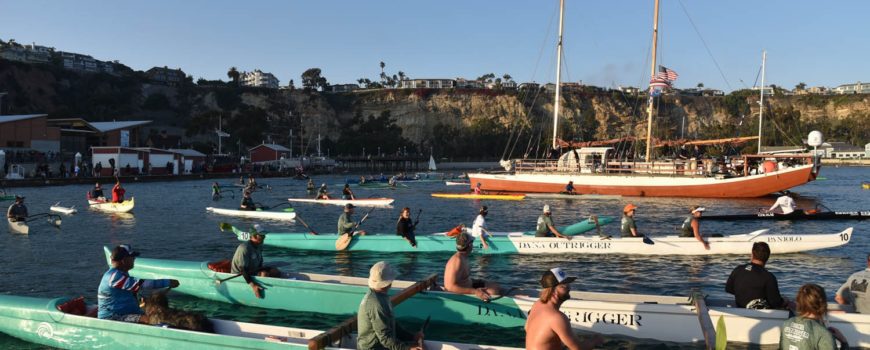
Over one hundred canoe paddlers, boaters and other water enthusiasts converged outside Dana Point to escort the Polynesian voyaging canoe Hikianalia and crewmembers into port after sailing in from Avalon Bay on Catalina Island.
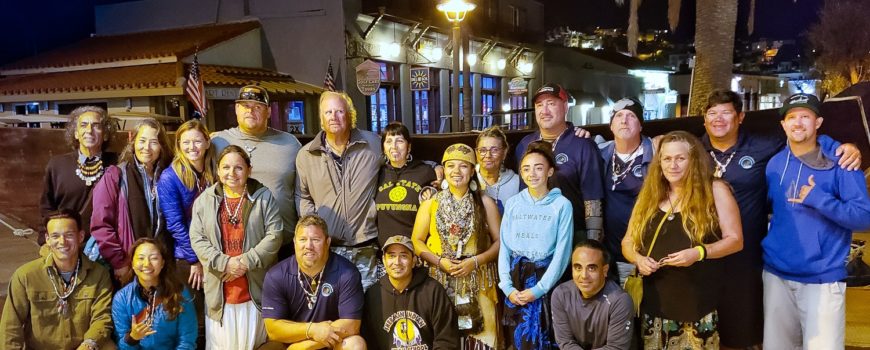
Acknowledging Hawaiian custom, crewmembers chanted outside the breakwater at Dana Cove, requesting permission to land in port. From a tribal canoe, members of the Acjachemen Nation, greeted the voyagers who proceeded into port at Ocean Institute where over 1,000 supporters cheered in support.
After disembarking, crewmembers and the public were greeted with ceremonial performances from Hula Hālau Lani Ola led by Puanani Jung, and Adelia Sandoval and the Acjachemen Nation. The arrival included welcome speeches from Acjachemen Chairwoman Teresa Romero, Mayor of Dana Point Rick Viczorek, Ocean Institute CEO Dan Pingaro, State Senator Patricia Bates, and Hikianalia Captain Mark Ellis.
“We have a saying in Hawaiʻi, he waʻa he moku, he moku he waʻa, our canoe is an island, our island is a canoe,” said captain Ellis. “As we live these values of sustainability, of taking care of our ocean, taking care of our island, we look to the canoe. Everything we have and need is on that canoe… like that canoe, this is the only Island Earth we have and we must take care of it,” he added.
During the one week stop in Dana Point, the crew will host crew presentations, screenings of Disney’s Moana, and dockside canoe tours which will give the public an opportunity to learn about traditional Polynesian voyaging and the mission of the Polynesian Voyaging Society’s Alahula Kai o Maleka Hikianalia California Voyage.
[tribe_events_list category=”Dana Point”]
After a 2,800-mile voyage from Hawaiʻi to Northern California using traditional non-instrument navigation, Polynesian voyaging canoe Hikianalia and her crew have been sailing down the coast of California. On Oct. 30, Hikianalia is scheduled to depart Dana Point for San Diego where the crew will visit for approximately two weeks before concluding their California tour. The weather window to return to Hawaiʻi begins Nov. 15 around which time a fourth crew of voyagers will arrive from the islands to replace the current crew. Below is a tentative port schedule for the California Voyage.. Please checkFacebook, Instagram and Twitter for the latest updates.
Crew Blog by Hiapo Elderts
Aloha kākou, we are wishing everyone well as you follow us along on leg three of the Alahula Kai o Maleka. We were sad to see the departure of our leg two crewmembers and our beloved Pwo navigator Tua Pittman–we wish them all well and a safe journey back home.
We were all excited and ready to and get on the moana and set sail for beautiful Santa Catalina Island that is called Pimu by the first nation people of Tongva. We had such a huge reception from the Pacific Islander community and the King Harbor Yacht club. The dockside tours were a homecoming for some as crewmembers reconnected with friends and family members–it made it hard to say goodbye.
With very light winds and dolphins guiding Hikianalia from the mainland across roughly 34 miles of water, we arrived just before sunset and were greeted with a wonderful reception ceremony from the Tongva who are the indigenous people of Catalina. While we approached Avalon Bay, they honored the occasion by paddling and meeting us with their traditional canoe called a tiʻaat, with this particular craft named Moomat Ahiko. This traditional canoe design is being revived by the Tongva and until today, has not been taken onto the waters of Santa Catalina for decades.
We were also told that Hikianalia might be the first Polynesian voyaging canoe to come to their shores in as many as 780 years and it was agreed all around that the event was historic for both cultures. After clearing and blessing ceremonies that included gift giving, we were treated to a traditional dinner that included acorn mash, venison and vegetable stew, local island lobster, and desert with locally grown chia seeds.
After dinner we were treated to an up-close and personal view of Moomat Ahiko canoe by paddler Gabe Robles–it is large enough to carry 6 paddlers and it is made with redwood plank strips lashed with cordage and bonded in a way as not to let in water between planks.
The night continued with cross-cultural sharing of tradition including a raven dance performed by the talented Miztla Aguilera. Craig Torres shared the story of how the ti’aat canoe design came to Cindy Alvitre in a dream from her ancestors.
As for me, this voyage has provided an exciting opportunity to reunite with Sr. Captain Bob Perkins and Captain Mark Ellis. It’s been 6 years since we were together for Hikianalia’s maiden sail from Aoteroa (New Zealand) to Tahiti, and then Hawaiʻi back in 2012. The second leg of that voyage from Tahiti to Hawaiʻi Island is some of the most spiritual voyaging I’ve experienced–truly following the footstep of my ancestors.
As for new beginnings, I have the pleasure of sailing with one of my Pa brothers Iliahi Doo from our school Pa Ku’i a Lua (Hawaiian martial arts): so here voyaging with me on this leg, I get to unite two of my traditional passions.
While I have this opportunity, I want to mahalo to the Polynesian Voyaging Society for making this voyage possible. This morning as we sail away from the island of Pimu (Catalina) we are all wishing we had more time in this beautiful place than the half day we spent there. However, looking forward, we are also excited to continue on to Dana Point–there was a Coast Guard warning over the radio airwaves to beware of over 70 outrigger canoes waiting for our arrival.
The crew, which is still new to each other, is excited and working very well together–we are already telling bad jokes and getting silly. I always feel blessed to lend my hand for the opportunity to be at service to my crew, my culture, and to share learn the message mālama honua!
Aloha, today’s update comes to us from Hikianalia medical officer Michi Wong who is part of the leg three crew of the Ala Hula Kai o Maleka California Voyage. Crewmembers sailed from Redondo Beach, California to Santa Catalina Island to meet up with the members of the Tongva tribe who call this island by its indigenous name, Pimu.
After a quick tour of the island, crewmembers will head back to Dana Point on the mainland for a massive arrival celebration. Join us at the Ocean Institute on Tues, Oct 23 at 4pm, or check us out online at www.hokulea.com
In the Redondo Beach area it’s impossible to go without noticing how Hawaiians here have made this community a place of their own… that is a home away from home filled with multicultural mix of people who share the common element of aloha.
Indeed, in the early years of 1907, well before the heyday of Duke Kahanamoku, the Hawaiian waterman George Freeth, greeted Redondo Beach with the gift of surfing–they promoted him as “the man who walked on water.” Freeth stayed in Redondo and would soon thereafter invent the first rescue board and create the practice of modern lifeguarding.
Sat, Oct 20, 2018
When Hikianalia sailed into King Harbor at Redondo beach this week, they were greeted by dozens of outrigger canoes from Lanakila Canoe Club led by a man who could be seen as Freeth’s modern day counterpart, Al Ching. Al’s been a mentor and coach to canoe paddlers here for nearly 50 years–many of his paddlers are champions in the sport including Al himself, who just this month led his masters team to first place at the Molokai Hoe in Hawaiʻi.
Al and the club were instrumental in helping us setup and celebrate Hikianalia’s arrival to King Harbor where over 400 people showed to take part in the historic arrival. Al shared that he has wanted for years to host a voyaging canoe and that he was grateful to have us sail into port.
The incoming leg three crew of Hikianalia began their busy weekend right next door to the the Lanakila Canoe Club at King Harbor Yacht Club. Our 8:30am start on Saturday began with providing a private tour to Hālau Hula Moaniʻaʻala Anuhea with Kumu Hula Nani Aiu-Quezada. Over 90 members showed up to tour the canoe and later presented a fine performance for the crew and staff at the King Harbor Yacht Club.
From 10am to 4pm, crewmembers hosted roughly 350 people including Mayor Bill Brand who arrived via standup paddle board.
We finished out the day ending up at Al’s house just up the street. There, we were treated to classic Hawaiian music in back-yard kanikapila fashion. Also, on hand was local style potluck island food that crewmembers enjoyed while mingling with paddlers from the club. In return for his immense hospitality, Captain Mark Ellis gifted Al with a photograph signed by the crew, as well as a kahili sporting colors that match those of Lanakila Canoe Club.
Sun, Oct 21, 2018
A later start Sunday morning afforded the crew some time to get on the water using one of the Lanakila outriggers that the club loaned us. A handful of crewmembers, including Mālama Honua Patagonia book author Jennifer Allen, took to the water to enjoy a gorgeous sunny morning.
When canoe tours fired up again at 10am we were surprised with a generous gift of 26 dozen (312) doughnuts from Malaea and Charles Coleman on behalf of the Pacific American Community Center. Malaea wanted to make sure the crew and visitors had a treat and indeed every doughnut disappeared by the end of the day.
“We need to return to our ancestors and connect… this is why we came today. Food is always a great way to make new connections and bring people together,” said Malaea. She wanted to make sure to thank Mr. Kʻs Doughnuts of Lakewood, CA who donated every single tasty delight–mahalo!
Word must have gotten out about the interesting tours and friendly crewmembers as there was a roughly 75% increase in visitors over the day before… around 440 people showed to Sunday’s canoe tours including the City of Redondo Beach council-member, Todd Loewenstein.
But the day wasn’t over, at 5pm we headed a short drive away to the Hōkūleʻa Brewing Company where the crew presented a thirty minute recap video of the Mālama Honua Worldwide Voyage and had a lively question and answer session that brought both tears and laughter.
Finally, we ended our day with friends, including Mark Hansen, from the King Harbor Yacht Club who, with the staff, has so graciously hosted us here for nearly a week. For dinner, we were afforded nothing less than the best that included steak and lobster.
Besides helping with logistics, getting the word out to media and club members, Mark also tracked visitor numbers for us… grand total over our stay: over 1550 people were engaged throughout Hikianalia events this week!
From all of us here aboard Hikianalia, we would like to thank each and every one of our hosts here in Redondo, as well as all the enthusiastic visitors who came to see Hikianalia and talk story with crewmembers. We are all reminded that Hawaiʻi is more than a place, it’s the embodiment of aloha that extends far beyond the boundaries of our island home.
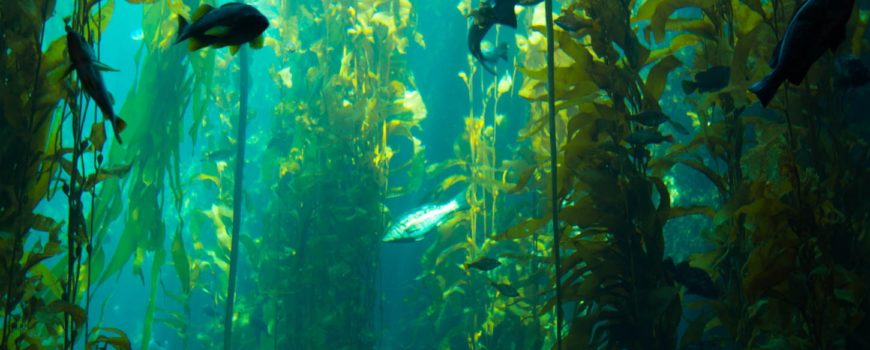
Just like the productive ocean waters off California, our learning journey along her beautiful coastline has been deep, wondrous and amazing. Thick kelp forests, frolicking sea otters, barking sea lions, diving pelicans and feeding whales abound everywhere we looked. Add to that riot of wildlife the very warm community welcomes that Hikianalia has received at every port, and the meaningful exchanges we’ve experienced with our hosts and you have the perfect storm of inspired and profound learning.
Leg 2 of the Alahula Kai of Maleka (frequented ocean path to America) voyage started in San Francisco where we shared our dock with a raft of sea lions. It was a cold and foggy night at Hyde Street Pier and the large bulls expressed their displeasure at our late-night arrival and our noisy luggage cart rattling on their creaky wooden docks by barking all night long.
The following day, we sailed past Alcatraz Island and across San Francisco Bay and into Richards Bay in Sausalito where it was surprisingly sunny and a lot warmer. We tied up next to the community-build tall ship, Matthew Turner, and enjoyed the microclimate here and the very welcoming community that hosted us. As we said goodbye to our new friends and the Marin headlands, we blew our conch and sailed south under the Golden Gate Bridge and the fog lifted as Hikianalia re-entered the open ocean.
As if that moment was not magical enough, we saw breaching whales and seabirds feeding on schools of fish as if to signal that we were now outside the city’s realm and back in the wild ocean. We continued to sail south in cold fog and following seas with big swells but were ultimately received with heartwarming welcomes in Half Moon Bay, Monterey, Ventura County and the Channel Islands. Our learning journeys were guided by three recurring themes—Nature, People and Hope for the Future.
Nature
The rich ecosystems along Californiaʻs coast is due to its unique confluence of ocean currents, estuaries, deltas and deep sea canyons. In San Francisco Bay, we learned through the US Army Corps of Engineersʻ Bay Model that the gold rush from 1848-1855 drastically altered the landscape and the bay’s ecology by silting up its many tributaries from the mine tailings as the land was scoured by powerful water hoses in the prospectors’ search for gold.
The Bay Model was constructed as a tool to test the impact of proposed changes to the Bay and related waterways and is now an educational center highlighting the natural and cultural history of San Francisco Bay. In Monterey Bay, we learned of once-rich fisheries and how a network of marine protected areas today are helping California protect its economically important fisheries by bringing back the ocean’s abundance. Monterey Bay is bisected by a deep sea canyon whose nutrient-rich upwelling waters attract sardines and anchovies, which in turn bring in the sea lions, seabirds and lots of cetaceans (whales, orcas and dolphins).
In the past, peak whale migration and feeding seasons did not coincide with the crab fishery, but in recent years these activities now collided and resulted in a lot of reported whale entanglements in fishing gear. Through a science-based and collaborative approach, The Nature Conservancy worked with researchers and fishers to better understand this problem and find ways to reduce and prevent whale entanglements. Working together, conservationists, harvesters and managers created and implemented a new early warning system to track entanglement risk and identified a suite of actions to take when the threat of entanglement was high, including changing how fishers were setting gear and removing gear from an area. The goal is to ensure thriving fisheries and healthy whale populations.
To protect California’s fisheries and marine life, many stakeholders worked through many issues together to establish a network of marine protected areas with varying levels of protection along its northern, central and southern coastlines. Today, Monterey is a hotbed of marine conservation organizations including the world-famous Monterey Bay Aquarium, The Nature Conservancy, NOAA, Oceana, and Seafood Watch are all doing their part in caring for our oceans. Out of necessity, California had to pioneer their leadership in clean car emission standards, which much of the country now follows. In the ocean realm, they are figuring out how to work together to protect their marine resources wisely. California is progressive in its stewardship of its marine resources and the whole world can learn a lot from how we can all better balance nature and the economy, for they are one and the same and as the oceans thrive, so do our communities.
People
Everywhere that Hikianalia visited, she was warmly received by the beautiful coastal communities. As we spread the mEessage of mālama honua and shared the spirit of aloha with everyone we interacted with, we make it a point to honor the people and places we visited. Our first order of protocol is to always ask the indigenous people of a place permission to come to shore and set foot on their land.
Each welcome was a joyous and moving celebration as the communities see in our voyaging canoe that the ocean connects us rather than separates us. We all share a maritime heritage and seeing the waʻa come over a long distance to their shores reawakens this spirit of connectedness in their communities. Be it with the Native Americans, expatriate Hawaiians and Polynesians living on the West Coast or the larger community of our wonderfully diverse nation, there were many outpourings of love for Hikianalia and the message that she brings.
A special moment for us crew was sailing around Point Concepcion, which can never be taken lightly since the weather there can be unpredictable and seasoned sailors know that this area can go from flat to 30 knots with big seas in no time. This point is where the mostly north-south coastline of California takes a sharp east-west orientation. We rounded this point which delineates the beginning of southern California at around 4:00am. We were confident in our canoe and our Captain who was familiar with these waters. A yellow crescent moon was rising and the milky way was brightly lit above us. As we sailed past the lighthouse, we blew our pu (conch shell) to honor this most sacred spot to the Chumash people. They call this place Humqaq and they consider it their Western Gate—a sacred leaping off place for spirits to leap off into the spirit realm. After blowing our pu 4 times, we rounded the point and our sailing became smoother and the ocean swells gracefully carried our canoe swiftly to our next destination. As part of the TNC ‘ohana, I am very proud that this place is being managed to honor the cultural and natural richness of this very special place and made my personal voyage extra special.
Hope for the Future
In each community that we visited, we made it our topmost priority to visit schools and give canoe tours for the public. We visited many schools to share our message of mālama honua (Caring for our Earth) and we were inspired and filled with hope to see the next generation of ocean stewards so aware and ready to step up to the challenge of cleaning up our oceans. We engaged with students by sharing what ocean plastics the Leg 1 crew saw in its voyage from Hawaiʻi to California as it sailed through the North Pacific gyre. It is estimated that globally there are 5 trillion pieces of plastic and 1.8 trillion is found in the great garbage patch of the Pacific. Humanity can no longer use the ocean as an endless receiver of our trash and pollution and the students we met were full of bright ideas and doing the right things to help care for our oceans.
Sadly, we are now past planetary boundaries on how much pollution our oceans can take and must now collectively take action to clean up our oceans. How this touches back home in Hawaiʻi is that a lot of our windward shores receive a lot of this marine debris. Just like the keiki back home, a lot of the school children we met did ocean cleanups and reduce their use of plastics. We were so impressed with the students’ environmental awareness and learned a lot from them about the actions they are taking to help our oceans. Today, the 4th graders from Hollywood Beach School left us a hand-written poster on recycled cardboard with their signatures and laid out their manifesto:
“We pledge to protect our Island Earth. We will be thoughtful consumers. We will advocate for clean energy. We will reduce our carbon footprint by using non-motorized forms of transportation. We will take responsibility for keeping our environment clean. We will refrain from purchasing plastic water bottles and refuse plastic straws. Thank you for your message of Mālama Honua and for your visit to our community. We love Hikianalia.”
On their second day of the voyage, leg three crewmembers aboard the Hikianalia California Voyage wasted no time jumping into the mix with a full day of canoe tours. Besides visits to the canoe, the crew hosted outreach stations for more than 150 Redondo Beach area students who ranged from kindergarten to high school in age.
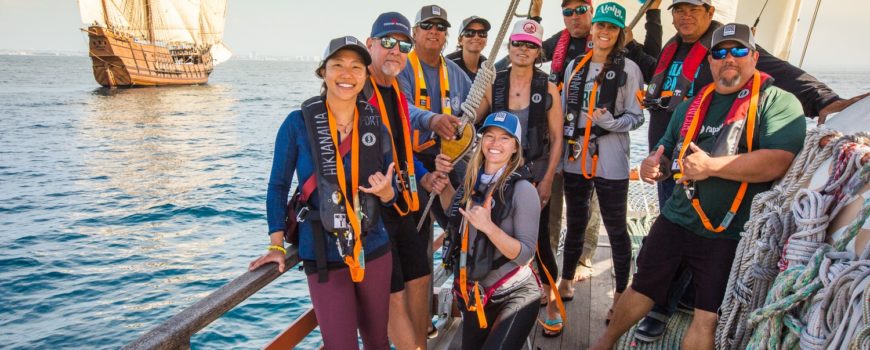
Captain Mark Ellis and senior captain Bob Perkins are staying on to lead leg three of the Hikianalia California Voyage while eight fresh crewmembers arrived in mid-October replacing outgoing leg two crewmembers. The team is sailing Hikianalia from Redondo Beach, to Catalina Island, Dana Point, and our final California destination, San Diego where fourth and final leg crewmembers will set sail for Hawaii in mid-November. Leg three crew was selected based on their sailing ability, cultural knowledge, and outreach and education strengths in order support the many public events scheduled through the Southern Californian Coast.
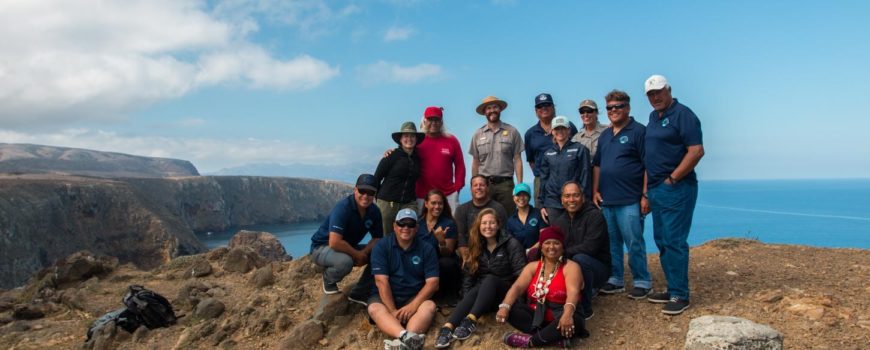
This week, the crew had an amazing adventure to the Island of Santa Cruz, known as Limuw to the Chumash Nation. We were gifted the opportunity the spend the day exploring with several Chumash cultural practitioners, including Julie Tumamait, who has graciously welcomed us in ceremony at both Ventura and Channel Island Harbor with songs, prayer and gifts. It was extremely special to have the opportunity to visit Limuw with members of the Chumash Nation, it being their ancestral land; they know stories and histories and elements of Limuw in an intimate way that only those indigenous to a place can.
We hiked to the uplands, where we were met with stunning views of Limuw, the surrounding islands and ocean, and the coast of mainland California. There, against the blue skies and cliffs, Julie shared a few Chumash moʻolelo, and it was so interesting the hear the similarities between these beautiful stories and some of our own in Hawaiiʻi.
The crew also had the privilege to explore the island alongside rangers of the National Park Service, and they shared with us their successful restoration of native plants and animals, such as the Island Fox, a small species of fox that Julie said were cherished pets of the Chumash people. We were excited to come very close to a few foxes, as they seem well adjusted to campers and visitors on the islands.
After hiking and exploring, the crew gathered at the beach, and some of us jumped into the ocean to swim through the kelp forest. Although chilly, the waters there are clean and clear, light glittering down into the kelp below. There are many things that are different between Hawaiʻi and California, but on the Island of Limuw, I kept catching myself forgetting I wasn’t somewhere in Hawaiʻi–sometimes the landscape looked so similar to our drier, leeward areas, and the Chumash stories felt so parallel. This learning journey definitely left an impression on the Leg 2 crew and reminded us of the similarities that connect us, even thousands of miles apart.
The thriving Hawaiian community of the Redondo Beach area celebrated Hikianalia’s arrival this week with great fanfare that included a dazzling water-welcome, hula, Tahitian dance, and cultural protocol. Mahalo to Klein Creative Media, and our friends at the King Harbor Yacht Club for the video clip.
Hikianalia and her crew arrived into port this afternoon at 4 p.m. at King Harbor in Redondo Beach, California. The canoe and crew were escorted into port with jubilant cheers by outrigger canoe paddlers from Lanakila Outrigger Canoe Club, Nahoa Outrigger Canoe Club & Marina Outrigger Canoe Club.
Awaiting Hikianalia’s arrival at the dock was the Tongva Tribe and members of the Redondo Beach area Hawaiian community. Crewmembers and the public were greeted with ceremonial chants and performances from Hula Hālau O Lilinoe of Kumu Annette ‘Olilinoe Ka’io, Kekaiulu Hula Studio of Kumu Kekaimoki Yoshikawa, Hālau O Ka’onohiokala of Kumu Tiana Price, and Nonosina Polynesia of Kumu Tiana Liufau.
Layered with many beautiful lei, the crew was met with aloha by a large crowd of paddlers and community members, as well as City of Redondo Beach Mayor Bill Brand, and King Harbor Yacht Club Commodore Kelly McMartin.
After the crew was introduced and Senior Captain Bob Perkins and Pwo Navigator Tua Pittman spoke about the mission of Hōkūleʻa and Hikianalia to share and encourage mālama honua throughout Island Earth. After additional hula performances, Hikianalia crew offered Pule Hoʻomaikaʻi, a prayer the crew often shares both at the beginning and end of many sails, followed by the singing Hawaiʻi Aloha by all in what made for a truly memorable arrival.
On Oct. 22, Hikianalia is scheduled to depart King Harbor for Catalina island where the crew will visit for a couple days before Continuing to Dana Point. Below is a tentative port schedule for the California Voyage. Please check Facebook, Instagram and Twitter for the latest updates: