November 12: in the intertropical convergence zone, above 5° N

November 11, Sunset:

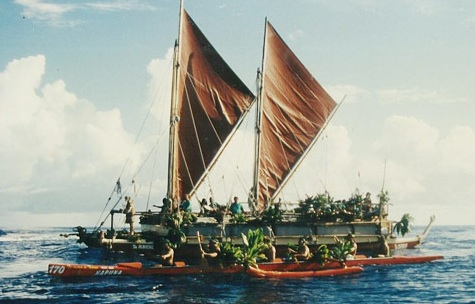
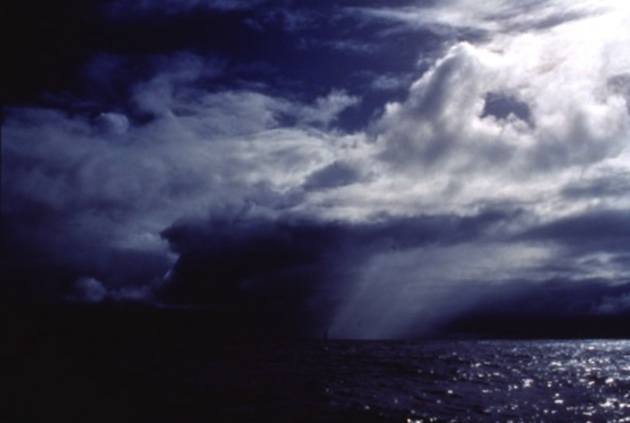
Today, we entered weather normally associated with the Inter-Tropical Convergence Zone (ITCZ).

Our weather forecaster, Hans Rosendal, told us to expect the main ITCZ activity to be between the latitudes of 5 degrees North and 11 degrees North.  He was exactly right.  At 6 a.m., we were nearly to 4 degrees North and the weather changes were becoming obvious – more overcast, larger clouds, and “heavier” air.

The best change was the wind clocking around from a more southerly direction.  This change, coupled with the forecasts of solid trades north of the ITCZ, has allowed us to turn pretty much directly toward Hilo.  We will still aim for arrival about 150 nautical miles east of Hilo to ensure we have a downwind run into Hilo Bay.

The ITCZ is sometimes called as “the doldrums”, meaning no winds and bobbing around.  So far, so good – keep your fingers crossed that we encounter no doldrums but just sail right through the ITCZ.  Hans also warned of more frequent showers in the ITCZ and that has already proven accurate.  Just as we passed through 5 degrees North, we sailed through our first squall.  The crew is safe and well and stoked to be heading more directly home.

  • course: west of north, heading 353 degrees True, Haka Ho’olua
  • speed: 8 to 9 knots, faster in winds associated with squalls
  • wind: south of East, 10 to 15 knots, higher near and in passing squalls
  • sea state: East 5 to 6 feet, southeast 4 to 5 , both well established

For Complete Sail and Education Data, see the Tracking Map.

Hawaiian Star Compass (Click on the link for an explanation of the names of the directional houses of the compass. Click on the compass for a larger image.)

November 12, Sunrise

Last night, we were graced by consistent, if light, winds – a true blessing in the Inter-Tropical Convergence Zone (ITCZ). Last night, we made 62 nautical miles (averaging 5 knots) on a heading of 353 degrees True (Haka Ho’olua). Not bad, for “the doldrums”, when we were aiming for 350 degrees True (Haka Ho‘olua), our heading more directly toward Hilo. This performance is a testament to the training and development of this crew since we left Papeete, Tahiti, twelve days ago. Especially considering that it is more challenging to steer in light airs than stiff breezes. We must admit, however, that the mellow seas help. We’re doing great so far in the ITCZ and hope for continued good fortune.
essay writers

  • course: west of North, heading 353 degrees True, Haka Ho’olua
  • speed: 5 knots
  • weather: Abundant cumulus (5/8 coverage).  Some sunny clear patches.  Some wind-torn mid-level clouds streaming slowly in from southeast.  No high clouds. Dry and warm.
  • wind: south of East, 5 to 10 knots
  • sea state: Southeast 4 to 5, well established.  Northeast 1 to 2 feet.

Celestial Observations, Navigation Stars, Planets and Moon Phases (See Hawaiian Star Lines for star names and configurations.)

10 pm to 2 am watch –  Clouds, clouds, clouds, that’s what we were working with tonight.  For our entire watch we had < 90% cloud cover and light winds of about 10 knots out of the southeast. The winds combined with our movement in the same direction of the swells allowed Hikianalia to swim between 4-5 knots.  It can be a lonely thing in the dark night to have few and shifting celestial cues.  Because of this we decided to rotate short pieces on the steering hoe, with everybody pitching in to locate, identify, and help hold us on track.  The constant rotation on the hoe kept everybody alert and moving, which can be a challenge as the light weather and gentle rocking tries to lull you to sleep.  “Good job” goes out to the crew, since our desired heading tonight was Haka Ho’olua, and the digital mapping of our course on the AIS/GPS thankfully confirmed that that was the heading we held despite the clouds. 2 am to 6 am watch– Our watch began with 90% cloud cover but, within the hour, began to clear.  We at first had a bit of a game of ‘name that star’ and needed to constantly change our useful steering pointers in order to maintain our desired heading of 350 degrees (Haka Ho’olua, erring preferably towards ‘Ākau [North]). Venus rose in Hikina (East), making our steering much easier as we kept it approximately one house aft of the beam.  This was followed by Hikupau (Alkaid), the last star in the handle of Nā Hiku (the Big Dipper), which we kept in the forward starboard shrouds. Hikianalia (Spica) on the eastern horizon once again led us to daylight. We even caught a glimpse or two of Hōkūle’a (Arcturus) between the clouds affirming our position and our ever-northward migration.  Saki chose tonight to begin her long hours of sleepless navigator training, staying up all night and helping us to keep our course.  We are all enjoying the downwind smooth sailing, and are even able to surf the canoe at times.  Even with the light winds, we were able to maintain a speed of 4.5 to 5 knots.

 Hōkūleʻa rising between east and northeast. Hikianalia rising south of east, below Venus. Hikupau (Alkaid) rising above northeast.
Continue Reading

Crew View: Saki

Saikou maoli no keia, guys!

Aloha everybody! Today is not really a good day because I have to finish my blog and turn it in…haha!  I started writing my first blog since my first voyage (sorry Heidi!), Aotearoa to Tahiti, so I am going to talk about leg 1.

It was my first deep-sea voyage, and I was the baby on the canoe, so for me, everyone was my teacher.  I was just so excited about my first voyage, but at the same time I was really nervous.  Most of the time in Hawaiʻi, I had sailed with Kapu Nā Keiki. They are my waʻa sisters and brothers. They have been taking care of me since when I didn’t speak English at all until now.  This time they were not with me, and probably this is why I was really nervous.  Maybe this would be the time for me to grow up to be a crew member without relying on them.

However, after day 1, my nervousness got smaller and smaller, because all of the leg 1 crew were so awesome and really, really nice to me all the time.  I got great experiences and memories on that voyage.

My watch was 10-2am and 10-2pm with Uncle Kealoha, Kaleo and Brad. Uncle Kealoha was our watch captain. I had a bunk next to him and he made a big mess all the time! Haha!  But he is the best. He always made sure I was okay.  He taught me a lot about voyaging and canoes that I never knew before.  I like to listen his stories of voyages on Hōkūle‘a.

Every watch, we had language class.  I speak Japanese, Kaleo speaks Hawaiian, and everybody else speaks English.  They taught me a lot of bad English words, so I taught them bad Japanese words.  Haha!  We mixed all the languages together, so we talk Jawaiian English now.  Kaleo and Brad also play ukulele, and I liked to listen to the Hawaiian songs that they played.  My watch was just so much fun. They acted like a Bakatare and Hen sometimes, but they know all kinds of stuff about canoes, sailing, and voyage. Actually, Saikou maoli no keia, guys! 🙂

My favorite watch was the night watch, even though it was freezing cold (that is why I drank Milo every night.  You have to try Milo when you visit Aotearoa or Tahiti or Japan!!)!  Nights were usually only us and Uncle Bruce.  It was so much easier to learn and understand about stars and the night sky on the canoe, because there is nothing around the canoe and we wake up at the same time and are watching the same stars every night.  When there were stars, Uncle Bruce gave us star lectures, and when there were no stars, he talked about his experiences on Hōkūle‘a.

Another thing I would like to talk about is Uncle Gary.  He was the master cook!  I got a chance to learn how to cook on the canoe from him.  He made us all kine good foods.  When we caught a fish, he made 5 kinds of different things from one fish; he is amazing!!  Also he always gave me some samples when I was in the galley.  🙂  That’s why I was supposed to lose weight, but I gained weight!  Hahaha!

The best part of the voyage was the connections with the people that we met because of the voyage.  I met a lot of people during these past seven weeks.  I met my little friend Tataiarangi; Magnus and Franky, who helped us to learn how to sail on Hikianalia; Nick and the people from Salthouse; Faafaite guys; ʻOhana in Tahiti; and the crew. Uncle Gary told us we can find lifetime friends through the voyage.  Hōkūleʻa always made us one big family, and now I know baby sister Hikianalia will as well.

I cannot thank the leg 1 crew enough.  It was hontoni great voyaging with them.  I am still baby crew, but I would like to grow up every voyage from now on.  I will never forget what my teachers taught me during my first voyage.

Now I am with captain Bob and the leg 2 crew to go back to Hawaiʻi.  Nikki, Darienne, Brenda and I are learning navigation from Uncle ʻOnohi.  I am a really slow learner, but he is teaching me really kindly and patiently.  I hope to share more about my experiences on this second voyage with everybody when I get back to Hawaiʻi.

The wind is strong and giving us good speed and heading right now.  We are getting closer to our home.

Mahalo Uncle Bruce and Nainoa for inviting me, and Heidi for all the work you did for me, and everybody who made this happen for me.  🙂

Makemake au e holo kai hou me ʻou kou.

Arigatou.

Aia la!

Saki

Continue Reading

November 11: A day of fast sailing on a good heading

Nov. 11 Sunrise:

Last night, we made 116 nautical miles (averaging 9.6 knots) on a heading of 12 degrees True (Haka Ko’olau). The last several days of available easting, combined with a favorable wind shift from north of east to south of east, moved Captain Bob Perkins to change course to 350 degrees True (Haka Ho’olua), a heading more directly toward Hilo. We will still navigate to a point east (upwind) of Hilo to be safe from ending up downwind of our destination, but we believe we can basically “head for home” at this point.

Celestial Observations, Navigation Stars, Planets and Moon Phases (See Hawaiian Star Lines for star names and configurations.)

6 pm to 10 pm watch-Our watch had good stars all around the compass available for steering, but we had to play hide and seek with them as they hid behind dark black clouds, then appeared for brief periods.  It was great training, maintaining two or three steering stars at a time and switching off often as they disappeared.

10 pm to 2 am watch – From our post-equator-crossing reflections we found that our watch really wanted to step up our navigation training, so tonight with starry, clear skies, we went to Navigation Bootcamp..  We divided our four person watch into four stations: Navigator, Steersman, Speed, and Rest.  The stations are rotated every 30min.  Here are the kuleana of each position:  Navigator – set the course and give the steersman his/her mark. Requires knowledge of star declinations and calculation of our desired heading based on the known star declination.  Steersman – hold true to the course set by the Navigator.  Requires a good feel for the movement of the canoe.  A good steersperson can anticipate the swing of the wa’a and steer accordingly to keep right on target.  Speed – this person is estimating our speed based on the time it takes bubbles to pass from our first ‘iako to our last (about 40ft). Speed is distance divided by time.  Rest – this person kind of gets to take a break, but they are also responsible for using the computer’s AIS system to place a waypoint at the start of each rotation.  The crew did a phenomenal job and honed some really important voyaging skills.  Stay tuned for tomorrow’s Bootcamp Part 2.

2 am to 6 am watch– We picked up the watch maintaining a steady course of 15-20 degrees (Haka Ko’olau) with speeds of 7-9 knots. We started out with Achernar behind us in Nālani Kona and the northern meridian pointers of Hokulei aligned with Nāleo Ho’olua. And for the first time we were able to briefly see Hōkūpa‘a (Polaris, the North Star), just above  the horizon. As we moved further into the northern hemisphere, now well above 3 degrees of latitude, the cloud cover became thicker, obscuring most of our stars, and swell motion diminished. For a short time we were able to follow the moon, which rose just after 3:30 in Lā Ko’olau but we eventually lost that too as the sky clouded over completely. From then on we followed the motion of the swells and wind direction with its apparent speed to guide us, along with the help of the GPS to ensure we were on our correct course.

Hōkūpa‘a (Polaris) appears due north above the horizon in the northern hemisphere, it’s altitude approximately equivalent to the latitude of the observer. (At  3° N in the graphic above, about 3° above the horizon; in Hawai‘i, at 20°N, Hōkūpe‘a appears about 20° above the horizon.)  Nā Hiku (the Big Dipper) appears rising to the east (right ) of Hōkūpa‘a; ʻIwakeliʻi (Cassiopeia) is setting to the west (left).

For Complete Sail and Education Data, see the Tracking Map.

Nov. 10 Sunset:

A day of fast sailing on a good heading with easy steering.  Since 6 am, we made 97 nautical miles on a heading of 016 degrees True (Haka/Nā Leo Ko’olau), an average speed of a little over 8 knots.  The crew is safe and well. For Complete Sail and Education Data, see the Tracking Map.

Hawaiian Star Compass (Click on the link for an explanation of the names of the directional houses of the compass. Click on the compass for a larger image.)

Continue Reading

Two Maori Voyaging Canoes Have Left Mangareva for Rapanui

Te Ara ki te Pito o te Whenua | Voyage to Rapanui:

Two maori waka hourua (double hulled sailing canoe) departed Mangareva on Nov. 7, bound for Rapanui. The two are Ngahiraka Mai Tawhiti, captained by Jack Thatcher, senior navigator; and its elder sibling Te Aurere, captained by Stanley Conrad. The canoes left Auckland, New Zealand, on August 18.

The 10,000 mile voyage from Aotearoa to Rapanui has been the dream of Hekenukumai Busby, the master waka builder who built both vessels. At 80 he is won’t do the full trip but hopes to hop back on board as they get closer to the eastern tip of the Polynesian Triangle.

Ngahiraka Mai Tawhiti is named after his late wife. Given the significance of this project, Te Aurere has been consecrated to recognise the cultural and spiritual significance of the voyage. The waka will be made tapu and a stringent set of cultural restrictions put in place for the journey to Rapanui. Te Aurere is crewed by men only, while its sister-ship has a mix of women and men.

Te Aurere and Ngahiraka

  •  17.5 metre long
  • Made of kauri, weigh between 7-11 tonnes
  • Travelling up to 100 nautical miles a day
  • Crewed by 23 18-62 year-olds

(Compiled from an article by Yvonne Tahana, NZ Herald, Sunday August 26, 2012 4:20 PM NZT)

Continue Reading

Crew Views: Brenda, Krista, and Mike

Blog from Brenda Smith

A warm aloha to all of our followers!

The most exciting news first:  we were able to see Hikianalia rise for the first time early this Tuesday morning (November 6), about an hour after Venus rose and shortly before sunrise.  I really enjoy my 2-6 watch since it allows me to see every sunrise and sunset.

We are now on day 6 of our journey, and all our crew members are well into their rhythm of life at sea with watches. I am finding that some days I am tired and sleep most of the time that I am not on watch, but other days I am not tired and spend my off hours getting to know all my fellow crew members a little better.  It is quite interesting to find out what I can learn from each of them, as everyone comes from a different place.  There are constant things to learn about voyaging from Uncle Maka and sail trimming and course plotting from Captain Bob.  We are practicing our oli and learning a new one from Nahaku.  On Monday, I had a very interesting conversation (if that is what you call it when one person (me) asks a lot of questions and the other one answers!) with Hiapo, whom I had never met before, about Hawaiian education and a bit of politics.

Best of all for me though is to have nice warm clear nights on deck for applying all I have learned about star lines and navigation, and relearning all I have forgotten.  There are many of us who learned together in Ka’iulani’s Ho’okele class, and many others who know much more.  We are all also thankful for Tina’s laminated star chart.  Our crew, as well as the Faafaite crew from the last leg of the voyage, use it every night. We are very lucky to have Onohi on board with us, and I never cease to be amazed at his patience and willingness to answer any question we may ask, no matter how basic.  On my watch, Brad is the go-to guy for star or navigation questions or if the steering is tricky.

Keala has been supplying us with fish every day for the last few — poisson cru and poke are welcome every day. I think he may now be a few ahead on the Fish vs. Keala competition!  Keli is ceaselessly energetic — so happy to prepare meals even though I know she is getting really tired and needs a nap!

This trip so far has been completely different from my trip on Faafaite from Aotearoa to Tahiti.  For one thing, nobody is speaking French.  I am also hot in a t-shirt and shorts, versus being cold in two layers of fleece and heavy-duty foul weather gear.  Seawater showers are welcome and refreshing, versus take-your-breath-away cold.  Hikianalia has has a very nice, enclosed bathroom (head) with a toilet that flushes, which is unfathomably easier to use than one which requires collecting buckets of water from over the side of the canoe while waves are crashing over the bows and sides!  Faafaite’s crew had been sailing together for quite a while, and most things were done without much conversation, whereas Hikianalia is new to all our crew, and we spend much more time trying different combinations of sail trimming and centerboard placement.  The seas have so far been significantly calmer, and we have yet to have truly favorable winds for any length of time.  I can’t wait until we do get good winds and our speed can increase so the crew can hear the amazing humming of the centerboards!

While on the topic of favorable winds: Monday was my birthday, and my birthday wish was for just that — favorable winds, so we are better able to maintain our plotted course.  What happened instead was mediocre to crummy winds and squalls.  It was interesting to see the differences between each event — some giving us increased winds and causing crazy course changes, some dumping us with rain, and some just leaving us drifting as the wind completely died after the weather passed.  I am glad the squalls started out fairly mildly so our new crew could see what they were all about before the weather got too crazy.

So passes another day at sea, while I hum along to the Hawaiian songs being played beautifully or the Tahitian ones I learned on Faafaite.  I am feeling very lucky to be along for this learning experience and very grateful to Kalepa and all the Faafaite crew both aboard and on shore for making the last few weeks such an amazing experience for me.

Aloha, Maruuru and Mahalo,

Brenda

Blog from  Medical Officer Krista Tla-chit-in-itl Stogryn

Aloha mai kākou…

Today (November  is an exciting day for all of us as we count down the miles to Ka Piko a Wākea, which at last estimate we will cross at about midnight tonight.  We have been preparing ourselves with protocol to honour the crossing, with guidance from ʻOnohi and elders at home, and practicing our oli and mele together as crew. Keli is planning a special meal, and the day has blessed us already with two Aku.  (I’ve lost track of Keala’s fish score… he’s way up by now!)  For most of us, this will be the first time we will cross the equator by water.  Whispers of initiation rituals and talent shows has us “pollywogs” waiting with baited breath.

The day otherwise is following the daily rhythm and pace of our voyage, as crew members cycle in and out of their watches, kuleana and sleep.  The afternoon is one of my favorite times of day, because many people are up and about on deck.  Over the past few days, we have found Hikianalia’s sweet spot in the steady ko’olau winds, which has freed us up a little from the sweep and the sails, and left us with more time to hang out.  Brad, Nahaku and ʻOnohi keep us singing with the ukulele through the day’s hottest hours, and we are slowly making our way through the huge black binder of Hawaiian songs.  I’ve also been enjoying a live daily blog from Dariennne on a wide range of topics.  She is a wealth of information, great to talk to and stoked to share and educate.

My kuleana as medical officer has thankfully not been needed much.  Gratitude and prayers for health and safety of our crew has been a feature of our daily pule, and thus far has held true.  Crew members were well educated by Drs. Ben and Zunin before me, and arrived for the voyage well prepared for all the usual suspects on the water. The past few days of big swells and stronger winds brought up a bit of seasickness among a few members, but generally everyone seems to be feeling happy and well. As we come together more and more as ʻohana, personal privacy seems to have become less important.  Deck conversation has taken to comparing bruises of all shape, size, colour and description (though none can compare with Keala’s who set the bar high on day one).  With all the lurching and bumping of life at sea, it is truly a mystery where some of them arise, and it’s been good entertainment trying to match up bruises with possible sources around the wa’a.  (This is shared with the reassurance that all bruises are minor and everyone is ok. 🙂  )

Serving as medical officer at sea for a strong and healthy crew has been an interesting change of pace for me. In my busy practice as a doctor at home, being of service to those in need is a big part of my day-to-day life.  It has been a healthy, though at times challenging, change for me to find peace and reward in the humble tasks of day-to-day life, for which there are often more hands than needed.  Perhaps this is true for all of us.

At the same time, it has been amazing to be immersed in Hawaiian culture, and the knowledge and traditions of voyaging and navigation that are coming alive for me on the wa’a. I am grateful to be so welcomed here and to have a chance to share in this journey with so many inspiring individuals.  Above all, I am learning, reflecting and appreciating even more about home.

All my relations,

Krista

Blog from Mike Taylor

Aloha mai kākou,

Since you are reading today’s blog, I thought you might be interested in learning how these crew reflections, the daily morning and evening reports, photographs and other information gets to you.  All of us crew members must stand watches; steer the canoe; and change, trim and reef sails.  You may have gotten glimpses of this and other aspects of crew life, such as settling into watch schedules, meal preparation, etc. from earlier blogs.  In addition, there are about 30 responsibilities, or “kuleana”, that must be carried out:  quartermaster (logistics), fisher, medical officer, carpenter, safety officer and many others.

One of these kuleana is that of maintaining electrical, electronics and communications.  On Hōkūleʻa, this job basically requires you to understand, maintain and operate two banks of batteries, two radios and navigation lights so others can see you at night — pretty  simple.  On Hikianalia, which will serve as Hōkūleʻa’s safety companion, there are many modern technologies that help ensure the safety of the two canoes.  All of these technologies require electrical power. We do not use a single drop of diesel or gasoline.  All our power comes from the wind, through the sails, and from the sun, through the ten, large solar panels that charge our two big battery banks.  These batteries then provide us both 110-volt electrical current, like you have in your house, and 12-volt current, like you have in your car.

The attached photo shows much of what we use this electricity to accomplish.  In the deckhouse (across the top row), we have the ship’s clock and barometer, the Global Positioning System (GPS), the circuit breaker panel, and the battery charge-level meter.  Across the bottom row, you can see the laptop computer (which is showing the chart [map] of where we are and the AIS information about any vessels near us), the satellite phone above an iPad, the white VHF radio (to talk to other vessels or port authorities), and last, the old fashioned pen-and-ink log book.

Down below, in the starboard hull, is a computer that controls the whole system.  It even runs a small wi-fi “hotspot” on the boat that shows displays on the laptop and iPad that let us monitor the solar panels, batteries and motors.

So, the way we get information to you is by connecting the satellite phone to the laptop and sending you an email — as simple as that on the surface, but a little complicated when you consider what it took to harness the sun and use that power to communicate with you, cook our rice, run our motors and power many other things we do.

Like all other kuleana on PVS canoes, no one accomplishes their assigned job alone.  I want to thank everyone on the crew for their kokua in managing our use of power and, especially, to Brad Wong for helping so often in so many ways that he has been designated “Senior Deputy Electrician”.

Aloha, Mike Taylor

Continue Reading

November 10: crossing the equator; aku for lunch and dinner

Nov. 10 Sunrise

Last night continued our recent fast sailing, improved steering and valuable easting.  Last night, we made 94 nautical miles (again averaging right at 8 knots) on a heading of 13 degrees True (Haka Ko’olau).  At 11:30 pm, we crossed Ka Piko O Wākea (the Equator), reaching into our home Northern Hemisphere.  Whoops and hollers resounded from the 10 pm to 2 am watch and a handful of other crew who stayed up for the event.  This morning, we celebrated both traditional (sharing rice among ourselves and with Kanaloa) and modern (tossing coins to Poseidon/Neptune) rituals to mark this right of passage.  There are no longer “polliwogs” aboard Hikianalia – we are all proud “shellbacks” now.

  • position (in Northern Hemisphere; see the Tracking Map): 00 degrees 50.4 minutes N, 148 degrees 33.2 minutes W
  • course: east of north, heading 035 degrees True, Nalani Ko’olau
  • speed: 9 knots
  • weather: Clear overhead, small puffy cumulus (1/8 coverage).  No high clouds.
  • wind: North of East, 15-18 knots
  • sea state: North-East 3-4 feet (subsided a little more this morning), East 1 to 2 feet, South 1 to 2 feet, small rollers, very gentle.

Celestial Observations, Navigation Stars, Planets and Moon Phases (See Hawaiian Star Lines for star names and configurations.)

6 pm to 10 pm watch– Our heading at the beginning of the night was Haka Ko’olau.  Again, our watch had good stars available for steering to the north and east of us, the rest were covered by clouds. We used primarily Jupiter, Iwakeli’i (Cassiopeia), Makali’i (Pleiades); the Navigator’s Triangle of Pira‘etea (Deneb), Keoe (Vega), and Humu (Altair); and the stars of Ke Kā O Makali’i.

10 pm to 2 am watch  – We crossed ka Piko a Wakea!!!! (Equator!!!)  into the northern hemisphere.

2 am to 6 am watch-The moon rose in Leo just after our watch began, followed shortly by Venus and then Hikianalia (Spica).  These stars, rising in Hikina (East) and Lā Malanai (south of East) were the backbone of our steering.

Celestial bodies in the eastern sky, 2 am-6 am watch: the moon, Denebola in Leo, Venus and Hikianallia (Spica, in Virgo) have risen, in that order. Below the horizon, rising about 45-50 minutes before sunrise (5:35 am): Saturn and Hōkūle‘a (Arcturus).

We had intermittent cloud cover, so also used other stars and constellations tonight, especially Makali’i (Pleiades), Na Hiku (Big Dipper) and Me’e (Corvus) to keep us oriented and on track.  We have come to really appreciate how quickly the stars travel overhead, allowing us to adapt our course as steered by them more easily and keep a more consistent heading.  We are quite excited to have good winds continuing, enabling us to keep up 7-9 knots through the night while also gaining a bit of ground eastward.  The eastern sky begins to lighten around 4:30 am, and most of our stars are no longer visible after 5 am.

For Complete Sail and Education Data, see the Tracking Map.

Nov. 9 Sunset

Caught two chubby aku – one for lunch and one for dinner – both delicious.  Saw a lot more mālolo (flying fish).

A fast day of sailing on a good heading with easy steering.  Since 6 am, we made 87 nautical miles on a heading of 015 degrees True (Haka/Nā Leo Ko’olau), an average speed of a little over 7 knots.  As this is being typed, we are 28 nautical miles from Ka Piko A Wākea (the Equator) and making between 7 and 7.5 knots.  As we are approaching the line at a slight angle, it will probably take a little more than four hours to get there – so maybe 11:30 pm or midnight.  We’re going to let the off-duty crew sleep through the event, if they choose, and celebrate with traditional and modern protocols in the morning.  Next report from the Northern Hemisphere!

  • speed: 7.5 knots
  • weather: mostly clear during the day, 2/8 cumulus coverage.  Now, thinning overcast with stars peeking through.  Cumulus on 360-degree horizon.  Warm, humid, no rain.
  • wind: East 15 knots
  • sea state: North-East 4 to 5 feet, East 1 to 2 feet, South 1 to 2 feet, very gentle rollers – easy steering.
  • Sea Life: the usual terns and boobies.  One tropicbird.

For Complete Sail and Education Data, see the Tracking Map.

Hawaiian Star Compass (Click on the link for an explanation of the names of the directional houses of the compass. Click on the compass for a larger image.)

Continue Reading

November 8: Photos of Hikianalia Under Sail (Aotearoa to Tahiti)

[Photos of Hikianalia under sail, Aotearoa to Tahiti, were brought back from Tahiti by returning crew. For more photos, click on “About Hikianalia.” Photos by Brenda Smith, crew member on Fa‘afaite, Aotearoa to Hawai‘i; currently on Hikianalia, Tahiti to Hawai‘i.]

Nov. 7 Sunset

Easy steering in light winds; sometimes even tying down the handle of the hoe (steering sweep) and letting the canoe steer herself with the sail rig balanced.

We’re still being forced further west than we prefer to go, but we plan to keep the canoe moving as fast as we can with these light and northeasterly winds.

Today, we saw a second longline fishing vessel nearby, which we identified with our Automatic Identification System (AIS) on the laptop computer.  The longliner  was still working her gear off our stern.

We just finished a delicious dinner of ono sashimi, fried ono belly and bones, ginger ono and watermelon, topped off with Oreos.  We caught two ono on a double strike – one for lunch and one for supper.

Sea Birds and Sea Life: the usual terns and boobies.  Highlight of the day was a beautiful white-tailed tropicbird very close to the canoe for several minutes.

There are fewer squalls tonight as we sail gently toward more familiar stars of the Northern Hemisphere.  Everyone is well, well fed and happy.  Thanks for all the support!

  • actual course: west of north, heading 348 degrees True, Haka Ho’olua.  Preferred course:  east of north as much as possible, 10 degrees True Haka Ko’olau
  • speed: 5 to 6 knots
  • weather: partially clear during the day with passing squalls not hitting us.  Now, clear overhead with stars emerging.  Cumulus on 360 degree horizon.  No high clouds, warm, humid
  • wind: east 10 to 15 knots
  • sea state: North-East 4 to 5 feet (built to 6 feet then receded during the day), East 1 to 2 feet, South 1 to 2 feet, very gentle rollers.

Hawaiian Star Compass (Click on the link for an explanation of the names of the directional houses of the compass. Click on the compass for a larger image.)

Nov. 8 Sunrise:

 The NE swell has increased in size again this morning.   Steering last night was a new experience for many of our first-time long-distance voyagers.  It is an amazing sight to see a large, double-hulled, Polynesian voyaging canoe making good speed over mile after mile, swimming free with the hoe (steering sweep) out of the water – running free and steering herself.  This “autopilot” sailing is stress-free on the wa’a and restful for the crew.

As this is being written, the hoe is back in the water as we have shaken out the main and are trying to get as much speed on a good course as we can.  So, Hikianalia has to be nudged a little to the course we need, rather than swimming free like last night.  We’re making 8 knots and moving basically ‘Ākau (north).  All is well aboard Hikianalia – both vessel and crew, physically, spiritually and morale-wise.

  • actual course:  north, heading 000 degrees True, Akau
  • speed: 7 to 8 knots
  • weather: Clear overhead, some cumulous (2/8 -3/8 coverage).  No high clouds.
  • wind: North of East, 15-18 knots
  • sea state: North-East 5-6 feet (built a little overnight, slight white-capping), East 1 to 2 feet, South 1 to 2 feet, rollers less gentle.

Celestial Observations, Navigation Stars, Planets and Moon Phases:

  • 6 pm to 10 pm watch: Our heading at the beginning of the night was Haka Ko’olau.  For a change, our watch had good stars available for steering. We used primarily Iwakelii (Cassiopeia), Makali’i (Pleiades); the Navigator’s Triangle of Pira‘etea (Deneb), Keoe  (Vega) and Humu (Altair); and the stars of Ke Kā O Makali’i (Orion).  One word describes tonight’s watch – autopilot.  The mizzen and working jib were working in perfect balance to get us maximum available easting while Hikianalia swam unimpeded by human steering.
  • The hoe was tied down all watch for us and the 10 pm to 2 am watch who continued to use the familiar constellations of the northern hemisphere to verify our heading and Hikianalia’s awesome tracking.  Early in the night they could hold Hokulei (Capella) off our bow, and then, as she moved across the sky, they moved to the setting ‘Iwakeli‘i (Cassiopeia) that was off the port railing.  The moon rose like a happy-face smile at 1:15am.
  • 2-6 Watch – We continued on from the watch before us cruising at 3-5 knots Haka Ko’olau and Haka Ho’olua (N by E to N by W) with only our working jib and mizzen. In the early hours we followed the same friendly stars and planets as on previous watches: Makali’i (Pleiades), other stars of Ke Kā O Makali’i (Orion), Jupiter, Hokulei (Capella), Gemini, and Hānaiakamalama (the Southern Cross).  Later in the watch, cloud cover became with 40-75% high cumulus and some dark, ominous regions. We managed to stay dry however, with the exception of the occasional salt water dousing over the rail (which we are getting better at dodging). Venus marked Hikina (east) later in the watch, however we weren’t able to spot Hikianalia (Spica) or see the sun rise over the horizon due to cloud cover.
  • Animal Life: Three malolo (flying fish) were found on deck this morning.

For Complete Sail and Education Data, see the Tracking Map.

Continue Reading

November 7: squally weather continues; passing a Korean longliner, at a distance

Nov. 6 Sunset

We noticed a vessel on our Automatic  Identification System (AIS) display on the laptop computer—the 170-foot fishing vessel Chung Yong Number 73 (a longliner out of South Korea.)

[Wikipedia: Longline fishing is a commercial fishing technique. It uses a long line, called the main line, with baited hooks attached at intervals. …  Hundreds or even thousands of baited hooks can hang from a single line. Longliners commonly target swordfish, tuna, halibut, sablefish and many other species]

The AIS combines  Global Positioning System (GPS) location technology with Very High Frequency (VHF) radio communications technology.  It broadcasts our name, vessel type,  size, position, course and speed to other vessels with AIS aboard.  It tells us the same information about those other vessels.  It calculates when and how  close vessels will approach each other if they hold their course and speed.  Tonight, thanks to AIS, we had a safe passage within 4 nautical miles of Chung Yong Number 73.

The AIS is another modern  convenience we have not had on a PVS voyaging canoe, or escort boat, before.  It greatly enhances our safety.

  • course:  still being forced farther west than we prefer to go—east of north, heading 339 degrees True, Nā Leo Ho’olua; trying to head east of north as much as possible, Haka/Nā Leo Ko’olau
  • speed: 5 to 6 knots
  • weather: partially clear during the day with passing squalls not hitting us.  Now, completely overcast with dark gray cumulous clouds all around, raining heavily on us now.  No high clouds, warm, humid
  • wind: East 10 knots
  • sea state: North-East 4 to 5 feet, East 1 to 2 feet, South 1 to 2 feet, very gentle rollers – easy steering except when wind gets shifty.

Hawaiian Star Compass (Click on the link for an explanation of the names of the directional houses of the compass. Click on the compass for a larger image.)

Nov. 7 Sunrise

Steering at night was a great test for our crew, some of whom had never experienced steering in these winds, swells and speed at night.  Although it can seem overwhelming, it helps to remember that, during the day, Hikianalia cruises easily at these speeds and it’s really only the nighttime and our change in perspective that makes it any different.  Everyone is doing well and praying for wind shifts that will allow us to get more speed toward home – this capable canoe is certainly ready for it if/when we get the chance.

Celestial Observations, Navigation Stars, Planets and Moon Phases:

6 pm to 10 pm watch – Our heading at the beginning of the night was Haka/Nā Leo Ko’olau.  There were no stars available, so we were steering by staying as high into the wind as we could without luffing in order to make easting.  Just as we got  off watch, the skies of the northeast horizon began to open up and steering stars became available.

10 pm to 2 am watch – We came on deck to a single- reefed main sail, storm jib and full mizzen.  The squally winds were intensified by the night, and for our first two hours we sped along at 8 knots heading  in Haka Ko’olau.  At 1230, Captain Bob called us to drop the main to give an easier ride to our sleeping crew.  Great teamwork had it down and furled  quickly, and from then on we balanced out our sails and were able to sail at about 4 knots.

2-6 Watch – The beginning of our watch was as described above:  small jib and mizzen only.  We continued to keep the sails balanced and averaged 4.5 knots on a heading varying between Haka Ko’olau and Haka Ho’olua (NNE  to NNW).  The wind unfortunately did not allow us to maintain a more easterly course, as any attempt to steer up caused our speed to decrease markedly.  All  the usual stars and planets we have grown accustomed to seeing and using to steer were visible between thin clouds:  Makali’i, other stars of Ke Kā O Makali’i (Orion), Jupiter, Hokulei (Capella), Gemini, and Hānaiakamalama (the Southern Cross).  Later towards dawn, we used Venus and our namesake,  Hikianalia (Spica).  This watch marked the first appearance of Nā Hiku (the Big Dipper) when we saw Hikukahi (Dubhe) and Hikulua (Merak), two stars forming the cup of the dipper.  We know for sure that the Northern Hemisphere cannot be far away now! (See Hawaiian Star Lines.)

  • course: east of north, heading 005 degrees True, Haka Ko’olau
  • speed: 5 to 6 knots
  • weather: Cumulus overcast covers most of the sky overhead (7/8 coverage).  Squalls in the area.  Rain on the NE horizon.  Still no high clouds.
  • wind: North of East, 15 knots; some localized high winds associated with passing squalls.
  • sea state: North-East 5-6 feet (building a little), East 1 to 2 feet, South 1 to 2 feet, rollers less gentle.

For Complete Sail and Education Data, see the Tracking Map.

Continue Reading