Mālama Honua My Voyage app is now free!

Earlier this year, the Mālama Honua My Voyage Appisode 1  was developed based on the values and lessons of the Mālama Honua Worldwide Voyage. The locally created educational app engages five to eight-year-old “junior navigators” in building a traditional Polynesian voyaging canoe, learning lessons in environmental sustainability and Hawaiian culture along the way. In an effort to engage as many students as possible, the Hoʻomālamalama Foundation has made the first appisode (see trailer below) now available for free.

You can check out a trailer for app here or visit the app website at www.malamahonua.com for more information.

The Hoʻomālamalama Foundation thanks the supporters who purchased the first appisode – which gave them the confidence to pursue Appisode 2 – Starting the Voyage.

“The second appisode will pick up where we left off,” said Vance Martin, one of the app’s creators. “In Appisode 1, we focused on making the canoe and mālama ʻāina. The second will be about sailing and navigating the canoe and mālama wai. By the end of the appisode we will land in Tahiti and learn how that community embraces Mālama Honua.”

The Hoʻomālamalama Foundation collaborated with the Polynesian Voyaging Society (PVS) and the Mālama Honua Public Charter School (MHPCS) in creating the app. Hoʻomālamalama intends to share app proceeds amongst the three non-profits to further their respective educational missions.

The Polynesian Voyaging Society would like to thank Hoʻomalamalama Foundation for creating this app and promoting the Mālama Honua Worldwide Voyage amongst children and their parents in a manner that is educational, fun and true to the values of mālama honua.

About Hoʻomalamalama Foundation
Hoʻomālamalama Foundation was created in 2014 to create educational tools that inspire learning while supporting worthy charities. The Foundation is operated exclusively for charitable and educational purposes.

About Mālama Honua Public Charter School
Mālama Honua Public Charter School (MHPCS) prepares children to be community leaders and environmental stewards for our island home and the world. MHPCS prepares students to navigate their many voyages through life, drawing on a blend of indigenous and global knowledge to create positive solutions for the environmental and social challenges that their generation is facing. Students gain science, math, reading, art, and music skills through hands-on experiences in the community that help them identify ways they can mālama — care for — the world around them. For more information about MHPCS, visit malamahonuapcs.org.

Crew Blog | Kaipo Kiaha: Leg 24 Crew Arrives in New York

img_1472img_1477

At 7am on October 3, 2016, we, the “Final Four” crew members on Leg 24, arrived in New York. We came to join up with the rest of the Leg 24 crew who were already here and to overlap with the outgoing Leg 23 crew. The nature of these East Coast legs is a quite unique experience for a voyager of double hulled sailing canoes. Hōkūle‘a has gone through numerous locks and inland waterways, many of them freshwater, over the past 6 months or so since arriving in Florida. The route our Leg 24 crew will take will begin in New York and end in Hampton, Virginia, where the canoe will be hauled out of the water for a three week long dry dock at the Mariner’s Museum. Her last dry dock was in South Africa nearly a year ago.

This past summer, halfway across the globe from Hōkūle‘a, Hikianalia underwent her own dry dock on O‘ahu. It was here where many of our Leg 24 crew happened to bond and get to know each other. Leading Hiki’s dry dock was Captain Bob Perkins, who will be captaining Hōkūle‘a for the first time on the Worldwide Voyage. He will also be one of the captains leading Hōkū’s dry dock immediately following our leg in mid October.

[IMG 1310/0444/0520]

img_1584First time Worldwide Voyage crew members include Manuel Mejia, Matt Caires, Jackie Meggs, and Hana Yoshihata. For myself, Kekaimalu Lee, and Kula Barbieto, this will be our first leg on Hōkūle’a for the Worldwide Voyage. We had all previously crewed on Hikianalia on a few of the legs in 2014 and 2015. Keli Takenaga, img_1585Nakua Lind, and Kaʻai McAfee-Torco, who were crew on Leg 23, will be continuing on with us on Leg 24. Mark Ellis, first mate, watch captain, and outreach coordinator for the leg, was previously on Leg 19 – Florida to Virginia.

Upon arrival in New York, after a couple hours of transit from the airport to the Haverstraw where Hōkūleʻa is docked, we met up with the rest of our crew mates. For me, it has been almost two years since seeing Hōkūleʻa. I played the moment in my head over and over before seeing her again, but when we were reunited, it was like seeing your family after being apart for a long time – instantly familiar again, like you were never apart.

We brought down our sails and are preparing for some rough weather ahead, but we will still be doing learning journeys and outreach. Having the Leg 23 crew here to help transition is also a huge help, and they made sure we were up to speed on all the happenings on the canoe. After getting settled in, some of the crew talked to school groups in Hawaiʻi over Google Hangouts. After finding some kalo at a small town grocery store in the area, Waimea, Sam, Nakua, and Matt prepared paʻi ʻai with the papa kuʻi ʻai and pōhaku kuʻi ʻai on board. One of their last meals on board will be one of our first, and the fact that we were able to find our kūpuna plant in New York is pretty remarkable. As we spend the next few days in Haverstraw we will continue to keep you all updated on Hokulea.com, so keep following!


Help fund the Voyage as we sail the East Coast

Hōkūle‘a’s visit to the eastern United States is a historic milestone in her 40 years of voyaging.

Celebrate with us by pledging your support to the Mālama Honua Worldwide Voyage.

Mālama Honua discussed on Think Tech Hawai‘i

The Polynesian Voyaging Society’s Miki Tomita was interviewed last week on Think Tech Hawai‘i, a digital media platform raising public awareness and promoting civic engagement in Hawai‘i.  Miki discussed how the Mālama Honua Worldwide Voyage is impacting global climate change awareness and action. She shared some of the stories of hope from around the world, as the Polynesian Voyaging Society’s voyage touches people in New Zealand, Africa, Indonesia and most recently at the United Nations in New York and right here in Honolulu at the World Conservation Congress earlier this month!


Help fund the Voyage as we sail the East Coast

Hōkūle‘a’s visit to the eastern United States is a historic milestone in her 40 years of voyaging.

Celebrate with us by pledging your support to the Mālama Honua Worldwide Voyage.

Continue Reading

Classroom Connections | Papahānaumokuākea

Papahānaumokuākea Marine National Monument (PMNM, or the Monument) is home to more than 7,000 species, including the oldest animals on Earth – black corals that have lived for more than 4,000 years.  The Monument, encompassing the 10 islands and atolls of the Northwestern Hawaiian Islands, is a sanctuary for endangered species, including blue whales, short-tailed albatrosses, sea turtles, and Hawaiian monk seals, and contains some of the world’s healthiest coral reefs. In all, a quarter of the creatures living in PMNM are found nowhere else on Earth, and many more have yet to be identified.

Native Hawaiians consider Papahānaumokuākea to be a sacred place from which all life springs and to which spirits return after death.  There are many wahi pana (places of cultural significance or practice) scattered across the main atolls and islands, which are still accessed by cultural practitioners today.  The name, Papahānaumokuākea (pronounced Pa-pa-hah-now-mo-koo-ah-keh-ah) comes from an ancient Hawaiian tradition concerning the genealogy and formation of the Hawaiian Islands, and a deep honoring of the dualisms of life (for more information, see http://www.papahanaumokuakea.gov/about/name.html).

Last summer, Mālama Honua Voyage crewmembers sailed Hikianalia to Nihoa, on a joint expedition that brought together traditional navigators, cultural practitioners, and scientific researchers to exchange ideas on how to better manage our oceans.  In 2003, PVS sailed Hōkūleʻa along an ancient route to Nihoa to examine the cultural and biological wonders of such a unique and rarely seen ecosystem.  In 2004, Hōkūleʻa then sailed to Kure, an atoll at the western end of the Northwestern Hawaiian Islands.

In concert with Hōkūleʻa’s 2003-2004 voyage to the Northwest Hawaiian Islands, PVS worked with a long list of government, educational, scientific and cultural partners to develop an educational mission, along with a classroom curriculum called Navigating Change.  This is a standards-based curriculum with lessons that integrates science, social studies and language arts standards with guidelines developed by the Native Hawaiian Education Council, in partnership with the Ka Haka ʻUla O Keʻelikolani, College of Hawaiian Language, UH-Hilo. The goal of Navigating Change is to motivate, encourage and challenge individuals to change their attitudes and behaviors, and to take action to improve the environmental conditions in their own backyards.  The curriculum has five units that are designed to help students explore their relationships to the environment, and find ways to “navigate change” in their own lives and communities.  Although it is intended to be used with students in grade 4 and 5 classrooms, the units can be adapted to other grade levels.

Midway Atoll, one of many in the PNMM, is home to a National Wildlife Refuge and the world’s largest albatross colony.  Mōlī, or Laysan albatross were present on every island in the Hawaiian archipelago, numbering in the millions for thousands of years.  Unfortunately, recent changes to their habitat and the invasion of invasive species like pigs, cats, and dogs made these ground nesting birds vulnerable to prey by predators and humans alike.  The albatross numbers have drastically declined.

Students can explore the pressures humanity puts on the environment and the other organisms living in it through activities like the Albatross Bolus Dissection Unit.  Albatrosses feed their growing offspring by regurgitating the squid, flying fish eggs and fish larva it collects from the ocean into their chick’s mouth.  The “thrown up” mass that contains the partially digested baby food is called a bolus.  In Hawaiʻi, teachers can request bolus from the National Wildlife Refuge Bolus Program.  Twice a month, a plane travels to the Refuge to resupply the remote field station, transporting personnel, scientists, volunteers, and boluses.  National Geographic has a virtual albatross bolus dissection available for those teachers that don’t have access to actual boluses.

Last month, President Obama used his executive authority under the American Antiquities Act of 1906 to increase the Monument to 582,578 square miles, more than quadrupling the monuments original size.  PMNM now covers an area larger than all the national parks combined.


Ready to try out any of these lessons or resources? Email us at education@pvshawaii.org to share with us what you do with this content – we would love to see pictures and student reflections that we can share on social media and our website!

Doing another kind of project to mālama your community? Share Your Mālama Honua Story with us!

Are your students still in the beginning stages of identifying a problem they would like to try and solve? Don’t forget to check out the Mālama Honua Challenge and share your ideas about work that can be done in the future!

Continue Reading

Classroom Connections | Locks and Canals

How did Hōkūleʻa rise 600 feet in 6 days?  The secret is in the locks… 

Hōkūleʻa and her crew recently made their way up the Erie Canal, a system of 35 locks that connects Lake Erie to the Hudson River. Canals and locks played a primary role in the expansion of the United States. Proposed in 1808, the Erie Canal created a path for settlers to move west of the Appalachian Mountains and opened up trade and commerce. When it was completed in 1825, it was the engineering marvel of the day. The canal’s 18 aqueducts and 83 locks allowed barges to travel over ravines and across rivers, rising 568 feet from the Hudson River to Lake Erie (Source: www.eriecanal.org).

img_7006

DJI_0037
img_7017  To accommodate the growing demands of a growing nation, the Erie Canal System was enlarged and then expanded since first being built. Between 1836 and 1862, the canal was widened from 40 feet to 70, and dug three feet deeper from 4 to 7 feet. This allowed the number of locks to be reduced from 83 to 72. In 1903, the canal was expanded to the “Barge Canal” connecting the Erie Canal and three additional branches: the Champlain Canal, the Oswego Canal, and the Cayuga-Seneca Canal.

image-2 In upstate New York, school groups can take the “Lock Thru” Cruise, a field trip that engages students in learning about the history of the Erie Canal and the process of using locks to move boats from the Great Lakes to the sea. Students in Virginia and Maryland can visit Great Falls National Park and explore the history, life and engineering of locks and a canal, while discovering the impact on the natural environment. The National Park Service partnered with a local Maryland Public School to develop a projIMG_5436ect and place based unit plan that includes a field trip to the Park, a mapping project, and a variety of other pre- and post activities. NPS has also published curriculum related to the locks and canals of the upper Mississippi River, that teachers in Minnesota can use to engage students both inside and outside of the classroom.

IMG_5415Locks have been used all over the world and can provide a way to explore this history or geography of places, as well as compare and contrast different places. The Canal and River Trust, a non-profit organization based in the U.K. has a breadth of resources that cover topics in Science, History and Geography, and can be used both in and outside of the classroom. Crayola, the same company that makes our favorite coloring utensils, has an art-based lesson for young children that explains locks, as well as the engineering principles behind them.IMG_5431

Locks and canals are also a great way to explore concepts like gravity, volume, buoyancy and energy. Students create model locks and explore how they work using standards based classroom lessons. This unit from Teach Engineering explores dams and takes a quick look at relationship between locks and dams, as well as their impact on the natural environment. The Energy of Moving Water Project, developed by the NEED Project helps students explore water and dams as an alternative source of energy, as well as the role locks and dams play in the transfer of that energy.


Ready to try out any of these lessons or resources? Email us at education@pvshawaii.org to share with us what you do with your haumana (students) – we would love to see pictures and student work that we can share on social media and our website!

Doing another kind of project to mālama your community? Share Your Mālama Honua Story with us! Also, don’t forget to check out the Mālama Honua Challenge and share your ideas about work that can be done in the future!

Continue Reading

1,000 Our Ocean Actions

Our Ocean is threatened and leaders around the world are taking action to protect it. As part of Secretary Kerry’s Our Ocean conferencehttp://1000oceanactions.org/ will be highlighting 1000 actions from individuals and organizations  that are making a difference to save our ocean! Don’t miss out. 

The U.S. State Department and Paul Allen’s Vulcan Inc. are partnering to show how together, our global community is working hard to save our oceans. With your help, we will create a public visualization of the most successful solutions, inspirational stories and significant innovations powering positive change in our seas.The State Department will feature the greatest local achievements from NGOs, schools, local governments and individuals in a compelling visual guide that will drive the next wave of significant actions.

Has your school helped clean a local beach? Does your organization combat illegal fishing? Is your company developing a technology that will mitigate the effects of climate change on coral?

Apply to be listed as part of the 1000 Our Ocean actions. The State Department will present qualifying stories directly to the foreign ministers, major NGO leaders, and high-profile philanthropists attending this September’s Our Ocean Conference – at which Nainoa Thompson will be speaking! – and will post them online for the world to see at an interactive web portal. Your successes will be the catalysts that guide their commitments to save our ocean.


Help fund the Voyage as we sail the East Coast

Hōkūle‘a’s visit to the eastern United States is a historic milestone in her 40 years of voyaging.

Celebrate with us by pledging your support to the Mālama Honua Worldwide Voyage.

Continue Reading

An Ocean Perspective for a Planet at the Crossroads

A conversation between Ocean Conservancy’s CEO Andreas Merkl and Nainoa Thompson, president of the Polynesian Voyaging Society and navigator of the iconic Hōkūle‘a, as Hawaiʻi hosts the IUCN World Conservation Congress. This conversation is reposted from National Geographic and Ocean Conservancy’s blogs.

With a shared passion for our ocean, Merkl (@AndreasMerkl) and Thompson spoke about experiencing unparalleled beauty on the water, the plague of plastic pollution in our ocean and the importance of bringing people together to find solutions.

The Polynesian Voyaging Society and Ocean Conservancy will be part of an International Coastal Cleanup organized by the U.S. Department of State in James Campbell Wildlife Refuge on September 9, 2016. For over 30 years, Ocean Conservancy has rallied the world’s biggest single-day volunteer effort on behalf of the ocean through the International Coastal Cleanup. (Please click here if you’d like to sign-up to cleanup on September 17, 2016.)

The following was edited for clarity and length.

Andreas Merkl:  We are both ocean people because we really want to be, but it is rare to see anybody who is as connected as you are. Being as deeply connected to the ocean as you are, how do you square both happiness and sadness when it comes to the issues it faces?

Nainoa Thompson: My draw to the ocean is because I fell in love with it. I fell in love with it because of just the infinite beauty of life itself. It was the definition for me. Through my journey around the world, we’re recognizing how much we’ve hurt the earth. We made a trip to Palmyra, sailing eleven hundred miles, a number of years ago, and we didn’t even get a single [fish] bite. It was like an empty ocean. We get a sense of the life not just by what’s in the oceans but by what’s in the air, the seabirds. It’s just clearly diminished.
IMG_3199AM:  You have that visceral sense that it has been degraded, that there’s fewer fish, fewer birds. I’ve heard this from other sailors as well, lifelong sailors with many crossings, that say that sometimes there’s a sense of dread and loneliness that they feel now, because it seems so depleted.

NT:  Yet when we got to the southern tip of Madagascar and the coast of South Africa, oh my God, it was one of the most amazing experiences I ever had.

AM: It’s teeming?

NT:  It was like “Avatar” truly. There was so much bioluminescence. You could see so much. You could actually see small fish pass through the waters at night. It was just amazing. Then you get up to Cape Town, and it’s just teeming with those super pods of whales. We’ve seen the brilliance of life, too. We’ve seen just the amazing, amazing power of the ocean in certain spaces. We’ve also seen the emptiness.

AM:  Tell me about what you actually see out there in terms of plastic pollution.

NT:  What’s good about the deck of the canoe, because we’re not sailing with instruments, it requires the navigator to constantly be observing. They’re looking at the surface of the oceans all the time. It depends really on the conditions of the ocean to see plastics. If it’s windy and rough, they could be there, you just can’t see them. I’ll tell you, when you come in close to some of these countries, and I don’t want to blame any of the countries, but it’s pretty appalling, the amount of stuff that’s just thrown into the ocean with no regard.IMG_2576

AM: The science shows about 8 million metric tons a year going into the ocean. We’re putting as much plastic in as we’re pulling tuna out. There is already one hundred and fifty million tons in there. In ten years or so there will be two hundred and fifty million tons unless we do something.          

You spend a lot of time talking to leaders. I know that you had Ban Ki-moon on your boat. You talk to senior officials in the countries that you go to, and heads of state. Do you also talk to them about really concrete action?

NT:  Many times what I do, like with the United Nations, it’s really trying to make connections between organizations and working with the leaders to try to bring some kind of larger unity to the movement of things like the Pacific Islands and the health of the ocean,  climate change, and all these kinds of issues. I’m trying to convene, and I’m trying to bring people together. I think that’s part of the equation to really have success.

AM:  What is your journey for the next eleven months?

NT:  Once we reach Montreal, we will start heading south towards Florida, and once we are in the Caribbean, we’re looking for inspiring stories as we make our way toPanama. In the Pacific side of Panama, we’re going to go out to at least Cocos Island, Galapagos, probably Ecuador. From Ecuador we go down to Rapa Nui (Easter Island) to Polynesia. Then we go to Pitcairns, Marquesas. Then down to Tahiti.

IMG_6114The voyage home from Tahiti to Hawaiʻi is really a mechanism to unify Pacific leadership around the key issue of protecting the oceans.

You need to come with us.

AM: I would love to!

Want to join an International Coastal Cleanup on September 17, 2016? Please click here to find a cleanup near you.


Help fund the Voyage as we sail the East Coast

Hōkūle‘a’s visit to the eastern United States is a historic milestone in her 40 years of voyaging.

Celebrate with us by pledging your support to the Mālama Honua Worldwide Voyage.

Continue Reading

Classroom Connections | Manu ʻImiloa

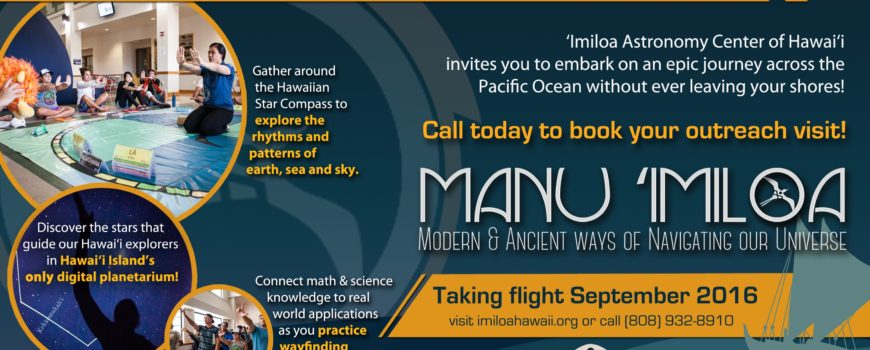
ʻImiloa is continuing to expand our impact through our newest educational endeavor,  MANU ‘Imiloa, a mobile outreach program aimed at sharing ‘Imiloa’s unique brand of culture-based science education across Hawaiʻi island! 

Taking flight once again this Fall, 
MANU ‘Imiloa (Modern and Ancient ways of Navigating our Universe) will send ‘Imiloa staff on the road to deliver an interactive curriculum inspired by the Polynesian Voyaging Society’s epic Worldwide Voyage, designed to explore the skills involved in non-instrument ocean navigation, or wayfinding.  
2013_5_30_WWV_start
Outreach will be offered in two formats:
NOIO (Non-instrument Orientation, an Introduction to Oceanic Wayfinding) is a 30 – 60 minute package that ‘Imiloa can deliver on request to K-12 schools and community centers, or offer as part of local events. Audiences of all ages are invited to gather around a model of the Hawaiian Star Compass or to sit “under the stars” in ‘Imiloa’s custom digital portable planetarium to learn how wayfinders rely upon cues from the environment to determine their course and direction.

KŌLEA (Keeping Our Legacy of Exploration Alive), the second offering, is a two-week+ curriculum package designed specifically for middle school teachers to implement in their 7th and 8th grade science or math classes.  Titled “He Manu He Waʻa, The Geometry of Wayfinding,” it drills down into the geometry, astronomy and other sciences that undergird traditional Polynesian non-instrumental navigation. KŌLEA includes five essential components:
  1. A 4-Day MANU ʻImiloa Teacher Training Workshop on site at the ‘Imiloa Astronomy Center.
  2. Access to the “He Manu He Waʻa: The Geometry of Wayfinding” instructional curriculum guide, equipped with curriculum maps, background information, lesson plans, activities, worksheets, rubrics and assessments. This curriculum is aligned with HIDOE Standards: Common Core State Standards for Mathematics, Next Generation Science Standards, Nā Honua Mauli Ola Guidelines, and Nā Hopena Aʻo Learner Outcomes. 
  3. Access to our customized traveling toolkit that comes complete with the necessary math, astronomy and wayfinding equipment needed to perform all activities and support instruction. 
  4. A complimentary outreach visit to your school by MANU ‘Imiloa Outreach staff
  5. Priority access to MANU ʻImiloa Outreach staff for consultation.
The 2016-2017 KŌLEA program will be limited to 15 enthusiastic and passionate middle school teachers across Hawai‘i Island. If you’re a 7th or 8th grade teacher who is interested in being a part of this year’s KŌLEA flight, you are invited to apply! Applications for the 15 places will open Monday, August 1 at 9:00am and close September 1, 2016; selection committee decisions will be announced by September 15Click here for full details and registration. 

If you’re ready to embark on a remarkable new voyage without having to leave your own school or community, visit our outreach page at 
http://www.imiloahawaii.org/258/manu-imiloa-outreach or email outreach@imiloahawaii.org.

Ready to try out any of these lessons or resources? Email us at education@pvshawaii.org to share with us what you do with this content – we would love to see pictures and student reflections that we can share on social media and our website!

Doing another kind of project to mālama your community? Share Your Mālama Honua Story with us!

Are your students still in the beginning stages of identifying a problem they would like to try and solve? Don’t forget to check out the Mālama Honua Challenge and share your ideas about work that can be done in the future!

Continue Reading