Nainoa Thompson honored with an Ocean Conservation Legacy Award

Pwo navigator and PVS president Nainoa Thompson was recently honored with the 2016 Legacy Award at the annual BLUE Ocean Film Festival and Conservation Summit. The prestigious accolade celebrates and recognizes leaders that have made extraordinary achievements to create a lasting legacy in ocean conservation, exploration, education, innovation, and the pursuit of marine knowledge.

“Like crossing the deep ocean in a voyaging canoe, navigating towards a better Island Earth takes a crew of passionate people with the power and commitment to make a differenceNainoa BLUE Ocean Fest,” said Thompson. “I am truly inspired to be surrounded by so many others here at the BLUE Ocean Film Festival who are taking risks and making great strides towards global sustainability, respect for our ocean, and the kind of education that prepares our next generation of stewards who will navigate our communities to a brighter future.”

Thompson was acknowledged for his leadership on the Mālama Honua Worldwide Voyage as captain and navigator of iconic sailing canoe Hokulea. Throughout the world-spanning wayfinding journey, he has guided crew members in successfully sharing experiential education and inspiring communities to care for themselves, each other, and their natural and cultural environments. In addition to Thompson, the honor was also presented to Academy Award-nominated filmmaker Greg MacGillivray, who has produced and directed some of the industry’s most enduring conservation education films.

“It is a privilege to welcome Nainoa and Greg as this year’s Legacy Award winners and praise them as outstanding pioneers that personify great courage, passion and wisdom,” said BLUE CEO Debbie Kinder. “For seven years, we’ve successfully hosted this celebration of achievements in ocean conservation and are proud to call it the birthplace of many inspiring and innovative collaborations each year.”

Founded in 2009, BLUE Ocean Film Festival and Conservation Summit is a unique convergence of film festival and ocean conservation summit, highlighting ocean-related films, breath-taking photography, inspiring keynotes, captivating art, thought-provoking panels, engaging music, hands-on workshops, conservation activities and great parties. It has become one of the world’s most popular ocean events for innovators, entrepreneurs, government dignitaries, emerging talent, media icons, thought-leaders, scientists, teachers, explorers and industry professionals from all walks of life who share a common passion for the sea.

Past recipients of the Legacy Award include Captain Don Walsh for ocean exploration, James Cameron for ocean filmmaking, Phil Nuytten for ocean exploration, Eugenie Clark for ocean science, Stan Waterman for ocean filmmaking and HSH Prince Albert II of Monaco for ocean stewardship.

For more information on the 2016 BLUE Ocean Film Festival and Conservation Summit, please click here.

Hōkūleʻa Update | The Canoe Splashes and the Crew Arrives

On Monday November 7, 2016, Hōkūleʻa re-entered the water after an extensive and successful dry dock at the Mariners Museum.

PVS Education Volunteer Diane Tom-Ogata described the splash that day:

“Today, Hōkūleʻa touched the water of the eastern shore.  With crew on hand, she was lifted into the water, towed to Bluewater Marina, and smoothly docked by experienced crew and navigator Bruce Blankenfeld.  Within a few hours, Hōkūleʻa transformed from a seemingly simple craft to an alluring vision, with masts, spars & boom erected proudly and lines draped.  Crew and dedicated volunteers assisted with the minutiae of lashings, hull arrangement and the many other hundreds of details that the average person does not understand or probably even notice. As the sun began to set against a sky tinged in blue and red, there she sat, the Star of Gladness, shining bright on the water.”

As Hōkūleʻa made that small journey to Bluewater Marina, in Hampton, VA, her next hui of crewmembers packed their bags and began making their way from their respective homes to Virginia to start the next leg of the voyage. Crewmember Kaipo Kiaha describes their reunion with the canoe:

“After over 24 hours of travel for some of the crew, we have traveled across the United States and have been reunited with Hōkūleʻa in Hampton, Virginia at the Bluewater Marina.

We had a brief crew meeting over dinner with Nainoa and Lehua who are on their way out tomorrow morning. Nainoa spoke of his appreciation for this crew and all those before who have gotten the canoe this 27,000 miles from home. He also stressed to us that this will not be an easy sail, but he has utmost faith in our Captain, Kālepa, and our crew.

The sail plan will include roughly 16 stops covering 950 miles until we reach Miami. There is no planned outreach at this time as far as physical canoe tours.  We will only be moving the waʻa in daylight hours, which as we get closer to the end of the year are becoming fewer and fewer.

Sunset tonight was at 4:57, and it was fully dark by the time we arrived at the waʻa at around 6. It is a cool 45 degrees outside. Staying warm and dry will be of paramount importance over this next month.

Randy Rickard will arrive on Saturday. He is a local from Florida and will pilot Julie’s Cat. He will be going over the sail plan with Kālepa in detail on Saturday, including the ports of call, and conditions of marinas and navigational aides post-hurricane along the AIW (Atlantic Intracoastal Waterway). That day the crew will also apply the waterproofing liquid to the outside of the canvas. Saturday is forecast to be light wind which is the best condition for doing that.

Tomorrow we will be offloading some of the sails to return to Hawaii on the Matson container with the dry dock gear. We will also be prepping the canoe to leave: bending on sails, shopping, and loading food and water.”


Hōkūleʻa’s Dry Dock Fundraiser

Every year since embarking on the Worldwide Voyage in 2014, Hōkūleʻa has taken several weeks of downtime annually to ensure she is safe, seaworthy and beautiful for the thousands of nautical miles that lay ahead.

Please help fund Hōkūleʻa’s 2016 dry dock efforts.

Continue Reading

Hōkūleʻa Update | November 8, 2016

Dry Dock and Education Update at the Mariners Museum

By Diane Tom-Ogata

In the days leading up to her departure from The Mariners Museum, we found ourselves in the midst of a flurry of special events honoring Hōkūleʻa and her crew, while the dry dock crew continued to work 14-hour days.

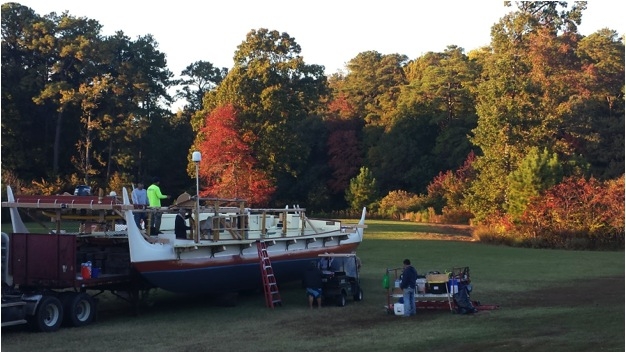
We have been blessed with beautiful weather of clear blue skies and sunshine, though periodic wind chill can be felt.  Hōkūleʻa is breathtaking as she sits against a background of trees turning vibrant colors of red, orange and yellow.Hoku@MM

This past Friday, the Dry Dock Crew were taken on a special tour of the museum, which included a behind the scenes tour of artifacts and art from around the world relating to Mariner history dating back to the Viking era.Hoku@MM2

Friday was also a special day for our canoe – the “Hōkūleʻa” lettering was applied to her hull as our skilled Dawson painters continued finishing touches, and Museum Staff and supporters slowly gathered on the great lawn for a special evening. The Mariners’ Museum held a celebration in honor and appreciation of Hōkūleʻa and her crew with a huge Virginia-style BBQ, which included a roasted pig and bon fire. The skies were clear, and with a bit of chill in the air the bonfire (and oversized marshmallows for s’mores) kept everyone toasty.

Hoku@MM3

Hoku@MM4As dusk approached, a short program included the exchange of gifts to the Museum and Polynesian Society. One gift to the Polynesian Society was a Deck Prism. Traditionally, a deck prism was used for additional light that was placed in the deck so when the sun hit the prism, light refracted below so the crew down below had daylight. This prism is a replica of an original prism from the USS Monitor, made by a local artist from a mold of a prism taken from the USS Monitor while The Mariners Museum restores the historic vessel. The deeper meaning of the Prism presentation was explained as helping to shed light to guide and support Hōkūleʻa and her crew on the Mālama Honua Voyage and the journey home.

On Saturday, the dry dock crew worked at a rhythmic pace, transferring items from the workshop to Hōkūleʻa, loading what they could while our painters continued diligently painting. The big event on Saturday was a special Hōkūleʻa Celebration at The Mariners Museum with Hawaiian and Tahitian Entertainment, Uncle Calvin’s well attended workshops to make Pū Ohe (which participants took outside and greeted Hōkūleʻa with) and Ohe Hano Ihu (Nose flutes), a special showing of Nā’ālehu Anthony’s film “Papa Mau: The Wayfinder”, and a tour of the Polynesian Voyagers Exhibit with the Museum Curator, Mark Nucup. Uncle Calvin’s ʻohana, Nani Hoe and her husband, drove 4 hours to set up and provide entertainment outside for all museum-goers.Hoku@MM5

The Mariners’ Museum and Park new display “Polynesian Voyagers” is impressively well thought out. Marc, Curator of the exhibit, and support staff have put in hours of research of every facet to make sure they “get it right,” going as far as re-mapping the sail plan as it exists today and following up with copyrights. Marc’s visitor tour is so impressive, comparing cultures of the Pacific and the East Coast indigenous peoples and European voyaging.

Hoku@MM6On Sunday, visitors came purposely to visit Hōkūleʻa before her departure from the Museum. The dry dock crew worked diligently to prepare Hōkūleʻa for her entry into the water, with masts, boom, fenders, etc all loaded and placed onto Hōkūleʻa by the end of the day. The workshop was cleared, with all supplies & equipment loaded onto the canoe or into the Matson container.

So many of these visitors touched our hearts with their commitment to see Hōkūleʻa and learn the story behind her and this historic voyage, some traveling many hours and many miles. Many visitors from various backgrounds, from Hawaiʻi and far-away lands, shared stories of their connection with Hōkūleʻa and Hawaiʻi.

Hoku@MM7Mahalo to The Mariners’ Museum for their hospitality, which has been above and beyond what we could imagine, accommodating and furnishing kindness beyond words. And to the many visitors who have touched us with their ways of supporting Hōkūleʻa and the Mālama Honua Voyage – thank you for your passion and dedication, and we encourage everyone to follow us on hokulea.com for updates on her departure from Virginia.

E Mālama pono and a hui hou!

Diane, on behalf of the Education & Outreach team


Hōkūleʻa’s Dry Dock Fundraiser

Every year since embarking on the Worldwide Voyage in 2014, Hōkūleʻa has taken several weeks of downtime annually to ensure she is safe, seaworthy and beautiful for the thousands of nautical miles that lay ahead.

Please help fund Hōkūleʻa’s 2016 dry dock efforts.

Continue Reading

Uncle Calvin at the Mariners’ Museum

by Diane Tom-Ogata, PVS Education Volunteer

While the dry dock crew and painters busily prepare Hōkūleʻa to look shiny and new for the voyage home, some of us work side-by-side with our hosts at The Mariners’ Museum to support the Polynesian Voyaging exhibit the museum has curated in our honor.  Today, Uncle Calvin Hoe has captivated the minds and hearts of the staff, taking them on a once-in-a-lifetime journey.

With a slow, thoughtful voice, his introduction begins with his genealogy – who he is and where he has come from.  He tells of being from Hakipuʻu, where Hōkūleʻa was first launched.  He then breezes into the topic of wind, talking about the Wind Gourd of Laʻamaomao and the names of wind that are put into a wind gourd, as he seamlessly takes out his flute and plays.  The resonance is just as captivating as Uncle.

20161104_110633

Suddenly, Uncle sits up in his chair and like a ball of energy tells the staff, “Now you will make a flute”.  The energy in the room suddenly changes from quiet melancholy to hyped excitement, and even a quiet request (“I want to make one, please”) from Lauren, who stepped away for a moment and missed the distribution of flutes.   As we clean and sand our flutes, Uncle continues to chat, and when the flutes appear to Uncle’s satisfaction (he does inspect each flute as it is worked on), he announces “OK, now I teach you folks how for play.”  He carefully states where each finger on what hand is placed on the flute, and within moments we have clear tones from each of us.  Once he hears what he wants, he then moves on to explain the science and physics of sound.

Next on the agenda is the Pu.  Uncle simply explains the technique of pressing your lips together and blowing, like when you were a little kid and didn’t want to eat something.  With much surprise, the clear sound of the pu is heard right away from some in the room (except for me, I still cannot master the art of blowing).

Someone asks the time, and we are all surprised that it is a bit past lunch time.  Uncle reminds me that Union rules states he gets a 30 minute break, so 30 minutes we take.

When we reconvene, Uncle begins with the story of why he does the coconut waʻa activity.  He recalls that when he asked master navigator Papa Mau Piailug what his first memory was of canoes, Papa Mau replied “playing with coconut boats.”  Since Mau did not elaborate, Uncle Calvin created an activity to create coconut waʻa.

Before we can begin the activity, we first need to find the right type of “pick” Uncle needs to husk the coconut for his waʻa.  Initially, our search turns up a hammer and two picks; none of which met Uncle’s expectations. Uncle is then escorted by Museum staff to the Carpentry Division, where the staff indulged in making an oʻo to Uncle’s specifications.  Then the husking and waʻa building can begin – so fascinated were the staff of a coconut, their curiosity brought out their photographer.

After the first coconut waʻa session, Uncle ceremoniously hands over the oʻo to Curator Marc, who shares “this is the most fun I’ve had in years!”

This living treasure trove of knowledge named Calvin Hoe, whom I have been blessed to accompany and work side-by-side with, is a humble conduit eager to share his life’s unmatched experiences and skills. Having made over 80, 000 nose flutes in his life, he shares that he learns something new with every flute he makes.  We can learn something new every day, even by doing the same job, just doing it better and better.

And perhaps the best part, as Uncle says, is that we don’t learn FROM but WITH each other.


Hōkūleʻa’s Dry Dock Fundraiser

Every year since embarking on the Worldwide Voyage in 2014, Hōkūleʻa has taken several weeks of downtime annually to ensure she is safe, seaworthy and beautiful for the thousands of nautical miles that lay ahead.

Please help fund Hōkūleʻa’s 2016 dry dock efforts.

Continue Reading

Canoe to Classroom exchanges continue and deepen

Throughout the Worldwide Voyage, Hōkūle‘a crewmembers have connected with students back in Hawaii through live, video conversations with classrooms across the state in a program called Canoe to Classroom.

At Kamehameha Schools, these conversations started with basic questions to the crew such as “How do you use the toilet on the wa‘a?” More recently, kumu (teachers) have developed ways for the conversations for older students to delve deeper and connect the voyage to their middle and high school curriculum such as World History and Biology. On Leg 24, sailing from New York to Virginia, Hōkūle‘a crewmembers fielded thoughtful student questions on topics such as leadership traits and community values.

Read more about the engaging questions posed and discussions resulting through the unique opportunity to connect wa‘a to papa (classroom) in Kamehemeha School’s ‘Wa‘a Wednesday’ article.


Help fund the Voyage as we sail the East Coast

Hōkūle‘a’s visit to the eastern United States is a historic milestone in her 40 years of voyaging.

Celebrate with us by pledging your support to the Mālama Honua Worldwide Voyage.

Hōkūleʻa Update | November 3, 2016: Moani Heimuli

Moani HeimuliBy Moani Heimuli

Aloha All,

It’s been a bit since my last update and so much has been accomplished here at dry dock since.

Hōkūleʻa has got a new coat of paint on the hulls by the boys of Dawson. Currently they are working on the final coat on the wet decks and deck and also painting the deck boxes and hatch covers. We are really grateful that they are here and are doing such beautiful work.

Big Bill is putting the final coats of varnish on the masts, spars, booms, and sweeps. It takes a lot of patience and attention to detail to make the sticks look brand new again. Bob and Uncle Kimo are fabricating new pieces for the wa’a to make her safer and other pieces for more efficient work. Uncle John has taken the new hoe uli (steering paddle) and shaped it down to a lighter more streamline hoe. He’s also been able to fix up the old paddle that will be sent home in the Matson container. Nakua and Kaleo have been taking care of odds and ends jobs from lashing on the new front nets to making new outriggers for fishing. Kealoha has been assisting the painters which has been a big help. Irish has become our cook since his brother Tom left to go on a trip. Irish has also managed to grind down the old Kualoa anchor and give it a fresh coat of paint. All of this work is being completed in a timely fashion because of the awesome organization by Uncle Bruce who gets about a million questions a day and is always helping where need be. He’s constantly teaching us why we do it this way and how we’ve tried other ways in the past that hasn’t worked. He’s always thinking of ways to make improvements to the wa’a.

The education team, consisting of Uncle Cal and Diane, arrived on Tuesday and are helping out with outreach within the Mariners Museum. Another volunteer, Ann Bell, also arrived recently. She has sailed on Hōkūleʻa in the past to Papahānaumokuākea and she drove all the way from Tennessee just to come see us and help out.

Mālama,
Moani H.


Hōkūleʻa’s Dry Dock Fundraiser

Every year since embarking on the Worldwide Voyage in 2014, Hōkūleʻa has taken several weeks of downtime annually to ensure she is safe, seaworthy and beautiful for the thousands of nautical miles that lay ahead.

Please help fund Hōkūleʻa’s 2016 dry dock efforts.

Continue Reading

Crew Blog | Nāʻālehu Anthony: He ʻOhana Waʻa Kākou

Naalehu Anthony By Nāʻālehu Anthony

Every morning has been similar for us here on the East Coast. We beat the sun to rise and from the warmth of the multiple blankets we make our way downstairs to the cold living room and kitchen where almost a dozen people are gathered and busily getting ready for the day. The cold does not hamper spirits, if anything it’s a new oddity that few of us are used to dealing with on workdays. We have a motley crew here with the youngest in his early 20ʻs, while some of the most senior dry dock crew was born before World War II. No matter the age the mood is joyous and the kidding around started at the breakfast table as soon as the first cup of coffee is poured and has not stopped since.

Brothers Tom and Irish Mike work the kitchen hard to provide the food for each day, making for delightful surprises at breakfast, lunch, and dinner. The breakfast this morning of hard boiled eggs and fruit as well as English muffins are washed down with coffee and tea. The flurry of activity throughout the house is measured with an understanding that we need to leave on time to get to the work at hand at dry dock. We’re out the door by 7 am in two vans and the American Canoe Association (ACA) Subaru. Most mornings we’re in a bit of traffic heading over to the Mariners Museum. The timing is great though, as two mornings in a row the sun was just starting to rise as we head over the York River bridge to Newport News providing for a spectacle that only a cold morning on the East Coast can provide.IMG_0606IMG_0357

Arriving at the Mariners Museum within 5 minutes of the other cars we get ready for our day. The barn doors are heaved open and light pours into the bay where we have all of the steering paddles and the masts, spars and booms. Half of our crew works here the bulk of the day to refinish these pieces. Cracked epoxy is ground out out. Some worn parts are bolstered with fiberglass. Everyone here is a specialist of some sort. ʻAnakala Sam Kaʻai came specifically to help refurbish the kiʻi kane and kiʻi wahine, Captain Bob Perkins is here as the guy who knows about all the composites and the list goes on and on. But no matter the specialty or the letters after your name we are all here to help sand parts of the canoe. It’s amazing how much sanding there is to get done. Sanding with disc sanders, sanding with grinders, sanding by hand, the thousands of nooks and crannies all need to be sanded and scuffed so that the next coats of protective coatings can stick. I counted no less than 8 sanders in the barn the other day of all makes and models. Through the generous support of Matson navigation, a 40ʻ container sits a few hundred yards away. It carried all the equipment, tools and parts needed to accomplish this dry dock in a timely fashion. It really is a sight to see everyone’s “stuff” here like we are at METC, PVS’s home in Honolulu, or some other familiar home base that isn’t 5,000 miles and two plane rides away from Hawai’i.

The rest of us head down the hill a bit to where Hōkūleʻa is parked in a grassy field, which is hands down the best dry dock location I have ever had the opportunity to go to. The 500-acre property that the Mariners Museum sits on is mostly filled with forest and a huge pond system. Hōkūleʻa sits on the back lawn behind the museum next to the Monitor, the replica of the ironclad war ship that participated in the civil war. Hōkū still sits on the trailer that brought her just a few miles from where she was hauled out. Even though the canoe is stripped down with no canvas or masts, you can still feel how special she is. Museum guests stop by throughout the day and we all marvel at how far she has come to get to Newport News, Virginia. The next task is to ready her to make the rest of the trip home, some 9,000 miles back down the East Coast, through the Gulf, the Panama Canal and then the Pacific to Hawaiʻi in June of next year.IMG_0466

That’s where this crew is so critical. Be it the people sanding or making new parts or rewiring the electrical system, everyone here has the determination, intent and aloha to leave our canoe in better shape then we found her. From the original 1976 crew members who set the tone and the pace each day with a work ethic IMG_0371etched into their brows and hands, to the young ones who pace them trying to learn every step of the way, we all understand that this leg of the journey, too, is about perpetuation of these crafts as well as passing on knowledge.

Albeit foreign in location, the crew and the canoe being here make it feel just like home. And I guess that’s the point for today. For everyone here the canoe is home. The mood is always light here. Don’t get me wrong, there is a tremendous amount of work to be done but no one has to do any of it alone. Just like when we are sailing there are always hands to help lift whatever burden might be in front of you for the day. The collective spirit is always upbeat and filled with a sense of kuleana. I think I can speak for the whole crew in saying that it is our absolute privilege to be here and participate in this dry dock as this canoe and her leadership has given all of us so much.

ʻAe, he ʻohana waʻa kākou.
IMG_0446


Hōkūleʻa’s Dry Dock Fundraiser

Every year since embarking on the Worldwide Voyage in 2014, Hōkūleʻa has taken several weeks of downtime annually to ensure she is safe, seaworthy and beautiful for the thousands of nautical miles that lay ahead.

Please help fund Hōkūleʻa’s 2016 dry dock efforts.