Hōkūleʻa Update | January 7-8, 2017

On Leg 26, Hōkūleʻa voyages south from Florida to Panama. In this update, Nakua Konohia-Lind narrates the days the crew spends waiting to pass through the Canal – and a field trip to ruins of Fort San Lorenzo.

January 7

Blog by Nakua Konohia-Lind

The sun rises and the day begins with the meal kuleana aboard the Wa’a being passed over to the 2-6 watch, led by watch captain Duane DeSoto and crew member Scientist Anushka Fauicci and of course ʻŌiwi TV’s own Justyn Ah Chong. With access to fresh food shopping while at dock during this period of waiting, the watch was able to whip up some fresh chorizo sausage, sautéed onions, fresh fruit salad, boiled and scrambled eggs with tortilla wraps – talk about five star dining.

We’ve been docked at Shelter Bay Marina for about five days now, so in that time we were able to get a lot of canoe work done and for once had nothing to do on the wa’a. With that being said, the crew and captain Bruce sat around on the decks of Hōkūleʻa with the shade cloth hovering just enjoying each other’s company playing some music and waiting for the call about our transit through the locks of the Panama Canal. Whenever the crew meets up, captain updates the crew on the weather thanks to Hans Rosenthal –  a retiree of the National Weather Service. ” If you look around you can see the clouds converging which is a sign that rain is already starting to roll in!” says captain Bruce “so the transit through the canal is gonna be a wet one.” With that update the Sun still finds its way through the clouds and heats up the land so the crew made their way to the air conditioned restaurant for some ice cream and lunch – a brilliant idea, I say.

The down time we have takes a toll on the crew and we miss our families even more because we’re not going anywhere. Instead just hoping and praying for good news from the canal authorities for the green light to go through the locks.  But this is what a voyage is all about. It’s like its own person, it tests your patience and it may stress you out but the voyage is about trying to overcome little obstacles like these which makes a person stronger in character. Just like everyday life as well, everyone goes through trials and tribulations but at the end of the day we’re all thankful for another breath of life and another day on this amazing Mālama Honua voyage.

January 8

Blog by Nakua Konohia-Lind

With the clouds rolling in early morning the crew rises to another day of waiting and minor waʻa cleaning. We all enjoy another simple and ʻonolicious breakfast made by the 2-6 watch – bacon and scrambled egg wraps. And must I say it again? It was fantastic. With a squall lurking offshore the crew awaits for some rain but as always Mother Nature has a mind of its own, so it still remains off shore taunting us.

Since the rainsquall doesn’t arrive, a question is asked by captain Bruce, “Did everyone wash and wipe down their entire bunk area?” Without hesitation the crewmembers that hadnʻt had a chance to clean their area starts jamming it out so we could go on a little excursion later in the afternoon. Fortunately I was able to finish all that cleaning during the first day of arrival so I was able to do some extra curricular activities like learn how to sew a hole in my shorts and whip the ends of a few frayed lines around the waʻa.

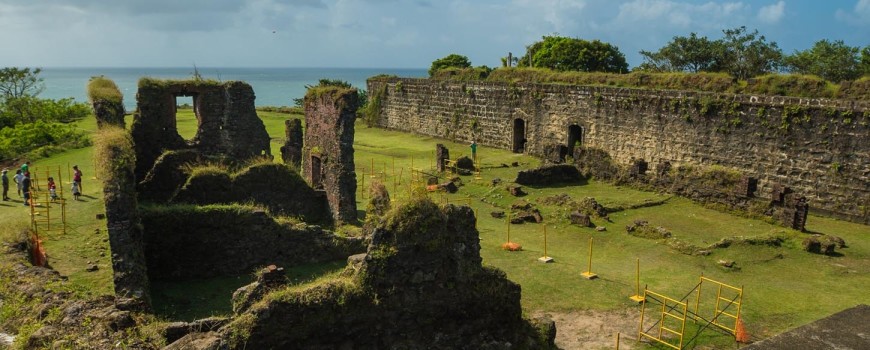
Our bus arrives and we hit the one-lane roads of countryside Colon on our excursion to Fort San Lorenzo in the Jungle. In hopes to see a few animals, we scan our surroundings looking for Tucan birds in the trees, pumas in the brush and possibly some monkeys on the lawn. We arrive and walk throughout the ruin in astonishment of the old walls, stairways and trenches leading to the ocean. Of course, with Paula Akana and her photographer Braddah Stuart there with us recording, everyone was on their best behavior. With the sun reaching its peak we wait for a few more crew members to finish the fort tour while our fellow crew member Darienne Dey takes us to look at an amazing work of nature – something so small but amazing. We approach the area and notice a tiny trail spanning across the entire lawn – a kind of trail that’s created from consistently walking on the grass. I think to myself  that it’s too small for a human trail. As we take a closer look we realize a colony of ants walking in both directions like a two lane road. Ants were carrying things in one direction and returning empty handed walking in the opposite direction.

After experiencing that act of nature and having the sun beam us up Scottie, we find a lovely piece of shade in the middle of the lawn. I take a seat on the grass with the boys, again waiting for the rest of the crew. The shade was so ʻono that we all slowly changed the shape of our bodies from vertical to horizontal. Sometime in the midst of all the madness you have take a step back and just take a chill pill and Mālama our own bodies, which itself is also a honua.


Hōkūle‘a Homecoming – Save the Date

Sign up for updates and be the first to know as we continue to detail

homecoming festivities that will include multiple events!
Hōkūleʻa Update | January 5-6, 2017

On Leg 26, Hōkūleʻa voyages south from Florida to Panama. In this update, Lohiao Paoa explains some of the kuleana while in port and recounts a few crew funnies.

January 5

Blog by Lohiao Paoa

We are all individuals. Most of us on this current leg have never met prior. Even with our individual foibles and responsibilities, each and every crew member must help one another accomplish even the simplest tasks. From washing dishes to dropping the spar, Hōkūleʻa has the tendency of tying individuals into one crew, and it starts with knowing your role. Do what your supposed to, nothing more, nothing less.

One of the most important kuleana on Hōkūleʻa is the Quartermaster. The Quartermaster is in charge of knowing where everything is on board. Everything! I had the honor of helping Uncle Gary quartermaster for Leg 16, and was somewhat relieved to have canoe supplies, towing gear, and rescue swimmer second time around. Communication is key when being a Quartermaster because when captain needs something or when things can’t be found, weight will fall on the quartermaster. Just one of the pieces to the puzzle.

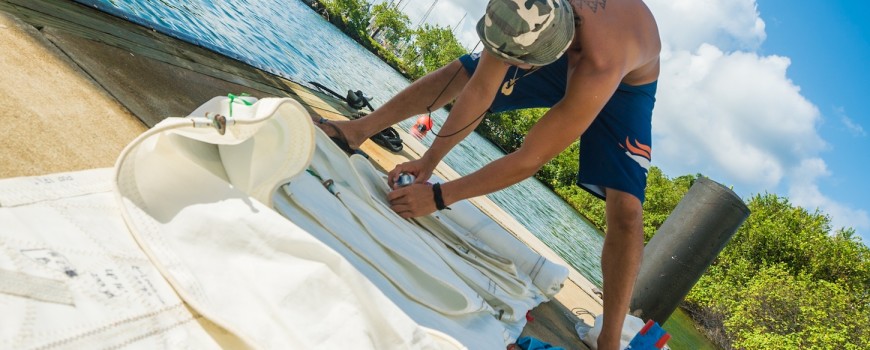
January 5th, 2017, consisted of sail repair, cleaning, and quartermastering for Leg 27. From Miami to Panama, jibs and genoa’s 7, 9, 13a, 15, 17a, 21, 24, and 26 were the sails used, coupled with the primary big boys, the 28 and 30 triangles and 28 and 32 crab claws. Typically, numbers of the sails correlate with the square footage of the sail. 7=70 square feet, 15=150 square feet, etc. The so called motors of our waʻa must be treated with tender loving care, soak um, lube um, and rub um down.

Like Ice Cube would say, “today was a good day.”

Funny story of the day: Nakua decided to start a conversation with Captain Bruce asking him “Uncle Bruce, how many stars do you know?” Cap proceeded by pulling out his star chart and pointed out over 200 stars on the spot, 219 to be exact. He knows more I’m sure.

January 5

Blog by Lohiao Paoa

Last night was open mic at the local marina bar. Hōkūleʻa crew stole the show as we sang songs of our homeland. The key is confidence.

This morning was an active morning. The Dugong watch (10-2) made some bacon, eggs, and French toast that was quickly devoured. We then turned the waʻa around to set up side tow with our potential escort, the DWS Linda. After about an hour of moving lines and fenders, we got the approval from the Canal officials. Mahalo to the DWS Linda. Estimated time of departure from Shelter Bay is still pending.

Hōkūleʻa is in pristine condition, so that allowed us to have a few hours of free time. Some of the crew went to San Lorenzo point, a scenic park that still had forts that were built in the 1500s and had views similar to ones in the movie Pirates of the Caribbean. Some crew had time to jump in the pool near the marina and others just enjoyed a peaceful nap. Our navigator, Brad Wong, lost his left slipper two days after leaving Key West. He was able to duct tape cardboard and some line together to protect his left foot from the Panamanian terrain.

Days are hot and winds are minimal. Everyone is healthy and excited to carry on through the canal. It is my nephews fourth birthday today, Happy Birthday Kolohe! I’ll be sure to eat a couple extra Oreos for you.


Hōkūle‘a Homecoming – Save the Date

Sign up for updates and be the first to know as we continue to detail

homecoming festivities that will include multiple events!

Hōkūleʻa Update | Arrival in Panama

On Leg 26, Hōkūleʻa voyages south from Florida to Panama. In this update, Darienne Dey recounts arriving in Panama and the crew’s first huakaʻi to Panama City.

January 3

Blog by Darienne Dey

Today” actually began yesterday.  We had been surfing the swells all day when the afternoon engulfed us in an overcast haze reminiscent of the doldrums.  Clouds crowded the sky (much to our relief, from the nearly equatorial sun) as thoughts of anticipated landfall crowded our naʻau.  The faint outline of a lone barge or cruise-liner would occasionally creep up on our horizon, but today was different.  Beyond our ʻākea hull, a familiar silhouette began taking shape.  Was that land?  No.  Ships?  Yes.  Big ships.  A whole line of them.  We could feel multiple convergences upon us:  of weather and waves, of oceans and lands, of commerce and culture.  We were entering Panamaʻs canal zone.

As the sun converged with the horizon, the waves converged below us, making our initial approach (under tow by the Gershon II and her intrepid crew) serve as a hearty exercise in five-person steering.  Veering past less-than-ideally-lit buoys like the Millennium Falcon through an asteroid field, we nevertheless could not help but marvel at the multitude and magnitude of the ships that were, by that time, surrounding us.  Framed by their lights, these monsters of the deep looked even more unearthly as they stealthily moved past us (or rather, as we stealthily moved past them).  Eventually, we anchored with Gershon II off on the western side of Limon Bay.

The next morning (“actual” today), we awoke for the first time in many days to a stationary waʻa.  We promptly swapped out our Marconi sails for our bare crab claw booms (to free up our catwalks) and started cleaning and taking inventory.  During our short side-tow (from Gershon IIʻs dinghy) to nearby Shelter Bay Harbor, we were greeted by SUPers Richard Chirri and Jolienne Marten, whose Naish boards glided smoothly on either side of us (just as they had when crossing Pailolo and Kaiwi channels in months past).  At our designated dock, cheehoos erupted from our welcoming party, which consisted of several sailors who were also partaking in their own circumnavigation of the Caribbean (having crossed paths with Hōkūleʻa previously in Cuba) as well as Oriana Kalama, who had served as cook and quartermaster on Haunui with the Pacific Voyagers from San Diego to Tahiti.  True to her previous kuleana, Oriana stuffed us with a delicious lunch of rice, beans, onions, and fish.

Soon afterwards we were visited by various canal authorities who will help ensure Hōkūleʻa’s safe and timely transit of the canal and return to her home ocean.  It was refreshing to witness their enlightenment about the waʻa’s mission and what she has already accomplished worldwide.  We look forward to Hōkūleʻa’s path converging with more people’s lives as we prepare for the coming days’ short yet historic crossing.

January 4

Blog by Darienne Dey

Last night, after two weeks of staying one to two nautical miles apart, Hōkūleʻa and Gershon II crews finally got to reconnect in person and share our first land-based dinner together at Shelter Bay Marinaʻs “The Dock” restaurant.  Needless to say, dessert was ordered by all.  Then today, while part of the crew cleaned and prepped the waʻa (as well as engaged in water recreation off of and around it), some of both crews (including the captains) teamed up to huakaʻi together to Panama City for provisions and supplies for the canal transit.

Soon after our navigator Luis (of Viajes Especiales) picked us up, team Hōkūgershon was back on the water, riding a ferry across the canal and heading east towards Colon proper.  Looking north as we crossed, we could see (by the light of day) where we had made our exciting entrance to the canal two days earlier (and the ever-present crowd of ships still dotting the horizon).  We continued our journey on a highway (not unlike the Likelike or Pali back home) surrounded by jungle as far as the eye could see.  Every few miles, tin-roofed residential communities and edges of meandering waterways revealed themselves through the dense foliage, but the greenery otherwise appeared ready to engulf the entire landscape.

Thanks to my Panamanian mother naming me for the particularly infamous Darien portion of the isthmus’ jungle, I have held a lifelong appreciation and respect for this place that can be as dangerous as it is beautiful.  Voyagers can just as readily apply this sentiment to the ocean.   In the words of explorer Ernest Shackleton, “…if you wish to see Nature robed in her mantle of might, look at a storm at sea; if you want to see her robed in her mantle of glory, look at a sunset at sea.”  Storms and sunsets serve as constant haʻawina for us on the water and on land.  They help us hone our cognizance of our immediate and distant surroundings.  They help us see connections and make decisions to restore lōkahi.

During our errand running in Panama City, we recognized a certain ʻano.  Cars were small.  Housefront rubbish receptacles were finite (and relatively small).  Packaged food came in smaller proportions.  Toilets were for natural waste only (with nearby rubbish bins for all used paper).  There was an understated level of environmental consciousness that fascinated us almost as much as hearing howler monkeys or seeing bioluminescent insects at night.  We have learned much about striving for lōkahi among our crews as well as with our surrounding environments, but we look forward to the voyage that each new day brings.


Hōkūle‘a Homecoming – Save the Date

Sign up for updates and be the first to know as we continue to detail

homecoming festivities that will include multiple events!
Hōkūleʻa Update | January 1-2, 2017

On Leg 26, Hōkūleʻa voyages south from Florida to Panama. In this update, Dr. Colleen Finnegan describes a green flash, Hōkūleʻa’s approach to Panama and the crew’s thoughts on re-entering the Pacific.

January 1

Blog by Dr. Colleen Finnegan

HAPPY NEW YEAR to everyone sharing this Worldwide Voyage with us! The crew received a package (hidden under Darienne’s bunk) of 2017 goodies – including 2017 sunglasses, treats, blow horns, and bottles of sparkling cider. At midnight, as determined by the position of the stars, pū (conch shells) were sounded and a short celebration ensued. We considered sending up a flare, but thought better of it given the possibility of misinterpretation.

Honestly, though, our first day of 2017 was a lot like the last 10 days of 2016. I awoke each day to see large, rolling waves with Hōkūleʻa easily riding over them, no land in sight.  I also enjoyed seeing malolo (flying fish) skimming from crest to crest. At any given time, if you look, you will see them – like looking up to the branches of a monkey pod tree, you would expect to see a bird.

Speaking of looking upwards, another delightful part of this passage has been moonless nights accentuating a bright canopy of stars, and in particular, shooting stars, some a pinpoint of light, others with a thin silver tail and not infrequently an orange ball of fire with a long trail of orange behind. If you look, you will see them. 😉

January 2

Blog by Dr. Colleen Finnegan

This afternoon we are sailing due South towards Panama, with less than 100 miles to Colon.  I asked my fellow crewmembers what this leg of the voyage meant to them, specifically, the planned transit through the Panama Canal. “A historic home coming”, “An ancestral home coming” “On my bucket list; a big one,” “A privilege, a kuleana to be on Hōkūleʻa during this epic moment in her life after 2 years, connecting into the Pacific” “Amazing,” “Beginning of the completion of the full cycle,” “Hōkūleʻa is the destination. Hōkūleʻa is home.” “Awesome, in the most reverent use of the word,” “A way to experience a place with an appreciation of a different form of transportation.” ʻThe minute the last lock is opened and a drop of the Pacific Ocean touches her hull—means a lot to me. She has not touched the Pacific in nearly 3 years.” “This is a way to experience a new part of the world. I thought the Caribbean would be calm, but it has been rough.”

You will undoubtedly hear more about this powerful and meaningful event in the next few days.

I am fortunate enough to serve as the Medical Officer for this leg of the Worldwide Voyage, and we are all fortunate that my job has largely consisted of applying Band-Aids, and preventing sea-sickness and constipation. The Hōkūleʻa is however, quite prepared to handle medical emergencies of all types, outfitted through the experience of many medical officers before me. This is an experienced crew, fit beyond all requirements, and they make safety a priority.

I just want to relate one last incident, especially for any non-believers out there. A few days ago we had a cloudless sunset, and watched intently for “the green flash.” As the sun dipped under the horizon, the Hōkūleʻa rose on top of a wave, giving us a second glimpse of the last, bright sliver of the sun. Duane then said, “awe, the wave ruined it!” at which time a plume of green rose from where the sun disappeared. The crew let out a collective “ahhh.”

At about 530pm this afternoon, we began to see the faint outline of Panama on the horizon.  Itʻs kind of incredible to realize that after 13 days at sea, our destination was now in sight.  Once our apprentice navigator, Brad Wong, spotted the island, we radioed to our escort vessel, the Gershon II, to come and pick up our towline.  As night came upon us, the lights from hundreds of large ships anchored offshore became visible.

We continue to make our way into our anchorage point where we will remain overnight.  At first light, the plan is to make our way to the marina where we will dock and clear customs, at which time the crew will set foot on land for the first time since leaving Key West, Florida two weeks ago.

Mahalo to all for your continued support, and continue to follow along as we bring Hōkūleʻa through the Panama canal and back into the Pacific.


Hōkūle‘a Homecoming – Save the Date

Sign up for updates and be the first to know as we continue to detail

homecoming festivities that will include multiple events!

Hōkūleʻa Update | December 20-31, 2016

On Leg 26, Hōkūleʻa voyages south from Florida to Panama. In this update, Justyn Ah Chong describes listening in on star discussion by the navigators, observing a full sky of constellations and shooting stars, and receiving a 35-lbs New Year’s Eve present from Kanaloa.

December 30

Blog by Justyn Ah Chong

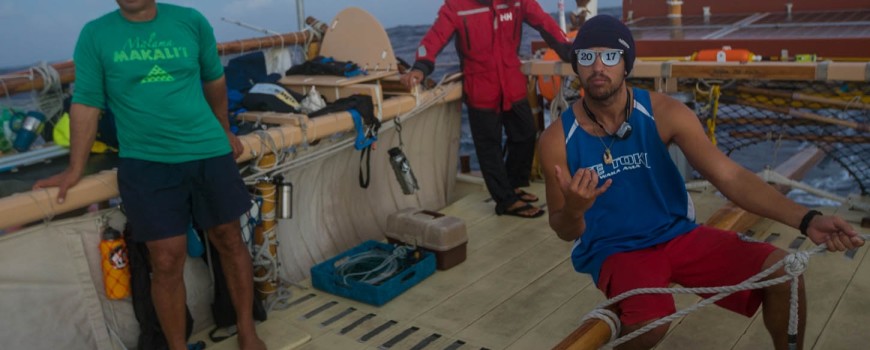
The crew was blessed with another clear night as we sailed under a moonless sky full of stars to guide our way South to Panama.  On nights like these, we lose count of the number of shooting stars we are blessed to see blazing their way across the night sky.  The wind and swells are almost directly behind us as we point just west of south in nice, comfortable 10-15 knot winds.  With the wind pushing us from behind, steering becomes a little trickier, requiring a bit more finesse so as to keep the waʻa from accidentally jibing.  This being our 10th day at sea now, this crew has become fine-tuned to the rhythm of the canoe and the touch of the hoe (steering paddle), keeping Hōkūleʻa balanced on her current course line.

As the sky begins to lighten with the anticipated arrival of the sun, my 2-6 watch hands the reigns over to the 6-10 watch, while Captain Bruce talks through various star lines with apprentice navigator, Brad Wong.  Instead of going back into my bunk to get some rest, I decide to stick around and capture some of this interaction.  As uncle Bruce continues, I canʻt help but be amazed at the vast depth of his knowledge, pointing out the faintest of stars and calling each one out by name.  It was a lecture that was so easy and enjoyable to get lost in.  Before I knew it, the horizon began to fill with the soft warm glow of an approaching sun as one by one, another star slowly faded into the brightening sky.

It truly is one of the most phenomenal things to witness at sea, especially from the lens of the photographer – the way the light and colors painted across an endless sky move and dance as the sun makes its morning climb up from the horizon, dips in and out of shape-shifting clouds, and then crawls back down below the horizon again at the end of the day.  The progression of colors and the cascading of light rays remind us that most times the simplest things in life are the ones we often take for granted, like the coming and going of the sun each day.  Yet these are often the most breathtakingly beautiful things we are blessed to witness.  It’s a beauty great enough to bring on the memory and presence of loved ones that have come and gone.  To remind us they are still here, always watching, always guiding, and in instances like these – smiling.  These simple beauties remind us how fortunate we are to be here in this moment in time, doing whatever it is that we do, with whomever we were meant to intertwine paths with, fulfilling the responsibilities we were put here to fulfill, and to enjoy and make the most of every moment of it in the process.

As another day passes aboard this waʻa kaulua, we welcome the night with a wonderful meal, the strumming of a guitar, light conversation, and a beautiful setting sun, taking us one day closer to our destination.  Our bow continues to point hema (south), and hokupaʻa (Polaris, North Star) sits behind us as we move quietly through another clear starry night to soon pull Panama from the sea.

December 31

Blog by Justyn Ah Chong

Tonight was definitely not as clear as the last few nights.  All throughout our 2am – 6am shift we were met with a series of long far-stretching squalls pelting heavy rains onto the waʻa.  Dressed head to toe in our foul weather gear we sailed on, learning how to keep on course when all the stars in the sky disappear.  The heaviest of the squalls came just after 6am after our shift change, bringing with it 30-35 knot winds, sending the canoe boosting forward.  It was a scramble on deck to readjust sails and regain control of the waʻa through the squall, but the crew managed tactfully.

This being the start of our new years eve, and also the last day of our 2016, these pelting rains, in a way, felt natural, felt right. It felt like a sort of cleansing; a washing away of the high’s and the lows, the good, the bad, and the ugly of another year gone by.  It brought about in the dark early morning hours a cool, fresh start to welcome a new year, and with it, a new energy.

Spirits amongst the crew remain high as we continue to head Hema toward Panama, sailing with beam reach winds and a beam swell on a port tack, gliding along at 6-8 knots.  Just before lunch, Kanaloa decided to bless our crew with a nice 35 lb New Years gift.  A glimmering ʻono hooked onto our line and made its way toward the waʻa as Uncle Bruce and Lohiao reeled in the catch.  Needless to say, everyone on board is stoked!

This is the last day of our 2-6 watch’s 3-day cooking rotation, so as Uncle Bruce cuts and cleans the ʻono, we gather the knives and bowls, the garlic, onions, and ginger, and start prepping for an ʻono New Years Eve lunch. On the menu is freshly sliced sashimi with wasabi-shoyu sauce and fried ʻono steaks with rice.

As we enjoy our amazingly ʻono lunch, folks can’t help but have thoughts pulled to family and loved ones back home.  As we continue to celebrate our New Years Eve on board Hōkūleʻa, we remember all those at home who are also ringing in the New Year; those that love and support us, those that allow us to be here sailing the Caribbean right now instead of being at home with each and every one of them this holiday season.  As the New Year brings about a new energy and the anticipation of new changes upon the horizon, one thing remains a solid and constant foundation – ʻohana.  Though we miss and think constantly about our loved ones and ʻohana at home, the canoe has a magical way of bringing a diverse group of individuals together and over time, over wind and waves, over the winding course of a voyage, make them family.  So today, in the absence of our family at home, we celebrate the coming of a new year with our canoe family, our ʻohana waʻa.

It’s a rare and special thing to ring in the New Year at sea aboard mama Hōkūleʻa, and for each and every one of us, we honor the privilege and the burden – the kuleana.  It’s definitely a New Year celebration that we won’t soon forget.

As the year changes, it’s clear from the look on everyone’s faces that there’s one more thing that still hasn’t changed – the kuleana of mālama honua and the mission to bring mama Hōkūleʻa back home.  Now just a few days out of Panama, we have come that much closer to bringing Hōkūleʻa back into her home waters of the Pacific Ocean; that much closer to bringing her back to our ʻohana throughout Oceania, and eventually to her birth sands of Hawaiʻi.  It’s an honor for each and every one of us on this leg of the Worldwide Voyage to wrap up our mama canoe’s travels around the globe through never-before sailed oceans, like tying up the loose ends of a fading year, and bringing her back into the waiting arms of the Pacific Ocean, full of new stories, new life, and new mana to share – just like the feeling of stepping boldly into a new year.

To all of our friends and ʻohana celebrating the New Year back at home, know that each one of us love you and miss you dearly.  But we will see each other again very soon, in the ebb and flow of a New Year.

Hauʻoli Makahiki Hou, Happy New Year 2017!


Hōkūle‘a Homecoming – Save the Date

Sign up for updates and be the first to know as we continue to detail

homecoming festivities that will include multiple events!

Hōkūleʻa Update | December 28-29, 2017

On Leg 26, Hōkūleʻa voyages south from Florida to Panama. In this update, Bob Perkins describes Hōkūleʻa’s course and winds around Cuba.

December 28

Blog by Bob Perkins

Aloha from the deck of Hōkūleʻa, and greetings from the Caribbean.  Today is Hōkūleʻa’s eighth day since dropping the mooring line in Key West.  If you look at the route we have established on the tracker, it seems we are crossing in a rather haphazard way. There is a method to the madness. florida_to_panamaHōkūleʻa’s course is dictated by the winds.  Because of the prevailing winds in this region, the leg was divided into 3 distinct sections.  The first section was from Key West to the west tip of Cuba.  We sailed this section for the first three days, as the winds were in our favor.  Once we rounded the western tip of Cuba, the wind direction was unfavorable, as we wanted to parallel the Cuban coast in order to get to the 80th Meridian before turning southerly for Panama.  Because of this, we picked up a tow from our escort vessel, Gershon II.  For the past five days or so, we have been towing, making sure to get as far east as possible before turning south.  Today, Captain Bruce, along with apprentice navigator Brad Wong, determined it was time to point our bows southerly for Panama.

So for the first time in 5 days we dropped tow and hoisted our sails! And boy did it feel great.  About an hour into sailing, we hooked up with our first fish of this voyage! A nice 7-pound aku, which Bruce reeled in.  Our science crewmember, Anuschka then measured and weighed the fish for our data collection, and then proceeded to dissect the stomach to see what it contained.  We were surprised to find so many undigested fish of all sorts of varieties.  And then, deeper into the stomach Anuschka discovered a plastic candy wrapper that seems to have been blocking the fish’s digestive system, because all the contents in the stomach after the wrapper were all fully digested.  It was a good reminder of the conditions of our oceans and the prevalence of human influence.  Also a reminder of the importance to mālama honua.

The whole crew waited in anxious anticipation as Kaniela’s watch, including Nakua and Doctor Colleen, prepared the aku for dinner.  Since the start of the voyage the watches have been rotating cooking kuleana every three days, and this was the 10-2 watch’s final night in the rotation.  They’ve become affectionately known as the Dugong Diner.  The trio proceeded to slice some of the aku up as sashimi, with wasabi shoyu sauce, while Nakua fried some of the aku meat and bones.  When all was said and done, it was a delicious meal every crewmember savored.

It feels great to be sailing again, and to add our first fish of the trip to it made it that much better.  Southward to Panama we continue.

December 29

Blog by Bob Perkins

The last 24 hours on Hōkūleʻa, in my mind, has been the type of voyaging dreams are made of.

This period of time started with us dropping tow for the first time in several days and letting the waʻa feel the wind in her sails and creating a movement with the swells much more natural and fluid than when having to be towed.  We were then able to turn our manu toward our ultimate, having reached favorable wind angles for Hōkūleʻa to deliver us to our final port in the Caribbean.  As the sun set, we were blessed with seas of rarely seen calm, mixed with winds of sufficient strength to propel us forward at estimated speeds of 5-6 knots, sometimes perhaps reaching 7.  As the final light of day disappeared, the absolute cloudless and moonless heavens provided those of us on watch with a spectacular display of nature’s pins of light cascading down and reflecting onto the almost mirror flat sea, creating a feeling of flying through a void of space with no up, no down; only a feeling of oneness with the waʻa and nothing else.  I have experienced this phenomenon very rarely in my sailing life.

As the day’s first light changed the night sky, and our fishing lures were put out, the morning routine of preparing breakfast was interrupted by the sound of “Hanapaʻa!” Fish on the line.  We were blessed with a 90-pound Marlin, which provided us with lunch and dinner for today and enough to share with our stalwart escort vessel crew on board Gershon II.

This type of day is one that makes me feel so blessed and so thankful to be a part of this special experience.  Tonight we sail through a series of small islands, then on to Panama.


Hōkūle‘a Homecoming – Save the Date

Sign up for updates and be the first to know as we continue to detail

homecoming festivities that will include multiple events!

Hōkūleʻa Update | December 26-27, 2017

On Leg 26, Hōkūleʻa voyages south from Florida to Panama. In this update, science crewmember Anuschka Faucci describes getting settled into her bunk and details some of the marine life she observes in her plankton tows.

December 26

Blog by Anuschka Faucci

It has been over a week now since we have left Miami. Everybody has been adjusting to life on the canoe at their own pace. This is my second deep-sea voyage but my first on Hōkūleʻa. It took me a few days to figure out how to make my bunk comfortable, especially how to have all the things I truly need easily accessible without them getting wet. The bathroom is another one of those things we take for granted at home, but that is different on Hōkūleʻa. It took me a few goes to find out what works best for me, even in rough sees. What has helped throughout this process is the help and advice from the more experienced crewmembers. It has been really great to see this crew, who has known each other just for a few weeks, work together from day one and fine-tune their teamwork over the last few days. We have become a true little family, helping each other out, talking story, singing together after dinner and really getting to know each other.

We are still being towed by Gershon II eastwards into the wind and waves to gain easting. The swells have been up to 15 feet high, making everything a little slower – our progress eastward, walking on the deck, brushing our teeth, cooking, and even typing this blog, as I need to close the box the laptop is in periodically so it wont get drenched in salt water as waves crash over the bow of the canoe.

As a marine biologist one of my roles on board is to record data on water quality and marine life. I am using a multiprobe device to periodically measure temperature, salinity and pH of the water. Since leaving Miami, the water surface temperature has increased from 24 to 27 degrees Celsius. Salinity has mostly been around 34 PSU and pH at around 8, values that are typical for open ocean waters. The salinity was only lower (29 PSU) in Miami at the marina where we were docked, probably due to freshwater input nearby. Tomorrow I will talk a little bit about the marine life we have been seeing floating by or in plankton tows, so stay tuned.

December 27

Blog by Anuschka Faucci

Today has been another beautiful sunny day. We are still heading eastwards against large swells. To kill some time we played a few rounds of a new waʻa balance game some of the crew came up with and are calling “Kūpaʻa.” Its our version of a waʻa makahiki game while weʻre under tow and it was just as entertaining to watch as to participate in and I suspect we will have a few more rounds in the days to come.

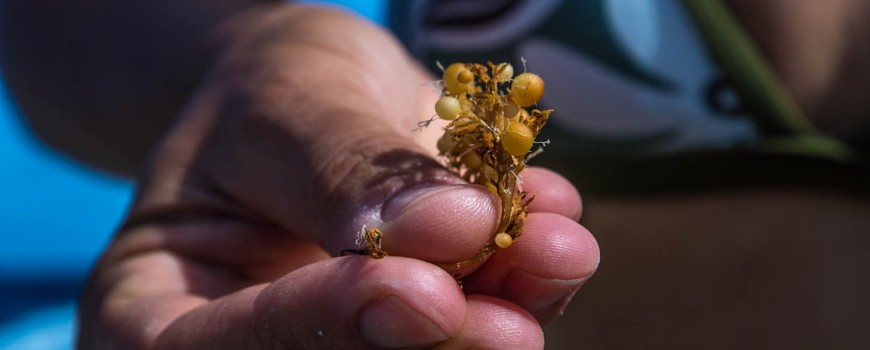
As promised yesterday, this blog will feature some marine life we have seen so far. Since we left Miami we have encountered lots of seaweeds and sea grasses floating by. Most of the seaweed consists of Sargassum (in Hawaiʻi called limu kala). Sargassum is a common seaweed worldwide and got its name from a Portuguese word for grape, describing its little grape-like structures. Those grape-like structures keep the seaweed afloat, carrying it along ocean currents. Here in the Caribbean, the main currents will carry floating Sargassum to the Gulf Stream northwards and will eventually end up in a gyre called the Sargassum Sea. The Sargassum Sea got its name from all the Sargassum that accumulates there, building a huge floating habitat for many organisms to live in.

So far I did two plankton tows with the plankton net we have aboard. This plankton net has a very fine mesh size of 80 μm to catch both, the smaller phytoplankton and the larger zooplankton. Phytoplankton is the plant-like photosynthetically active plankton that forms the base of the marine food web and produces at least 50% of oxygen on our planet. Zooplankton includes all planktonic animals, some living their whole lives as drifters in the open ocean and some only during their larval stage while living in coastal areas as adults.

The plankton tow I conducted in the marina while we were docked in Miami included some diatoms (common phytoplankton with silica skeletons), lots of copepods (shrimplike crustaceans), and a few larvae of snails, bivalves, and bristle worms. The plankton tow from the waters South of Cuba resulted in much higher diversity especially of zooplankton, including many different copepods, many larvae of coastal invertebrates such as snails, bivalves, and several different worms, as well as smaller one-celled planktonic organisms such as radiolaria, which look like little spiked balls, foraminifera, dinoflagellates, and many many more. Additionally, there were many puffs and strands of a blue-green alga called Trichodesmium, which can form large accumulations of filamentous strands, forming floating habitats for small organisms, similar to the way Sargassum does for larger ones. The difference in diversity between Miami and South of Cuba probably is due to the difference in salinity. Salinity of open ocean water is around 34-35 PSU, but lower salinities are common in coastal areas with the influx of freshwater. Only few species of plankton tolerate lower concentrations of salinity, and therefore it is no surprise that we found lower plankton diversity in Miami, where we also measured lower salinity.

Iʻm curious to see what we will discover in future plankton tows as we continue to make our way south to Panama.


Hōkūle‘a Homecoming – Save the Date

Sign up for updates and be the first to know as we continue to detail

homecoming festivities that will include multiple events!
Hōkūleʻa Update | Christmas Day 2016

From our team of crewmembers, navigators and staff here at the Polynesian Voyaging Society, we’d like to share with you a gift of hope and inspiration during this holiday season!

As we celebrate with our loved ones, crewmembers aboard Hōkūleʻa are celebrating Christmas Day at sea while in transit to Panama where they will clear customs before crossing the Panama Canal. With approximately a week to go before Hōkūleʻa reaches Panama, the crew took the opportunity to decorate the canoe with festive trimmings to get into the holiday spirit.

“Not many people get to celebrate the holidays while at sea on the deck of Hōkūleʻa during this epic around-the-world voyage,” said Hōkūleʻa captain, Bruce Blankenfeld. “As much as we’d love to be home in Hawaii with our loved ones at this time of year, we are all truly honored to be sailing Hōkūleʻa to share our Mālama Honua message with communities around the world.”

Hōkūleʻa sailed along the coast of Cuba today and will arrive in Panama around December 31st, where the crew will ring in the new year. Once she re-enters the Pacific Ocean, Hōkūleʻa will make stops in the Galapagos Islands, Rapa Nui and French Polynesia before sailing back for the celebratory homecoming at Magic Island in June of 2017.

Since departing Hawaiian waters in May 2014, Hōkūle‘a has sailed more than 28,000 nautical miles and made stops in 15 countries and approximately 150 ports. Here’s to their safe return and to you and yours during this holiday season!

Me ke aloha,
Polynesian Voyaging Society ʻohana


Hōkūle‘a Homecoming – Save the Date

Sign up for updates and be the first to know as we continue to detail

homecoming festivities that will include multiple events!