Crew Blog | Kālepa Baybayan: Aloha to Leg 22

Aloha,

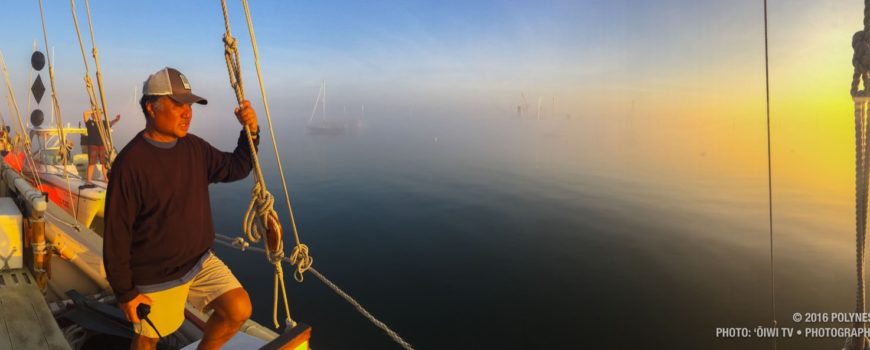
I would like to take this opportunity to thank all members of Legs 22; we made it to our final destination safely, withouth mishap, and everyones health intact. Part 1 of Leg 22 took us from Mt. Desert Island to Yarmouth in Nova Scotia, Canada.

Leg 22, Part 1: Maine to Nova Scotia
Nainoa Thompson, Captain
Kālepa Baybayan
Keala Kimura
Lehua Kamalu
Jenna Ishii
Tamiko Fernillius
Zane Havens
Niko Powell
Kaʻai McAfee-Torco
Nāʻālehu Anthony
Rick Kilbride, Escort Boat Captain

It was a busy sail getting Hōkūleʻa back to New Jersey from Maine for the crew of Part 2 of Leg 22, having to time safe weather windows for transiting the Northeastern seaboard. We made stops in Boothbay, Maine; Salem and Cape Cod, Massachusetts; Newport, Rhode Island; Oyster Bay, New York; with final arrival at Newport Marina, Jersey City, New Jersey.

Leg 22, Part 2: Maine to New Jersey
Kālepa Baybayn, Captain
Keala Kimura, Escort Boat Captain
Art Harris, Navigator and Pilot
Nāʻālehu Anthony
Timi Gilliom
Tamiko Fernillius
Zane Havens
Nakua Konohia-Lind
Niko Powell
Hina Keala
Kala Thomas
Hye Jung Kim
Trissy Chun
Kaʻai McAfee-Torco, Land Waʻa Captain

We could not have done it without the amazing help from Polynesian Voyaging Society staff Heidi Guth, Ramona Ontiveros, and Mikiala Akiona. Once again, it was an honor and a privilege to serve on the Mālama Honua Worldwide Voyage with each of you.

Mahalo,
Kālepa


Help fund the Voyage as we sail the East Coast

Hōkūle‘a’s visit to the eastern United States is a historic milestone in her 40 years of voyaging.

Celebrate with us by pledging your support to the Mālama Honua Worldwide Voyage.
Continue Reading

Hōkūleʻa passes by Stellwagen Bank National Marine Sanctuary

As Hōkūleʻa and her crew sailed through the waters off Massachusetts on their way up and down the New England coastline, they touched waters home to New England’s only National Marine Sanctuary and famed home of the North Atlantic Humpback Whale, Stellwagen Bank National Marine Sanctuary.

Stellwagen map

Stellwagen Bank National Marine Sanctuary

The Gerry E. Studds Stellwagen Bank National Marine Sanctuary (http://stellwagen.noaa.gov/) is one of 13 sites managed under the National Marine Sanctuary Program, and is the only Sanctuary of New England. The Sanctuary program is run by the National Ocean Service of the National Oceanic and Atmospheric Administration (NOAA). Other widely recognized NOAA services are the National Weather Service and the National Marine Fisheries Service.

Stellwagen Bank National Marine Sanctuary (SBNMS) sits at the mouth of Massachusetts Bay, between Cape Ann and Cape Cod. It is the only Sanctuary of New England, and home of NOAA’s “Get in Your Sanctuary Day” national campaign this summer (http://sanctuaries.noaa.gov/visit/giys.html).

The sanctuary is an 842-square-mile (638-square-nautical-mile) marine protected area at the mouth of Massachusetts Bay. It encompasses all of Stellwagen and Tillies Banks, and the southern portion of Jeffreys Ledge. Stellwagen Bank is an important feature in the area. It is an underwater plateau at the mouth of Massachusetts Bay, formed by the sand, gravel and rock left behind as the ice sheets of the last Great Ice Age retreated. It is thought that 12,000 years ago Stellwagen Bank was actually above sea level, but as sea level rose and the glaciers continued to melt, the bank gradually submerged beneath the sea.

The mission of the Sanctuary is to conserve, protect and enhance the biological diversity, ecological integrity and cultural legacy of the sanctuary while facilitating compatible use. For centuries, Stellwagen Bank has served as a rich and productive fishing ground for groundfish species like cod, haddock and flounder, as well as giant Atlantic bluefin tuna and large schools of herring. During the past 50 years, the area gained fame as a whale watching destination – there are consistent sightings of the active behaviors of some of the largest animals on the planet here. Stellwagen Bank National Marine Sanctuary was recently voted Best Place to See Aquatic Life in USA Today, but has long served as a research and study area to protect the endangered humpback whale. In certain cases, four generations of whales have been documented in SBNMS!

After reading all about the Stellwagen Bank National Marine Sanctuary, test your memory with this quiz! http://stellwagen.noaa.gov/about/quiz.html

Humpback whales are long-distance migrants but return over and over again to the same feeding and birthing waters. Long–term research shows that individuals spend the summer and fall in the rich feeding grounds of Stellwagen Bank National Marine Sanctuary (SBNMS), and then in late fall migrate some 1,500 miles south to the warmer waters of the Caribbean to mate and give birth to their young. This pattern of migration from north to south and back again is followed by humpback families across Island Earth.

humpback whales

Image accessed from: http://www.oneworldoneocean.com/blog/entry/infographic_humpback_whales_around_the_world)

The North Atlantic and other humpback whales are cousins to the humpbacks we see annually in Hawaiʻi. Learn more about our own Hawaiian Islands Humpback Whale National Marine Sanctuary by visiting their site (http://hawaiihumpbackwhale.noaa.gov/) and downloading resources such as this great activity book for students (http://hawaiihumpbackwhale.noaa.gov/documents/pdfs_activity_books/activity_book_2010.pdf), or visit other exciting organization sites to learn more about Humpback whales such as http://www.oneworldoneocean.com/. For more information about visiting a National Marine Sanctuary near you, or to explore the Sanctuaries virtually, click here: http://sanctuaries.noaa.gov/visit/

TEACHER TIP:
Did you know that visiting sites like NOAA.gov can yield a wealth of classroom resources and ideas for lessons? We tried it using the search terms “humpback”, “whale”, “activity”, and “book” – and look what we found! https://search.usa.gov/search?utf8=%E2%9C%93&affiliate=noaa.gov&query=humpback+whale+activity+book


Ready to try out any of these lessons or resources? Email us at education@pvshawaii.org to share with us what you do with this content – we would love to see pictures and student reflections that we can share on social media and our website!

Doing another kind of project to mālama your community? Share Your Mālama Honua Story with us!

Are your students still in the beginning stages of identifying a problem they would like to try and solve? Don’t forget to check out the Mālama Honua Challenge and share your ideas about work that can be done in the future!

Continue Reading

Classroom Connections | The Bay of Fundy and Tidal Range

DJI_0112

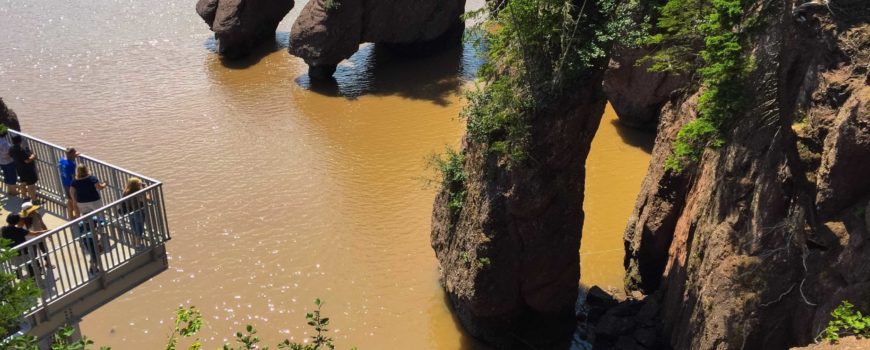
Hōkūleʻa was in the Bay of Fundy, Nova Scotia this week! The Bay of Fundy is known for having one of the most extreme tidal ranges in the world. Hawaiʻi, on the other hand, is known for having one of the least extreme. Tides actually provide a great opportunity for teachers to integrate different subject areas using a project or place-based approach. Tides can be used to explore concepts in math and science through the study of the gravitational relationship between the Moon and the Earth, or the biological diversity of a tide pool ecosystem. Tides also provide an opportunity to explore concepts in geography, due to the large impact coastal geography and location on the Earth have on the tides.

fishpond_maggiepulverfishpond2_maggiepulverTides also play a significant role in many indigenous coastal cultures, including Hawaiian culture. Teachers in Hawai’i can schedule field trips with organizations like ʻAoʻao O Na loko Iʻa O Maui (Maui Fishponds Association), Paepae ʻo Heʻeia, Waikalua Loko Iʻa, and Hui Mālama Loko Iʻa, to visit fishponds and learn about the knowledge and skills of the Hawaiian farmers in designing and maintaining fishponds that used tidal phenomena to their advantage. Classes in Hawaiʻi can also work with organizations like Mālama Maunalua and Mālama O Puna that engage community members in the restoration and conservation of local tidal ecosystems while also educating them to the stories of the place.

For teachers who are not able to take their students to places where tidal phenomena can be observed, like the Bay of Fundy or a Hawaiian fishpond, the online lesson Gravity and Tides, published by Carolina Curriculum, provides a good framework for studying tides in the classroom. The lesson can also be used to explore geography by comparing the tidal range in different places. Search engines like Google provide students with the opportunity to search the internet for daily tide information, and nearly anything else, for any place on Earth. The possibilities are endless.

You might also want to check out this awesome resource from the Exploring our Fluid Earth program published by the Curriculum Research Development Group (CRDG) at the University of Hawaiʻi at Mānoa, that provides a full and comprehensive physical science unit on tides.


Ready to try out any of these lessons or resources? Email us at education@pvshawaii.org to share with us what you do with this content – we would love to see pictures and student reflections that we can share on social media and our website!

Doing another kind of project to mālama your community? Share Your Mālama Honua Story with us!

Are your students still in the beginning stages of identifying a problem they would like to try and solve? Don’t forget to check out the Mālama Honua Challenge and share your ideas about work that can be done in the future!

Continue Reading

Crew Blog | Maya Saffery: Everyday Acts of Aloha ʻĀina

Aloha ʻāina is love for the ʻāina (land), love for your kūpuna (ancestors), love for your culture, love for your lāhui (people, nation). But it is more than a feeling or a belief. Aloha ʻāina needs to be acted upon and practiced over and over in different spaces and contexts so that we are constantly reminding ourselves and others that we as ʻŌiwi (Indigenous peoples) have been here, are still here, and will always be here caring for our places, peoples, practices, languages, and knowledge systems. Aloha ʻāina can reveal itself through large-scale movements but also through everyday acts by individuals and communities that may appear on the surface to be small or insignificant but can in fact have huge impacts on the healing, revitalization, and resurgence of a community.

At its core, I see Hōkūleʻa’s Mālama Honua Worldwide Voyage as a way for us to seek out, recognize, and highlight everyday acts of aloha ʻāina happening in communities around the world so that we can celebrate these actions and find strength in each other’s challenges and triumphs, which will in turn inspire us to continue to practice aloha ʻāina with our own people and places when we return home to Hawaiʻi.

From the moment Hōkūleʻa arrived in Pemetic (Mt. Desert Island), everyday acts of aloha ʻāina were visible all around us. We were greeted on the water by several ah qwee den (traditional birch bark canoes) made and paddled by Wabanaki (or Waponahki), the First Peoples of this place who have been traveling these waterways for generations and are still paddling their canoes on these ancestral routes today. Once Hōkūleʻa was safely tied to the dock, we called out in our Native language to our Wabanaki hosts, introducing ourselves and asking their permission to disembark and come ashore. On the gravel ground of the boatyard surrounded by warehouses, woodworking shops, and boat trailers, we created a ceremonial space where we could share prayers, speeches, songs, and dances in Hawaiian and Algonquin languages that honor this historic coming together of our peoples as well as express our sincere mahalo to all those who have worked so hard to host us in their community.

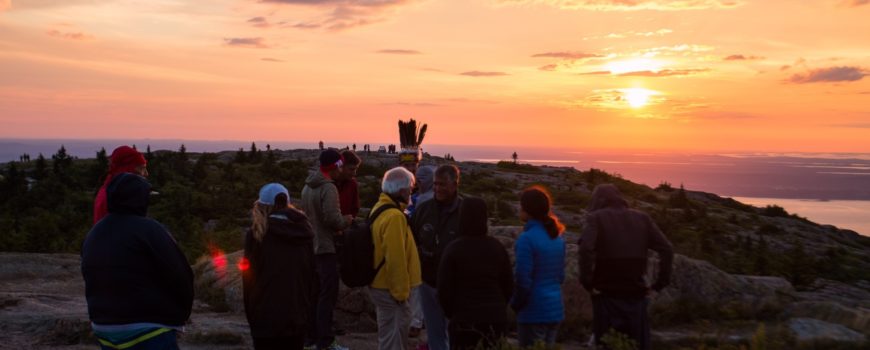
The next day, we were honored to participate in a sunrise ceremony on the sacred mountain of Wapuwoc (Cadillac Mountain) where Wabanaki (“the people of the dawn”) and Hawaiian prayers, songs, dances and genealogies were offered side by side, each of us honoring and remembering our own kūpuna who have passed but are still with us today. The following day, we were invited to Indian Island, the reservation for the Penobscot Nation, which is a part of the Wabanaki Confederacy. Unlike most of our interactions with the Wabanaki up until that point, there were no ceremonies, no formal speeches, no set programming. But, for me, some of the most moving and impactful acts of aloha ʻāina during Leg 21 were shared and witnessed that day.

While at the Penobscot reservation, we shared a potluck meal with our hosts – one of the most important everyday acts of aloha ʻāina one can do: share a meal together and talk story. What struck me most about that evening was that during the pāʻina (meal), tribal members, mostly youth, would spontaneously come together to drum and sing. There was no program, no introduction, no microphone and speakers, no chairs lined up for an audience to sit and watch. It was just a bunch of ʻŌiwi coming together to drum and sing together while their families and community talked, ate, and laughed together. It felt so normal, like they do this everyday. And even more amazing was that as they drummed and sang, people would just get up to dance around them. From toddlers with grandmothers to teenagers with their friends, there was no shame, no pleading from the drummers to get people to come up and dance. Everyone just wanted to dance together.

This dancing seemed natural for them, but for me it was a unique interaction to witness. I saw it as a time for them to express their identity as Penobscot. No one was staring, gawking, or videotaping. They could practice their culture in a safe place. They created an environment for their children where they can grow up being proud of being Penobscot and expressing that identity through song and dance. By simply drumming, singing, and dancing together they were proclaiming as Wabanaki without hesitation that they, the people of the dawn, are not only surviving but thriving.

While this experience may not have stood out to some, I cannot help but be aware of how other ʻŌiwi express themselves through their songs and dances because that is how I express and practice my aloha ʻāina as a Kanaka (Hawaiian person). As a practitioner of traditional hula, I am constantly mindful of how I can move away from the “performance” of hula where our dances and songs become objects for display and consumption and instead move towards the “practice” of hula as a lifestyle and expression of aloha ʻāina. Ceremony is certainly part of this shift, but it is also through informal, social expressions like the one I witnessed and participated in at Indian Island that help us to truly live our aloha ʻāina through song and dance.

I will definitely take the memory and lessons of that evening back home with me: one person at a time, one family at a time, one community at a time. That is how aloha ʻāina is collectivized and raises the consciousness of a people so that they are inspired to act and bring about large-scale, positive change for their communities.

The only way I really knew how to mahalo our Penobscot hosts that evening was to affirm their aloha ʻāina actions through a mele aloha ʻāina from my kūpuna to say to them, ‘I recognize what you folks are doing and I honor your love for your land, culture, and people.’ Here is part of the mele that I offered:

ʻUmia ke aloha i paʻa i loko
No ke one ʻōiwi ou e Hawaiʻi
ʻEha ai ka ʻili o kūpuna,
ʻO Keawe, ʻo Kalani-ʻĪ-a-Mamao
Ka hua i ka umauma mailani ʻia,
Pāpahi ʻia ke aloha ʻāina

Persist in your deeply held love
For your native sands, O Hawaiʻi
Where the legacy of your kūpuna has been violated
That of Keawe and Kalaninuiʻīamamao
The watchword of the chiefly heart is this:
Wreath yourself in Aloha ʻĀina
(Words by Liliʻuokalani. Translation by Kīhei de Silva)


Help fund the Voyage as we sail the East Coast

Hōkūle‘a’s visit to the eastern United States is a historic milestone in her 40 years of voyaging.

Celebrate with us by pledging your support to the Mālama Honua Worldwide Voyage.
Crew Blog | Michelle Knoetgen: An Island Repurposed

One of the stops on Leg 21 of the Worldwide Voyage, Hurricane Island has been called a “ghost island” because, one day in 1914, an entire community of rock quarry workers evacuated, and not due to a violent storm. They dropped their tools, packed only necessities, left dining tables set and work unfinished, and were ferried to the mainland before ferry service halted altogether. This wasn’t the island’s first or the last abandonment, though it might have been the most abrupt.

Today, clam and mussel shell middens hidden by trees and bushes remind us of the first peoples on Hurricane – a nearly forgotten Native American presence. Massive granite blocks line the shores, striking mementos of Hurricane’s quarry days around the turn of the nineteenth century. If those rocks could talk, they might explain some of the mystery of this place. Rustic cabins are built on the granite foundations the stonecutters left behind. A ropes course, along with tent platforms, a dining hall, and a large boathouse remain from Hurricane Island Outward Bound School, which was based out of the island from 1964-2006. The island’s current caretakers are members of The Hurricane Island Foundation (HIF), a non-profit that runs a Center for Science and Leadership and a Field Research Station. This is the organization that drew us here.

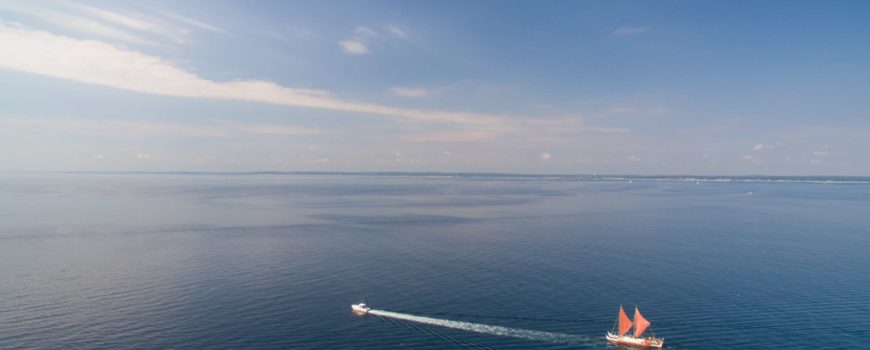
Hōkūle‘a sailed gracefully into Penobscot Bay and sat secured to a mooring ball just off of Hurricane Island for a two-night stop. We came to learn and to be inspired: Hōkūle‘a’s crew sails around the world looking for navigators in environmental stewardship, intending to build relationships with individuals and communities who are on a sustainable sail plan.

As we know, many islands across the planet are dependent on outside sources for food and power, but charged by solar, HIF is completely off-the-grid. The Hurricane Island folks are making the lightest human impact possible by growing some of their own food,, composting, and re-purposing waste. The facilities systems are all regenerative: gray water and black water are recycled; solid human waste is separated as fertilizer for non-edible plants. The instructors teach and practice a cyclical, rather than linear, method of dealing with waste.

Hurricane Island is now a respite for professionals in fields of sustainability and experiential learning looking to recharge and refocus on why they do the work they do. While we were there, the executive team of the Nature Conservancy was having a leadership retreat, along with passionate people from Outward Bound, The Apprenticeshop, Breaktheanchor, and Courage Earth.

The island has hands-on summer learning opportunities for middle, high school, undergraduate and graduate research in marine and island ecology. The crew met with high school students in the marine ecology program and the students shared their observations of seals and hermit crabs. One group of students took samples of the various types of sea kelp on the island, documenting which ones were edible and which ones dominated certain parts of the inter-tidal zone. Students were excited to learn from the island classroom: they spent almost all day outside, and were even able to learn from some of our navigators under the stars at night.

The simplicity of life on the island reminds me of a quote by author John Ruskin: “Each increased possession loads us with a new weariness.” Here, spirits are lifted by the simple joys of foraging for wild raspberries and beach peas, and jumping into the refreshing 56-degree ocean water every day, a brisk reminder that we’re alive.

Three of the young people that I got to know, Michelle, Bailey, and Jessie, are unlike most young adults in that they’re not tethered to their phones. They’re happy to spend the summer in platform tents, collecting data for scientific research. Jessie and Bailey are studying the health of the scallop population through underwater field research, scallop collections, and lots of measurements. Michelle is an ecologist who led us on a naturalist hike around the island. They all sail and are intrigued by Hōkūle‘a, both the mission and the lifestyle.

Our whole crew was impressed by the way HIF uses the island as a laboratory and an example for sustainable living. The Hurricane Island Center for Science and Leadership, under the direction of Sam Hallowell, is leaving the island better even than they found it; not leaving a trail of plastic debris and waste from overuse in their wake, as unfortunately many communities produce. I overheard my crewmate Kaleo Wong say, “Hurricane Island is all about mālama honua! They’re doing it! That’s what this whole voyage is about. Going to these places around the world and seeing what each individual community is doing to care for their home. Collectively these actions of individual communities add to a better earth.”


Help fund the Voyage as we sail the East Coast

Hōkūle‘a’s visit to the eastern United States is a historic milestone in her 40 years of voyaging.

Celebrate with us by pledging your support to the Mālama Honua Worldwide Voyage.

Waimea Valley Native Forest Restoration Project

Written by Kailee Jackson, member of Nā Kelamoku

April 30, 2016 and July 10, 2016

Nā Kelamoku, Polynesian Voyaging Society’s Youth Leadership Initiative, participated in Waimea Valley’s Native Forest Restoration Project on July 10, as a follow up to an initial collaborative work day on April 30.

April 30

On the morning of April 30, North Shore community members, Nā Kelamoku, and other volunteers met at the Waimea Valley Botanical Garden. Several Waimea Valley employees led us through morning protocol so that we could enter the valley and work safely throughout the day. After protocol, our group hiked up the Kalaheʻe Ridge to plant trees as part of the Waimea Valley’s ongoing reforestation effort.

The hike up took many turns and changed terrain multiple times. The different terrains included a muddy, rocky ground with tall trees covering the path and a dry, open path with no trees. Eventually we reached the top where the Waimea Valley conservationists spoke about which plants we would be planting and how to plant them properly. The plants we were planting were a’ali’i, koa, and nau paka ua hiwi. After planting, we would water them once and then the plants have to depend on the environment to grow. Because we were so high up and there weren’t too many trees where we were planting, these new transplants had to be securely planted so they could withstand the strong winds and stay rooted. So we were taught to hold the plant by its stem and tightly pack in dirt around the plant so the plant was secure and so the bottom of the plant did not J-curl. J-curling prevents the roots from getting a good hold in the ground, so the plant could be blown away. After about an hour of working, we finished planting 200 koa trees and aʻaliʻi.

Feeling satisfied with our hard work, the conservationists led us to a shaded spot that overlooked Haleiwa and Wailua. We sat, rested, ate our lunches, and talked story with the other volunteers and the conservationists. Eventually we hiked back down and said our goodbyes and thank yous to our group’s leaders and the other volunteers in the group. We all felt a sense of pride and pleasure knowing our hard work would always rest in Waimea Valley.

July 10

    After visiting Waimea Valley and helping with the reforesting of natives, I was so happy when they asked Nā Kelamoku to come back and work in the valley again. For this second trip on July 10 into the valley, we cleared a section of invasive species so native plants could be planted there instead. One of the main trees that we removed were strawberry guava. Parker, one of the conservationists who led our group, mentioned that  the strawberry guava consumes a lot of water from the aquifer.

It was hard, tiring work in the scorching sun all day, but at the end of the day, we all felt so accomplished. The thick, tangled section of land looked impossible to clear at the beginning of the day, but with all of our hard work, we were able to do it. Looking at the cleared patch where all the invasive plants once were, I felt a sense of pride. Now native trees could be planted and they would thrive there for years to come. Helping in the valley is such a great feeling because you know your hard work will be there forever. You feel like you really made an impact, even if it was just clearing a small section of land of invasive plants. We hope to continue volunteering with the Waimea Valley Hiʻipaka LLC and learning more each time we visit.

Click here for more information on Waimea Valley’s Conservation efforts or contact Laurent Pool LPool@waimeavalley.net.

Protecting Coasts, from the Pacific to the Chesapeake

As Hōkūleʻa sailed up the Chesapeake Bay this week learning about coastal issues and efforts to preserve unique maritime cultures along the East Coast, back home in Hawai‘i scientists, policy makers and planners were simultaneously coming together to protect Hawai‘i’s coastline. On Tuesday, May 10th, the Interagency Climate Adaptation Committee (ICAC) held their quarterly meeting at the Old Archives Building next to the ‘Iolani Palace in Honolulu. The ICAC is the first committee of its kind in the state, established by the Hawai‘i State Legislature in 2014 in recognition of the threats that climate change poses to Hawai‘i. The committee’s first order of business is assessing and addressing sea level rise and associated impacts to the coastal areas of the state such as coastal erosion and groundwater inundation.

At this meeting, committee members from agencies such as the Department of Health, the Department of Transportation, and County Department of Planning Offices, among others, discussed the Sea Level Rise Vulnerability Assessment and Adaptation Report in progress, which will serve as a foundation for addressing sea level rise in the state. Dr. Chip Fletcher, whose research group at the University of Hawaiʻi at Mānoa School of Ocean and Earth Sciences is preparing the sea level rise modeling for the assessment, showed a short animation of sea level rise projections for the island of Oʻahu by 2100 – a preview of what’s to come.

The committee was also briefed on Hōkūleʻa ’s current visit to the Chesapeake Bay area and the coastal erosion that crewmembers were learning about there. The crew learned about the “hot spot” of subsidence along the East Coast between North Carolina and Massachusetts that is causing the offshore and nearshore the land to sink below sea level at a faster rate than other areas due to multiple geologic factors. Pwo navigators and Captains Nainoa Thompson and Kālepa Babayan joined students and representatives of local government and community organizations in a discussion about causes of erosion and how to protect our environment.

ICAC Committee members felt solidarity with the coastal communities of the Atlantic seashore in protecting our unique, ocean-tied cultures and sent their aloha across time zones.

More information about sea level rise and climate adaptation work in Hawaiʻi can be found on the Climate Adaptation Portal at climateadaptation.hawaii.gov


More than Adventure

Beyond a daring expedition, the Worldwide Voyage is quite possibly the most important mission that Hawaiʻi has ever attempted. As people of Oceania, we are leading a campaign that gives voice to our ocean and planet by highlighting innovative solutions practiced by cultures around the planet.

We could not have begun this great journey without your support, nor can we continue to its completion.

Voyaging-Themed Curriculum Guide Created Connecting Virginia and Polynesia

IMG_2022In celebration of Hōkūleʻa and her voyage to the East Coast, one of our leading East Coast education partners, The Mariners’ Museum, worked with PVS and local Virginia educators to create an educational guide, called Voyage Across The Sea: Exploring Connections Between Virginia and Polynesia – A Curriculum Guide, for use in classrooms that are aligned with the Virginia Standards of Learning.

The curriculum guide contains a series of activities and resources designed to help educators bring Hōkūleʻa, mālama honua, into the classroom. These activities serve as a way to further explore the connections between the Pacific Islands and the Commonwealth.

The Mariners’ Museum and Park, located in Newport News, Virginia, makes a difference in peoples’ lives, inviting them to discover their relationship to the sea by exploring maritime culture, science and history. The Mariners’ Museum is committed to using its art and artifacts to educate local, national and international audiences of all ages about the vital role of the sea in mankind’s development. The Museum aspires to be the leader in promoting an appreciation of the maritime world – past, present and future. Visit http://www.marinersmuseum.org/ for more information.


More than Adventure

Beyond a daring expedition, the Worldwide Voyage is quite possibly the most important mission that Hawaiʻi has ever attempted. As people of Oceania, we are leading a campaign that gives voice to our ocean and planet by highlighting innovative solutions practiced by cultures around the planet.

We could not have begun this great journey without your support, nor can we continue to its completion.

Continue Reading