Hōkūleʻa in Cape Town: A Celebration of Friendship

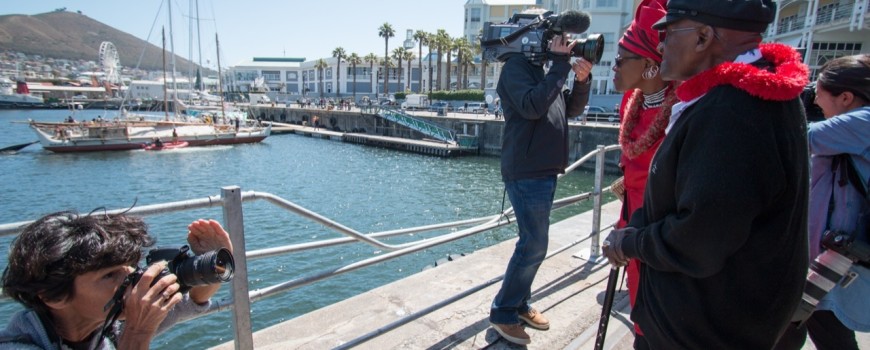
A Ceremony of Friendship was held today at 2 p.m. South Africa Time (2 a.m. Hawaii Standard Time) at the V&A Marina to officially welcome and celebrate the historic arrival of Hōkūleʻa to Cape Town, South Africa. Themed Crossing Oceans & Connecting People, Hawaii To Cape Town, the Ceremony of Friendship featured greeting chants and a prayer of blessing followed by traditional South African performances and hula by members of the Hawaii delegation. Words of welcome and unity were made Mpho Tutu, executive director of the Desmond & Leah Tutu Legacy Foundation, US Ambassador Patrick H. Gaspard of the US Embassy in South Africa, pwo navigators Nainoa Thompson and Kālepa Baybayan, a representative of the Executive Mayor of the City of Cape Town, and Hōkūleʻa supporter Pam Omidyar. Global peace leader Archbishop Desmond Tutu, who sailed on Hōkūleʻa during his 2012 visit to Hawaii, also attended the ceremony to greet and engage with crewmembers and the Hawaii delegation.

Following the Ceremony of Friendship, Hōkūle‘a crew and the Hawai‘i delegation invited families and members of the Cape Town community to come aboard the canoe, meet the voyagers from Hawai‘i, hear about traditional navigation and Hawaiian culture, and learn about ways to care for the ocean.


Please help keep us sailing for future generations. All contributions make a difference for our voyage. Mahalo nui loa!

iSimangaliso Wetland Park

While in Richards Bay South Africa the Hōkūleʻa crew visited iSimangaliso Wetland Park. Designated a UNESCO World Heritage site in 1999, the 820,400-acre park comprises diverse ecosystems that are also of great significance to the native people. As the first landfall in Africa, the crew took this time to honor the indigenous community of the area.

Hōkūleʻa crewmember Billy Richards said, “Why was it necessary to pay respect to the people of this land, well because we are visitors and we expect no less from others who come to our land, it’s mutual. The respect must be mutual. For us it was our opportunity to express to them our intent is positive and it is full of aloha.”

Zulu tribal elders accompanied the crew on a tour of the park and invited them to share in their culture.

Richards said, “It was very nice to be able to share this with the elders and the people of the area that came with us. One of the great things about today was to be able to exchange with other peoples who are bringing back their culture as much as they can and regaining control over their ʻāina, land. You know it’s important that we understand each other and how we both share the same sort of cultural values that tie us to our land.”

Mandisa Nkosi, an intern at iSimangaliso Wetland Park, said, “Within the park there’s lots of diversity. Now we are having tourist who come in to see the nature, the biodiversity and all that. We have many different species. We have the oceans, we have the lake, we have the inland animals. All the stuff like that it’s a kind of diverse area. It’s very special in a way to people who love nature and appreciate it.”

Richards said, “They were given the land back and what they’ve done now is that they’ve taken the cattle off and they’re trying to they’re recreating what was there in the past: the grasslands, bringing in the animals that use to reside there. We saw rhinos, we saw hippopotamuses, we saw crocs, crocodiles, horned animals, baboons, monkeys and all of the above.”

Nkosi said, “The organization strives to to to keep everything in this area at its natural state, to conserve it for people to see how the area is. Even an ant is just as important as a lion as important as an elephant. Every animal has its role in the ecosystem, in the food chain and stuff like that so it’s very important to us that we take care of the environment and we conserve for future generations.”

Richards said, “The important thing for us to do as we go around the world is to recognize people who are doing good for the earth. And they are, and that’s one of the wonderful things about what happened today was to be able to view that.”

To follow Hōkūleʻa and her crew as they travel the world to connect with communities and spread the message of mālama honua, visit Hokulea.com


Please help keep us sailing for future generations. All contributions make a difference for our voyage. Mahalo nui loa!

Crew Blog | Kālepa Baybayan: Simon’s Town, 34˚ 11’ S, 18˚ 26’ E

In this Mediterranean-like climate sits the coastal port of Simons Town, nestled along a rocky mountainous landscape. To the east and west, steep ridges plunge pecariously into deep water. Simons Town is located in False Bay; not a very large harbor, but home for the South African Navy. We arrived on Tuesday evening after an overnight sail from Mossel Bay, and intend on spending another evening in this idyllic port before pushing off to Cape Town.  That final 60-nautical mile jaunt will bring this portion of the Mālama Honua Worldwide Voyage to a close.

So far on our South African journey we have visited the ocean-side ports of Richards Bay, Durban, Port Elizabeth, Mossel Bay, and Simon’s Town. They say you can go through four seasons of weather in one day here in South Africa, something which the crew of Hōkūle’a have experienced. Sunny mornings, hail in the afternoon, brilliant sunsets, and 30˚ nights, all in one day. The weather systems here, like the African continent, loom large and ominous, clouds quickly forming on the horizon and enveloping the canoe in a misty fog.

DCIM100MEDIADJI_0641.JPG

One of the most beautiful things that the voyagers have experienced is the nightly luminescence that radiates across the sea and emerges in the wake of the canoe, it is stunning to behold.

Undoubtedly, the most historic stop to this point has been our visit to the Pinnacle Point caves in Mossel Bay. In coastal bushlands and shoreline caves, the earliest Homo sapien population, speculated to be from a pool of only 400 humans, held residence. It is from this tiny pool of homo sapiens that all humans are reported to descend. Some 200,000  years ago homo sapiens emerged in east Africa, residing there for a short while until a cataclysmic climate event occurred – the earth re-entered into it’s cyclical ice age – that expanded the Sahara desert exponentially, turning once fertile wetlands arid. This event sealed off Africa from northward human migration, forcing Homo sapiens to search southward for a warmer climate, which they eventually found in the more temperate environment on the edge of the southern shores of Africa. Here they spent the next 70,000 years living in the South African bushlands and shoreline caves, developing the human traits that make the Pinnacle Point Caves in Mossel Bay the Cradle of Human Culture.

DCIM100MEDIADJI_0659.JPG

Fed by a nutrient-rich diet of omega-3s from the abundant supply of shellfish found in the rich shoreline resources of the South African coast, this brain “fertilizer” assisted in language development, art in the form of personal adornment and rock wall paintings, and heat-treated stone tool shaping of fine spear points used in hunting expeditions. Here in this environmental “Shangri-la”, the beginnings of human culture took shape. Eventually, when the world warmed, these Homo sapiens worked their way northwards, settling Europe, Asia, and the Americas. Some 60,000 years ago, these Homo sapien explorers eventually emerged on the edge of the great ocean that spread eastward from Southeast Asia, thus beginning the last chapter of the great human odyssey, the exploration of Oceania.

IMG_5678

They quickly learned how to construct robust and durable craft capable of deep sea exploration. Equipped with sails of plaited leaves and lashed together with cordage of plant fiber, they become highly skilled mariners. They were attuned to their environment, fast observers and learners, and from practice and experimentation they created a system of orientation and direction-finding. They bravely sailed away from the safety of shorelines to explore new horizons and discover the stars. They were the worlds best navigators…. and I am descended from them.

IMG_7764

Along the longitudinal antipode of the Pinnacle Point caves in South Africa is the Marine Education & Training Center (METC) in Honolulu’s Keehi Lagoon, home of Hōkūleʻa. In this story of the great human odyssey that begins with the first human migration northward out of the Pinnacle Point caves in South Africa 120,000 years ago and closes with the final chapter of the great human exploration of the world in Hawaiʻi 1,200 years ago, it is appropriate that we Hawaiians – children of the first human explorers to venture forward out of South Africa – come full circle, and embrace our South African ancestors.  

IMG_5670

We are in essence, all brothers and sisters, coming from the same source of life, and from the same curious species.

As we prepare for the final leg of our journey it has been a rare privilege and honor to have shared my time with this group of excellent humans and Homo sapiens, I am honored to call you all my friends:

  1. Nainoa Thompson
  2. Billy Richards
  3. Archie Kalepa, Southern Ocean Bald Eagles Club*
  4. Keahi Omai, Southern Ocean Bald Eagles Club
  5. Timi Gilliom, Southern Ocean Bald Eagles Club
  6. Lehua Kamalu
  7. Nikki Kamalu
  8. Tamiko Fernelius
  9. Carolyn Annerud
  10. Sam Kapoi, Southern Ocean Bald Eagles Club
  11. Kaimana Barcarse
  12. Daniel Lin
  13. Derek Ferrar
  14. and my friend Max Yarawamai, Southern Ocean Bald Eagles Club

Signing off from South Africa,
Kālepa

**The Southern Ocean Bald Eagles Club is made up of hairless crew mates Sam Kapoi, Keahi Omai, Timi Gilliom, Archie Kālepa, and recent addition, Max Yarawamai. Max made a appointment for me to get my head shaved in Durban, but I politely refused the invitation. My partial bald spot at the back of my head should be considered as a qualifying condition.


Please help keep us sailing for future generations. All contributions make a difference for our voyage. Mahalo nui loa!
Continue Reading

Hōkūleʻa Update | November 5, 2015

Hōkuleʻa arrives in Mossel Bay along the southern coast of South Africa. Known as the historical capital of the world, archaeological findings show that Mossel Bay and the Pinnacle Point Caves may be the home grounds from which all modern man descended. Researchers believe humans who inhabited the area between 170,000 and 40,000 years ago became the lone surviving human inhabitants of the earth living off a diet of shellfish, fish and wild plants, forming the ancestral part for all humanity.  


Please help keep us sailing for future generations. All contributions make a difference for our voyage. Mahalo nui loa!

Continue Reading

Hikianalia Update | November 4, 2015

Aloha mai kākou, good morning! We are here on board Hikianalia en route to Kahana Bay from Moku o Loʻe, Kāneʻohe Bay, and we are sailing along beautifully this morning. We should get to Kahana in about half an hour or so and get to spend some time with the community today and tonight, get to share a little bit about mālama honua and the Worldwide Voyage, and spend some time with the people there. Itʻs been a beautiful sail with an awesome crew. Hikianalia is on a statewide tour right now, and we willb e visiting every island and many ports, so please continue to follow us on Hokulea.com. 


Please help keep us sailing for future generations. All contributions make a difference for our voyage. Mahalo nui loa!

Hōkūleʻa Update | November 3, 2015

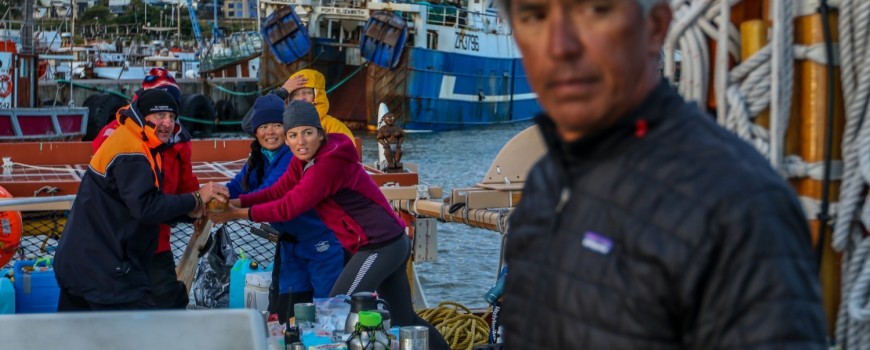
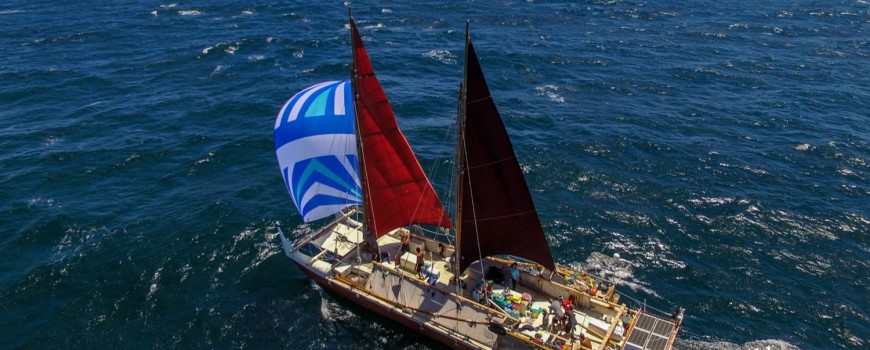
Aloha, this is Kālepa Baybayan on board Hawaiʻi’s famed voyaging canoe, Hōkūleʻa. We have just departed Port Elizabeth on the southeast coast of South Africa. We have to transit 186 miles to get to our next destination Mossel Bay before continuing around the Cape of Good Hope and eventually making a final landfall of Cape Town. The weather right now is mild, but the wind’s coming directly at us as we head in a southwesterly direction. It has been extremely frigid the past two days. It was 52 degrees this morning, and it was definitely in the low forties the previous night as the crew sat in the harbor to weather out a low pressure system. With the wind chill factor, it must have been in the 30 degrees, which really was a rude awakening for us warm blooded Hawaiians who live in the tropics. But the crew is enduring well. We’re able to warm up during the middle part of the day, but we will endure and we will make our destination of Cape Town in a few days. So thank you for following us and keep tracking us on board Hokulea.com. A hui hou!


Please help keep us sailing for future generations. All contributions make a difference for our voyage. Mahalo nui loa!
Continue Reading

Worth the Risk

After sailing more than 16,000 nautical miles on the Worldwide Voyage, Hōkūleʻa now faces new challenges and risks on the most dangerous leg to date.

Master navigator Nainoa Thompson revealed, “It’s probably the most complex sail plan we’ve ever had. It’s twenty-four hundred miles in a direct line going from Mauritius to Madagascar to the eastern side of South Africa and then we go around the southern tip of Madagascar. We enter the Mozambique channel, it’s got the fastest oceanic, it’s called a western boundary current, in the world. It’s stronger than the Gulf Stream. This leg more than any leg I think in the last 40 years is really trying to be able to be really really intelligent about how you deal with the wind plus the wave.” 

“So when the current comes down, it goes against the wind, what it does is it makes the waves bigger and it stacks them, it brings them closer together. Hōkūleʻa does not like those stacking waves, she’s not built for that. The canoe is not designed for that and so if we get into the situation where it is so rough then I do think that there’s nothing you can do. The canoe will be in overwhelm: you won’t be able to steer her and you won’t be able to raise sails. And so basically all you can do is sit it out,” explained Thompson. 

The unique challenges of this leg are also reflected in the crew, which includes both veteran and younger sailors.

Thomspons said, “Itʻs a challenge, it’s got risk, we know it, we understand it, we’ve been preparing for this particular leg. This is a good crew and I can hear it in their voice, I can feel it with them. They understand what they’re getting into, they’re matured, and they’re focused” 

Among the crew is Archie Kalepa, former Director of Ocean Safety for Maui County and current safety officer aboard Hōkūleʻa. 

“I don’t think I’ve ever been more afraid of a particular leg than I am of this leg. But in the same sense, I think that I’m really more aware of what’s going on and my role within this canoe,” said Kalepa. “I can take some of my knowledge that I’ve gained over the years of being on the ocean and look and see what’s out there and be able to analyze what I see as safe for the canoe, for the crew, and for the rest of this particular leg.”

“In my mind, I played out all the worst case scenarios so that when and if that does happen, at least I’m a little bit more prepared. Number one is knowing the responsibility I have to the people of Hawaiʻi and really the responsibility that each one of us, including myself, have to the canoe and every other crew member onboard that canoe,” said Kalepa. 

Thompson reflected, “I’ve been preparing for this leg for a long time. Years of research and this long process of mitigating risk and at the same time looking at these enormous opportunities of having Hōkūleʻa touch the sands of Africa. That notion that there would be possibly this moment that you would put her on the sands of Africa, half way around the world, the genesis of humanity, and us being the youngest culture to go back and to pay respect to humankind, I mean all of that. So you know, I mean, it may be the most dangerous leg, but it’s also one of the most pivotal legs.”


Please help keep us sailing for future generations. All contributions make a difference for our voyage. Mahalo nui loa!
Surfs Up in Durban

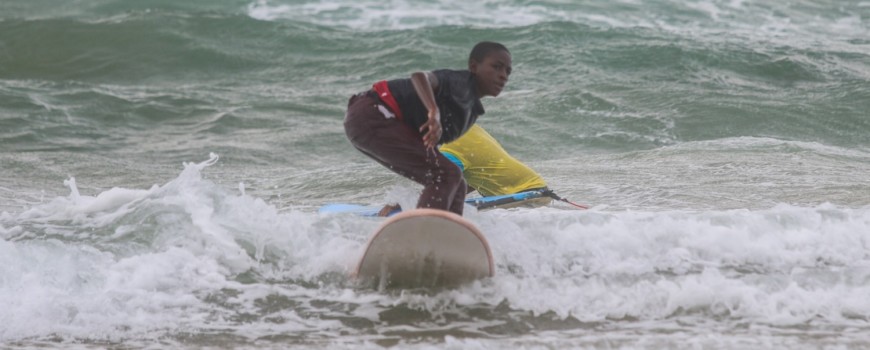
“Here we are in Durban, South Africa, and today we went to with a Christian surf group,” said Hōkūleʻa crewmember Archie Kalepa.

Christian Surfers is an international organization who really love the water and surfing, and our group of surfers that we went to work with are mainly street children from the Durban streets who mostly come from broken homes,” said Nicolene Chapman, a volunteer with Christian Surfers Durban.

IMG_4648“There is a lot that the ocean has to offer, and just the fact that Christian Surfers is taking the time to help these kids and give them an outlet, it was amazing to see,” said Archie.

“Many of them do come from broken homes, many of them either from divorced homes or abused homes, or a lot of them no homes. And most of them love water, and just donʻt have access to their own equipment. So this gives them a chance to surf and show off their skills with someone to cheer them on,” said Nicolene.

IMG_4670“They were so rich in happiness that just that one little moment that they have together on that beach or surfing on the water, they were 100% joyful. It was an amazing experience,” said Archie.

“We were just grateful that the Hōkūleʻa and the crew took the time to meet the kids and learn about the message that the Hōkuleʻa carries of conservation, caring for the oceans, and courage and bravery. The way the Hōkūleʻa travels and sails by the stars and winds, thereʻs no advanced technology, thereʻs no advanced equipment. A lot of these kids don’t have advanced anything. They don’t even have a surfboard. And the Hōkūleʻa can do it with a small crew, with little resources, then the kids can do it too. Itʻs a lot of combined messages for them all in one go. The kids totally engaged, and it was an amazing day and amazing opportunity. They were so engaged, and Archie gave the most wonderful message about how the kids just need to reach for their dreams, and if they love the water, the water can offer that to them,” said Nicolene.

“The ocean is an outlet for them. I think itʻs an opportunity for them to really feel free, and it was amazing to see,” said Archie.


Please help keep us sailing for future generations. All contributions make a difference for our voyage. Mahalo nui loa!