Crew Blog | Derek Ferrar: Surfing Durban

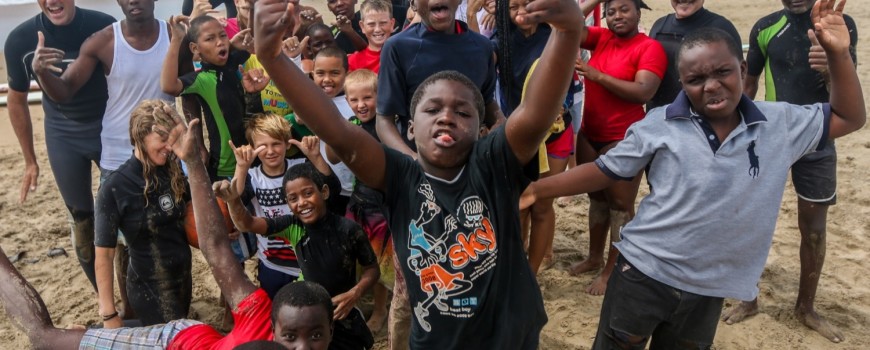
On Hōkūleʻa’s first full day in Durban, several members of the local group Christian Surfers invited rescue swimmer Archie Kalepa – lifesaver and big wave charger from Maui – to a Saturday surf session they offer each week for local street kids and youths from troubled homes. As soon as Archie stepped out of the car at the downtown beach, about thirty amped youngsters of various ages, sizes and colors mobbed around him, bouncing with energy.

IMG_4586After getting them settled onto a patch of grass, Archie asked, “How many of you guys love the ocean?” and everyone’s hand flew up. “How many of you guys want to do something that involves work in the ocean?” Again, all hands. “Well, you can do it, but only if you put the time in and work hard. It’s like going for a big wave – you’re scared, but if you give it 110%, you know what happens? You have the ride of your life. And that’s what this is all about – riding the wave of your life.”

IMG_4594He told them that he had started out not much different than them, “but since I made the ocean my passion, I’ve been able to travel around the world, surfed some of the biggest waves there are, and made my living doing it. And you guys can do that in life too, but you’re gonna have to work twice as hard. People will tell you that you can’t do it, but believe me, you can. The key is that you’ve got to believe in yourself first, just like when you’re riding a big wave.”

IMG_4621When Archie gave the word, the kids went scrambling for a patchwork collection of donated boards. Despite the fact that the waves were small and windblown, with “bluebottles” (aka Portuguese man o’ war) visible at the water’s edge, they charged in, all smiles and shouts as Archie and others pushed them into rides over the frothy whitewater. Some showed a real knack for the sport, including a 16-year-old named Ronnie, who said he’s been coming to the Saturday sessions for two years and had just made the semifinals of a local surf competition that morning. “Each time I go out, I get more and more excited and inspired,” he said.”

IMG_4628An older girl named Gabriella said she’s only been coming to the program for a couple of weeks, but already she’s totally hooked on “the tranquility it gives you, and the connection between the surfer and the waves.”

Back on the canoe, Archie said that it was heartwarming and moving to see that those kids from troubled homes and lives knew that people cared about them, but that the best part of the day for him was simply seeing “that they were just truly, soulfully happy in the water. That was a takeaway for me, because a lot of who us who spend time in the water can start to take things for granted. But that being such a positive outlet for them was just a reminder of the healing, spiritual gift we have from the ocean.”


Please help keep us sailing for future generations. All contributions make a difference for our voyage. Mahalo nui loa!

Continue Reading

Crew Blog | Kālepa Baybayan: This Is Africa

How do you know that Hōkūleʻa is in Africa?  When you have monkeys in your rigging.

Hōkūleʻa and her crew arrived in South Africa at the port of Richards Bay on Monday October 19, 2015.  In four days, we have danced with Zulu, seen hippos and rhinos from the back of trucks, met our guardian angels face-to-face, and prepared our canoe for the next jaunt to Durban.  

IMG_4055

There is a saying in Africa, “This is Africa!” (pronounced “This Is Ahfrikaa!”), or “T-I-A” (pronounced Tee-Eye-Ay), meaning things get done at their own pace and in their own way.

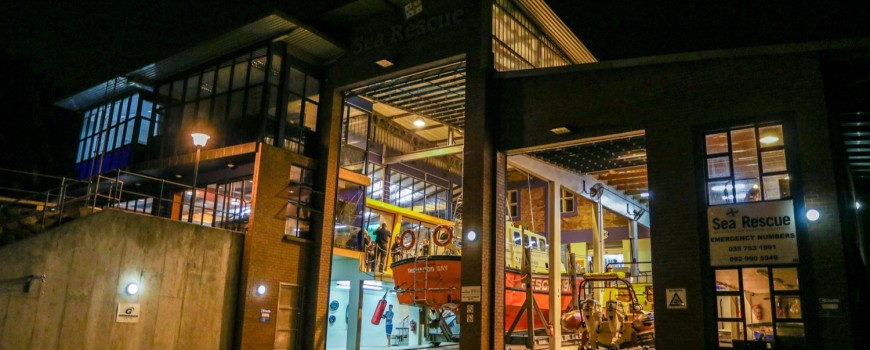
We arrived on Monday at around noon and began the tedious task of cleaning up the canoe. On Tuesday, representatives of local tribes hosted us to a Welcome to Country Ceremony. On Wednesday, we washed and reorganized the canoe, sterilized the bunks, and checked the stays for chafing, then visited the Sea Rescue of South Africa facility for a tour and barbeque.

IMG_4134

Sea Rescue is the South African Coast Guard, a fully volunteer organization. Each station in South Africa is responsible for raising funds for equipment and operations, which they secure through donations from individuals and corporations. Sea Rescue has become Hōkūleʻa’s guardian angel, providing escort and piloting service into Richards Bay, and each port we enter for the duration of this leg.  

DCIM100MEDIADJI_0355.JPG

On Thursday, we were hosted at the UNESCO World Heritage site iSimangaliso Wetland Park and Saint Lucia Estuary. Upon arrival, we were greeted by a Zulu dance troupe of a dozen men and 2 women, brandishing spears and fur-lined shields. They performed for a while, and then invited us to participate in song and dance; I offered something that I thought might be part-Haka and part-Africa inspired. For four hours, we toured the site accompanied by Zulu tribal elders; by boat we were treated to viewing hippos and crocodiles, and saw zebra and rhinos from the back of trucks in the grasslands. We wrapped up with a late lunch, and I was honored to present gifts to the tribal elders and the UNESCO manager.

IMG_4206

It is now Friday.  This morning at 5:30am, we exited Richards Bay Marina and are now searching for the Agulhas Current. Once established in the southward flowing Current, we should be able to add an additional 2-3 knots of hull speed, shortening the time of our 90-nautical mile transit from Richards Bay to Durban. The 12 of us who left Mauritius together are still aboard Hōkūleʻa, but now with an additional team of 3 – Daniel Lin, Kaimana Barcarse, and Derek Ferrar – making up a land-logistics team driving to Durban. We need to time our transit down the South African coast to the constantly changing weather, which comes in 5-day cycles. After Durban, we prepare for what is potentially the most dangerous part of this leg, a 260-nautical mile jaunt to our next planned port of East London.

And no, no monkeys in the rigging yet – but they supervised Max as he washed down the canoe in Richards Bay, keeping a watchful eye on him and the rest of the crew from afar.

T-I-A (This Is Ahfrikaa).


Please help keep us sailing for future generations. All contributions make a difference for our voyage. Mahalo nui loa!

Hōkūleʻa Update | October 21, 2015

Worldwide Voyage crewmembers recently visited the Richards Bay National Sea Rescue Institute (NSRI) station and learned more about the unique organization. Renowned Hawaiʻi waterman Archie Kalepa, former director of Maui County’s Ocean Safety Division and safety officer for the current leg of the voyage, was among the crewmembers who went to see the facilities.

IMG_4147

According to station commander Dorian Robertson, “NSRI is a voluntary sea rescue organization. All of our funding comes from public donors or sponsorships. All the bases and boats…are all purely from public donations and sponsorships. The station commanders – like myself – down to the crew, are all volunteers. We don’t get paid a cent for what we do.”

IMG_4118

Since its establishment in 1967, NSRI has grown to over 1,000 unpaid volunteers who are on standby day and night to save lives in South African waters. NSRI operates 31 bases along the South African coast and relies on a fleet of 96 rescue craft, 38 rescue vehicles, 16 quad bikes, and 11 tractors. The team from the Richards Bay station greeted Hōkūleʻa as she approached her first African landfall.

DCIM100MEDIADJI_0339.JPG

After learning more about Hōkūleʻa and the Worldwide Voyage, station commander Robertson said, “I think the crew is very brave to do what they are doing, but it is certainly an experience. The whole story around the voyage is very, very good…But it could be scary going around the world in a vessel like Hōkūleʻa.”


Please help keep us sailing for future generations. All contributions make a difference for our voyage. Mahalo nui loa!

Continue Reading

Crew Blog | Kālepa Baybayan: Pulling for South Africa

Kalepa_BaybayanWritten by Kālepa Baybayan

We have arrived in South Africa.  

But the journey here was not an easy one.  Yesterday, as we attempted to leave the safe harbor we sought in Maputo, we ran into difficulty.  Or rather, difficulty snared us.  

We stood – 8 crew in a line – rope in hand, pulling and tugging, trying to lift our anchor off the ocean floor.  We tugged and tugged, to no avail.  We tried to use Gershon II to tug, letting Gershon II motor ahead with Hōkūleʻa under tow, attempting to lift the anchor with the added force.  Nainoa even contemplated cutting the rode and leaving the anchor – a hard decision to make with this expensive anchor, long chain and 300 feet of rode, valued at $2,000.  

IMG_3625

From off in the distance, a big motor boat approached us with a lone driver, camera in hand, videoing us and our strange-looking craft.   I put on my best Aloha, and called over to the driver “Would you mind taking a few of our crewmembers aboard your vessel to help us retrieve our anchor?” We explained that we – the canoe and escort vessel – needed to move to the next anchorage before the sun set.  The driver – Mike Ferguson, Chairman of International SOS, a medical service provider in South Africa – agreed to help us, returning our aloha and smiles.  He agreed to help run the boys in to retrieve the anchor, and then run them back out to our vessels.

IMG_3534

We boarded three crew members  – big Sam Kapoi, our media specialist; OluKai waterman Archie Kalepa, our safety officer; and Honolulu Police Department officer Keahi Omai, our watch captain.  We tied a large fender to the anchor line to float the line, provided rope for a bridle to be rigged up on Mikeʻs stern, and gave the three Hawaiians a hand-held radio so the boys could communicate with the canoe.  

As they headed out to retrieve the anchor, Mike relayed to our three Hawaiians on board a theory of how the anchor got stuck – during the war, the Dutch sank a number of ships in the harbor at the start of the water to stop an all-out invasion; as a result, there is still a lot of metal in the water which the anchor likely got fouled up on it.  

IMG_3632

The boys rigged the bridle to the stern of Mikeʻs boat and tugged, but the anchor still didnʻt move an inch.  Mike spun his boat around the anchor in a large circle hoping to unfoul it, but that didnʻt work either.  As Archie called in to Nainoa to explain and Nainoa was facing the decision to cut the anchor line, Mike decided to go for it – he gunned his engines, the boys scrambled for cover from the fully loaded anchor rode, and the line snapped!  The anchor came free.  As Archie relayed the message to Nainoa, cheers came up from both vessels.   We escaped Maputoʻs last attempt to hold on to the canoe, with the assistance and now friendship of one of the best of the 1.7 million people we are saying goodbye to in Maputo.  

IMG_3657

We anchored Hōkūleʻa and Gershon II 17 miles outside Maputo Bay, and prepared for our 190 nautical mile run down to Richards Bay.  We plotted a course that would take us into the Mozambique Current, hoping to add 2 more knots of speed to our hulls for what we anticipated would be an overnight passage.   

IMG_3666

We took off early yesterday morning, in hopes of getting in to Richards Bay this afternoon.   Under sail and tow, we started at 5 knots and moved quickly to 7 knots, in keeping with our projected 6.5 knots of speed.  Soon we hit 8 knots and then, in the Mozambique Current – 10 knots!  

Our plan for an afternoon arrival in reality became a mid-morning landing.  The South African Rescue Service was there to assist, rafting up to Hōkūleʻa’s stern to as we transferred the tow rope from Gershon II back to the canoe.   The South African Rescue Service guided us the final mile into our berth alongside the wharf in Richards Bay.

IMG_3661

We were greeted by a number of people , including Customs and Immigration Officials and Nick Alexander, our jovial Shipping Agent.  Everyone was so helpful, even helping us to move several vessels to make room for Gershon II.  We began the process of cleaning up the canoe, already gearing up for the next ocean endeavor.  We huddled in prayer, full of gratitude, our two captains speaking with and for us to thank our families and ancestors, those who are welcoming us to this shore, and those who worked from home and afar to support our safe passage.

DCIM100MEDIADJI_0332.JPG

Now, from the comfort of this hotel room, having showered and cleared a backlog of 400 emails I have received since we departed Mauritius 15 days ago, my last kuleana for this night before I sleep is to write this update to all of you.  As I finish writing this, Iʻm smiling thinking about our crewmember Max, and the conversation we shared at lunch today at the hotel.  I told him that we should be consdering him for a management position with the canoe because of his work ethic – he has been doing a great job, always helpful, very enthusiastic, with a great attitude.  In response, he tells me that heʻs been trying to guess how many baths I took on the way from Mauritius.  I wonʻt divulge that information to you all, but I can say it was more than one.  But a hot, freshwater shower…  letʻs just say that in this land that gave us our first Homo Sapien, I am now feeling pretty Homo Sapien myself.  

From the comforts of Richards Bay,
Kālepa


Please help keep us sailing for future generations. All contributions make a difference for our voyage. Mahalo nui loa!

Continue Reading

Hawaiʻiʻs Antipode

Yes, that is the outline of our Hawaiian Islands, but upside-down… Why?  That spot on earth is exactly opposite our island home!

While Hōkūle‘a lay at anchor in Maputo, Mozambique waiting out a storm, she was actually at the closest point in her voyage to Hawai‘i’s antipode. This means that our wa‘a and her crew were as far away from Hawai‘i as they could be on this Worldwide Voyage (and still be on water) – every other port is actually geographically closer to the islands in one direction or another!

DCIM100MEDIADJI_0312.JPG

The antipode of a location is where you would find yourself if you dug “straight down” through the center of the Earth from where you are standing, and came out the other side. That would be a tunnel nearly 12,700 km (around 7,900 miles) long! If you were to drive a truck through that imaginary tunnel at 60 mph, it would take almost a week of driving, non-stop.

Dr. Rhett Butler, director of the Hawai‘i Institute of Geophysics & Planetology at the University of Hawaiʻi, has studied seismic waves from earthquakes measured from the antipode of the quake’s epicenter as a way to learn more about the earth’s core. “At the antipode of a seismic event, the earth acts something like a huge lens, encompassing vibrations from all directions at once,” he says. “As the seismic waves pass through the center of the planet, it gives us a kind of sample of the core that allows us to see a lot more about what’s there.”

Hawaiʻi’s antipode (the pronunciation rhymes with “aunty toad”) lies in the middle of the massive Central Kalahari Game Reserve in Botswana, about 700 miles from where Hōkūle‘a is right now, and a world away from Hawai‘i both literally and figuratively.  The CKGR is the largest reserve in South Africa, and the second largest wildlife reserve in the world.   The reserve was originally established as a place for the San (the indigenous hunter-gatherers of South Africa) as a sanctuary where they could live and practice traditional hunting and gathering.


Please help keep us sailing for future generations. All contributions make a difference for our voyage. Mahalo nui loa!

Continue Reading

Hōkūleʻa Update | October 17, 2015

The horizon lights up, wide sweeping arcs of brilliant long flashes of lightning touch the surface of the sea. The deck of the canoe vibrates with the rumble of the thunder surrounding us.

The breadth of the systems here is extremely large, like the continent of Africa; the weather is also terrifyingly beautiful, and somewhat sinister to behold.  Warm air migrating from the African plains merges with the cool air of the Indian Ocean, producing very large and powerful weather systems, such as this one that interrupted our progress south towards Richards Bay.  Such a stark contrast to the tropical weather I am accustomed to in Kona Mauka, the kind of weather many of us are familiar with no matter where in the Pacific we call home. Here, we are trapped by lightning, thunder, and gusting winds throughout the night, our crew huddled under our awning, which we have dropped low to the deck to protect us from the sideways-blowing wind.  Our shelter resembles the shelled back of a turtle, legs and head drawn in to protect against the elements.

DCIM100GOPROG0030867.

The weather has settled now, and we anticipate leaving this anchorage once we complete a few maintenance duties this afternoon. Our plan is to transit the length of the bay, anchor at its edge, and depart for Richards Bay early Sunday morning, weather permitting. If we are fast, we should be there Monday afternoon.

IMG_3487

The crew eagerly anticipates arrival into Richards Bay. We talk about cold drinks, hamburgers and steaks, creamy milk shakes and ice cream, and doing loads of laundry. A bath is next on the list, with sleep somewhere further down – we don’t want to interrupt the sleep cycles we have become accustomed to, and our plan is to continue to stand 8 hours of daily watches throughout the leg to Cape Town, even while we are at anchor.

So – a few more hours of maintenance and then the plan is to push off… Hopefully the next update I send will be from the comforts of a seaside hotel room, or at least much closer to one.

Kālepa


Please help keep us sailing for future generations. All contributions make a difference for our voyage. Mahalo nui loa!
Continue Reading

Hōkūleʻa Update | October 16, 2015

Our canoe Hōkūleʻa and our escort vessel Gershon II have sailed in to Maputo, Mozambique.

Two-person dhows line the horizon with fishermen. These traditionally rigged vessels, similar in sail design to Micronesian proa, speak to the oceanic heritage of African seafarers who plied this coastline as traders, freighters, and fishermen. They continue this proud tradition of using the wind to propel their vessels out to the sandbars offshore to fish, a practice that has been passed on for generations.

IMG_3336

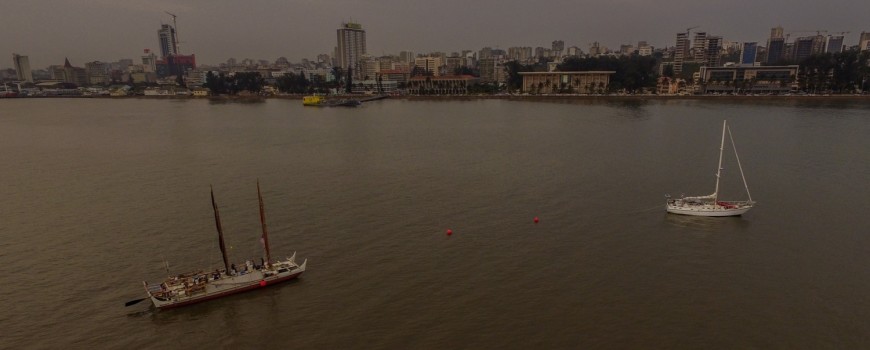
From our vantage point, anchored 200 yards offshore of downtown Maputo, this growing port metropolis of 1.7 million people looks very modern. Many tall, modern-looking buildings with large cranes above them frame the skyline of this former Portuguese colony (Portuguese is still the official language of Mozambique).  When Portugal returned independence to Mozambique decades ago, there was a mass exodus of Portuguese patriots, resulting in a decline in Maputo’s economy and city infrastructure.  From our view offshore today, the city looks like it is going through a strong recovery period. Crewmember Max jokes that a number of Portuguese expatriates must have returned to Honokaʻa after they left Maputo.  I laugh, and think about my own ties to the Portuguese.  My great-grandfather and great-grandmother came from Portugal… again, we feel these connections, halfway around the world.

IMG_3086We shifted anchorages in the afternoon from the outer harbor to the inner harbor, for better shelter from the quickly approaching low-pressure system to our south. At 2:30 AM, those of us not on watch woke to an “all hands on deck” situation – the winds had increased to gale force, and the crew had to react quickly to tend our tow line that tethered us to the stern of the Gershon. The weather has since settled, and at the moment we are riding more comfortably.

In the morning we are arranging to refill our fresh water containers, working with the incredibly helpful Port Authorities to do this. We have ample food for the remainder of our trip, although I long for a fresh garden salad.

IMG_3444

Sailing, crossing the world’s oceans 1 foot at a time, takes endurance and patience. I sail because of the perspective it lends my life and the life skills it provides me; sailing also makes me appreciate my family more.   The crew aboard Hōkūleʻa forms a family of professional and competent collaborators, but there are also those whose tie goes beyond our waʻa ʻohana – of our 12 crewmembers, 8 men and 4 women, two are sisters and two are cousins.  

1.      Nainoa Thompson, Captain
2.      Kālepa Baybayan, Watch Captain
3.      Billy Richards, Watch Captain
4.      Archie Kālepa, Safety Officer
5.      Carolyn Annerud, Medical Officer
6.      Tamiko Fernilius, Quartermaster-Cook
7.      Timi Gilliom, Fisherman
8.      Sam Kapoi, Media Specialist
9.      Lehua Kamalu, Electrical Specialist
10.     Nikki Kamalu, Science Specialist
11.     Keahi Omai, Carpenter-Sail Repairer
12.     Max Yarawamai, a great guy, every family should have one of him

Aloha from all of us off the coast of Africa,
Kālepa


Please help keep us sailing for future generations. All contributions make a difference for our voyage. Mahalo nui loa!

Hōkūleʻa Update | October 14, 2015

Hōkūleʻa crew sighted land from the deck of the canoe today, an historic first glimpse of the African coast. Hōkūleʻa plans to remain in the water off the coast of Mozambique’s capital city, Maputo, to avoid the potentially dangerous weather conditions currently gathering in the Mozambique Channel. 

Maputo’s harbor master, port control and Hōkūleʻa’s ship agent have gone beyond their normal duties to assure that Hōkūleʻa will have a safe port in a storm.  The crew is grateful that Maputo is graciously extending their hospitality, despite the fact that Hōkūleʻa will not dock in their port. While waiting out the adverse weather conditions, Hōkūleʻa will be considered a “vessel in transit” under international maritime law.

IMG_2999

In international maritime law, a vessel in transit is defined as vessel passing through another nation’s sea without stopping, accessing land, or allowing anyone from the country to board.  A vessel in transit may continue on, in motion, operating within the international laws of the sea and universal safety standards. 

The U.S. Embassy in Mozambique as well as the Harbour Master of Maputo and the voyage’s ships agent have been exceptionally helpful as Hōkūleʻa continues to Richards Bay, South Africa.  


Please help keep us sailing for future generations. All contributions make a difference for our voyage. Mahalo nui loa!