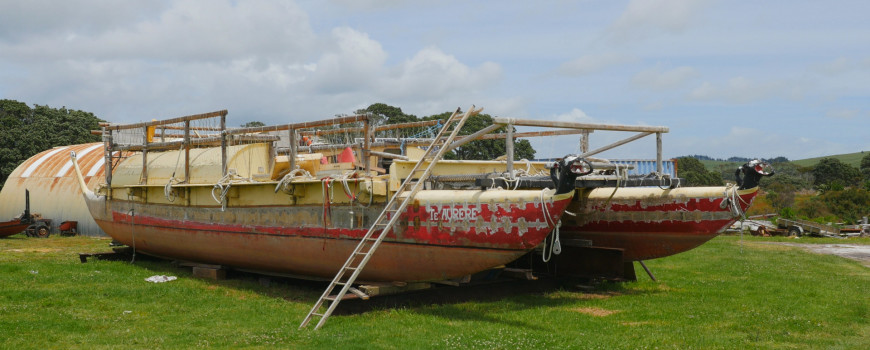
Te Aurere
“We’re up at Far North, that’s what they call it here and it’s more the north half of the North Island at Te Aurere, which is Uncle Hector Busby’s place,” says Moani Hemuli, a crewmember of the Worldwide Voyage.
“Uncle Hector is an amazing person. He started off as a bridge builder and all of the bridges that we drove over to come to his place, he built all of those. But then he kind of stopped because there were no more bridges to build,” she continues to say.“Then he continued on as a bridge builder in a different way and he started building waka. His bridges became longer being that he could sail to these far places like Rapanui on a Waka Tapu voyage.”
Far, yet familiar places, reconnecting ʻohana waʻa throughout the Pacific. To have a waka of their own was a dream that Māori elder, Sir. James Henare had for Aotearoa after greeting Hōkūleʻa for the first time in Waitangi back in 1985.
Uncle Hector Busby took on the responsibility of creating such a waka for his own people.
“When we started the canoe, Nainoa, the Hawaiians were here, the Rarotongans were here and this old kaumātua Huata was his name, he did the, he did the pule for that morning,” says Uncle Hector Busby. “What he did was he handed each, a part of the pule to every islander here that’s when I started on, on Te Aurere.”
“Looking back I think for me anyhow, I’m really satisfied that did I turn from bridge building to waka building. But, as we all know, if it wasn’t for Hōkūleʻa it would never have happened,” he continues to say.
Te Aurere is made up almost entirely of Kauri wood, which is a native tree of Aotearoa. However, similar to our Koa trees here in Hawaiʻi, the Kauri are becoming harder to come by.
When you do stand in the presence of the Kauri tree though, it is an experience to remember. “They’re huge, amazing, awesome trees we’ve seen Tanemahuta, which is one of the biggest last trees and it takes thousands of years for these trees to grow and it’s similar to our koa trees back home in Hawaiʻi because of introduced species and invasive species, we’re losing them. And it’s the same thing here with the Kauri,” says Moani. “The Kauri trees are being eaten by a certain bug from the inside and it’s rotting.”
After being on land for almost a year, Te Aurere is touched by the healing hands of the Worldwide Voyage crew whose mission of Mālama Honua lead them straight to her. A project that would allow them to honor the Kauri trees and their ʻohana waʻa of Aotearoa.
“To see Te Aurere like this brings me back to when Hōkūleʻa was in her eighteen-month dry dock, where you know, she looked sad, but at the same time, we’re giving our mana back to her because she mālama’s us while we’re on the ocean,” continued Moani. “For us, it’s important to mālama Te Aurere because she is one of the bridges that will come to Hawaiʻi eventually.”
Click here to explore more about Aurere.
Please help keep us sailing for future generations. All contributions make a difference for our voyage. Mahalo nui loa!


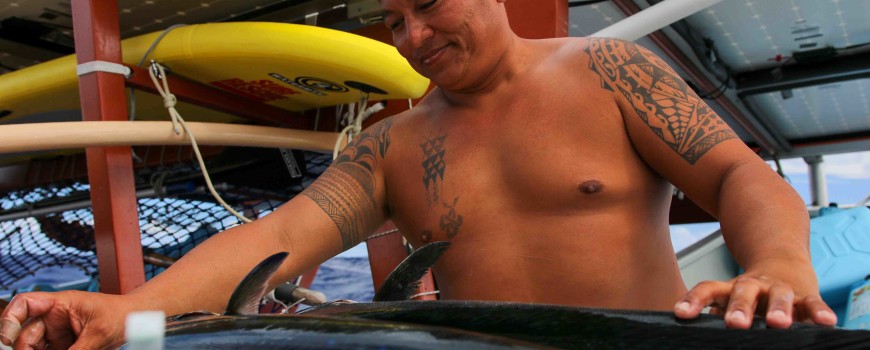


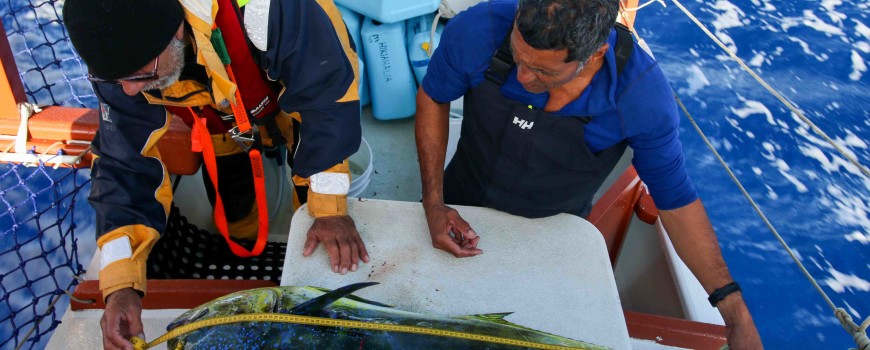
 After several days of helping Timi, our fisherman, setting out the fishing lines early in the morning on my watch, the crew was hopeful once more that today would be a successful fishing day. Around 10am in the morning I saw several schools of malolo [flying fish] jumping out of the water thinking that a predator might be chasing them. Not long after that, one of our fishing lines got a strike, and I called out “hana paʻa!” Crewmember Kalau and I went to the fishing line to pull in the fish. The canoe was racing ahead at about 9 knots and Brad asked if we should slow down the canoe, but I said not to worry; it’s was a small fish. However, as the fish got closer to the canoe I realized it was a good sized mahimahi and asked Brad to slow down the canoe. Brad directed the crew to sheet out the main sail and turn into the wind. At this point the mahimahi was alongside the hull and Kalau did a perfect head gaff so we could pull the Mahimahi on board. The Mahimahi turned out to be a male of about 4 feet and 35 pounds. The crew was very excited as we envisioned the fresh mahimahi prepared in different ways on their plate. For lunch, Nakua prepared poke mahimahi, fried mahimahi with special mustard sauce and rice. For dinner Puaita (in Tahiti known as Raihau) prepared some poisson cru, and Kaleo made a fish head soup. And everybody went to sleep happily ever after.
 The only way to supplement food supplies on ancient voyaging canoes at sea was to catch fish, and possibly birds. Fishing was a matter of survival. In the same tradition, fishing is not considered a pastime or sport aboard Hōkūleʻa. A good-sized fish provides a day or two of food for crewmembers, stretching food supplies and lengthening survival time at sea. One crewmember aboard the canoe serves as a designated fisherman, responsible for putting out lines at sunrise, bringing in the catch with the assistance of other crewmembers, and pulling in the lines at sunset.