Hōkūleʻa Update | April 24, 2015

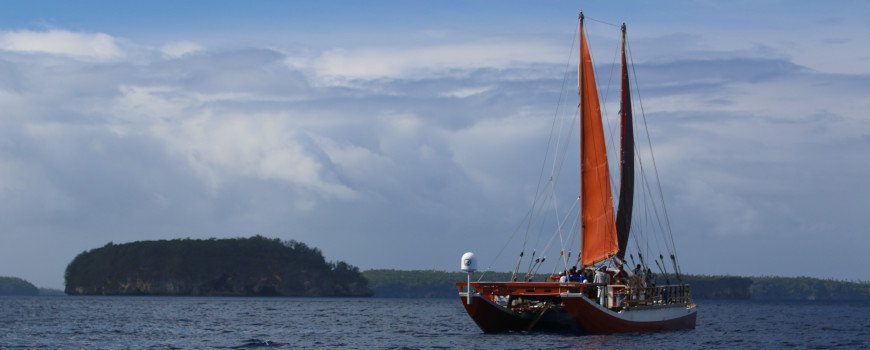
HONOLULU – Ceremonies began today and will continue tomorrow in preparation for Hōkūleʻa’s departure from the Pacific for the very first time in her 40-year history. The legendary voyaging canoe and her crew will depart Aurere, Aotearoa (New Zealand) for Sydney, Australia during the next good weather window, expected to be Wednesday, April 29.

IMG_0232

The departure ceremonies are taking place in Aurere, on New Zealand’s North Island and near to Waitangi, where Hōkūleʻa was ceremonially welcomed in 1985 during her Voyage of Rediscovery. Today, a large star compass and a voyaging learning center serve as enduring reminders of the voyaging connections shared between Hawaiʻi and Aotearoa for millennia. Maori leaders and a delegation of Hawaiian youth and adults led by Dr. Randie Fong of Kamehameha Schools, the education sponsor of the Worldwide Voyage, created cultural protocol to bless Hōkūleʻa and prepare her and her crew for a safe journey.

The delegation of Hawaiʻi students from island charter schools noted the special role of youth around the world in protecting our oceans and earth. They will present the Indigenous Youth Declaration from the World Indigenous People’s Conference on Education that will be taken around the world on board Hōkūleʻa.  Youth from Queen Liliuokalani Children’s Center, also joined the delegation, preparing an offering of hula and oli.

“Coming together to change the world affects us all, giving us a great kuleana to persevere and keep pushing forward,” said Kamaile Academy high school student Daniel Corpuz. “This experience will spark the flame to the change of generations to come.”

IMG_3296

Departure ceremonies will continue tomorrow with presentations of the Oceans Declaration, Voyage Leadership Declaration, and Indigenous Youth Declaration.


Please help keep us sailing for future generations. All contributions make a difference for our voyage. Mahalo nui loa!
Continue Reading

Hikianalia Update | April 18, 2015

The Polynesian voyaging canoe Hikianalia is on a 2,400 mile return journey from Aotearoa to Hawaii. Crewmembers will be sending frequent updates so that educators and students can track her progress in conjunction with the Worldwide Voyage Tracking Map


Time: Sunrise, April 18, 2015 Muku Moon
Course: Nalani Koolau
Wind: 20-25 Knots
Speed: 6-8 Knots
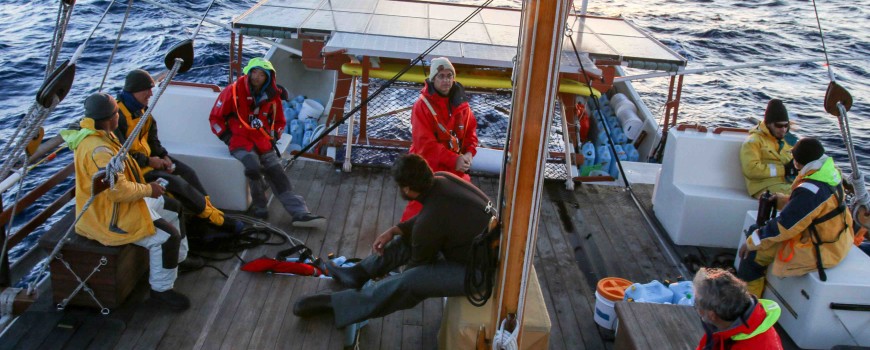
Weather: Windy, rainy and cold. There were passing squalls all morning, and we tried to dodge them the best we could.
Sea State: Ocean is a little rough although the swells arenʻt very large.
Marine Life: We still see lots of birds even a finch looking smaller bird. A small squid took an unfortunate jump onto the waʻa this morning as well.

Weather today is a complete change from the light winds of the past 2 days, where we were able to play around with all kinds of different sails to see what could get us the best speed and course.


IMG_3196


Please help keep us sailing for future generations. All contributions make a difference for our voyage. Mahalo nui loa!

Hikianalia Science Report | April 17, 2015

The Polynesian voyaging canoe Hikianalia is on a 2,400 mile return journey from Aotearoa to Hawaii. Crewmembers will be sending frequent updates so that educators and students can track her progress in conjunction with the Worldwide Voyage Tracking Map


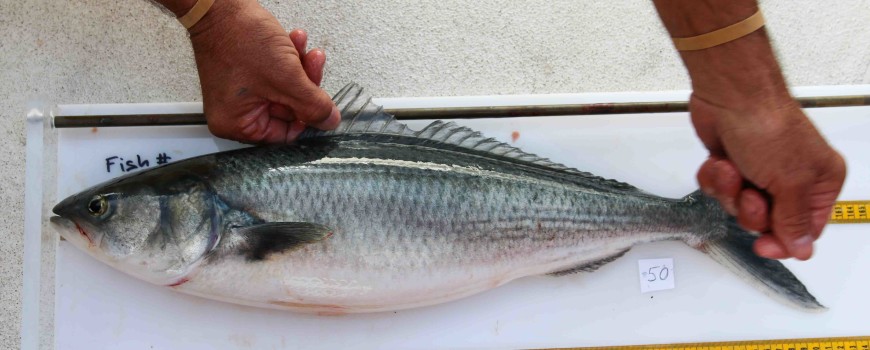
We left Auckland on Wednesday in windy and cold weather.  We put out the fishing lines and caught a small Kahawai (ca. 30cm total length) which we gave back to Kanaloa.  Later that afternoon we caught a bigger one (62cm total length) which we decided to keep.  It turned out to be a female with many eggs in the egg sack.  

IMG_2837-2

We cut off two spines of the fin to be used for one of our science projects.  The fin spines get stored in a special buffer that preserves the DNA in the tissue surrounding the spines. The DNA can tell us something about how the different fish we catch are connected to each other.  For example, the DNA could tell us if this Kahawai we caught is the same species as any of the other Kahawaiʻs we caught on other legs, and if so if it belongs also to the same stock.  We also opened the stomach for our other fish box science project to see what she has eaten and if it contained any parasites or marine debris like plastic.  The only thing we found were about 25 half digested anchovies between 3 and 10 cm in length. 

IMG_2845-2

We have been measuring the water quality regularly since we left Auckland. The temperature at the surface of the water is slightly increasing (from 18 to 19º C), which makes sense considering we are heading north east towards warmer waters. We are expecting bigger increases of temperature that closer we get to Tahiti.

IMG_3132-2

Several birds have been around us. Mostly albatross are gliding effortlessly throught the winds, circling around us. But amazingly we have also seen some smaller birds. Yesterday and today we saw a small flock of little black birds that look like swallows.  We also had a little green sparrow taking a rest on Hikianalia.  We suspect it got swept out to sea from Aotearoa by the high winds of the last few days, as it is not a bird that is equipped to fly long distances with rest.


Please help keep us sailing for future generations. All contributions make a difference for our voyage. Mahalo nui loa!
Hikianalia Update | April 15, 2015

The Polynesian voyaging canoe Hikianalia is on a 2,400 mile return journey from Aotearoa to Hawaii. Crewmembers will be sending frequent updates so that educators and students can track her progress in conjunction with the Worldwide Voyage Tracking Map


Navigation Report: Sunset
Course: Hikina
Speed: 6-10 knots, but weʻve slowed down starting in the afternoon
Wind: 15-30 knots for the day out of Hema.
Celestial: Clear night last night made it easy to use Southern Cross and South Celestial pole. Also rising Kāne moon.
Overall Weather: Clear skies, sunny
Sea State: Went from rough in the morning and mellowed out by evening
Sea Life: Timi caught 3 kahawai yesterday.  We gave the first back to Kanaloa. The second was too small, and we kept the third. There are lots of Mōlī (Great Albatross) and other sea birds.
Marine Debris: None

IMG_2928


Please help keep us sailing for future generations. All contributions make a difference for our voyage. Mahalo nui loa!

Hōkūleʻa & Hikianalia Welcomed to Point England

AUCKLAND, NZ –  Hawai’i’s education leadership yesterday sailed aboard deep sea voyaging canoe Hikianalia to build new partnerships with some of Aotearoa’s most innovative educators. Legendary canoes Hōkūleʻa and Hikianalia anchored together at Point England Beach to meet the students and teachers of Manaiakalani School Cluster. They were joined by education leaders from throughout Aotearoa to learn about the innovations in place-based education and community development programs underway at Point England School.

IMG_5454

Nainoa Thompson, president of the Polynesian Voyaging Society, described the significance of the gathering. “Today’s events were a key demonstration of our Mālama Honua vision; people of different ages and backgrounds came together to reimagine our future,” said Thompson. “Education is at the very core of Mālama Honua–caring for our Island Earth. We are honored to build relationships with youth leaders at Manaiakalani so that our voyage for a sustainable future will continue long after we return to Hawai’i.”

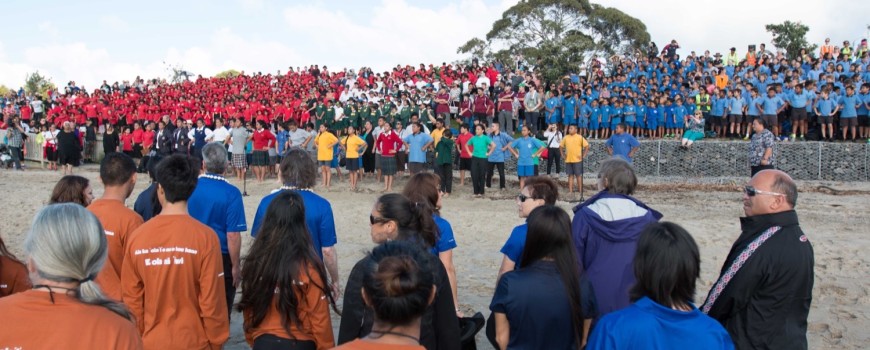
More than 2,000 students, predominantly Maori and Pasifika, greeted the Hawai’i visitors on the beach along with their community elders and teachers.  The students performed special oli (chants) that they had written together, and each one of them stood in line to shake hands with the Hawai’i educators and crewmembers.  The students also live-streamed the event on their student-run video conference platform. The Hawai’i-based educators toured Point England School to experience the schools’ pioneering approach of using 21st century technology together with indigenous wisdom in education.

IMG_9196

“I’m honored to join PVS and our teachers who are a part of the Mālama Honua Education Hui, and engage with our educational partners here in Aotearoa,” stated Kathryn Matayoshi, Superintendent, Hawaiʻi State Department of Education. “As we work towards empowering all of our teachers and public school students with digital learning, it is inspiring to see the technologically-based work taking place at Manaiakalani School Cluster here at Point England.”

The influential delegation of education leaders from Hawai’i includes superintendent Matayoshi, University of Hawai’i president David Lassner, and key thought leaders from Kamehameha Schools, Hawaiʻi charter schools, and the University of Hawaiʻi College of Education.  These teachers and administrators gathered for the Mālama Honua education summit in Aotearoa.


Please help keep us sailing for future generations. All contributions make a difference for our voyage. Mahalo nui loa!

Continue Reading

Update | April 15, 2015

On the eve of Hikianalia’s departure from Auckland, I look back on this trip with a sincere appreciation for the specialness of Te Ika A Maui and Te Wai Pounamu (North and South Island, New Zealand). We have been here a long five months, arriving in the north in November 2014, traveling to South Island in January 2015, and conducting drydock for almost two months. All of March, we hosted educational events at various venues but called the Auckland Maritime Museum home for most of the month. The staff at the museum have been outstanding hosts, true professionals in the informal education business, and we learned a lot from them about hosting students aboard Hikianalia.

IMG_2951

The crew spent the weekend with Kaumatua Hector Nukumai Busby and toured 90 Mile Beach and Cape Reinga. With tears in his eyes, he openly wept when he performed his farewell karakira, the same prayer he performed in 1985 when Hōkūle’a began its epic voyage to Aotearoa from Miloli’i, Hawaiʻi. He asked that when the crew departs Auckland they bid him a final farewell, I promised him we would. This man has given so much to the voyaging community; I do not think we can ever repay him.

IMG_3368

 As I prepare for the 2,300 nautical mile journey back to Papeete, I am focused on the job ahead of me. We conducted training all day today. We have a few housekeeping chores to accomplish tomorrow before our  departure. I think we are as prepared as possible. Now we need to focus and learn about becoming a good team. It has gotten terribly frigid down here in New Zealand, and it will remain cold for most of the way until we near Tahiti.

IMG_3285

Often I am asked what makes you a good leader, and quite frankly, I don’t know. What I have and what I support is a big dream. I want to be a part of a project that is not mediocre, that inspires others, that challenges me and pushes me beyond preconceived limits. I understand that leadership is the process one takes to achieving the big dream. It facilitates the positive growth of the many who support the pursuit of an ambitious dream. My wish is for everyone to have a big dream in their life, and then go chase it. In that process discover the leader within them. I challenge the crew of 15 on Hikianalia, including myself, to dream big, to discover teamwork, and to learn to be better friends at the end of the trip than we were at the beginning. I think we are up to that challenge.

Nga mihi,
Kālepa


Please help keep us sailing for future generations. All contributions make a difference for our voyage. Mahalo nui loa!

Continue Reading

Hawaiʻi State Legislature Honors Hōkūleʻa’s 40 Year History

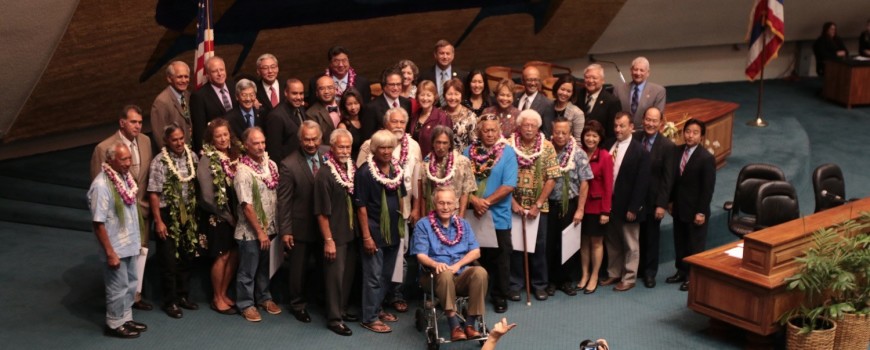
The Hawaiʻi State Legislature came together yesterday to honor Hōkūleʻa’s 40 years of voyaging, and the profound impact she has had on the state of Hawai‘i.

Twelve original crewmembers from Hōkūleʻa’s first voyage to and from Tahiti in 1976, including the last surviving PVS founder, Dr. Ben Finney, accepted the honors at the Hawaiʻi State Capitol. The State recognition also acknowledged the University of Hawai‘i, including the Honolulu Community College and its Marine Education and Training Center, for housing and caring for for Hōkūleʻa.

1976 crewmember John Kruse shared that:

IMG_9837Today, you are not only honoring the 1976 crew but all those that have made sacrifices so that we can be here. From the crewmembers who have passed on (too many to name), all the way back to the Polynesians who had the courage to make the voyage from the South Pacific a thousand years before us to settle Hawaiʻi. We are here representing them.

Let this honor and proclamation serve as a catalyst to create a solid foundation for more educational opportunities for young people across the state. Because canoe is not just canoe. It is a floating classroom… where math and science go right along with learning life skills like character, respect, trust, visualization. These things we can pass on to our children along with the stories of who we are as a people, where we come from, and how we can steer Hawaiʻi to a brighter future for all.

Click here to view a copy of the certificate given by the Hawaiʻi State Legislature.

We look forward to continuing to perpetuate Hōkūleʻa’s legacy as the Mālama Honua Worldwide Voyage takes Hōkūleʻa and her sister canoe Hikianlia across Earth’s oceans, growing a global movement toward a more sustainable world. Please help us grow that movement and celebrate 40 years of Hōkūleʻa by sharing on our website how you mālama honua (Care for our Island Earth).

The Mālama Honua Worldwide Voyage, together with navigators who are using the same traditional knowledge and techniques that steered their ancestors before them, is taking Hōkūleʻa and her sister canoe Hikianalia across Earth’s oceans to grow a global movement toward a more sustainable world. The Mālama Honua Worldwide Voyage, sponsored by Hawaiian Airlines, began in Hawaiʻi in 2013 and will cover 47,000 nautical miles, 85 ports, 26 nations, including 12 of UNESCO’s Marine World Heritage sites, through June 2017. The voyage seeks to engage all of Island Earth – practicing how to live sustainably while sharing Polynesian culture, learning from the past and from each other, creating global relationships, and discovering the wonders of the precious place we call home.

Continue Reading

Ask the Crew | April 1, 2015

Ask the Crew | Ryan Hanohano: As you sail South, does it get colder gradually and affect the canoe? 

Aloha, this is Ryan Hanohano, reporting to you from Hikianalia, here in Auckland, New Zealand. Today’s question is from Puʻuhonua from Kula Kaiapuni o Kualapuʻu, grade six. The question is, “When the canoes start going further south, towards New Zealand, can you feel it getting colder slowly or all of a sudden. When it does get colder, does the canoe sail differently?”

This is a good question Puʻuhonua. The answer to this question is yes, as we go further south, it does get colder. Not all of a sudden but gradually as we go further south towards New Zealand. A canoe sails the same, both in warm water and cold water. But the crew is not used to cold weather, because most of us are from Hawaiʻi. So we, as sailors, sail differently. We have to put on foul weather gear and warm clothes so that we can adapt to the cold weather. So great question, continue to follow us on Hokulea.com and do your part to mālama honua. Mahalo!


Ask the Crew | Ryan Hanohano: What role are creative arts playing on the Hōkūleʻa? 

Aloha this is Ryan Hanohano, I’m a crewmember on the Worldwide Voyage. Today’s question is from Captain Susan, Cedar Point, North Carolina: “Traditionally, sailors of all cultures have been inspired by the sea and have often dedicated their off duty hours to creative endeavors. What role are creative arts playing onboard Hōkūleʻa?”

This is a great question. The creative arts play a very important role on Hōkūleʻa and also on Hikianalia. During our off duty hours, we have a lot of time to spend, especially in good weather, to haku mele (song-write), to dance hula and to spend our time with the arts, so that we can improve ourselves in those little talents that we might have. It’s nice to hear a mele being sung and instruments being pulled out and played onboard the canoe, that we can pass the time and have a lot of fun while doing that. Mahalo for such a great question, continue to follow us on Hokulea.com and do your part to mālama honua. Mahalo!


Ask the Crew | Barbara Blake: How many people does it take to handle the steering paddle? 

This is Barbara Blake calling you here from New Zealand at a beautiful local marae that we’ve had the opportunity to stay at. Today’s question comes from Mark, from Fredricksburg, Texas. Mark asks, “When under sail, how many crewmembers does it take to handle the steering paddle? I would imagine that the number would change, due to weather and sea state.”

Well Mark, that’s an excellent question. Yes, to your question; the number does change according to the weather and according to the way the sea changes. On a typical day, when we don’t have any rough seas and when we’re not making any sharp turns, you can usually handle the paddle with just one crewmember. However if we’re making really sharp turns or if the sea happens to be moving in a particular way such that we need to push against the swell, we need more than one person to do that because the paddle tends to be pretty heavy. If you’ve never been aboard a waʻa [kaulua] (double-hulled voyaging canoe), I can tell you that the paddle is pretty heavy. Even on a light day, when you’re out there sailing and there’s no real big forces that are pushing against the paddle, it can still take more than one person to push around the paddle because it’s so heavy and because you are essentially pushing against the forces of nature.

I appreciate your question, Mark, thank you for writing us and letting us know that you are involved in the journey in your own way. Please let us know how you mālama honua and please don’t forget to follow us at Hokulea.com.


Please help keep us sailing for future generations. All contributions make a difference for our voyage. Mahalo nui loa!