Maritime Connections

“One of the reasons why we are sailing around the world is to bridge ancient wisdom with modern connections. And I feel like this is an incredible opportunity to draw on our shared resources with the Maritime Museum,” says Worldwide Voyage crewmember Linda Furuto.

Located in Auckland Harbor, the New Zealand Maritime Museum is an impressive educational resource to share and perpetuate rich maritime cultures – from traditional Polynesians voyagers and canoes who first settled Aotearoa, to modern sailors and vessels that fill her waters today.

Along with the excitement of sailing, the Maritime Museum’s mission is to unite people and the sea – a similar mission shared in Hōkūleʻa and Hikianalia’s Worldwide Voyage! It was fitting that during their long stay in Auckland Harbor, the canoes would host educational outreach opportunities with the support of the Maritime Museum.

Worldwide Voyage Master Navigator, Kālepa Baybayan says that, “We are forging this relationship with the Auckland Maritime Museum. It’s a true partnership; it’s all being done in the spirit of service to our communities. They support the mission of Mālama Honua, and in that effort, they’ve opened up their facilities to the canoes and to crews and we had this excellent opportunity to host the community event.”

The Maritime Museum hosted the Mālama Honua Community Event for the public to support and extend the Mālama Honua Worldwide Voyage mission to locals and visitors of the Auckland area.

“We’ve called it that because it represents the voyage of the Polynesian Voyaging Society around the world. But we also felt that that name is what we wanted this weekend to be all about – it’s about raising peoples understanding and awareness of the issues that the sea faces, and of course the people who all rely on the sea face.” says Department of Education Manager at the New Zealand Maritime Museum, Karen Walters.

“We have all kinds of stations here today at the Mālama Honua Outreach Event. We have the star compass, science and outreach experiments, informational booth and we also have an Aloha ʻĀina Peace Flags booth as well, where we can engage the public in helping them understand their unique and special role on island Earth – and what they can contribute to the planet as well.” says Furuto.

“We seek to have people wonder and be inspired, but maybe to also see a transformation in their thinking. And you see that when you see their faces. And when you hear the little conversations going on, between the grand parents or the parents and the children, that’s the magic.” says Walters.

“I think all children, if they are engaged effectively, are moved, are inspired. And that’s all you are trying to do – it’s having an idea go off in their minds. But if we can influence this world one person at a time, then better for us.” says Baybayan.

“What we discover and what the magic of it is, is we actually discover our similarities – how we all have a common unity, and that is our ocean and our people who live within it. So I think that that’s really, the joy of bringing the two groups together and working together.” says Walters.


Please help keep us sailing for future generations. All contributions make a difference for our voyage. Mahalo nui loa!
Crew Blog | Linda Furuto: He Lani Ko Luna, He Honua Ko Lalo

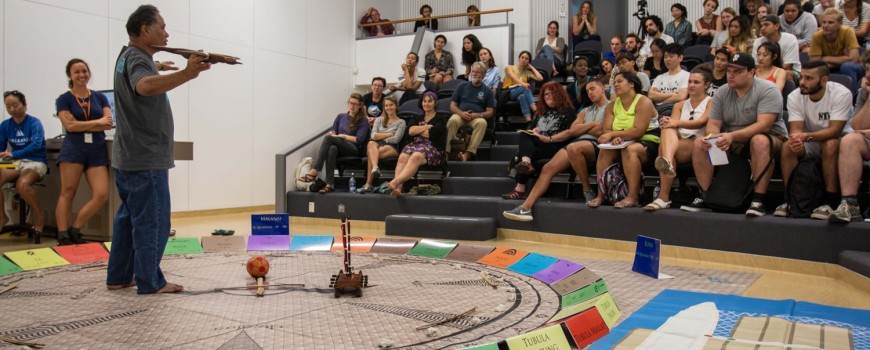
Pwo (Master) Navigator Kālepa Baybayan was invited to the University of Auckland to present the Hawaiian Star Compass and discuss the art of traditional navigation. I had the pleasure of attending and participating in the presentation as a crewmember on the Aotearoa Education Outreach Leg. The title of his lecture was He Lani Ko Luna, He Honua Ko Lalo translated as “The Heavens Above, The Earth Below.” According to Kālepa, “My job as navigator is for everyone to sail their waka to the correct horizon. The star compass is about the symbiotic relationship between all living things. The sky bears witness to actions on the land.” He taught participants that the world is our classroom, and reawakened me to the idea that there are answers found in the oceans, land, and skies that surround us.

IMG_4527This is my third leg on Hōkūle‘a’s Worldwide Voyage with Pwo Navigator Kālepa Baybayan as my kumu, captain, navigator, and hero. My first leg was from Hawai‘i to Tahiti; my second was from Pago Pago to Apia to Olohega; and my current leg is in Aotearoa. I learn something new each time under Kālepa’s tutelage, especially about how the heavens and oceans have deeply significant cultural and scientific connections.

On my three voyages with Kālepa, he has patiently trained me as an apprentice navigator. In doing so, I have had many opportunities to analyze and study the star compass with him utilizing practical applications at sea. However, while sitting in the lecture hall at the University of Auckland, I was able to engage with the star compass and his teachings on an intrapersonal level that opened my perspective on what our kuleana is on this Auckland Education Outreach leg, and how Kālepa is a perfect leader to guide us on this small journey of our larger Worldwide Voyage.

IMG_4579This Aotearoa Education Outreach leg is all about engaging with learners of all ages on what we are doing to mālama honua – care for our Earth, and how we are navigating our way – both metaphorically and physically on the voyage through our traditional celestial navigation. For myself, I’ve been able to share and demonstrate the star compass with students around the ages of 6-11. On this leg, Kālepa has been my alakaʻi, or leader, in conducting these demonstrations. The process is very simple and perfectly geared for learners of those ages. But in this college setting, it was interesting for me to see Kālepa transition his star compass teaching from 6-11 year olds to university students.

IMG_4596Instantly, I found myself looking at the star compass not as an apprentice navigator, not as an outreach presenter, but as an academic. Kālepa had seamlessly shifted his presentation, and made it applicable and interesting for these scholars. I was impressed, and reminded about the skill required to be an inspiring and effective educator. Kālepa is a skilled teacher, educator, and mentor; he teaches apprentice navigation on the canoe, he shares the star compass with children in elementary school, and even adults in a university setting. At each of these presentations, I have witnessed a change occurring. Our mission is to perpetuate the art and science of traditional Pacific Island voyaging and the spirit of exploration through the world as our classroom. We transfer knowledge of natural elements such as the stars, winds, and ocean waves to our schools in the form of science, technology, engineering and mathematics. People are seeing that the star compass is not just a compass – it is a reminder that the world is our classroom. And at the same time, there is also an understanding that it takes both academics and an intimate relationship to place in order to really learn in this world.

IMG_4577It is my understanding that the star compass is rooted in both mathematical practice and cultural wayfinding knowledge. For example, the Hawaiian star compass is comprised of 32 equidistant star houses each 11.25 degrees apart. There are markers and indicators on the canoes that reminds us of these navigational markers and mathematical ques. Then there are other markers or indicators that are constantly surrounding you when at sea – it is the heavens, the winds, the waves, and the living ecosystem swimming along the canoe or soring above the sails. The edge of the star compass is the horizon, where the sky touches the land or sea. Everything within those boundaries is a part of the compass – he lani ko luna, he honua ko lalo.

IMG_4606On this day, the biggest lesson I take away from the star compass is that the navigator is always aware of his/her surroundings and is able to make decisions based on guidance from the heavens above to the earth below. Kālepa has shown me by example how to translate our traditional knowledge to various participants. He has been instrumental in translating this art of navigation into curriculum that can be understood and valued in a classroom environment and ultimately, passed on to a next generation.

My kuleana is to follow in the treasured path of our ancestors in order to navigate a better future. As I continue to voyage, I will strive to always remember hero’s like Kālepa in order to find my way.


Please help keep us sailing for future generations. All contributions make a difference for our voyage. Mahalo nui loa!

Healthy Beaches, Motivated People

Kahi Pacarro, Executive Director of Sustainable Coastlines Hawaiʻi says that, “It can be a remote island in the middle of the Pacific, or it can be a very urban place lie Auckland, and you see the same stuff washing up on beaches. And it’s single use plastics, or broken down pieces of plastic.”

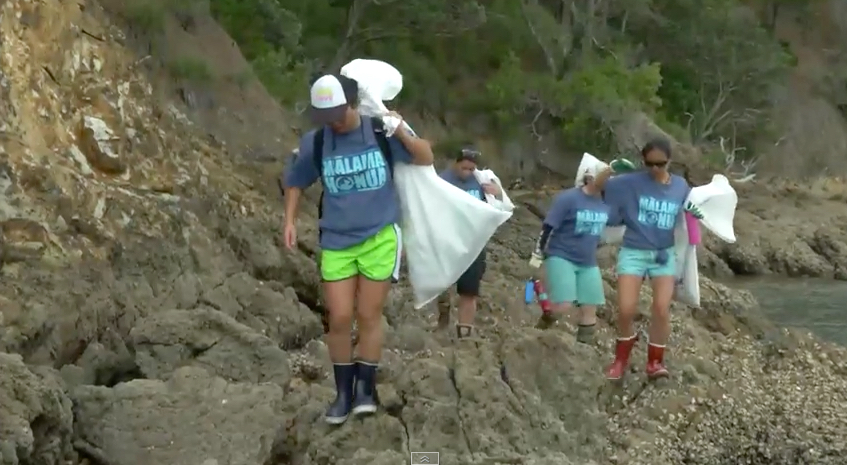
With a driving mission to protect their oceans, Sustainable Coastline coordinates an annual week-long “Love Your Coast Waiheke Island” event that focuses heavily on beach clean ups.

“Why do we do this? We love the ocean, simple as that. When you love a place, you look after it. Our mission is to inspire and educate people. And our vision is, healthy rivers, clean beaches, and motivated people.” says Sam Judd, Co-founder and Chief Executive Officer of Sustainable Coastlines.

The beach clean up event took place on Waiheke Island, which is about a 4 hour sail out of Auckland harbor. A task that the Worldwide Voyage crew eagerly jumped into as it was a positive action of mālama honua, caring for Island Earth.

“We are absolutely stoked to see the Polynesian Voyaging Society Hōkūleʻa team come and get involved today.” says Judd.

Worldwide Voyage crewmember, Barbara Blake, says, “We’re here on Waiheke Island with the Polynesian Voyaging Society and Sustainable Coastlines. I thought we were going to find a lot of trash all over the beaches here that we would be picking up. You know, constantly bending over and picking up. But what we actually found was, you know, far and few in between, pieces of garbage all over the beach. I think that’s a good thing for mālama honua. Expectations were that it would be really dirty. But, obviously, the folks around here are, practice mālama honua regularly.”

This active role of change perpetuated over a course of about 5 years, has led not only a decrease of plastics along the Waiheke Island coast, but more importantly an increase of appreciation and love for place.

“It’s beautiful, it definitely is makes this place unique. Everything about it, the walk – the journey that we’ve taken so far, the journey that we’ve climbed these different rocks you know, and it makes this place unique to the people here, and they definitely want to protect it, and sustain it, and keep it this way.” says Blake.

“Hōkūleʻa has this opportunity to share with the world that this issue is not just a Hawaiʻi issue, it’s not just an Auckland issue, but this is something happening worldwide. Together, we can fix this problem.” says Pacarro.

Share how you mālama honua your home, and support the voyage at hokulea.com. This is Kuʻulei Bezilla with ʻŌiwiTV, home of the Worldwide Voyage. Aloha!


Please help keep us sailing for future generations. All contributions make a difference for our voyage. Mahalo nui loa!

Ask the Crew | March 31, 2015

Ask the Crew | Ryan Hanohano: Where do you go to get out of the harsh weather? 

Wow, it’s really cold out there, guys. My name is Ryan Hanohano and we’re here aboard Hikianalia here in Auckland, New Zealand, and today’s question is from Kenneth, from Wahiawa. This question is “being out in the weather constantly is very harsh. Do you get out of the weather in some sort of shelter to keep you dry and to sleep in a dry place, where is that shelter located?”

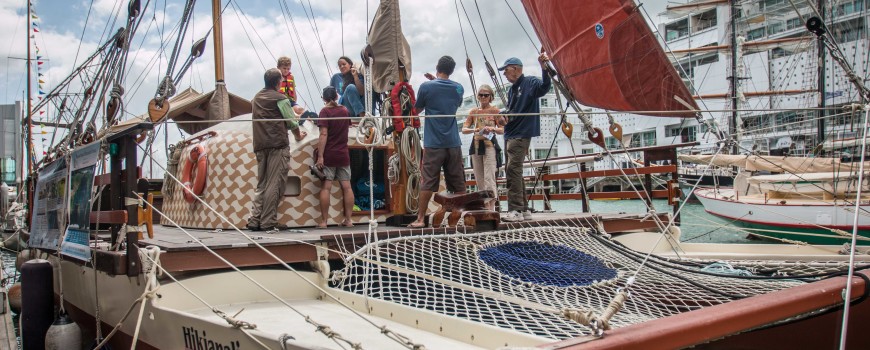
Well it’s funny that you should ask because right now, I’m sitting in the deck house of Hikianalia. When it’s cold and windy and rainy out there, sometimes we come inside here to get warm. As you can see, I have my foul weather gear on, and um, if sometimes we cannot be here, in the hale, we’ll go down inside the hulls where our bunks are so that we can have a rest. That’s what’s onboard Hikianalia, but on Hōkūleʻa, it’s not so easy. They have a tent-like canvas that goes over the railing from the moʻo or the gunnel of the canoe, and they can go inside the tent and try to get out of the weather that way. But it’s still a lot of water and wind that comes through that area. So we’re lucky to be here aboard Hikianalia where it’s a little bit dryer. Stay tuned until next time, follow us on Hokulea.com and do your part to mālama honua. Aloha!


Ask the Crew | Miki Tomita: How do people transfer between canoes at open sea? 

Hi this is Miki Tomita, and I am an education specialist aboard Hōkūleʻa and Hikianalia, for the Aotearoa outreach leg. This question comes from Quinn at Innovations Public Charter School. His question is “how do people transfer between Hōkūleʻa and Hikianalia at open sea?”

That is an excellent question and actually, we hope that we don’t have to transfer crew, one of the things that we are prepared for though as we are trying to sail, is in case of emergency, we do have protocol in place, and are trained in how to transfer crew members, whether they become ill, or if we need a specialist to transfer from one canoe to the other. We do practice those drills, and just hope that we never have to use them. That’s one of the rules that we kind of like to live by which is to prepare for the worst and hope for the best. Although we do have the protocol in place, we haven’t had to use it on any of the legs that I’ve been on or any of the costal sails so I’m very very grateful for that. Thank you, Quinn for that really awesome question, please continue to follow us on Hokulea.com and share with us how you mālama honua in your community. Thank you!


Ask the Crew | Barbara Blake: What happens if you go off track or someone gets hurt? 

Aloha, this is Barbara Blake calling you from New Zealand where we are staying at a beautiful marae. Today’s question comes from Sebastian at Punahou School Smart Surfers. He asks, “What happens when you are in harsh weather and crazy winds that you get off track or someone gets hurt?”

Well Sebastian, I want to let you know that safety is definitely our number one concern. Before we leave any port, before we even step foot on a waʻa, we go through multiple saftey trainings as crewmembers. Saftey is the number one concern of the captain, the navigator and the leadership who are involved with our sails. One thing that you always have to keep in mind is to remain calm, remain collective, and to think in the betterment of the crew. Loosing control and getting a little super excited in those circumstances doesn’t help anybody so you’ve gotta remain calm in those situations. I think that the crew and especially our leadership have prepared by planning ahead and putting a medic onboard any long distance journeys that we happen to undertake. So we always have a medic onboard who is there to assess the situation and to make the according call on anybody who gets hurt along the route. Speaking of routes, if we do happen to get off course, either the captain or the navigator will be able to tell that and will be able to correct it and will get on track and usually tell the steerersman which way to correct in those kinds of situations. Sabastian again, thank you for that question. Don’t forget to let us know how you mālama honua and follow us at Hokulea.com


Please help keep us sailing for future generations. All contributions make a difference for our voyage. Mahalo nui loa!

Crew Blog | Sam ʻOhu Gon III: Mālama Honua – Weaving Into Our Living World

Tāmaki Makaurau (Auckland), Aotearoa (New Zealand)
On the morning of March 11th, 2015, we found ourselves standing before one of the most massive kauri trees in the forests outside of Auckland. Its huge trunk spoke of centuries of presence in a forest that had not been cleared of its timber, and in its shade we called a chant of forest entrance. “Kuʻu moho kiʻekiʻe lā i uka” one of the lines of the chant says, “My beloved and magnificent champion of the uplands.” A more appropriate phrase you could not hope for in this situation. And after the chant was completed, in the waiting silence that followed came the call of birds, and the clicks and trilling sounds of the forest insects. “Hoʻāla ana ʻoe me he manu ke kani nei i ke kuahiwi, i ke kualono” (You awaken me as if with the songs of birds in the uplands, on the ridges).

IMG_3929

In moments like these we realize most strongly our place in the natural world. To weave ourselves back into the tapestry of our living world is the pahuhope, the ultimate ending goal. Whether at home in Hawaiʻi or 4,500 miles away in the mountains of Aotearoa, that respectful and protective relationship of guarding the living world as family, as ancestors, is the essence of mālama honua.

How heartening then to realize that we are not alone in that stance, that it is shared by our Māori cousins in the Ngati Tūhoe, and wielded as the fundamental approach to their kaitiakitanga (sacred guardianship) of the resources of their lands and waters. We realized that shared approach even in the similarity of names of plants in the forest around us, the kiekie vines that we in Hawaiʻi call ʻieʻie, the pua rata (flower of Rata) that we call lehua, but in the next breath recognize as a sacred kino (physical presence) of Laka. The language similarities, that linguists call “shared cognates,” indicate a fundamental similarity in worldviews. Anyone who knows about Hawaiians and Māori agrees that despite huge distance, those similarities are strong indeed!

IMG_3943

On the practical side of it, you can substitute a Māori “k” for a Hawaiian glottal stop, and turn the West coast place of Waikanae into our Waiʻanae (also west-side), or kiekie into ʻieʻie. After a short time you can also automatically switch the Māori “r” for the Hawaiian “l” and the Māori “t” into Hawaiian “k” and convert Rata into Laka, our goddess of hula. And even the major Māori atua (deities) are the same as our Hawaiian akua: Tū is fierce and hot-blooded Kū. Tāne is our Kāne imbuing life. Tangaroa and our Kanaloa embody the sea and the processes linking the sea to land.

But as an ecologist, the characterizations of the major akua speak far more about prevailing ecological process than they do about mythological character development. They speak of the seasonal heat of the summer season, and all the species that come to prominence during those times. They convert process into a reality that is comprehensible because of the association of an atua with a particular kind of plant or animal. To name a huge tree Tāne-mahuta is to describe the tree as a provider of life, a foundation for hundreds of species of epiphytic plants, birds nesting and foraging in its boughs, insects spending their entire lives under its bark.

IMG_3970

When New Zealanders think of the kiwi as a national icon, even as a nickname for someone considered a New Zealander, how that contrasts with the Māori ceremonial name for the kiwi as te manu huna o Tāne, the hidden bird of Kāne, god of forest. The pilina, the connection, between kiwi and the tangata whenua (people of the land) then becomes something far greater than a cute national icon; it becomes the continued physical presence of gods who are ancestors of us all. And THAT is perhaps the most powerful motivation for natural resource conservation that one could conceive.

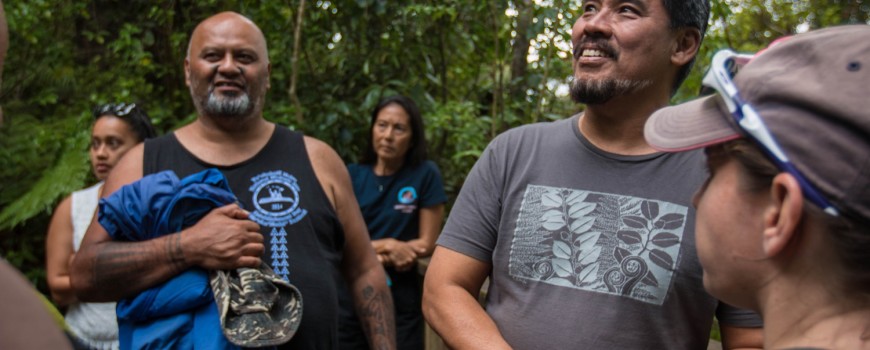
Such were the messages shared with us by Chaz Doherty artist, teacher, rangatira (tribal leader), and kaitiaki (conservation manager) for the Onukurangi biosphere in the Waikaremoana tribal authority in Te Urewera, who came up from the heart of Te Ika a Māui (the fish of Maui: North Island) where the Tūhoe people, Ngā Tamariki o te Kohu (The Children of the Mist) hold fast to their ancestral lands and waters. The forests of Te Urewera, until recently described as the largest National Park of New Zealand, has been conveyed by the Crown to the Tūhoe for their care. The Crown has relinquished ownership, and asked that the Tūhoe do the same, but for the Tūhoe it was never a matter of ownership. They say “We don’t own the land, but the land owns US!” “He aliʻi ka ʻāina, he kauwā wale ke kanaka,” Hawaiians say: The land is the chief, the people merely servants.

IMG_4051

The shared relationship of servant guardianship of the land that Māori and Hawaiians hold reflects in the aloha they express for their places. The most persistent and intense kind of care is that which springs from aloha, and no argument of economies or ecologies supersedes that! Yet the role of science, or technology, as ways to better know our resources are not necessarily at odds with this. When Tūhoe managers use radio telemetry to track kiwi nests, or learn the age of their freshwater eels by counting the concentric rings of otoliths in their heads, they consider it additional useful knowledge about the kino of the ancestors they are caring for, and it detracts not at all from their relationship with them.

If that relationship can be shared between people separated by thousands of miles of ocean, a relationship that respects and cherishes the living elements of a place as the continuity of the presence of the ancestors in modern times, and not as commodities, it offers a message of hope. If everyone in the world viewed their places and their natural resources in this way, how much richer would our collective existence be, and how much lighter our footprint. This is the gift of Mālama Honua to the world.


Please help keep us sailing for future generations. All contributions make a difference for our voyage. Mahalo nui loa!

Ask the Crew | March 23, 2015

Ask the Crew | Kalepa Baybayan: How many levels of Pwo do you need to know to become Pwo? 

Aloha, this is Kālepa from onboard the sailing canoe Hikianalia. The next question is from John from Nå Kålai Waʻa o Kauaʻi. So how many levels of pwo does a person need to know before he becomes pwo, and how many documented sea miles does a person have to have before he becomes Pwo? Well I’m not sure exactly how many levels one has to know. But we were brought into the hierarchy of pwo navigators in 2007 by Mau Piailug, and he must have thought that we were well qualified to be recognized as pwo. There is no set limit of miles that you need to have to become pwo. But trust me, it’s substantial. Each pwo has about 20,000 to 40,000 miles at least under his belt before becoming pwo, and I will have several more thousand miles under my belt by the time I get done with this voyage. Anyway, tell me how you mālama honua, John, and you can follow us on Hōkūleʻa.com. A hui hou.


Ask the Crew | Tara O’Neill: What items did you bring to help you travel? 

Aloha, this is Tara O’Neill from Te Mahurehure Marae in Auckland, Aotearoa. I’m answering a question that comes from Chelsea at Radford High School. The question is “what items did you bring with you to help you travel?” Chelsea, that is an awesome question and actually one that I had to think a lot about when I was packing because we have a slightly different leg. For this portion of the voyage, we’re primarily a land-based crew. For this month, we are doing educational outreach and community activities around the North Island of Aotearoa. So we had to bring a bunch of different things. We do day sails, and then we also do outreach and community activities. Some clothing for outreach kinds of things are jeans and mālama honua t-shirts and then some clothing for sailing. For example, when it gets chilly, my rain pants, and maybe a rain coat to get myself nice and warm for when the winds breeze up and the rain comes in. Then, if it gets a little chilly at night, when the winds are really coming in off the water, just slide on a rain hat or my winter hat. And of course for the sun, you gotta have your shades. So Chelsea, thanks so much for your great question, please continue to follow the voyage, at Hokulea.com and join our community. Thanks so much!


Ask the Crew | Tara O’Neill: What has been the most memorable moment of the voyage so far? 

Kia ora, this is Tara O’Neill from Te Mahurehure Marae in Auckland, Aotearoa. Today’s question comes from Kiono from Innovations Public Charter School. He’s in the eighth grade there. The question is what “has been the most memorable moment of the voyage so far?” So this crew, for this month of the voyage is primarily a land-based crew. We do day sails with smaller groups and then we do have a lot of education outreach. So one of my most memorable moments so far has just been the extraordinarily awesome people that I’ve gotten to meet when we go and visit different communities and different schools, around the North Island. Really, just the amazing grownups and parents and children that have come through to do some of the education outreach activities, like play with the cell scope where we do a plankton tow. We drag a net behind the canoe and then put a sample of the water on a microscope slide and then we use this cell scope thing which is a super cool microscope that works off your iPhone. It helps to really engage with folks and see the little tiny plankton critters that swim around in our oceans and help us put oxygen in the atmosphere to keep our food chain running. That’s really been the most fun. I would say, meeting cool new people, learning about the culture here, learning about the kinds of things they’re trying to do to mālama honua, and some of those “Oh wow, look at those little swimmer guys in our waters” moments. Thanks so much Kiono for a great question, and please continue to follow the voyage at Hokulea.com


Please help keep us sailing for future generations. All contributions make a difference for our voyage. Mahalo nui loa!

Update | Aloha from Mark Towill

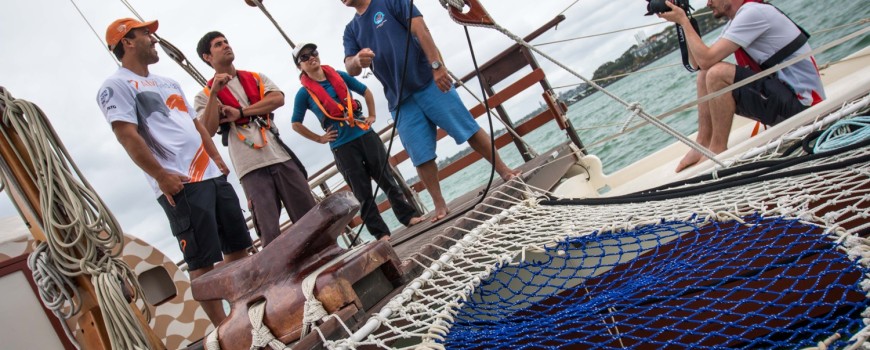
Aloha! My name is Mark Towill, racer and general manager of Team Alvimedica, coming to you from the deck of Hikianalia. We’re here in Auckland, New Zealand and out for a training sail. It has been a great day. I haven’t been on one of these canoes for a long time. I was quite involved with the Polynesian Voyaging Society back when I was in high school. In the last couple of years, I’ve been racing sail boats professionally, and I am here with the Volvo Ocean Race that is going around the world right now. It’s fantastic to be here at the same time as Hōkūleʻa and Hikianalia and reconnect with the whole community and see some familiar faces from Hawaiʻi. So it has been a wonderful day and we’re just headed back in. So I hope you guys continue to follow us on Hokulea.com. Aloha!


Continue to follow the Mālama Honua Worldwide Voyage by visiting us online and joining our global movement towards a more sustainable Island Earth.

Continue Reading

Update | Hōkūleʻa Returns to the Ocean

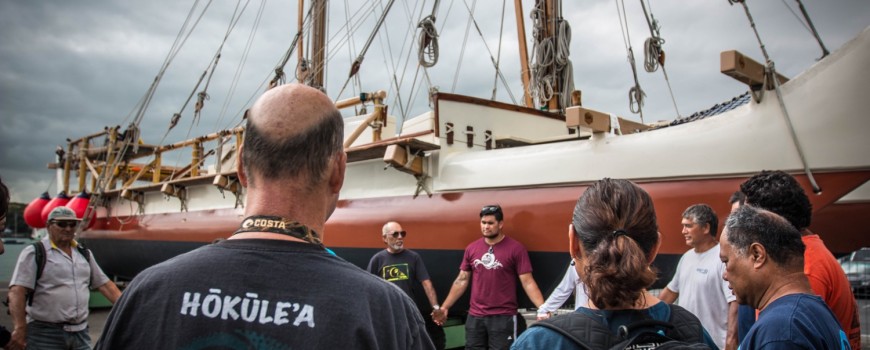
Hōkūleʻa is the creator of so many stories, memories, and lessons in forty years of linking people together and forming lifelong friendships. She is our home and provider on the ocean. She listens and nurtures us during rough times. She pushes us to the limits and drives us to strive for the highest. She is our mama waʻa.

On the eve of the forty year anniversary of Hōkūleʻa’s launch from Kualoa, Hawai’i, it was only right to spend our last day in dry dock with her in Aotearoa making her as beautiful as we can and getting her ready for her return to the moana nui. Hōkūleʻa looks beautiful and is ready to get back in the ocean and continue sailing.
Until tomorrow,
Moani H.

Continue to follow the Mālama Honua Worldwide Voyage by visiting us online and joining our global movement towards a more sustainable Island Earth.

Continue Reading