Crew View (from Mark): strange creature in the dishwater

Aloha from the 10-2 watch.

We are having a great day. It’s a little hot in our bunks.

In preparation for dish-washing duties this morning, when a bucket full of water was brought up, we found little creatures in our bucket.  We brought out our portable zoomy microscope, and this is what we found (see attached image).  We are not sure what they are; some on board think they are copepods.

We can’t wait to get Hikianalia to Hawaiʻi and start integrating her with Hōkūleʻa for the Worldwide Voyage.  She will be a great asset in support of the education mission of the Worldwide Voyage.

On a side note, we caught an Aku… Mahalo to our Fisherman, Keala.

Aloha until next time, Mark Ellis

Continue Reading

November 6: Turning on the solar-powered electric motors in light winds; a powerful, but brief squall

November 5: Sunset Report

The day started with a calm, peaceful sail with easy steering – too calm as the wind dropped off quite a bit and we really slowed and had  to turn back west.  So far west that we tacked east to head back toward our reference course line.  We were going so slow that the captain decided to  utilize the solar-powered electric motors that Hikianalia is equipped with to gain a knot or so of speed.

As Hōkūle’a’s companion vessel, Hikianalia will need the motors for certain support activities.  We need to test these  motors, learn the intricacies of the electrical system that powers them and also make some mileage toward home.  We accomplished a good deal of that today.

Just as this report was being written, a powerful squall hit Hikianalia.  We experienced winds in excess of 40 knots and a heavy downpour of rain for about  half an hour.

Our largely inexperienced crew did a terrific job of quickly and safely dropping the jib (foresail), dropping the mizzen (back sail) and  reefing (reducing in size) the main.  Everyone got soaked but had a great training opportunity and they all performed really well in their first true test  of this voyage.  The “first-timers” are neophytes no more and have their own sea story to tell.  The wind has mellowed after the passing of the squall and  we have shaken out the sails and are making 4 knots toward Na Leo Ko’olau.

  • course:  What we accomplished today – east of north, heading 005 degrees True, Haka Ko’olau.  What we’re trying for now – east of north, 020 degrees True, Nā Leo Ko’olau. (See star compass below).
  • speed: 3 knots at 6 pm, 4 knots now (8 pm)
  • weather: increasingly overcast with dark gray cumulous clouds all around, one small shower  today – watching squalls all around all afternoon, then the big one hit us right at 6 pm.  No high clouds, warm, humid
  • wind: East 5-10 knots
  • sea state: North-East 4 to 5 feet, East 1 to 2 feet, South 1 to 2 feet, very gentle rollers – easy steering.

Hawaiian Star Compass (Click on the link for an explanation of the names of the directional houses of the compass. Click on the compass for a larger image.)

For Complete Sail and Education Data, see the Tracking Map.

November 5: Sunrise Report

The squalls really tested the crew’s focus and training during the night.  They performed to a very high standard of both skill and  safety.  The canoe handled the conditions smoothly and was very user-friendly.  She runs very well balanced with just the foresail and mizzen.  As a result  of less than generous winds, we were only able to make 33 nautical miles last night between 6 pm and 6 am.  The good news is that our resultant course,  despite a track that looks like cursive handwriting, was Nā Leo Ko’olau (17 degrees True), leading us toward our desired course line, now 100 nautical miles  to our east.  Our efforts to gain more easting will continue today.

Note from Mike: Last night was the first time anyone laid eyes on the star Hikianalia and the wa’a kaulua Hikianalia simultaneously.  As someone who first  saw her in March of this year – incomplete, in a dark shed, covered with sawdust and construction debris – to see her running free in the South Pacific  brought a tear to each eye and filled my breast with love.  I can hardly wait until she sees her sister star, Hōkūle’a, in a few more degrees of northerly  latitude; then to see the sister stars rise simultaneously and turn downwind for her new home.  I cannot wait for Hawai’i to welcome this beautiful wa’a  into the ‘ohana.

Celestial Observations, Navigation Stars, Planets and Moon Phases

6 pm to 10 pm watch – Our heading at the beginning of the night was Haka Ko’olau.  Just  as we assumed watch, the first heavy squall of this leg hit suddenly.  The wind mellowed after the passing of the squall and we shook out the sails and were making 4 knots toward Nā Leo  Ko’olau.  There were no stars available, so we were steering by staying as high into the wind as we could in order to make easting.

10 pm to 2 am watch –  We got on watch with the wa’a riding with only the mizzen and working jib.  Immediately after taking the helm we got hit by another squall.  Winds picked up  and so did the sea chop, putting a good amount of strain on the hoe, and tossing us around a bit as the short swells pushed the hoe around.  We balanced out  the sails – easing the mizzen and pulling in the jib – and the incredible wa’a Hikianalia was soon riding smoothly through the turbulence.

Conditions  improved through the rest of the watch, and by the time the next watch came on, a beautiful starry night and great sailing winds prevailed.

2 am to 6 am  watch – We picked up the helm with a beautiful sky of stars above and maintained a course of Nāleo/Nālani Ko’olau. In the early hours we were able to follow  Nānāmua and Nānāhope (Castor and Pollux) in Nāmahoe (“The Twins,” Gemini) once again, as well as the ‘Olekūlua moon (see Hawaiian Lunar Month)  in Cancer off our starboard beam and Kalanikauleleaiwi (Achernar) to the  south. These became quickly obscured as we passed under an “arch of doom” – a dark arc of cloud and its accompanying squall – but they emerged again once  this passed.

Later in the morning we followed Venus rising in Hikina, and for the first time laid eyes on our namesake star, Hikianalia, which rose in Lā Malanai just before dawn.  After sunrise we were able to raise the main sail once again and gain some speed, however, true to the pattern of our previous  mornings, our course has fallen off a bit to Haka Ko’olau. (See Hawaiian Star Lines.)

  •  east of north, heading 005 degrees True, Haka Ko’olau
  • speed: 5 to 6 knots
  • weather: changing.  Overcast cover most of the sky overhead (7/8 coverage).  Families of squalls all around.  Still no high clouds.
  • wind: North of East, 10 knots; some light and variable periods; some localized high winds associated with passing squalls.
  • sea state: North-East 4 to 5 feet, East 1 to 2 feet, South 1 to 2 feet, very gentle rollers – easy steering.

For Complete Sail and Education Data, see the Tracking Map.

Continue Reading

Crew View: Nikki

November 5, 2012

Aloha pumehana kākou,

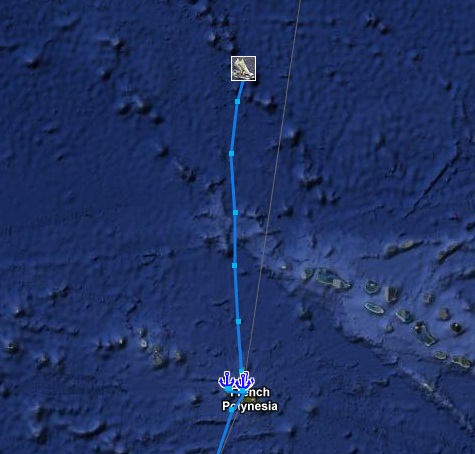
We are three days out at sea and Hikianalia has been steadily making her way north, but she is slightly off the reference course line in the east-west direction.  We made our first tack today to gain some easting to get back on our desired track. This may factor into the trip’s overall length of time. (See the Tracking Map.)

Indeed, Hikianalia is new and impressive and in many ways different from Hōkūleʻa. Nonetheless the practice is the same.  Thanks to modern technology equipped onboard, we have the ability to communicate with folks on land via email.  We are constantly thinking of our families, friends, and loved ones that we left in Tahiti and those that we will soon reunite with back in Hawaii.

This is Hikianalia’s first voyage ever, and personally it is mine too.  I’m very grateful and privileged for this opportunity to gain more deep-sea experience on a double-hull voyaging canoe. I’m constantly learning so much about sailing, wayfinding, and the importance of safety, especially from my watch captain. I have the 6-10 watch with Maka, Mike, Hiapo, and Keli. Usually on our watch Hiapo is the first to take up the steering, Keli is preparing a delicious meal for the entire crew, Mike is working on his daily report while standing by to take the hoe ‘uli next, and Maka is always finding work to do.

As far as navigation, we are currently using a GPS device, but we are progressively learning to use the elements of our natural surroundings including the sun, moon, stars, wind, and swell. Last night I had the chance to observe the night sky with some fellow ho’okele hoa.  I was awake long enough to gaze at three of the major star lines:  Manaiakalani, Ka Lupe o Kawelo, and Ke Ka o Makaliʻi.  (See Hawaiian Star Lines.)

Life at sea right now is going splendidly, and I hope for a safe and pleasant journey for Hikianalia and its crew to Hawaiʻi. Mahalo and a hui hou!

Nikki Kamalu

(For more on Nikki and her watch crew, see  Hikianalia Crew List: Tahiti To Hawai‘i, 2012.)

Continue Reading

November 5: pinching east, tacking east

November 4: Sunset Report

We had another very calm, peaceful sail today with easy steering, complicated only by the need to pinch closely to the wind without luffing the sails.

The wind was still forcing us to sail further west than we would prefer, and worse yet, toward Caroline Atoll.  So we tacked over to a port tack and traveled on a course of 110 degrees True (‘Aina Malanai) for about 13 nautical miles to give us sea room east of the atoll.  Then, we tacked back to our normal starboard tack and our current course of 10 to 15 degrees True (Haka Ko’olau).

We are west of our reference course line (the straight line on the map below, to the right of Hikianalia) by about 94 nautical miles and are looking for any opportunity to pinch more easterly.

Graphic below: Easterly winds are pushing Hikianalia to the west (left) of her course line. Hikianalia is aiming to arrive 150 miles east of Cape Kumukahi, the easternmost point on the Big Island of Hawai’i, for an easy downwind sail to Hilo. (See the complete course line on the Tracking Map.)

Morale remains high and everyone is well.  The aku was ono today.  Over the last 24 hours, we made 98 nautical miles on a heading of 009 degrees True (Haka Ko’olau).

  • course: east of north, heading 10 to 15 degrees True, Haka Ko’olau
  • speed: 3.5 knots
  • weather: mostly clear overhead with puffy cumulus clouds all around the horizon, no showers today, no high clouds, warm, humid
  • wind: East 10-15 knots, at sunset we had a period of light and variable winds making steering difficult
  • sea state: North-East 4 to 5 feet, East 1 to 2 feet, South 1 to 2 feet, very gentle rollers – easy steering.

Hawaiian Star Compass (Click on the link for an explanation of the names of the directional houses of the compass. Click on the compass for a larger image.)

For Complete Sail and Education Data, see the Tracking Map.

November 5: Sunrise Report

The winds really tested the crew’s focus and steering during the night.  It is an interesting phenomenon that steering is far easier in brisk winds than in light airs.  As a result of less than generous winds, we were only able to make 27 nautical miles last night between 6 pm and 6 am.  The good news is that our resultant course, despite a track that looks like cursive handwriting, was Na Leo Ko’olau (19 degrees True), leading us ever so slightly toward ourr desired course line.  Our efforts to gain more easting will continue today.

  • course: east of north, heading 005 degrees True, Haka Ko’olau
  • speed: 4 knots
  • weather: changing.  Overcast spreading to cover more of the sky overhead.  Families of squalls all around.  Still no high clouds.
  • wind: North of East, 10 knots; some light and variable periods; some localized high winds associated with passing squalls
  • sea state: North-East 4 to 5 feet, East 1 to 2 feet, South 1 to 2 feet, very gentle rollers – easy steering.
For Complete Sail and Education Data, see the Tracking Map.
Continue Reading

November 4: another day of peaceful sailing, but praying for more southerly winds

November 3: Sunset Report

We had another very calm, peaceful sail today with easy steering.  The wind is still forcing us to sail further west than we would prefer.

We are now off our reference course line by about 80 nautical miles and are looking for any opportunity to pinch more easterly.  If the reports are beginning to sound the same, we know how you feel!  Help us pray for more southerly winds, please.  We want to turn more to starboard!  But, morale is high, everyone is well and we are all enjoying this wonderful opportunity for learning and growth.

  • course: west of north, heading 350 degrees True, Haka Ho’olua
  • speed: 6 knots
  • weather: mostly clear overhead with puffy cumulus clouds all around, no showers today, no high clouds, warm, humid
  • wind: East 10-15 knots
  • sea state: North-East 4 to 5 feet, East 1 to 2 feet, South 1 to 2 feet, very gentle rollers – easy steering.

Hawaiian Star Compass (Click on the link for an explanation of the names of the directional houses of the compass. Click on the compass for a larger image.)

  • steering: by sun, wind and swells.
  • animal Life: We caught another ono – like his brother, he also tasted ono.
  • sea birds and sea life: Only a few terns and boobies at sea.  One bird pile was working on our course but no strikes when we sailed through it.
For Complete Sail and Education Data, see the Tracking Map.

November 4: Sunrise Report

The winds improved during the night so that we could steer a little east of north (haka ko’olau/na leo ko’olau) while maintaining 6 knots.

Our crew enjoyed another gentle night of smooth sailing and easy steering.  Between 6 pm and 6 am, we gained 68 nautical miles on a heading of 007 degrees True (haka ko’olau).  A little better, but still west of our desired course line.  Our efforts to gain more easting will continue today.

  • course: east of north, heading 007 degrees True, Haka Ko’olau
  • speed: 6 to 7 knots
  • weather: about half the sky is scattered with low puffy cumulus clouds with no vertical stratification.  They do not contain much moisture.  No high clouds.
  • wind: North of East, 10 to 15 knots
  • sea state: North-East 4 to 5 feet, East 1 to 2 feet, South 1 to 2 feet, very gentle rollers – easy steering.

Celestial Observations, Navigation Stars, Planets and Moon Phases: Our heading for the night has been Haka Ko’olau. On the 6 to 10 pm watch, we used Makali’i;  the Navigator’s Triangle of Pira‘etea (Deneb), Keoe (Vega) and Humu (Altair); the stars of Ke Ka O Makali’i, Ke Alii Kona I ka Lewa (Canopus) and the moon to steer by.

As the night went on, we used Ke Alii Kona I ka Lewa (Canopus) in the south and the stars of Hokulei in the north – keeping them just right of the mainsail early in the night and then just left of it later in the night as they moved west across the sky.  We also steered by the moon, which rose in Namahoe (nana mua and nana hope).  As always, the rising sun is always our best steering guide and directional reorientation each morning.

Animal Life: We caught an aku this morning – poke tonight!

Sea Birds: One iwa accompanies us now and again, eyeing the lures on our fishing lines.  There are only a few terns and boobies this far out at sea.  One bird pile was working on our course but no strikes when we sailed through it.

Continue Reading

Crew Views: Keala and Darienne

November 3: Blog from Keala

Howzit gang/crew!

We are a few days out and the score is: Fish — 2, Keala — 1.

The potential for injury is very real. I always considered myself pretty good on a boat.  But the other day we had a man down (me) due to fishing.

While setting the hand lines on the first day, not too far from Tahiti, the whole crew watched as a good-sized ono came in and tried to grab the lure. He hit and missed it three times, and on the fourth hit, the lure stuck. The ono maxed out the rubber on the hand line.

As I braced for the battle, the fish flew me from the aft deck to the very back of the boat, where I wedged myself until the gear broke and left me with the biggest black and blue thigh I have ever had.  So, right from the get-go: Fish — 1, me — 0!!!

It seems that in the morning when I set the lures, we get the strikes. The second day, as I was setting the other side’s hand line on the  wa’a, I had the line wedged and pinched by standing on it, but when I  tried to tie the hand line off, it went completely off! The whole rig gone.  Fish — 2, Keala — 0!  (Sorry, Bruce.)

But later that day we scored an ono — about 15lbs.  Yeah!  Keala — 1!!!

We are fishing hard from sunup ’til sundown. On sailing vessels, it’s  not that easy. Trying to hold a course and get somewhere does not help the fishing.

ʻTil next time, aloha Crew!

Keala

November 3: Blog from Darienne

Aloha mai!

Our journey beyond Pape’ete has been as smooth as peanut butter thus far.  After initially trimming our sails, we’ve been able to maintain our course using just the hoe (steering paddle).

Aside from a few small, refreshing squalls, the sky has been quite clear, allowing us to steer by  the moon (at times) and Huinakolu (the Navigator’s Triangle of Pira‘etea (Deneb), Keoe (Vega) and Humu (Altair). (See Hawaiian Star Lines.)  We even got to enjoy fresh ono  sushi today!   In other words, we’ve been blessed with optimal conditions (especially for us newbies) for transitioning to  life at sea.

Although our primary hopes for this journey are to arrive in Hilo in a safe and timely manner as well as to become ma’a with our mother Hikianalia, we also look forward to opportunities to increase our repertoires of mele/oli (so that we may all share in the kuleana of protocol) and to deepen our understanding and appreciation for the  legacy of which we are now a part.  Some of us have been designated with the kuleana of “education” within this particular crew, but we  all feel especially fortunate to be sailing with and learning from  true masters of their crafts.  Every moment has been a gift and a lesson.

In addition, it has been an honor to be working, learning, and laughing alongside my so many talented, generous, intelligent, and capable wahine crew members, who make up nearly half of the crew.  Like the constellation, we are Nā Hiku (“The Seven” or the Big Dipper) helping guide Hikianalia north toward our (and her new) home. Increasingly, both wāhine and kāne have been discovering their  strengths and weaknesses and have been adapting accordingly and  humbly.  But thanks in part to Keli’s amazing cooking, we get stronger as a crew every day.

A hui hou,

Darienne

(For more on Keala and Darienne, see  Hikianalia Crew List: Tahiti To Hawai‘i, 2012.)

Continue Reading

November 3: “… calm, peaceful sailing, with easy steering …”

November 2: Sunset Report

We had a very calm, peaceful sail today with easy steering.  The wind is still forcing us to sail further west than we would prefer.  We are off our course line by about 47 nautical miles and are looking for any opportunity to pinch more easterly.  See the Tracking Map. The new crewmembers are settling in and feeling right at home.

We caught an ono – which also tasted ono.  Only a few terns and boobies at sea.  One bird pile was working hard but they were off our course.

Happy Birthday, Cindy Perkins, from the Captain and crew!  Hau’oli la hanau!

  • course: 005 degrees True
  • speed: 7 knots
  • weather: mostly clear overhead now but large families of puffy, moisture-bearing cumulus clouds have been pass in from east to west  all day – we are now between two bands of these clouds to our east and west, several gentle showers bathed us today, no high clouds, warm
  • wind: East 10-15 knots
  • sea state: North-East 4 to 5 feet, more established and prominent; East 1 to 2 feet, South 1 to 2 feet, very gentle rollers – easy steering.
For Complete Sail and Education Data, see the Tracking Map.

November 3: Sunrise Report

Our crew enjoyed another gentle night of smooth sailing and easy steering.  Between 6 pm and 6 am, we gained 68.5 nautical miles on a heading of due north.  A little better, but still west of our desired course line.  The wind is a little tricky – for a brief time last night we were even becalmed, but we still averaged about 5.7 knots overnight.  We are pointing as high into the wind as we can, but we are forced a little west of our desired course line to avoid luffing the sails.  Our efforts to gain more easting will continue today.

  • course: 15 degrees True
  • speed: 7 to 8 knots
  • weather: about half the sky is scattered with small cumulous clouds, some reaching up into tall pillars.  They do not contain much moisture.  No high clouds.
  • wind: North of East, 10 to 15 knots
  • sea state: North-East 4 to 5 feet, more established and prominent; East 1 to 2 feet, South 1 to 2 feet, very gentle rollers – easy steering.
  • Celestial Observations, Navigation Stars, Planets and Moon Phases: Our heading for the night has been Haka (N by E) , trying for Nā Leo Ko‘olau (NNE). We used Makali’i (Pleiades);  the Navigator’s Triangle of Pira‘etea (Deneb), Keoe (Vega) and Humu (Altair); the stars of Ke Kā O Makali’i and the moon to steer by.  As the night went on, we continued to use the moon. (See Hawaiian Star Lines.)
Continue Reading

Mahalo to Hawaiian Airlines

Hikianalia has a new crew and she’s on her way from Tahiti to Hawai‘i.  The crewmembers of this second leg flew to Pape‘ete in time to see her arrive, and welcome the crew from the Auckland-to-Tahiti leg, who returned home earlier this week.  All of this air travel was made possible through the generosity of Hawaiian Airlines, which provided that important support to Hikianalia’s voyage home.

The crew members of Hawaiian Airlines’ sky wa‘a provided the perfect support to the crew of our ocean wa‘a.  Hawaiian Air’s coordinating staff was patient, understanding and flexible; its ticket counter representatives in both airports were helpful and so cordial.  Altogether, the Hawaiian Airlines staff navigated that important planning part of the voyaging experience.

Polynesian Voyaging Society has always relied on the good will and generosity of our community for support.  We couldn’t do what we do without our business partners.  Hawaiian Airlines, we are so grateful.  From Hikianalia’s crew and the Polynesian Voyaging Society staff, volunteers and leadership…

Mahalo nui loa and Mauruuru!

Continue Reading