Learning Journey (Fishpond Restoration): ʻAoʻao o Nā Loko Iʻa O Maui and Koʻieʻie Loko Iʻa, June 23

Maui (Miki Tomita) —

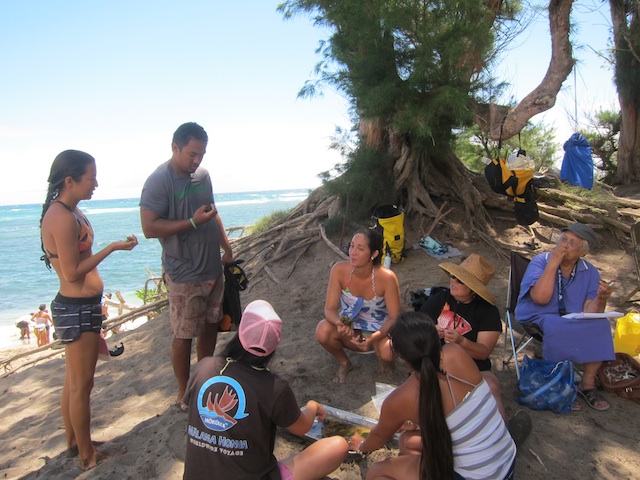
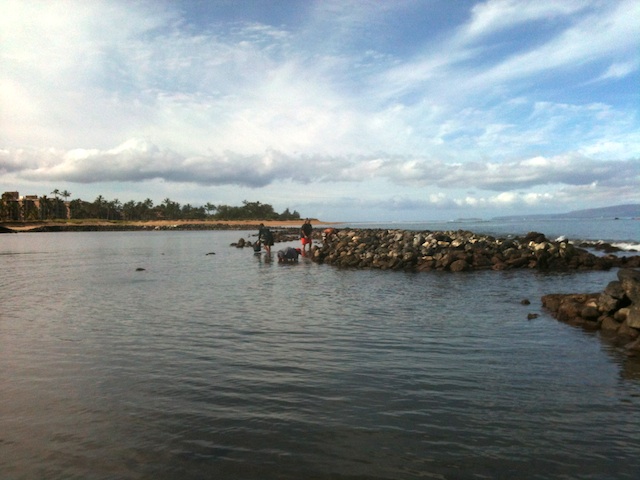
Crew members spent the morning learning from and working with the dedicated leadership of  ʻAoʻao o Nā Loko Iʻa O Maui, the non-profit organization dedicated to revitalizing Koʻieʻie Loko Iʻa for educational, archaeological, cultural, and recreational purposes.

According to the organization, “We feel that this fishpond is a symbol of the Hawaiian culture and history.  Therefore, it must be preserved as a monument to Hawaiʻi s past and an icon for the future.”

Led by Executive Director Joylynn Paman and President Kimokeo Kapahulehua, ʻAoʻao O Nā Loko Iʻa O Maui works to accomplish this by both physically restoring the 3+ acre loko kuapā, and by supporting community work days and education outreach to learners of all ages.

Ko`ie`ie Fishpond, also known as Kaʻonoʻulu Kai Fishpond and Kalepolepo Fishpond, is located in Kihei, in the Kaʻonoʻulu Ahupuaʻa of the Kula District of Maui.

lokoia1

Photo by Miki Tomita

As we worked side-by-side to gather pohaku that were moved off the wall by weather and human impact, our volunteer coordinator, Uncle Mack, provided us with moʻolelo and historical accounts related to this very special place.

Uncle Kimokeo, respected and beloved leader of this organization and community-building effort, posed thoughtful questions about the work we were doing at the fishpond to engage us to think deeper and find the multiple layers of meaning in this effort to revitalize rather than restore the fishpond.

According to Uncle Kimokeo, “to revitalize is not the same as to restore – we say revitalize because we want to be clear that the work has to bring back life into the community, from the organisms in the pond to the ones on the land, to the people”.

In addition to working to revitalize this community, Uncle Kimokeo travels the world in his canoe to learn and teach about sustainable living and the interconnectedness of all water of our Island Earth from a Hawaiian cultural perspective.  Thank you so much to the leadership and volunteers of ʻAoʻao o Nā Loko Iʻa O Maui for welcoming is into your work, and for all you do to support and develop commitment to mālama Hawaiʻi and mālama honua in our communities!

lokoia2

Photo by Joylynn Paman

Click here for more information about ʻAoʻao o Nā Loko Iʻa O Maui and Koʻieʻie Loko Iʻa.

Continue Reading

Learning Journey: Nā Wai ʻEha and Waiheʻe Limu Restoration Project, June 22

Maui (Miki Tomita) —

E ke hoa, aloha aina

O Akua ka po, Akua ka la,

Nani palena ole ke kau malie o ka mahina o Akua i luna o makou ka ohana o Hokulea ma Maalaea

Kau ka la i luna i kona hale, O Haleakala, Kipa makou ka ohana o Hokulea i ka aina o na kupa o Waihee.  Ua nanea makou i kahakai me na ohana e kanu  ka limu, e malama i ke kahakai o ia aina.  He la maikai no ia e malama honua.

– Mahina Hou Ross

Crew members spent the morning getting to know Maui from a limu-based perspective, with Alison Napua Barrows of Waiheʻe, Maui, through her work with the community and ecosystem of Nā Wai ʻEha, Maui. We joined kumu, kūpuna, and Maui ʻohana in learning about native and invasive varieties of limu, methods for removal and replanting, and different aspects of environmental quality and water systems particular to Na Wai ʻEha including the aquatic species within.

Crew and community helped to clean limu, separating invasive limu and other debris to prepare limu for planting. Kumu Napua and her group collect limu from Kanaha Beach, where the active surf and healthy reef provide fragments that can be gathered and sorted.  The limu is then replanted at Waiheʻe, in waters that Kumu Napua and her family have had the privilege and responsibility to mālama for generations

waieha1

waieha2

Photos by Kelly Kong and Miki Tomita

Captain Kealoha Hoe shared with the group information about the Worldwide Voyage and our focus on mālama honua and mālama Hawaiʻi; in particular, he shared about his ʻAi Pono program and how culturally-grounded foods and food practices are critical in keeping us grounded as we travel the world on this voyage.  Limu places a central role in traditional dishes, and limu knowledge remains part of the ʻAi Pono program.

waieha3

waieha4

Photos by Kelly Kong

A big component to this restoration project is strengthening the Waiheʻe community.  Kumu Napua envisioned the project to include weekend activities with keiki and kūpuna in the area: “It has helped the families, the families with generations before them who were fisherman on this very reef to reconnect to that knowledge and start teaching it to their children.  This has been a voyage for me, in a sense to return home, to be able to follow in the footsteps of my tutu, who passed the kuleana to me to mālama the ʻāina here in this area.  We work with other families to mālama this area, and we are fortunate to pass this along to the next generations.”

Kumu Napua also shared her personal experiences with Hōkūleʻa: “I have been fortunate to sail on Hōkūleʻa a few times with Nainoa, getting the feel of the ocean and winds… That short sail, and today’s experience with you, have only added to the learning experience and helps bring things into focus.”

Thank you so much to the leadership and volunteers of Waiheʻe Limu Restoration Project and especially to Kumu Napua Barrows for welcoming us into your work, and for all you do to support and develop commitment to mālama Hawaiʻi and mālama honua in our communities!

Kumu Napua Barrows, along with Crew Members on this Learning Journey Mahina Hou Ross and Matt Kanemoto, are members of the Kūlia I Ka Nuʻu program of the University of Hawai‘i at Mānoa's Curriculum Studies Department. This program focuses on supporting Hawaiian students' success in science and related STEM fields through providing professional development opportunities for teachers related to place- and culture-based education and participating in authentic science communities.

Click here for more information about the Kūlia I Ka Nuʻu.

Click here for more information about Kumu Napua and her efforts with the Waihe‘e Limu Restoration Group to restore both limu and cultural practices and knowledge associated with limu (article in Maui Nō Ka Oi Magazine).

Continue Reading

Hōkūle‘a and Hikianalia Set Sail on the WWV

METC, Sand Island, Honolulu —

Wa‘a kaulua (voyaging canoes) Hōkūle'a and Hikianalia set sail Wednesday, May 29,  on the Mālama Hawai'i leg of their four-year Worldwide Voyage (WWV). They are headed to Hilo for koa planting and other events on June 6-14, and will spend the next five months visiting communities in the Hawaiian Islands, before departing for Tahiti next May on the first international leg of the WWV.

Links:

Continue Reading

WWV Protocol Training: Reflections from Crew Member Maui Tauotaha

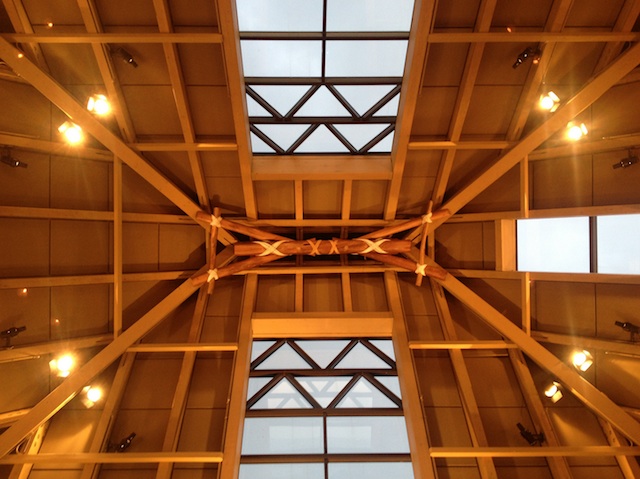
Kaʻiwakīloumoku Hawaiian Cultural Center,  Kamehemeha Schools Kapālama, Honolulu (April 20, 2013) — As I walk into the Hale Mana, I notice Uncle Pinky’s prayer at the entrance. Directly above us is the Kaupoku, or “ridgepole,” which is partly lashed with coconut sennit from Papa Mau.  It is comforting to see and feel these two kūpuna present during our first protocol training for the Worldwide Voyage.

We stand in a circle around the star compass and introduce ourselves. I try to introduce myself in ʻōlelo Hawaiʻi and am later reminded to use the “O Maui koʻu inoa” instead of “O wau Maui” during formal introductions.

Following introductions we move to the Māweke Moʻolelo room and sit amidst pictures of past voyages. We are reminded of the people and places Hōkūleʻa and her crew has touched across the Pacific.  One day soon, this will be us.

What is “proper protocol?”   Our alakaʻi describe protocol a number of ways and what sticks with me most are the values: respect, gratitude and humility.  When we visit these places around the world we will be guests.  The reason we practice protocol is in hopes of being “good guests” by treating our hosts in a manner that makes them feel good about hosting us.  One of the examples given to us centers around food: whenever we are offered food, we should eat it, even if we don’t want to for any reason.  Refusing food from a host is disrespectful.  The sharing and enjoyment of food is a good practice that crosses cultural boundaries.

In the Papa Hoʻomākaukau ʻAi we learn and practice a pule specifically composed by one of our alakaʻi, Pueo.  According to Pueo, “this general prayer of gratitude is intended to be acceptable by people of broad ranges of faith in seeking blessings of protection and enlightenment.”  Pueo is a vibrant teacher and aids us in memorizing our pule through visual cues.

We show respect to our hosts in many ways; one specific way we learn today is a “Mele Kāhea,” a chant requesting admittance, permission, and/or hospitality.  “A technique employed in forms of mele kāhea seeks the hospitality of a host by strumming the chords of sympathy through humility and grace.  To express hardships of exposure and travel displays humility; yet, to do so through oratory dignity exhibits grace.”  This mele kāhea, also composed by Pueo, is taught through his visual cue technique.

Another example of protocol is the exchanging of gifts.  We are encouraged to bring small gifts to share with our hosts.  However, a gift need not be a material thing.  A gift can also be given in the form of a mele, oli or hula. Our alakaʻi, Pueo, Keoni and Kaleo perform an oli and hula that we will hopefully learn in the near future and be able to share with our hosts.

We finish our day in the Hale ʻAha by singing “Hawaiʻi Aloha” and eating a meal of beef stew, rice, poi, and salad together.  Mahalo to all who helped make this day happen.

Continue Reading

Bringing Educators Aboard the WWV

Honolulu —

The first two months of Mālama Hawaiʻi (statewide sail 2013) / Mālama Honua (WWV 2013-1017) will focus on teacher training and bringing educators aboard the WWV.

WWV Education Open House, May 3

On May 3, at METC on Sand Island, PVS hosted an Education Open House with its WWV educational supporters Kamaile Academy (Public Charter School, Wai‘anae), Bishop Museum, STEMworks, Pacific Islands Climate Education Partnership (PCEP), ‘Ai Pono (Healthy Food for Hōkūle‘a and Hikianalia Crews), UH Mānoa College of Education’s Kūlia I Ka Nuʻu, and Propagate Peace, a school peace gardens project of University Laboratory School (Public Charter School, O’ahu) in partnership with the International School Peace Gardens.

At the Open House, Robert Witt, Executive Director of Hawaii Association of Independent Schools, also introduced the Mālama Honua Learning Center (MHLC), a new public charter school scheduled to open in Fall 2014  on Oʻahu.

A partnership between the Polynesian Voyaging Society and the Hawaiian Education Council, MHLC is committed to helping learners of all ages develop the “mind of the navigator,” a mindset that integrates contemporary and ancient academic skills, as well as the essential values of caring, courage, and integrity that are crucial for helping today’s young people chart a successful course through life. MHLC will help educators and other leaders cultivate new skills in themselves and their students – new ways of learning and doing that will help to shift global society in new and positive directions. Mālama Honua Learning Center will not only serve as PVS’s educational headquarters during the WWV and all future journeys, but will ensure that the voyage’s values and impact are sustained and nourished in perpetuity.

After the presentations,  charter school leaders from across the state were invited on a special sail on Hōkūle‘a.  Nainoa Thompson captained Hōkūle‘a, joined by teacher crew members from a number of charter schools who are training for the upcoming voyage.

During the late afternoon sail, Nainoa and Robert discussed the crucial role of charter schools in shaping and reforming education in Hawai‘i, as well as the place of Mālama Honua Learning Center in that process.  Nainoa also spoke to the charter school leaders about the need to bring education leadership together, with Hōkūle‘a and the Worldwide Voyage acting as a metaphor and catalyst to rethink education for a sustainable future.

Support from the University of Hawai‘i System, May 13

On May 13,  at the invitation President of the University of Hawaii System MRC Greenwood, Nainoa Thompson addressed UH educators, challenging them to join PVS to develop a sail plan to transform Hawai’i into a laboratory and model for cultural, environmental, and community sustainability, guided by kindness and caring; and to educate Hawai’i’s youth to carry out this sail plan. (See “UH partners with Polynesian Voyaging Society,” News UH System,  May 14 2013).

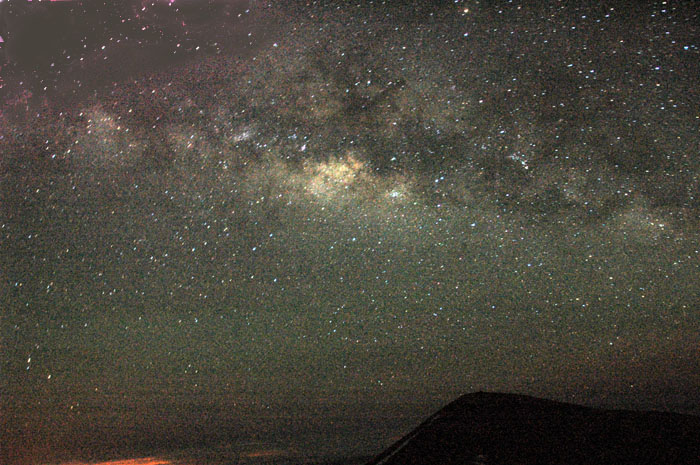
This vision for Hawai’i grew from the influences of Nainoa’s teachers, including PVS founder Herb Kawainui Kāne (1928-2011); Satawalese master navigator Pius Mau Piailug (1932-2010); big-wave surfer, lifeguard, and crew member Eddie Aikau (1946-1978); Nainoa’s father and community leader  Myron Bennett “Pinky” Thompson (1924-2001); and NASA astronaut Charles Lacy Veach (1944-1995). Nainoa and Lacy met once year on the slopes of Mauna Kea, under the stars, to share their hopes and dreams for their beloved Hawai’i, including inspiring its youth to explore, learn about, and care for their special island home.

Continue Reading

More events for Hawaiki Rising: Sam Low’s new book on Hōkūleʻa, Nainoa and the Hawaiian Renaissance

Honolulu and Hilo —

See the latest schedule below for events for  Hawaiki Rising: Hōkūleʻa, Nainoa Thompson, and the Hawaiian Renaissance, a new book by Hōkūleʻa crew member and documentor Sam Low.

To read a synopsis and the foreword by Nainoa, go to Sam’s Hawaiki Rising web page. See the April 25 post for pre-publication reviews.

About the Author: Sam Low served in the U.S. Navy in the Pacific from 1964 to 1966 and earned a Ph.D. degree from Harvard (in anthropology) in 1975. In 1983, after traveling throughout Polynesia, Sam produced his award winning film, The Navigators – Pathfinders of the Pacific, which told the story of the Polynesian settlement of the Pacific on PBS nationally and internationally on television venues throughout the world. He has sailed aboard Hokule’a on three voyages, from 1999 to 2007, and is the author of many articles on the canoe and her meaning to Polynesians.

Radio

May 14,  Tuesday, 8 – 8:30 AM

  • Chris Vandercook – The Conversation – Hawaii Public Radio, KIPO 89.3 fm, KIPM 89.7 fm and KIPH 88.3 fm.

May 16 – Thursday, 8:06 AM

  • Mike Buck Show  “Drive time,” KHNR 690

Events on O‘ahu

 May 18,  Saturday, Hawaii Book and Music Festival, Frank F. Fasi Civic Grounds, Honolulu Hale

  • 12 Noon Humanities Panel
  • 2 pm – 4:30 PM, with Nainoa Mission Memorial Auditorium
  • 5 PM  Book Signing – Barnes and Noble Tent

May 23, Thursday, 4:30 – 7 PM, Daughters of Hawaii

  • Queen Emma Summer Palace, 2913 Pali Hwy  Honolulu, HI 96817. (808) 590-2293

May 24, Friday, 5-6 PM, Book Signing

  • Bookends, 600 Kailua Rd  Kailua, HI 96734, (808) 261-1996

May 25,  Saturday,  Book Signings

  • 12 – 2 PM: Costo, Hawaii Kai
  • 3:30 to 4 PM: Barnes and Noble, Ala Moana

May 26,  Sunday, 3-5 PM, Book Signing

  • Na Mea Hawai’i/Native Books (at Ward Warehouse)

May 30, Thursday, 6-7:30 PM

May 31, Friday, 3-5 PM, Book Signing

  • Walmart Pearl City , 1131 Kuala St (808) 454-8785

Events in Hilo

June 4,  Tuesday, 10 -12 Noon, Book Signing

  • Walmart Hilo, 325 Makaala St  Hilo, HI 96720 (808) 961-9115

June 4 , Tuesday, After Dark

  • Volcanoes National Park, “After Dark in the Park” event

June 7, Friday, 7 – 9 pm

June 8, Saturday, 2 pm , Book Signing

  • Basically Books, 160 Kamehameha Ave  Hilo, HI 96720, (808) 961-0144
Continue Reading

Mālama Hawaiʻi: the WWV Continues

METC, Honolulu —

Hōkūle‘a and her sister canoe Hikianalia will sail 1,000-miles statewide, from May-October 2013, to connect with communities here before leaving for the South Pacific in May 2014. The canoes will visit 30 ports in the Hawaiian islands on their statewide sail. Click here for a Google Map with a Schedule and Location of ports.

Since 2008, PVS and ʻOhana Wa‘a have been preparing, planning and training for the Worldwide Voyage – a 45,000 nautical mile journey to circumnavigate Island Earth. Before leaving home in May 2014, we have a kuleana to our ʻohana and ‘āina (family and islands) to ensure that the voyage is pono and paʻa (good and solid).

Our vision to weave a lei around the world to mālama honua (care for Island Earth) starts at home; the five-month long statewide sail will strengthen the foundation for the WWV by bringing our diverse communities on board. We seek to engage leadership from these communities to support local efforts to shape sustainable food, energy and environmental practices and  to mālama Hawaiʻi.

The final leg of the WWV in 2017 will also be a sail around the Hawaiian Islands, with the two voyaging canoes bringing home gifts gathered from abroad: global knowledge and wisdom about we can all work together to mālama honua.

Objectives

The Mālama Hawaiʻi leg of the WWV will bring on board hundreds of volunteers working on various parts of the WWV, to share their knowledge, experience and ideas.  Under the leadership of ʻOhana Wa‘a, 500 crew members will be provided the leadership and safety training required for the next 22 legs of the WWV. At each stop, crew members will also be involved in community and educational outreach.

Community Outreach: Our voyaging leadership and crew members will coordinate and lead 36 public events and talk-story sessions in 30 communities. Moreover, they will participate in 30 service learning opportunities with communities who are caring for their coastal waters, lands and people.

Education Outreach: The first two months of Mālama Hawaiʻi will focus on teacher training, with 200 teachers and education leaders invited to be crew members. PVS will also work with 1,500 educators to pilot curriculum developed for the WWV and reach out to educators in every school in Hawaiʻi to participate in the WWV via our website at http://hokulea.org or through crew member visits. We plan to engage more than 25% of our schools in Hawai‘i with classroom presentations and invite 6,000 school children on board for canoe tours.

PVS will continue its youth leadership program and succession leadership training, as well as document the voices of our children and young leaders in Hawaiʻi, so we can share their messages of mālama honua around the Pacific and the world. PVS will also test scientific research projects aboard Hikianalia, gathering data on plankton, water quality, marine debris, and ocean sound, as well as testing an aeroponic system for growing fresh food plants at sea.

Documentation & Communications – PVS will test Hōkūle‘a‐to‐Hikianalia documentation equipment and protocol at sea and in port to ensure that stories gathered can be documented and shared with our communities and networks. Moreover, we will launch our media campaign to raise public awareness about the WWV.

Worldwide Voyage

The mission of Hōkūle‘a’s Worldwide Voyage is to navigate toward a healthy and sustainable future for our home, the Hawaiian Islands, and our Island Earth through voyaging and new ways of learning.

(To view the six-minute video at full screen, click on the expand button between “HD” and “Vimeo” on the right side of the control bar. Press escape to return from full screen video to this page.)

By voyaging around Island Earth, Hōkūle‘a and Hikianalia and their crews seek to elevate awareness of  inspirational people and organizations who are working to address global and local threats to communities and environments. By connecting as many of these efforts as possible, we hope to show how people can successfully meet challenges by working together as a single crew.

Protecting the Ocean

The WWV will join with other organizations in a global effort to protect the ocean because the ocean connects us all and is essential to the health of the planet. The ocean and its organisms play vital roles in the cycles of replenishment of water and air.  It’s a source of food and other resources that has to be protected from pollution and debris.

A rise in sea level due to climate change is also threatening islands and putting at profound risk  millions of island inhabitants who are experiencing measurable impacts such as the submergence of their ancestral homelands and loss of resources, leading to the abandonment of traditional practices and loss of cultures. As island and ocean people, we must take action to mālama Island Earth by learning more about it; raising awareness of issues facing the coastlines, reefs and deep waters of Hawaiʻi and the Pacific; and honoring leaders who are wisely managing ocean and coastal resources.
Continue Reading

Worldwide Voyage Receives First Major Sponsorship

HONOLULU —

In a significant display of support for the mission of the Polynesian Voyaging Society’s  Worldwide Voyage, Hawaiian Airlines has pledged to provide air transportation for PVS crew and cargo throughout Hawaiian’s route network for the duration of the four-year voyage.

Under a sponsorship contract signed the week of April 21, Hawaiian Airlines will provide 32 million air miles for  crew travel, as well as cargo support for supplies needed as the sailing canoes Hōkūle‘a and Hikianalia travel to international ports throughout the Pacific. The value of the sponsorship is estimated to be $1 million.  Hawaiian will be the lead sponsor of the voyage, which will be known as “The Worldwide Voyage Sponsored by Hawaiian Airlines.”

“We are deeply appreciative of Hawaiian’s extraordinary commitment to our mission to inspire young  people throughout the world to care for and sustain our planet, and to coexist in peace and compassion,” said navigator Nainoa Thompson, PVS president. “Sailing Hōkūle‘a has taught us the importance of understanding and  connecting with our natural resources. She is a reminder to us all of the need to celebrate and protect the natural and cultural treasures of Island Earth.”

“The Worldwide Voyage honors a legacy of connecting islands throughout the Pacific that Polynesian  navigators created centuries ago. It is our privilege as modern-day navigators and beneficiaries of that legacy to support this voyage and its message of sustainability and resource protection,” said Mark Dunkerley, Hawaiian  Airlines’ president and CEO. (To read more, see “Hawaiian Airlines Pledges Crew Travel and Cargo Transportation.“)

Continue Reading