By Sam ʻOhu Gon III
It was in 1998 that I was last in Rapa Nui with Nainoa Thompson. He was there, with other members of the Polynesian Voyaging Society crew, to make arrangements for the upcoming attempt to sail from Tahiti to Rapa Nui, such a tiny target in the vast Eastern Pacific Ocean.
Back then, I was serving as both naturalist and cultural advisor for the Kamehameha Hui Lama group, a student group focused on outings and science. With those students we were introduced to some of the amazing sites of the island: Rano Raraku quarry of the great carved moai ancestral figures of the people; Rano Kau, with its deep circular crater enclosing a large wetland; Orongo, with its low rock shelters of lava plates, overlooking the bird islands, and its boulders covered with the petroglyphs of the so-called Rapa Nui bird-man cult.
Along the way, Sergio Rapu was our guide and host; a Rapa Nui native, prominent community member (he had even been the governor of Rapa Nui) and one of the ground-breaking archeologists studying the moai and other anthropological and ethnological features of the island. Even at that time we avidly explored the connections between Rapa Nui and Hawaiʻi: our languages (so similar that those of us conversant in Hawaiian could haggle at the marketplace!), similar motif elements in our petroglyphs, and the role of oral tradition in the knowledgebase of Rapa Nui.
At the same time we noted how deforested Rapa Nui was: the vast majority of the island seemed to be grassland, and indeed, similar to some ecosystems in Hawaiʻi, there was a history of ranching on the island, with the same devastating effects on native forests. Nearly all of the grasses were introduced cattle fodder, and prominent among those, molasses grass, a major pest of Hawaiian dry and mesic forest, was prominent on the main shield volcano, Maunga Terevaka (which is the equivalent to the Hawaiian Mauna Kelewaʻa: Navigator’s Mountain!). Although the grasslands lent a pastoral beauty to the island, anyone knowledgeable of island ecosystems could see this was an island that had completely lost its native vegetation, and was now a sorry collection of introduced plants, transported from the rest of the world. As an ecosystem, Rapa Nui no longer held any of its original endemic distinctiveness.
 Scholars still argue whether the loss of Rapa Nui’s forest (and therefore wood for building voyaging canoes) was the result of unsustainable human exploitation of their forest. Or if it was the insidious predations of a human canoe animal: rats, which ate the seeds of the dominant trees, slowing or preventing their reproduction. Whatever the reason, it consigned the people to an isolated existence on an island all too easy to tip over into ecological oblivion.
In a manner all too similar to Hawaiʻi, the people of Rapa Nui suffered greatly from the consequences of Western contact. Diseases and slave trade took the native population down to a minimum of 111 people. In a culture relying on oral transmission of knowledge, such loss might mean that huge bodies of knowledge were lost, leaving descendants and modern researchers alike with only the bare archeology and scant traces of oral tradition to reconstruct Rapa Nui cultural history.
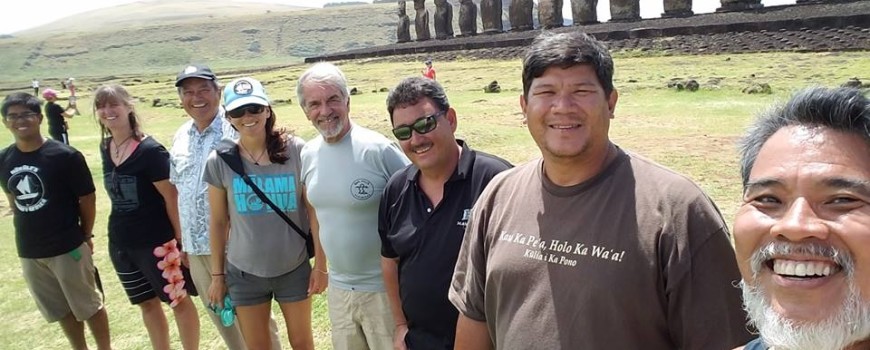
 Fast forward to 2017, 19 years later, with Hōkūleʻa returning to Rapa Nui, her first Polynesian landfall in home waters in the closing legs of the Worldwide Voyage. As part of an advance team with a mission to meet with both the Governor and the Mayor to officially ask for permission of entry, and plan the reception of Hōkūleʻa after 19 years, we landed at Mataveri airport, to be greeted, once again, by Sergio Rapu! Though twenty years older, he insisted on taking us to the major sites on Rapa Nui, where I had a chance to gauge how much the place had changed in nearly two decades.
 The roads were now paved nicely to all of the major sites: Tongariki, Rano Raraku, Anakena and its shrine Ahu Naunau, and Orongo. And where we could walk up to and pose standing against the walls of the ahu in times past, now subtle rope barriers indicated where we should advance no further. Two decades of increasing tourist visitation had necessitated protection of the sites from too much human traffic. There were far more cars than before, and we even were victim to the scourge of modern society: a traffic jam along one of the main cross-island roads, where it seemed every car on the island had converged to view one of the Tapati Festival’s most exciting events: the banana stump slide down a steep grass-covered cinder cone.
By the end of our short visit, the arrangements had been made to meet with both the Governor and the Mayor. As we stood at the main entrance to the mayor’s municipal offices, we offered oli welina: first a chant acknowledging our shared ancestry as Polynesian people–a chant I was taught specifically for Rapa Nui in 1998–followed immediately by Hōkūleʻa’s chant of entry, A Honua.
 As the chants ensued, heads of government workers popped out of their doorways, and the doors to the mayor’s office opened. Out stepped the mayor: Petero Edmunds Paoa, the same man who served as Mayor in 1998! As our chants ended, we were met with applause from the staff in their doorways, and the beaming smile of Mayor Paoa! As he shook our hands he mentioned to me: “I remember you from the last time!” Although official letters and emails had been received, this, in proper fashion, was the real official request for permission for Hōkūleʻa and a chance for us to prepare the way for her return.
Both Mayor Paoa, and Governor Carolina Hotu Hey offered support, and in the course of conversations with our host Sergio Rapu, I was struck by the fact that both the Mayor and Governor were fluent in Rapa Nui, their ʻōlelo makuahine! They could converse in English, Chilean Spanish, and Rapa Nui as-needed, and I wondered when there would be a day when our leaders in Hawaiʻi would be similarly fluent in the mother tongue of Hawaiʻi.
Although the ecological losses in Rapa Nui have been devastating, and the native people have gone through a much more horrific population bottleneck than in Hawaiʻi, so that so much of their oral tradition has been lost, the spirit of the culture, held tightly in language, remains as a model for us in Hawaiʻi. So Rapa Nui, so famous as a symbol of ecological destruction and social disintegration, offers us hope as well: great lessons are to be learned in the communing with our Polynesian siblings here, and we must take these lessons back with us as we enter once more into the heart of Moana Nui a Kiwa, and home.


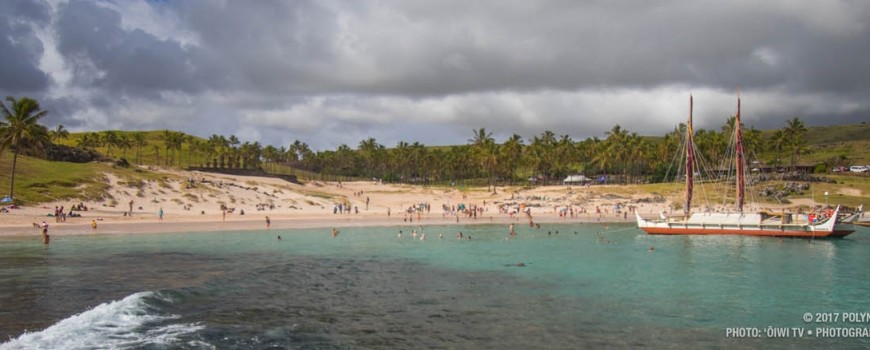
 Anakena is one of two small beaches along the island’s otherwise rocky coastline and is the historic site of seafaring arrivals and departures in Rapa Nui. The crew were met by the community through song and dance before heading inland for a feast and further entertainment.