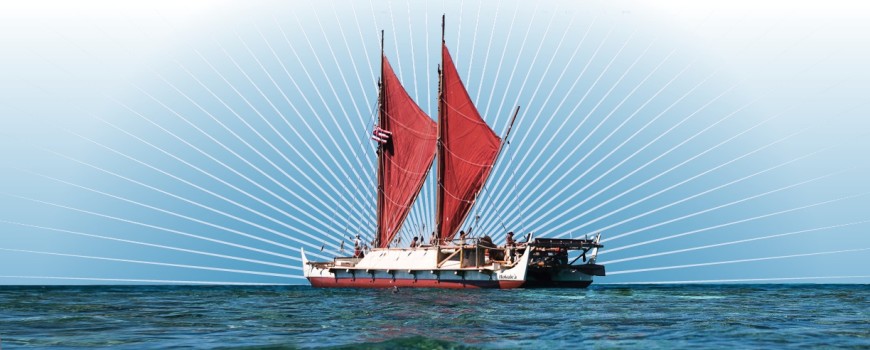
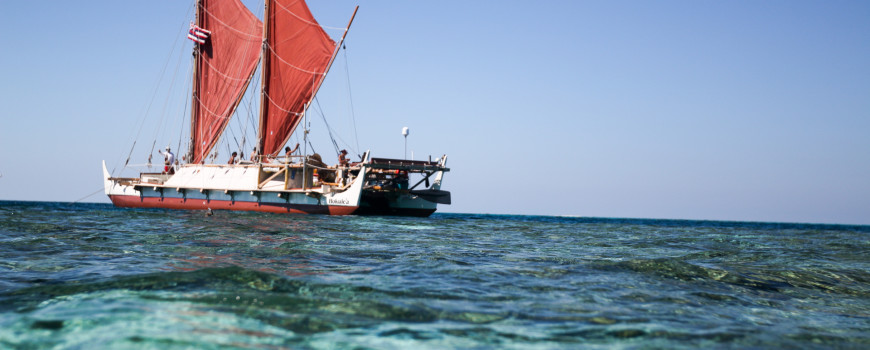
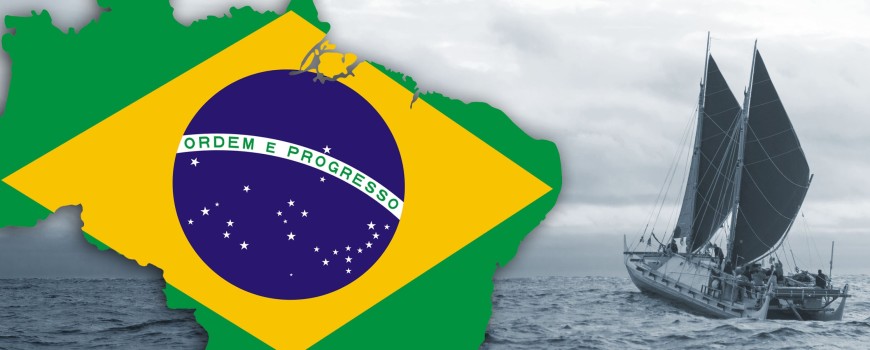
As Hōkūle’a makes her way to a historic landing in South America, a meet-up with Hawaiʻi’s Brazilian community will take place here at home later this month. The gathering will celebrate our local Brazilian community and provide setting for dialogue and the exchanging ideas.
Who: Members of our Brazilian community, Hōkūle’a crew and family, and Mālama Honua support and volunteers
When: Saturday, January 23, 2016 3:30 – 6:00 pm
Where: ‘Iolani School, Sullivan Center, 3rd floor
What: A potluck (bring your favorite traditional dish to share) of pūpū. Music and dance welcomed. This will be a family-friendly event with no alcohol, please!
RSVP by January 20.
Parking and Directions: Parking available in the structure on Kamoku St. In the parking structure, find the first floor (elevator or stairs) and walk toward the center of campus (toward Diamond Head and away from Kamoku St.). The Sullivan Center will be on your left. Enter the glass doors (left for stairs, straight ahead for elevator) to the 3rd floor.
Waʻa Hikianalia, escort vessel Hoʻokela and the Worldwide Voyage ʻOhana Waʻa crew arrived in Lāhaina on January 3, 2016, under the leadership of ’76 crewmember Snake Ah Hee. ʻOhana Waʻa representatives from Maui Nui (Maui, Molokai and Lanaʻi) and Oʻahu crewed the vessels. Hikianalia crewmembers included Kapala Novikoff, Eugene Tihada, Captain Snake Ah Hee, Bob Perkins, Jeff Schaefer, Kekama Helm, Archie Kalepa, Patrick Chong-Tim, Keoki Kahoohalahala, Sol Kahoohalaha, Mahina Hou Ross, Myrna Ah Hee, Kala Baybayan Tanaka (featured in the photo below, left to right, back to front). Hoʻokela crewmembers included Captain Moani Hemuli, Terry Hee, Clifford Kapono, Haunani Kane, CJ Elizares, and Cyrus Sutton.
Crewmembers departed from the Marine Education & Training Center on Oʻahu at 10:30pm on Saturday January 2, after a dinner of roast chicken, salad, chili and rice. Crews and volunteers worked on Saturday to prep the vessels for this first neighbor island leg of Hikianalia’s 2016 sail plan, including fellow ʻ76 crewmember Billy Richards. Captain and navigator Nainoa Thompson joined the crew at METC to talk story and wish them well before their departure.
After crossing the channels between Oʻahu, Molokai, Lanaʻi, and Maui overnight, the canoes arrived in the harbor at Lahaina in the afternoon, where ʻOhana Waʻa and Maui cultural delegation members awaited their arrival.
Hikianalia will be based out of Lāhaina for most of the month of January, with community outreach events planned for January 8-9 and January 21-23. Please see the attached flyer for the information about the January 8-9 events, and stay tuned for more information about the January 21-23 events. You can find updates on outreach events and track Hikianalia’s location at www.hokulea.com/hikianalia/.
Thank you for your interest in and support of the Mālama Honua Worldwide Voyage!
South Africa, current stop of the Mālama Honua Worldwide Voyage, is literally half a world away from Hawaiʻi. And while a delegation of Hawaiian educators and students are enjoying the field trip of a lifetime there, the students have adopted a novel concept making Africa accessible to their classmates and families back home. They are posting daily reflections of their trip online creating a virtual study tour to share with learning communities in Hawaii and throughout the world.
Ke Kā o Makaliʻi (The Canoe Bailer of Makaliʻi) is the name of a star line that is about to rise in the night sky above Hawaiʻi as well as South Africa. This is also the name of a youth delegation of eight Kamehameha Schools Kapālama students and four Hālau Kū Māna Charter School students currently visiting Cape Town through November 23. The students helped in the historic welcoming ceremonies for Hōkūleʻa last week and are currently engaging in cultural and educational exchanges, and participating in local service projects.
Kamehameha Schools is an education sponsor of the Mālama Honua Worldwide Voyage, and Hālau Kū Māna is one of many outstanding charter schools that excel at culture-based learning. Together both schools support the voyage and its goals to promote ancestral wisdom, care for the world’s oceans and grow global sustainability. To prepare for this journey to a destination literally on the other side of the world, students have been rehearsing oli, mele and hula, and have been studying two main themes:
Please join this group on their virtual study tour to Cape Town and Mossel Bay, South Africa by visiting daily at: KSHKM.weebly.com
All photos copyright and courtesy of Kamehameha Schools Kapālama and Hālau Kū Māna Charter School.
Hōkūleʻa crewmembers take a tour of one of the most ecologically rich coastlines in the world, False Bay, which is designated a Mission Blue Hope Spot. Award winning documentary filmmaker, Craig Foster, educates the crew on the inhabitants of this ecosystem, and guides them through the chilly waters to experience kelp forests, sharks and other marine life.
Before their momentous arrival in Cape Town, Hōkūleʻa and her crew made an important stop in False Bay near Simons Town, South Africa.
Nainoa Thompson, master navigator aboard Hōkūleʻa said, “We had no reason to go to False Bay, but we made a decision because of the extraordinary work of the many people that are there, that are in this area doing exceptional things to protect the world’s oceans. We aloha our great friend and mentor and teacher and inspiration, Dr. Sylvia Earle who has created this as one of the world’s great ocean hope spots.”
In 2014, False Bay was one of 6 areas in South Africa designated a Mission Blue “Hope Spot” — a special place critical to the health of the ocean. Mission Blue is an initiative of the Sylvia Earle alliance that works to ignite public support for the protection of our oceans by creating a global network of marine protected areas.
Craig Foster is an internationally recognized award winning documentary filmmaker, whose films reflect a deep passion and commitment to the natural world. He has been exploring False Bay nearly every day for years, building an intimate relationship with the place and its inhabitants in one of the most ecologically rich coastlines in the world.
After a tour of the coastline it was time to get in the water.
Craig led the crew through the breath taking kelp forest, braving bone chilling waters, without wet suits. An exercise, Craig believes, helps divers get into the mind set of our earliest ancestors and experience what they might have experienced thousands of years ago.
“It was an honor and privilege to be with him, and get an eye blink into his work,” said Thompson.
“We were taken on a tour of an amazing ecological system, some of the richest oceans, nutrient rich oceans of the world.”
Thompson said, “We were here to do what we were supposed to do on the canoes, that’s to capture stories. Not just hope, but people taking extraordinary action to protect the oceans and in doing so you protect the earth.”
To learn more about Craig Foster and his work towards protecting the earth, visit www.seachangeproject.com.
Aloha, mai kākou, this is Nainoa Thompson and we’re on Hōkūleʻa on the last African leg of this voyage to Cape Town. Cape Town will be our eighth port of this leg and we’ve got a little bit over 40 miles to sail. That’s like about less than 2% of the distance that we’ve sailed so far since we sailed from Mauritius.
We’ve been at sea traveling from Mauritius now for 39 days. It’s been an extraordinary voyage, and a challenging one with adversity. I just want to say that this crew has done a magnificent job to get it here and we did what we said we were going to do. So we’re more than half way around the world and every inch that we move now we’re heading back home.
What you see in the background is a place called the Cape of Good Hope–the farthest western tip of South Africa and originally called the Cape of Storms.
This big bay behind us called False bay. The reason they called it false bay was because early mariners thought that the bay was a good sheltered area to anchor. This wasn’t correct because the place has very strong winds–sometimes up to 100km per hour. We had no reason to go to False Bay and for safety reasons we shouldn’t have gone, but we made a decision because of the extraordinary work of many people who are there.
The people in this area are doing exceptional things to protect the world’s oceans. We met with those who are a part of Sustainable Seas, and those who are doing extraordinary documentation of this very rich ecological system.
This is a place where we aloha our great friend, mentor and teacher–the inspirational Dr. Silvia Earle. At this place, she has helped to create one of Earth’s great Hope Spots. We were here to capture stories of not just hope, but of people taking extraordinary action to protect the oceans, and in doing so, protect Earth.
We dove in the kelp forest; yesterday we were taken by Craig Foster on a tour of an amazing ecological system–some of the richest nutrient-rich oceans in the world. Craig is a documenter and it was an honor and privilege to be with him.
Now it’s time for us to focus on this crew and on ending this leg of the voyage. It’s been a hard one. Hōkūleʻa is in great shape–she’s in great condition, but she had to work hard on this one. If you look out on the ocean right now, even though there’s no wind, the ocean never stops moving here. There are these constant waves from all directions, big, steep and they are constantly, constantly working the canoe and the crew.
And so this is a voyage-leg that we need to end, but I don’t think this crew will ever forget it. It’s been a privilege and honor to be along the coast of Africa. And I thank you so much. Aloha.
Witness the historic arrival of Hōkūle‘a and her crewmembers who have sailed from halfway around the world to share their culture and discover stories of hope from South Africa. Blessings, greeting chants and traditional dances and performances will be featured alongside remarks by officials from the Desmond & Leah Tutu Legacy Foundation and a delegation of Hawaiʻi visitors.
Crewmember Dr. Ruth Gates is discovering how corals might survive ocean acidification and other threats pressuring the world’s reefs. Her visit to the Great Barrier Reef during the Mālama Honua Worldwide Voyage provided an opportunity to bridge and compare Hawaiian and Australian cultural reef knowledge making for a robust educational opportunity. Backed by 25 years of globe-spanning research, Dr. Gates touches on the fundamental link between the health of reefs and people, and the value of connecting with others to navigate positive change.
Twenty-five years into my career as a coral reef biologist it’s amazing to reflect on what has influenced and shaped the way I work. Here are some of the lessons I’ve learned: • Pursue your passion and share your interests with others to inspire them and learn from them.
• Connect, respect and listen to the local people about the problems they face and the solutions they’d like to see.
• Challenge the status quo to shift the current system and know it’s ok to color outside the lines.
• Gratitude makes the hard work of our daily lives much more joyful.
• Work towards the integrity of what you say you can do and what actions you take.
• Surround yourself with others who have shared values and missions.
From the start I was fascinated by how beautiful and complex corals and reefs were and was lucky enough to have a passionate teacher who brought them to life in a cold classroom in England 1000’s of miles from any reef. She used pictures and rich descriptions of their extraordinary biology and the importance of the three-dimensional structures that corals build. To me, reefs looked like submerged forests, teeming with life, vibrant in color, and full of energy.
The fundamental link between the health of the reefs and the health of people became clear to me while doing research for my PhD in Jamaica. It was at a time when there was much discussion about changes on reefs that related to human activities. I arrived with academic ideas about how the reef should be protected; that it was important to stop fishing on the reef. It made sense in the classroom, but later I saw first-hand how locals depended on reef ecosystems for their survival. I began to think about how academia could be more grounded in reality and how a participatory approach would be necessary for finding solutions.
I continued my training as a postdoc at the University of California, Los Angeles, which was an amazingly dynamic research environment. Coming from a remote, small marine lab in the Caribbean, I felt like a kid in a candy store. There were many experts, a plethora of equipment and a melting pot of ideas. An advisor encouraged me to think outside the box, to take lessons from other disciplines, and to commit to answering questions fully. He quietly enabled my development and success by connecting me to people with the tools and skills that would help me to become a creative thinker and a doer.
Eleven years into my professional career, an advertisement for a dream job at the Hawaii Institute of Marine Biology came by the way of a friend. It was a full time research position as a coral biologist–I felt it was unlikely that I would get the job, but I pursued it vigorously. Much to my surprise, I was hired.
Hawaii Institute of Marine Biology is on Coconut Island, or Moku o Loʻe, a small island off the coast of Oʻahu. It is a world-class research facility that focuses on marine life in tropical waters and is comprised of an amazingly dedicated community of researchers, students and support staff. We work on the very smallest, to the biggest marine organisms–from microbes to whales–and everything in between. I feel blessed to work in this incredible place and with such a creative and wonderful group of people.
My group is currently working to understand why corals either survive or die when exposed to high seawater temperatures, acidified waters and pollutants. We do cutting edge science that is often enabled by technology. Several years ago, a close friend asked me, “If you could do anything – what would you do?” I don’t think she expected me to take the question seriously, but it really hit a nerve. At that time, we were working in a very safe zone, surrounded by and talking almost exclusively too other scientists. We were spending time documenting why corals and reefs were dying, but almost none thinking about how to harness our knowledge to solve the problem. In that moment I knew we had to change the way we were doing business, that we needed to extend the reach of our science and to focus our skills on trying to solve problems on reefs.
With that new commitment to be actively engaged in solutions, many new doors have opened and we now interact with an ever-increasing circle of individuals and organization who are all working creatively to solve the problems facing our planet. We all have a deep dependency and connection with the natural world and we are united by values and a deep desire to see and help navigate positive change.
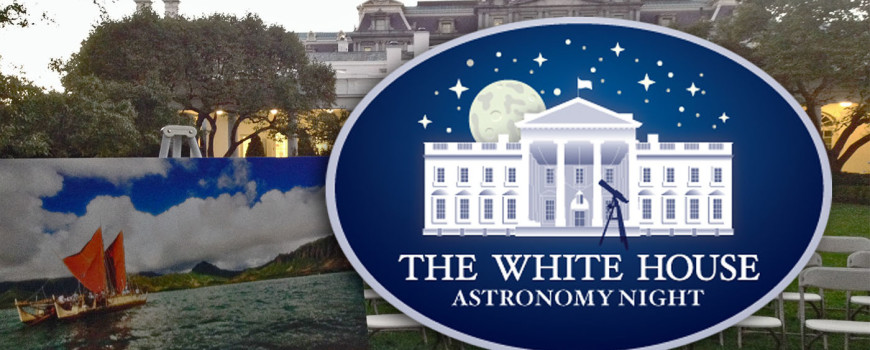
Hōkūleʻa crewmembers Jenna Ishii and Kaʻiu Kimura will be joining President Obama at the second-ever White House Astronomy Night in Washington D.C. Starting at 1:35 p.m. HST today, viewers will be able to follow the event here on this post, or directly from White House website.
President Obama will be highlighting the importance of inspiring more girls and boys with the wonder of science and space. The event will bring together students, teachers, astronomers, engineers, scientists, and space enthusiasts for an evening of stargazing – a cherished hands-on learning activity, and one that will spark the imagination of aspiring space explorers, young and old.
Crewmembers from the Polynesian Voyaging Society, including Kaʻiulani Kimura, executive director at the ʻImiloa Astronomy Center of Hawaiʻi, will be giving an overview of the Hawaiian Star Compass and sharing about Polynesian wayfinding with middle and high school students from around the nation. Also being shared is a special video from master navigator Nainoa Thompson recorded from the deck of Hōkūleʻa specifically for the youth at this event.
Thompson and other navigators are guiding the Mālama Honua Worldwide Voyage using only the stars, sun, moon and other natural elements to find their way. This ancient practice of navigating and voyaging was recovered and reclaimed by the Polynesian Voyaging Society for Hawaiʻi, where this masterful art had been absent for 600 years. Polynesian wayfinding today bridges the traditional technology of our ancestors with scientific discovery and environmental awareness our youth need in order to imagine and create a positive future for all of Island Earth including its land, oceans and people.
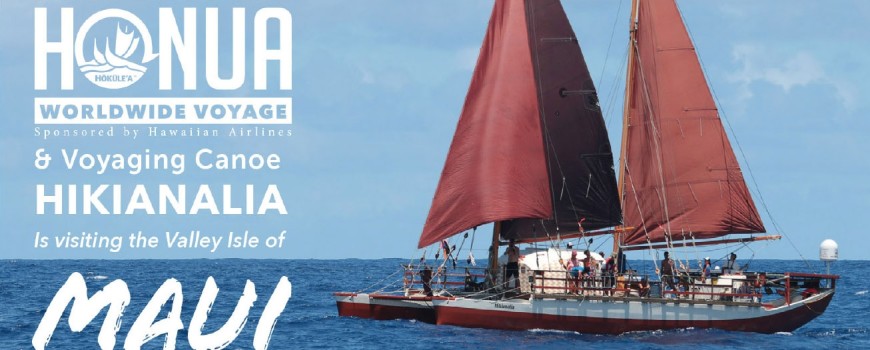
 Waʻa Hikianalia, escort vessel Hoʻokela and the Worldwide Voyage ʻOhana Waʻa crew arrived in Lāhaina on January 3, 2016, under the leadership of ’76 crewmember Snake Ah Hee. ʻOhana Waʻa representatives from Maui Nui (Maui, Molokai and Lanaʻi) and Oʻahu crewed the vessels. Hikianalia crewmembers included Kapala Novikoff, Eugene Tihada, Captain Snake Ah Hee, Bob Perkins, Jeff Schaefer, Kekama Helm, Archie Kalepa, Patrick Chong-Tim, Keoki Kahoohalahala, Sol Kahoohalaha, Mahina Hou Ross, Myrna Ah Hee, Kala Baybayan Tanaka (featured in the photo below, left to right, back to front). Hoʻokela crewmembers included Captain Moani Hemuli, Terry Hee, Clifford Kapono, Haunani Kane, CJ Elizares, and Cyrus Sutton.
 Crewmembers departed from the Marine Education & Training Center on Oʻahu at 10:30pm on Saturday January 2, after a dinner of roast chicken, salad, chili and rice. Crews and volunteers worked on Saturday to prep the vessels for this first neighbor island leg of Hikianalia’s 2016 sail plan, including fellow ʻ76 crewmember Billy Richards. Captain and navigator Nainoa Thompson joined the crew at METC to talk story and wish them well before their departure.
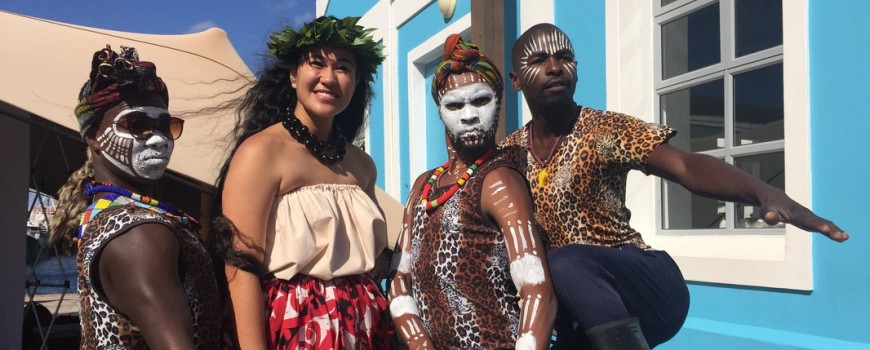
 Kamehameha Schools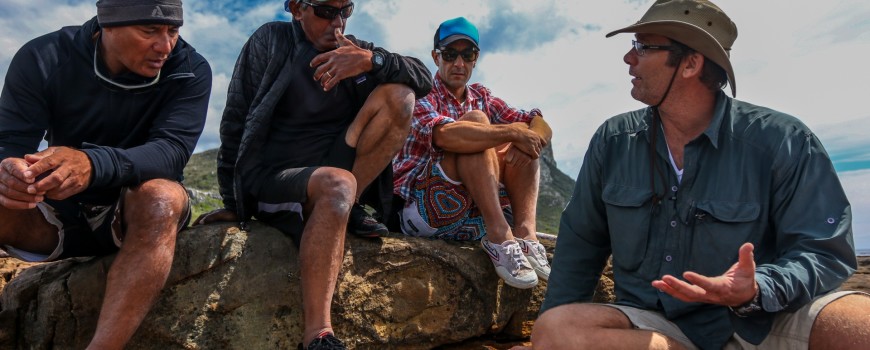
 Craig Foster