Hōkūleʻa Update | Feb 10, 2017

Naalehu AnthonyBy Naʻalehu Anthony

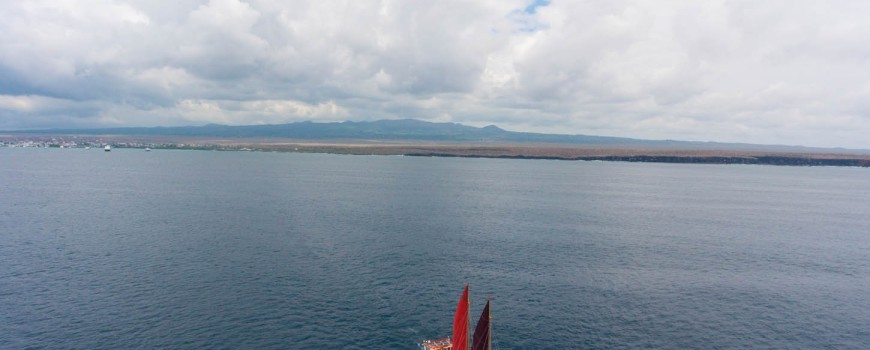
We departed Galapagos today at about 10:45am local time. Our paperwork for customs clearance and fumigation were the last items we needed to get before departure. We pulled up anchor and made our way out of the harbor, and said aloha to Santa Cruz Island.

We are currently under tow; the last land sighted was Espanola, which is where we started our reference course line. The moon is full tonight, washing out all but the brightest stars and planets. Venus and Mars set in the evening; Ke Kā o Makaliʻi is overhead including Orion, Makali’i, Sirius and Taurus. We are currently heading just to the East of South, and will continue this heading until we find wind that allows us to sail. That will likely be about 6-8 degrees South latitude. There are light winds at this time coming out of the East South East with a swell that matches the wind direction. Cloud cover is about 30% and mostly isolated to the horizon.

Our young and talented navigation team – Lehua, Haunani, Jason and Noe – have come together to embrace their kuleana as the latest in a very long line of traditional navigation. After being locked in their rooms studying for the last few days (they are amongst the few thankful for the delay in departure, as it allowed for last minute cramming), they have fully accepted the role and will use these next few weeks to put their years of training into practice.

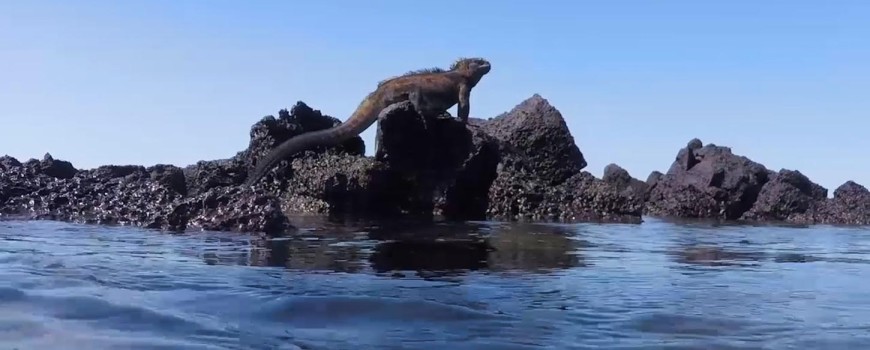
IMG_0998As the nav team sets their sights on our next horizon, we also took a moment to reflect on what we are leaving behind. Departure day in Galapagos was filed with the same awe we have experienced every day in this sacred place. This is truly a place where the nature gets to be nature, as the iguanas walked through the harbor within feet of the crew, and the sea lions lounged on the benches usually reserved for people. The Galapagos was stunning at every turn, from the moment we arrived and the giant tortoises came into view, to the last full day we had at Tortuga Bay with the pelicans in the air and baby sharks in 8 inches of water; this has proven to be one of the most encouraging stops in the voyage. Encouraging because we can find these places that are filled with biodiversity and have the kinds of protections that give us hope for the future. But this hope and these protections are really embedded in the people. The people we met on this stop showed us true aloha. They helped us with whatever we needed and showed us that terms like mālama and aloha ‘āina are not lost on those who do not come from Polynesian islands. And so we said a hui hou to Champy, and Norman, and Scott and their families today, but we know we will see them again soon. And we thank all of them for helping to keep the Galapagos wild.

We’ll be standing by 72,

Nā’ālehu


Homecoming__-_Save_the_Date_-_Banner

Hōkūle‘a Homecoming – Save the Date

Sign up for updates and be the first to know as we continue to detail homecoming festivities during the week of Hōkūleʻa’s homecoming
on June 17, 2017!

Continue Reading

Crew Blog | Naʻalehu Anthony: Adjusting the Sails

Naalehu AnthonyBy Naʻalehu Anthony

It had been an interesting week in the Galapagos, made a few days longer by an unexpected technical delay.  Asking for extra days in port is a stressful thing, especially when those days are difficult to come by because of our weather and travel windows. So when the onboard satellite terminal malfunctioned on the evening of our intended departure a few days ago, I asked for some time to fix the issue – yes with a heavy heart, but also with a clear conscience.  This satellite terminal is probably best appreciated for what it allows us to do in terms of communication with our followers and supporters via the assets that we post on Hokulea.com, social media, and send through to TV and print outlets, but its essential function is one of safety. If something breaks while we are in route and we need parts or supplies, or if some paperwork or logistics coordination hiccups need to be straightened out enroute to our next port, regular and consistent email is the best and fastest way to move those kinds of requests back to the office and other key contacts.

IMG_2996We found a solution through a local marine electronics store that could land us a new unit in a couple of days, and of course a couple of days was all I had before our departure window closed.  So the day before departure, three of us – fellow watch captain Russell, the Doctor, and myself – took our new satellite terminal and antenna and installed it where the previous iteration had been mounted. We got on the line to Inmarsat tech support, ironed out all the new settings and configurations, and got the new system integrated with the rest of our technical gear by mid-day. The thought of going dark for a month with no satellite interface was not something that I wanted to even imagine, so getting the system up and running again was a huge relief.

These last two paragraphs, however, are really the set up for todays story.

We were really lucky to have the equipment fail in a place like the Galapagos – although the Galapagos Islands are unique for a number of reasons, there are similarities we find in small port towns like this all over the world. In terms of our tech needs, there are really large yachts that regularly visit this port, which means there are resources available to fix problems like the one we just had. That aside, the one consistent, common factor?  Everything takes longer when you are in small port town, especially so when you do not speak the language.  It’s not a complaint, rather an observation on how it works when you are new to a place – seemingly simple tasks that we take for granted back home can take forever to accomplish. I remember it took me three days to get a piece of pipe threaded in Yap when we were preparing to go to Satawal to shoot.  Then there was that time in Bali, some of you may remember, it took us four very long days to fix our visa issue.  Our challenge this time? After the installation of the new satellite terminal, we decided to send the old terminal back to the manufacturer for repair. I had a feeling that it wouldn’t be as simple as the idea sounded.

IMG_2995I remembered seeing that familiar yellow and red DHL sign on the main road less than a mile away from the harbor, so Doc and I set out on foot with our boxes and a fresh email with the address our equipment should be sent to. The DHL sign was small and a little faded, but as it does everywhere in the world, it appeared to demark some place of business that ships items internationally. There was a small, locked wooden gate and an unfinished concrete wall blocking the short walkway to what could be the place we were looking for.  On the wall was a panel with a single button and a speaker; we pressed the button, and immediately that universal loud apartment building buzzing sound was heard, followed by the click of the gate opening.  We set out down the path towards the open door, and walked into a room that had been painted bright DHL yellow at some point, perhaps before Darwin came to the Galapagos on the Beagle.  In the midst of this faded yellow, we were relieved to find a very nice young woman who was more than happy to send our boxes several thousand miles.  At least I think she was happy, since she smiled and spoke nicely to the Doctor – while it is lucky for me the Doctor speaks English, it has been lucky for all of us he speaks Spanish too. We worked out that we had two boxes and they needed to be sent to a different corner of the planet than the one we currently occupy. The next part of the conversation went like this (through the doctor/interpreter):

Me: Can we send this to this address?

Her: Yes, you can

Me: Great. Can you tell me how much it will cost?

Her: How much does it weigh?

Me: I was hoping you could weigh it

Her: Our scale is broken. You have to take them (the boxes) up the road to the post office to weigh.

At this point I knew exactly where we were, having been in this situation a couple dozen times.  This was where a quick trip to the shipping office (supply store, grocer, customs office, etc) is actually a half-day gig.  No problem though, me and the Doc had exactly a half day left before we had to report to the next crew obligation.

IMG_3003So we three – the Doctor, and I, and a guy we found to show us the way (sounds like the beginning of a joke, or a great story, huh?) – set out on the multi-block tour with our satellite parts to the post office.  We weighed the boxes and walked back along the same cobblestone road down to the water’s edge to the DHL office. Cautiously proud of our accomplishment, we anxiously awaited the next hurdle.  After some wrangling about the address and where these items were going, the conversation continued:

Me: Can you tell me how much it is?

Her: Yes, its $386.60

(Me thinking, “she’s not even joking!”)

Me: You don’t take credit cards do you?

Her: No.

(Me thinking, “I knew it!”)

Me: You don’t have change either do you?

Her: No

Me: Well, we’ll have to come back.  I have the money but it’s at the hotel.

Her: Ok, but come back in an hour.  I have errands to run.

Me: OK, we’ll be back.

So, we left our boxes at the office and headed back across town for the hotel where the petty cash envelope was in my canoe baggage.  With a quick detour at a respectable eatery we got back in just over an hour. After a few optimistic rings of the buzzer, the door finally clicked and we were back in the DHL outpost. With a printed waybill from an inkjet printer, a roll of that yellow DHL tape, and a stack of money to the exact amount we were finished with our task of getting these precious pieces of technology ready for the long journey home. We booked it back to the hotel with 12 minutes to spare before the bus arrived to take us to dinner.

What’s the moral of this story?  There is a common nautical-themed quote often seen that says “we can’t direct the wind, but we can adjust the sails.”  Just like sailing canoes – the speed of the journey is the speed of the journey, and there is not a lot that you can do to change it – the challenge is to adjust yourself to the pace.  That is one of the precious gifts of this voyage – the opportunity to transition to a cadence that is not in your control, whether on water or on land.  Slowing down, speeding up, being observant of and falling in rhythm with whatever environment surrounds you – we become appreciative of all the good energy that surrounds us.
We’ll be patiently standing by 72,

Nā’ālehu


Homecoming__-_Save_the_Date_-_Banner

Hōkūle‘a Homecoming – Save the Date

Sign up for updates and be the first to know as we continue to detail homecoming festivities during the week of Hōkūleʻa’s homecoming
on June 17, 2017!
Classroom Connections: The Galapagos

PVS Volunteer Cindy McArthur, ‎National Partnership Coordinator at USDA Forest Service and currently a chaperone with the Hawaiʻi student delegation in the Galapagos, helped the PVS Education Team gather information and resources for this post. Thank you Cindy!

Crewmembers on the Worldwide Voyage are currently in the Galapagos, an island archipelago located nearly 1000 kilometers of the coast of continental Ecuador. The islands were accidentally “discovered” in 1535 by Thomas Berlanga when his ship bound for Peru went off course. The islands earned their name Insulae de los Galopegos, or Islands of the Tortoise, due to the amazing variety of tortoise species found there. Completely remote from the continent, creatures on these islands developed unique characteristics to survive the arid conditions and limited availability of fresh water. For example, the Galapagos Marine Iguana is the world’s only seagoing lizard and survives by feasting on seaweed deep below the ocean surface.

IMG_2741

The islands are also home to wide variety of sea birds, including blue-footed boobies, albatross, frigate birds, penguins, flamingos and the celebrated Darwin Finches.

Charles Darwin visited the Galapagos on his five year long voyage around the world on the HMS Beagle. A naturalist (natural scientist) by trade, Darwin’s took careful field notes, made detailed sketches and collectioned various species from the Galapagos Islands. The data he collected there played an important role in his influential and controversial 1859 publication called On the Origin of Species, where he articulated his theory that all species evolved from a common ancestor. He demonstrated that species could change over time by inheriting advantageous characteristics or traits that improved the individual’s chances of survival, through a process he called “natural selection.”

In Hawaiʻi, the endemic Honeycreeper species are much like Darwin’s Finches in the way that they can illustrate the concept of natural selection. The PRISM project out of UH Hilo published a lesson Adaptations, Genetic Variation and Natural Selection, which was designed for middle schoolers and piloted at the West Hawai’i Explorations Academy to better understand the concept using endemic species of Honeycreepers in place of Darwin’s Finches. The Hō`ike o Haleakalā Curriculum, designed by Maui teachers with the support of field biologists for high school students also offers a lesson on Adaptation and Speciation that draws connections between the Finches of the Galapagos and the Hawaiian Honeycreepers. The National Park Service even has an Electronic Field Trip that uses the Honeycreeper to educate students about adaptive radiation in birds.

Charles Darwin though was not the only person though who saw the Galapagos for the many gifts it had to offer. The Islands quickly became a destination for whaling ships who harvested many of the tortoise species and fur seals to extinction. However, the more recent history of the islands though has focused on conservation, leading to the creating of a National Park, UNESCO World Heritage Site and expanded Marine Reserve. Ecuador, which officially took over the island chain in 1832, has also acknowledged the economic importance of protecting these islands for science and tourism in recent years, and now prohibits the harvesting of the ancient tortoises, hammerheads, whale sharks and other species. An estimated 160,000 people visited the islands in 2006 generating about $418, 000,000.00 in tourism related revenue.

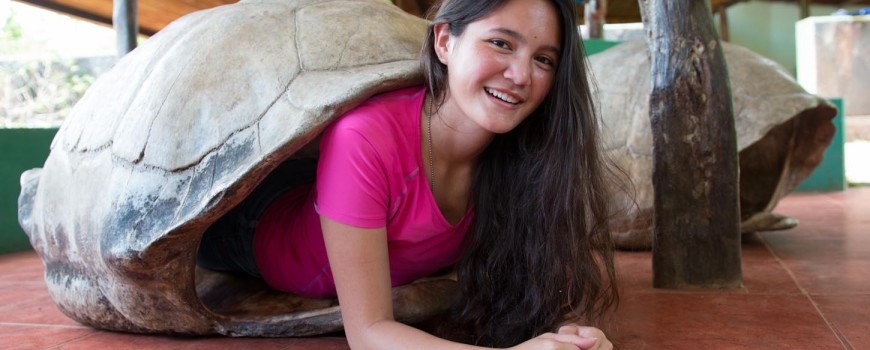
Giant-tortoiseThe local conservation efforts in the Galapagos has resulted in one of the few success stories in protecting wildlife and brining species back from the brink of extinction. In 2016, the first baby tortoises in 100 years were born on the Galapagos Island of Pinzon. More information about the Galapagos conservation efforts can be viewed at: http://darwinfoundation.org/en/science-research/sustainability/galapagos-verde-2050/

This past week, Hawaiʻi students and teachers from Kamehameha Schools, Hālau Kū Māna and Castle High School joined Worldwide Voyage crewmembers in the Galapagos Islands. Students visited the Charles Darwin Research Station, engaged in conservation activities with the National Park, and spent time with local students from the Tomas de Berlanga School on Santa Cruz Island. Through this experience, students were able to compare and contrast environmental and sustainability challenges facing the Hawaiian and Galapagos Islands.

mapVoyage Map Fall 2016

A map of Darwin’s HMS Voyage of the Beagle has similarities to Hōkūleʻa’s Mālama Honua Worldwide Voyage

Homecoming__-_Save_the_Date_-_Banner

Hōkūle‘a Homecoming – Save the Date

Sign up for updates and be the first to know as we continue to detail homecoming festivities during the week of Hōkūleʻa’s homecoming
on June 17, 2017!

Hōkūleʻa Update| Celebrating A Shared Commitment

Naalehu AnthonyBy Naʻalehu Anthony

This week in the Galapagos Islands has been action-packed, highlighted by opportunities to capture the story of our Hawaiian delegation interacting and learning from the people and places of these islands.

Today started at 6 AM with getting our media gear prepped and our team documenters out the door. Bryson went with their guide Nicoto to free dive some sites similar to yesterday’s, and I went to scuba at a more remote location about one and a half hours out of Baltra. The additional media content we’ve gathered with crewmembers out in the ocean is a crescendo to an already exciting stay at this amazing place. More sea lions, more sharks, more fish, more, more, and yet more. We returned to the hotel burnt, spent and ready to retire for the evening, though it was barely 4 PM.

But tonight was a time that we set aside to share a meal with our hosts her in the Galapagos. We drove the quick 20 minutes to the highlands to a small farm owned by Scott Henderson and his family. Scott, in his official capacity, assisted us in getting here as he works alongside with our crewmember ʻAulani Wilhelm at Conservation International. But as we learned up at Scott’s place, he also has a bunch of “hobbies.” These range from farming his 40 acres in the highlands, to sustainably harvesting some of the hardwoods on the island, to starting a school here. When I say farming, I really mean attempting to keep the habitat to what it might have been before humans arrived about a century ago, while also supplying food to his family and community. This organic farm blew me away: Scott has 55-gallon drums that are set up for growing basil, lettuce, kale, and the list goes on. The small greenhouses are scattered throughout the landscape: as his hobby grew so it seems did the need for more structures to support Scott’s habit.

The largest crop on the property is coffee. What started off as as few bushes, grew to about 30 acres in cultivation. Tourists and residents alike consume everything Scott can grow here in the islands. The availability of water is really the limiting element. He said that he emptied his reservoir this year and had to truck water onto the property or risk losing the seasons harvest. Nothing is wasted on the property. The pulp, or the fruity part of the coffee, is churned into these huge bins and mixed with other components to be used as fertilizer for the fields. The beans are dried over 5-7 days in a greenhouse where the sun is plentiful and free to use.

It took us some time to get up to the house that Scott and his family have built on the property. Everything from the view of the island, to the feel of the residence was reminded me of home. The slippers and shoes were stacked at the door in a pile big enough to signal a pretty big gathering. The open deck was only separated by a set of screens to hold back the prehistoric bugs of Galapagos from entering the living room and the kitchen area. Speaking of the kitchen, it was booming with activity. There were friends from Santa Cruz cooking up more dishes than I could count. Just like we would be having at a paʻina in Hawaiʻi, our crew pitched in to make a pretty big selection of raw fish dishes. The smells coming from the pots on the gas stove matched the happy chatter of those in full meal production, together, as one group so as to celebrate this short but important time together.

And so as the night bore on, a proliferation of conversations continued through the night across different parts of the property until the all familiar Ua Hiti E rang out by the crew calling everyone everyone together. Nainoa took some time to talk about why we were here with the canoe and how important this stop is on the Worldwide Voyage. He spoke of the effort to voyage her from a world away, to the friends we have made, to the important perspectives of the Galapagos: conservation, resilience and education. It was clear that this was a stop that had changed everyone who participated.

Nainoa’s words of praise were for everyone who aided in getting the canoe to the Galapagos. This effort included one of the most grueling permitting processes on the planet. Protective measures that exist for good reason: the Galapagos has more to lose than to gain if a vessel introduces invasive plants or animals. And so when the National Park director responded to Nainoa, it was clear to all of us that the risk of coming was worth the reward of new connections that will continue to grow in the years to come. He talked about the message of the canoe being an inspiring one for the people in the conservation work here as Hōkūleʻa herself is a story of conservation and success. Conservation of a culture almost lost, conservation of a knowledge set on the brink of extinction, and conservation of a history that binds Polynesia together. While stories of success and hope in this arena are sometimes few and far between, they are also the ones that inspire us to move forward in this work.

I’m not sure who from the crew started singing Hawaiʻi Aloha at the end of all the speeches but it was a moment that I will never forget. The voices of our crew rang out in the darkness together with a slight echo against the great trees behind us; hand-in-hand, we sang with love and aloha for our home, from the sands of our birth. Not everyone knew the words, but these voices resonating as one made it clear of the aloha we share for all the places we call home.

Standing by 72, Naʻalehu Anthony


Homecoming__-_Save_the_Date_-_Banner

Hōkūle‘a Homecoming – Save the Date

Sign up for updates and be the first to know as we continue to detail homecoming festivities during the week of Hōkūleʻa’s homecoming
on June 17, 2017!

Continue Reading

Hōkūleʻa Video Update | Welcome to the Galapagos

Want to know what Worldwide Voyage crewmembers have been up to in the Galapagos Islands? Come along with us as we take a swim with sharks, orcas, sea lions, and iguanas. Bienvenidos a Galápagos!


Homecoming__-_Save_the_Date_-_Banner

Hōkūle‘a Homecoming – Save the Date

Sign up for updates and be the first to know as we continue to detail homecoming festivities during the week of Hōkūleʻa’s homecoming
on June 17, 2017!

Hōkūleʻa Update| February 1, 2017

Naalehu AnthonyBy Naʻalehu Anthony

Our exploration of the Galapagos continues as leg 27 and  leg 28 crewmembers took to the water to see what treasures the Galapagos has to offer. Three teams went out to different sites to explore and learn about this very special place. The team I was on drive across the island to the pier near Baltra Island where most of the dive boats launch from.

As we spent 30 minutes bussing it across the island we found that our guide David was very knowledgeable about the history of this place and how it came to be that we see giant tortoises roaming around farm land and iguanas both IMG_0228nearshore and in mountainous regions. David explained that humans are guests here and that the animals have the right to travel wherever they want. Apparently if there are animals in the road, cars must yield and there have been many noted traffic jams caused by basking tortoises. By the time we reached the pier to load onto the boat it was clear that we were heading for a place where the wildlife not only has the priority but also has the upper hand.

It’s somewhat unnerving to see that ominous shark fin sticking up in the water as you prepare to get in, but that’s what were here for right? That is to see some of the things you might not be able to see at home. Our guides were reassuring that the wildlife was friendly and that if we didn’t chase any of the sharks around we would be fine. Regardless, we let our hosts go in first, and, after donning on our suits, fins and tanks, we leaned backwards into the soup.

DCIM100GOPROGOPR0196.

The underwater world here enveloped our senses; the salty ocean water came as a bit of a shock as it was more frigid than I expected. Peering down I could barely make out the murky seafloor that would lead us to a dark shelf in the distance. I had expected the type of clarity we have experienced in the South Pacific and in Papahānaumokuākea where visibility can go for hundreds of feet. But the guides would explain that the Galapagos has turbid water because of the intense currents that bring up the deep ocean nutrients from thousands of miles away.

DCIM100GOPROG0249846.

As we took our time getting used to the pressured descent, the underwater world here began to reveal itself. The sheer

abundance of life just a few feet down is nothing short of amazing. Huge schools of small reef fish clean the rocks and play in unison with parrot fish larger than I have ever seen in my life. The sharks worked the perimeter of our dive group as we let the current slowly carry us across the shelf. Hammerheads drifted above and as we rose back to the surface – after a little under an hour, reality had shifted for many of us.

While it may not have been the clearest that we have seen in other locations it was certainly a reminder how far we have to come back at home in the main Hawaiian Islands. I got to dive Maunalua Bay just a little over a week ago and while there were fish in 40 feet of water, the diversity and volume paled in comparison to what we saw today. We took the boat back to the pier, a little tired and hungry but certainly excited at what we saw.

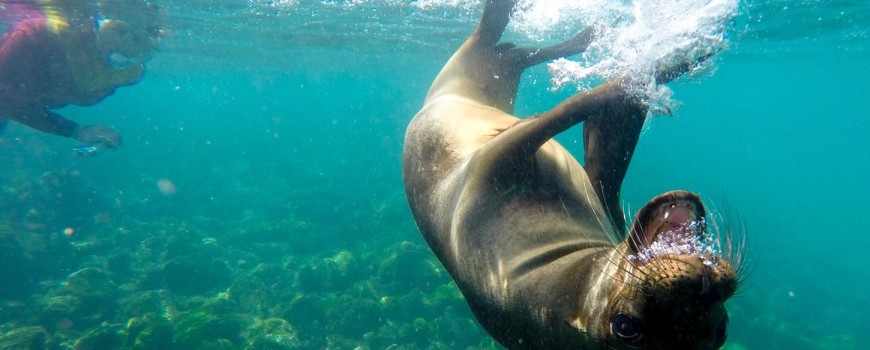
Getting back to our accommodations on these trips is always an exciting time: it provides our media crew time to review and compare the day’s catch in the way of photos and video. It’s not a competition per se but certainly we try to get the best images that we can based on the conditions. Bryson, who was with a separate group, got back to the room with a charred smile after being on the water and hiking today. We talked about what the conditions were and what we saw. He talked about the land and saltwater iguanas that dominated the landscape in some places. And that the sea lions he saw today were curious and friendly. He too commented on how many fish there were in this place as compared to back home. Bryson was happy with his shooting but agreed that the visibility was tough.

Jason returned last from his group outing and looked the most burnt. He spent the entire day on the water with other crewmembers. We asked him about his shoot and he simply replied “ah, it was OK.” The sheer amount of media from the day had us backlogged in processing photos and video and so Jason’s media would have have to wait to be reviewed. On top if it all, we had to curate content for a community presentation so we were pretty busy and didn’t think anything more Jason’s shoot.

DCIM100GOPROG0489997.

Our initial take on the murky water shifted soon after leaving the hotel. We began to talk more about playful sea lions, schools of fish bigger than anyone had seen before and then a crewmember made a joke about an orca whale? What was this!? Jason gave only raised shoulders and a sheepish look of someone who probably had the best shoot day of his life.

While writing this post tonight, Bryson had reviewed the remaining material and was stunned by the results of Jason’s shoot. Arguably some of the best wildlife material we have seen in the lens over the last 33 months and 32,000 nautical miles. Iguanas basking by the sea, sea lions laughing with the crew, and orcas? Yes, orcas. Well you’ll just have to wait for the video. One more dive day to go and we are certain that what people say about this place is true, the Galapagos does not disappoint. Enjoy the pictures everyone.


Homecoming__-_Save_the_Date_-_Banner

Hōkūle‘a Homecoming – Save the Date

Sign up for updates and be the first to know as we continue to detail homecoming festivities during the week of Hōkūleʻa’s homecoming
on June 17, 2017!

Crew Blog | Shawn Kanaiaupuni: Ocean & Indigenous Connections in Panamá

Shawn KanaiaupuniBy Shawn Mālia Kanaʻiaupuni

Hōkūleʻa’s visit to Panamá was chock full of activity spotlighting ocean and indigenous connections. For Leg 27 crew, Sunday, January 15, 2017 celebrated these connections with the community, who gathered to honor the arrival of the waʻa in kindred spirit and positive energy committed to caring for the earth.

Connecting with the community in Panamá and joining hands with those who share our passion is a great example of activating what Nainoa Thompson has called, the “lei of hope,” woven by Hōkūleʻa as she circumnavigates the globe.

How does something like this happen? It begins with a lot of preparation way in advance of each port. For example, building these networks with the Panamanian community began a few years ago with a youth exchange in Hawaiʻi between Polynesian Voyaging Society crewmembers and InterTribal Youth. The young ambassadors visited a number of places on Oʻahu, including the Marine Education and Training Center, Hālau Kumana Public Charter School, and Kamehameha Schools Kapālama campus, where they learned about the star compass.

On that visit, InterTribal Youth program director/founder, Marc Chavez, learned that Hōkūleʻa was headed to the Panamá canal and began reaching out to local educational and culture-based organizations. Within a short matter of time, various partners started to gather to welcome Hōkūleʻa, including the Balboa Paddling Club, Four Worlds International Institute, Earth Train, and the Balboa Yacht Club. From Four Worlds International Institute, our contact, Giuseppe “Olo” Villalaz, also connected the crew to the four major indigenous groups of this country. In addition, a few months ago, a Hawaiʻi delegation went to Panamá and visited local schools to share about Mālama Honua Worldwide Voyage, strengthening these connections even further.

DSC04615Spending time with the indigenous peoples in Panamá was mission critical for this stop of the Worldwide Voyage. We’ve learned from our hosts that Panamá has a diverse group of indigenous peoples that play an important role in the country’s cultural diversity. For a little background, there are seven distinct indigenous cultures, which are divided into four major Indian groups, each of which presented their welcome and dances at Sunday’s community gathering, colorfully dressed in their traditional garb. The four groups are the Ngäbe-Buglé (Guaymi), the Kuna, the Emberá/Wounaan and the Naso (Teribe)/Bribri.

These peoples are generally small in stature and and large in their political influence, bridging across their diverse cultures to work collaboratively and to protect their indigenous interests and rights. In addition to Panamá’s nine geo-political provinces, there are also three “comarcas”; states belonging to the indigenous groups. Comarca (meaning shire or county) is a traditional region or local administrative division and allows the indigenous cultures to practice traditional forms of government without interference.

According to the 2010 census, there are over 410,000 indigenous people living in Panama and they make up almost 13% of the overall population.

panama map

Our crew’s last day in Panamá was a special one. We spent most of the day visiting one Emberá village, located in the town of Gamboa about 35 minutes away from the marina. We arrived at the Gamboa Rainforest Hotel and then the crew traveled the rest of the way to the village by boat and kayak.

IMG_7836

As one chief shared, the Emberá people are also seafarers who use the sun, wind, stars and currents to navigate their vessels in the Atlantic and Pacific. They were very interested to learn about Hōkūleʻa, how we sail her, what kind of wood she is constructed from, and they were curious to learn about the most turbulent waters that we had crossed, among other questions.

DSC04647

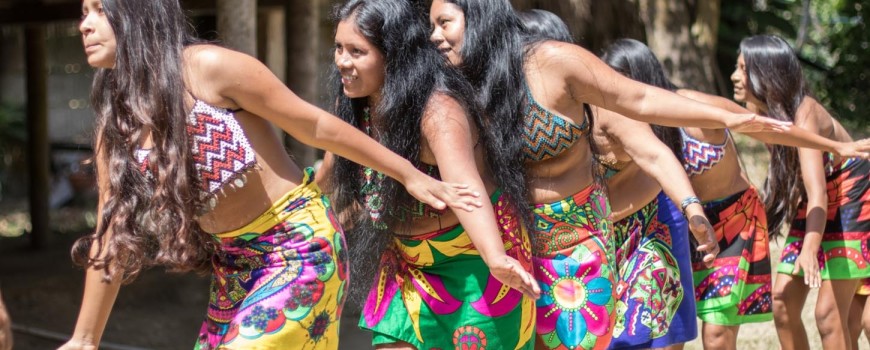
In their small village in the forest, we saw thatched roof single room homes, high on poles in case of flooding. A notched log stretched from ground upward to the hale, so that family members could climb up to their door. Small boys ran around wearing something like a malo secured by a string around the waist. The women and young girls wore brightly colored, thigh-long pareos and a bead necklace, nothing more. They had long shiny black hair. In some cases with visitors, the women would don a beaded halter top to cover their usually bare chests.

IMG_7803

The chief of the village welcomed us, explained their traditions, and the construction of the village. A group of women performed a buzzard dance. Their graceful flying motions evidenced careful study of how buzzards looked in the air, which they mimicked perfectly in their dancing. After this short welcome, one of the elder males led the crew through their forest, showing us the medicinal plants used for various healing purposes, for example, stomach or skin ailments. Our guide even showed us a plant that naturally removes hair. Other plants are used for spiritual needs, like protecting a family from a witch or curse. At one point, he pounded on a tall, wide tree so we could hear its hollow sound as he explained that the trees are full of water. A good thing to know for survival in the deep forest!

IMG_7758

After captain Billy Richards described the purpose of our voyage and the reasons for the day’s visit, they villagers thanked us graciously, expressing that they also are equally committed to caring for the planet and their own communities. As our visit comes to a close, despite our differences, we feel a strong bond with these small but proud people. We reflect on the importance of building the lei of people, places and ideas as Hōkūleʻa and crew make their way home in the final months of the Worldwide Voyage.


Homecoming__-_Save_the_Date_-_Banner

Hōkūle‘a Homecoming – Save the Date

Sign up for updates and be the first to know as we continue to detail homecoming festivities during the week of Hōkūleʻa’s homecoming
on June 17, 2017!

Galapagos Update | Visits to Land & Sea – Photo Galleries

Representatives from the Hawaiʻi high school delegations, the Worldwide Voyage crew and the Nature Conservancy staff went into the uplands today to the highlands park on Santa Cruz Island to look at some of the flora and fauna unique to the Galapagos.

IMG_0037Some of the things that the crew and the students got to see were the huge tortoises that this island group is famous for as well the habitat in which they thrive. Students also got to squeeze into a lava tube to check out what was inside. At the end of the day everyone came away with a deep appreciation of this very special place.


It’s always amazing to see how the canoe connects people from everyday walks of life. Today we got to share the canoe with the individuals who have shared this very special place with us. We welcomed staff from Conservation International and the Charles Darwin Research Station on board to see what we are all about. They brought their families along for this once in a lifetime chance to step aboard our mama canoe.

IMG_9849Original crew member Billy Richards shared the route the canoe has taken over the last two and a half years and watch captain Russell Amimoto showed families around the waʻa and how everyday things we take for granted on land can be a challenge on board. The afternoon on the water provided us all with a great time and opportunity to share and discover the ways in which we are more similar than we are different.

Stay tuned for more daily media from Galapagos and the Worldwide Voyage.


Homecoming__-_Save_the_Date_-_Banner

Hōkūle‘a Homecoming – Save the Date

Sign up for updates and be the first to know as we continue to detail homecoming festivities during the week of Hōkūleʻa’s homecoming
in June, 2017!