Every Bit Counts

Miki TomitaPick up a Bit of Beach Trash on Saturday for International Coastal Cleanup!

By Miki Tomita

Years ago, I was part of an environmental action group whose main focus was the problem of marine debris. We used to spend hours and hours every month hauling broken crates and plastic jugs from shoreline naupaka, cutting nets and fishing line from tidepool rocks and reefs, and sifting sand for tiny tiny pieces of plastic.

Along with hundreds and thousands of other concerned volunteers and organizations around the world, we were troubled by the growing amount of plastic we saw floating in on the tides, buried in the sand, blowing around in streets, and in the bellies of the fish we eat or the birds and other animals we seek to protect. And while the number of people who are working to help solve this plastic problem is on the rise, so too seems to be the amount of trash we find. I remember going to the same spot at the same beach every week for a month one winter, and removing the same amount of trash each time…. It seemed that each wave brought in more plastic large and small to replace what I just removed. The situation seemed so hopeless… but…

I firmly believe that every bit counts.

When you look at the efforts of people all around the world, we know that there is hope. People are becoming more aware of not just the “forever-ness” of plastic, but also the toxicity of certain types of plastics. The quest to eliminate or reduce single-use plastic has been taken on by many high profile organizations and individuals, as well as governments and communities.

Hawaii and Hawaiʻi people are some of the leaders of these initiatives – President Obama signed a bill that prohibits selling and distributing products containing microbeads – those tiny beads in face scrubs, toothpaste, and antibacterial gels you probably didn’t even know were plastic – to protect our nation’s waters; and Hawaiʻi became the first state to ban plastic bags at grocery store checkouts.

Movies and books about the large garbage patches in the ocean are now common, and names like Captain Charles Moore of Algalita Foundation, Marcus Eriksen and Anna Cummins of 5 Gyres, Jack and Kim Johnson of Kōkua Hawaiʻi Foundation, and Dianna Cohen of Plastic Pollution Coalition are well-known in environmental and sustainability circles, if not mainstream society. Innovative individuals are creating new products out of old materials, and new technologies are being created to remove more plastic from oceans and shorelines than ever before. People like Kahi Pacarro and Sustainable Coastlines Hawaiʻi team up with Bureo Skateboards to “upcycle” plastics from beach cleanups into skateboards, and are working hard to bring innovative interventions such as the Trash Water Wheel to our island home.

image03This weekend ushers in the annual International Coastal Cleanup, the world’s largest volunteer effort for the ocean. Started in 1985 as a local cleanup in South Padre Island, Texas, The Ocean Conservancy’s Coastal Cleanup went global in 1989 when it spread to Canada and Mexico. Last year, on its 30th anniversary, more than 18 million pounds of trash was removed by nearly 800,000 volunteers in one day. The Ocean Conservancy’s Ocean Trash Index is the world’s largest item-by-item, location-by-location database of trash found in near-shore environments. Over 30 years, 11.5 million volunteers have helped to remove and log more than 225 million items of trash from beaches and waterways around the world.

This year, The Ocean Conservancy has released an app version of their data collection card, Clean Swell. It is AMAZING. Easy to use, engaging, and best of all – does not go flying away down the beach as you try to pick up trash with one hand, hold a collection bag with another, and record data using paper and pencil.

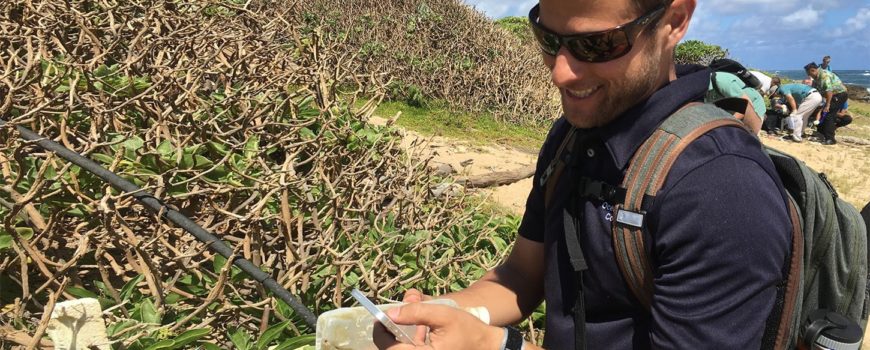
I tested the app out with Nicholas Mallos, the director of Ocean Conservancy’s Trash Free Seas program, out in Kahuku at James Campbell National Wildlife Refuge. We were participating in a World Conservation Congress event hosted by the US State Department involving representatives from 5 different countries as well as local government agencies. This was one of 6 coast-to-coast beach cleanups hosted by the US State Department as part of their build-up to the Our Ocean Conference where our own Nainoa Thompson will be speaking, along with many other incredible advocates for the ocean.

In about 1.5 hours, I picked up almost 15 pounds of trash, and logged hundreds of data points. The app then congratulated me on my first cleanup (sigh), provided a quick fact about plastic pollution, and updated me on my progress in helping to steward the ocean. It was a fun, quick and informative experience, one that I think my students and fellow crewmembers will find easy to do.

When Marcus Eriksen presented at IUCN last week during the Student Day Design Challenge, he encouraged students to dream incredible solutions to huge problems like plastic pollution. He encouraged kids to take our Mālama Honua Challenge, and share with us their ideas about work that can be done in the future. For those of you who are doing another kind of project to mālama your community, please Share Your Mālama Honua Story with us!

So about this weekend… download the app, and join a Coastal Cleanup near you! Sustainable Coastlines Hawaiʻi has posted information on several cleanups on Oʻahu spanning from Town to North Shore, including what is anticipated to be the largest effort of the year in Kahuku – a cleanup at James Campbell National Wildlife Refuge hosted by Plastic Free Hawaiʻi – Kōkua Hawaiʻi Foundation and Sustainable Coastlines Hawaiʻi. Not all cleanups are happening on Saturday – if you find yourself near Kahana Bay on Sunday, Kahana Kilo Kai and Keep the Hawaiʻi Islands Beautiful are hosting a cleanup. If you are not on Oʻahu, click here to find cleanup locations near you using the Ocean Conservancy interactive map. Remember – every little bit counts.
PVS Applauds State’s Commitment to Manage 30 Percent of Hawaii’s Ocean by 2030

thumb-p2p-30x30-marine-goal-release

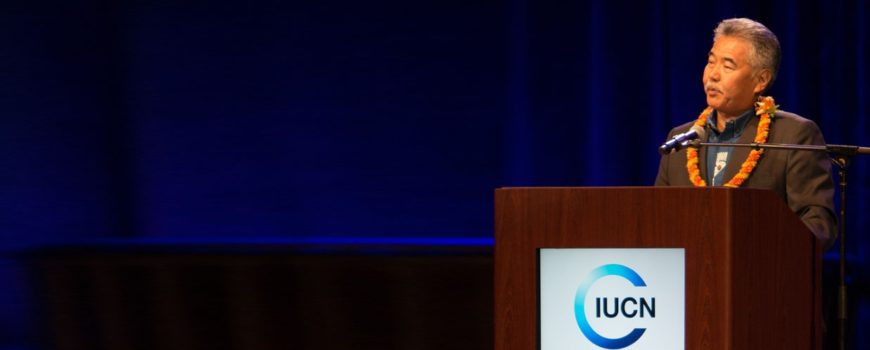
Polynesian Voyaging Society (PVS) and Promise to PaeʻĀina partners (P2P) are celebrating Governor David Ige’s announcement today that the State is committed to effectively managing 30 percent of Hawai‘i’s nearshore waters by 2030 in the main Hawaiian Islands. Announced at the opening ceremony of the IUCN World Conservation Congress, this 30 by 30 marine goal is a milestone event for P2P, a Mālama Honua Worldwide Voyage-inspired collaboration of partners with a collective commitment to ensure Hawai‘i is a better place when Hōkūle‘a returns than when she left in 2014.

In his speech today, Governor Ige said “Our reefs provide habitat for spectacular marine life, and feed us. That’s why I’m committed to effectively managing 30% of our nearshore ocean waters by 2030.”

Multiple sources of scientific research suggest that the health and function of at least 30 percent of nearshore reef areas are necessary to sustain the productivity of reef regions like those in the main Hawaiian Islands. 30 by 30 provides an overarching target that builds on the State’s current efforts to improve the capacity and coverage of enforcement, support community-based marine management, develop a plan to address coral bleaching, and strengthen statewide regulations, monitoring, enforcement, and other adaptive management measures. Effective management will be measured by a broadly agreed-upon set of biological parameters for “healthy” reef systems developed by scientific expertise, traditional knowledge, and user input. The plan for this effort is to be an open, inclusive process balancing fisher and other ocean user interests with the State’s restoration and conservation needs.

“Initiatives such as 30 by 30 are essential for our sail plan to a sustainable future. To protect life on earth, we have to protect the ocean waters,” said Nainoa Thompson, president, Polynesian Voyaging Society. “The impact made by the collective efforts of our partners is a testament to how the community can come together to create change that will benefit our children and our future,” he added.

The 30 by 30 commitment was developed through a collaborative effort of conservation organizations, marine resource management groups, community members and government agencies brought together by Promise to PaeʻĀina o Hawaiʻi (P2P), a collective impact initiative inspired by the Mālama Honua Worldwide Voyage. As Hōkūleʻa sails the Worldwide Voyage (WWV) sharing her message to mālama honua, to care for Island Earth, P2P’s primary focus is to compel the ocean management community to acknowledge that the issues facing the environment are shared problems that need shared solutions. The group came together and penned the Promise to the PaeʻĀina declaration (http://www.hokulea.com/wp-content/uploads/2016/08/Promise-to-Paeaina.pdf) document on April 23, 2014.


thumb-p2p-30x30-marine-goal-release

For the P2P press release of this story, click here: http://www.hokulea.com/wp-content/uploads/2016/09/P2P-30×30-Marine-Goal-Release-with-Partner-Quotes.pdf

Governor Ige’s speech at the IUCN World Conservation Congress can be accessed by clicking the following link: http://governor.hawaii.gov/main/governor-david-iges-remarks-at-the-iucn-world-conservation-congress/

30×30-effective-marine-management_final

30x30-effective-marine-managementTo view the World Conservation Congress Legacy Commitment: “Hawai‘i 30 by 30 Oceans Target” visit the following link:
http://www.hokulea.com/wp-content/uploads/2016/09/30×30-Effective-Marine-Management_FINAL.pdf

Polynesian Voyaging Society Hopes to Inspire Action During IUCN

Nainoa_ThompsonAs the Polynesian Voyaging Society (PVS) sails the iconic voyaging canoe Hōkūle‘a around the world to grow the global movement for a sustainable future, the organization will have an opportunity to share its message of environmental and cultural sustainability here in Honolulu with the thousands of attendees at the International Union for Conservation of Nature (IUCN) World Conservation Congress, which starts this week. PVS will host a session at the IUCN Hawaiʻi Pacific Pavilion on Sept. 2, and PVS president Nainoa Thompson will participate in several high-level events and discussions focused on climate change and ocean protection:

Thursday, September 1

Moana Pasifika Voyage Vaka (Canoe) Arrival Ceremony, 6:00 to 7:30 a.m., Duke Kahanamoku Beach at Hilton Hawaiian Village (Public Event)
Thompson will join Governor David Ige to officially welcome Pacific leaders and dignitaries who will arrive at Duke Kahanamoku Beach at Hilton Hawaiian Village by double-hulled voyaging canoes with a call for action on climate change and a sustainable Pacific Ocean. Three canoes: Hikianalia, Hawai‘i Loa, and Mo‘okiha o Pi‘ilani will sail with a flotilla of outrigger and youth canoes. After arriving, the honored guests will be officially welcomed with remarks by the Governor, Thompson and Jerry Gibson, area vice president of Hilton Resorts Hawaii. Additional remarks will be made by President Peter Christian of Micronesia, President Tommy E. Remengesau, Jr. of the Republic of Palau and Inger Anderson, Director General of IUCN. http://www.moanavoyage.org/moana-pasifika-voyage/

Moana Pasifika, Pacific Ocean Summit, 4:00 to 4:30 p.m., Hilton Hawaiian Village, Tapa Ballroom (By Invitation)
Thompson will provide remarks in the Pacific Ocean Summit’s closing session, “Where to from Here,” along with Governor Ige; President Peter Christian of the Federated States of Micronesia; Peter O’Neill, Prime Minister of Papua New Guinea; and Ratu Inoke Kubuabola, Minister for Foreign Affairs of the Republic of Fiji. http://www.moanavoyage.org/pacific-ocean-summit-the-iucn-world-conservation-congress/

Friday, September 2

Mālama Honua Worldwide Voyage & Promise to Paeʻ Āina o Hawaiʻi Session, 6:00 to 7:00 p.m., Hawaii Pacific Pavilion, Exhibit Room A/B of the Hawaiʻi Convention Center (Open to registered congress attendees or by invitation)
This event is a platform to inform invited guests and interested participants about the Mālama Honua Worldwide Voyage and the stories of hope that legendary voyaging canoe Hōkūleʻa has collected while on her epic journey around the globe. The session also will provide an interactive informational showcase of the Promise to Paeʻ Āina Collective Impact Effort. Inspired by the Voyage, this collaboration of community organizations, government, private entities and environmental institutions is working together to improve the health of the ocean. https://portals.iucn.org/congress/session/12239

Sunday, September 4

Actions for a Sustainable Ocean, 2:30-4:30 p.m., Room 310, Hawaiʻi Convention Center (Open to registered congress attendees)
Thompson will join Dr. Sylvia Earle, Prince Albert of Monaco and other ocean protection leaders for this high-level panel discussion on ocean conservation and sustainability management. Although largely unknown, most of the ocean ecosystems are under threat of degradation and destruction. This session is about turning promises into action. After a string of global engagements, leaders will share solutions for improving conservation and sustainable management of our ocean. https://portals.iucn.org/congress/session/13829

Tuesday, September 6

The Challenge of Preserving the Health of the World’s Oceans, 4:15-6:15 p.m., Hawaiʻi Convention Center (Open to registered congress attendees)
Thompson will be the concluding speaker of this session to discuss taking stronger action and making a clear commitment to protect the world’s oceans. This interactive panel discussion will feature global ocean experts including Pierre-Yves Cousteau and Dr. Sylvia Earle.

Students’ Day Hawaiʻi Youth Challenge 2020, 8:00 a.m.-2:00 p.m., 1st Floor, Hawaiʻi Convention Center (Open to registered congress attendees or by invitation)
Polynesian Voyaging Society (PVS) and it’s Promise to Paeʻ Āina partners will participate in this interactive, interschool, design thinking activity for Hawaiʻiʻs middle school and high school students. The student participants will design environmentally conscious systems, and develop ways to engage in long-term conservation projects for Hawaiʻiʻs schools and communities. The results of this Students’ Day Hawaiʻi Youth Challenge will help to advise a statewide legacy initiative called the “2020 Challenge” to determine future Hawaiʻi education targets for year 2020. PVS crewmembers, conservation experts and representatives from the Promise to Paeʻ Āina organizations and PVSʻs Promise to Children education initiative, will host engaging presentations in the Hawaiʻi-Pacific Pavilion and provide lessons from the Mālama Honua Worldwide Voyage. https://gallery.mailchimp.com/4e0cacb243c94cee0ac935633/files/Students_Day_Hawaiʻi_Youth_Challenge_2020_Information_Packet_FINAL.01.pdf

About the Mālama Honua Worldwide Voyage presented by Hawaiian Airlines:
The Mālama Honua Worldwide Voyage will cover over 60,000 nautical miles, 100 ports, and 27 nations, including 12 of UNESCO’s Marine World Heritage sites. Voyaging from Hawaiʻi in 2013 with an estimated sail conclusion date of June 2017, the Worldwide Voyage is taking the iconic sailing vessel, Hōkūleʻa, around Island Earth and her sister canoe, Hikianalia, around the Hawaiian Islands to grow a global movement toward a more sustainable world. The voyage seeks to engage all of Island Earth – practicing how to live sustainably while sharing Polynesian culture, learning from the past and from each other, creating global relationships, and discovering the wonders of the precious place we call home. To follow the Mālama Honua Worldwide Voyage, visit http://hokulea.com/track-the-voyage

The online press kit is available at www.hokulea.com/press. Since departing Hawaiian waters in May 2014, Hōkūle‘a has sailed more than 26,000 nautical miles and made stops in 14 countries and 70 ports, weaving a “Lei of Hope” around the world. Along the way, more than 200 volunteer crewmembers have helped to sail Hōkūle‘a to spread the message of Mālama Honua (or taking care of Island Earth) by promoting sustainability and environmental consciousness, as well as exchanging ideas with the countries she has visited. So far, crewmembers have connected with more than 45,000 people in communities across the South Pacific, Tasman Sea and Indian Ocean including Samoa, Aotearoa (New Zealand), Australia, Indonesia, Mauritius, South Africa, Brazil, U.S. Virgin Islands, and Cuba. The Mālama Honua Worldwide Voyage reached the East Coast of the United States in March 2016, stopping in Florida, South Carolina, and Virginia before continuing north to Washington D.C., New York City (where it celebrated World Oceans Day at at the United Nations on June 8) and New England.

Voyaging App Inspires and Supports Kids to Mālama Honua

Like other sea birds, Manu does a particularly good job helping navigators find their way. Unlike her fine-feathered friends though, Manu does the guiding by talking and singing along the way – and that’s because she is the central, kid-friendly character of a new app.

Inspired by Hōkūleʻa and the Mālama Honua Worldwide Voyage, the locally created app engages five to eight-year-old “junior navigators” in building a traditional Polynesian voyaging canoe, learning lessons in environmental sustainability and Hawaiian culture along the way.

You can check out a trailer for app here or visit the app website at www.malamahonua.com for more information.

Created by the Hoʻomālamalama Foundation, launch of the app punctuates an 18-month effort that received collaborative support from the Polynesian Voyaging Society (PVS) and the Mālama Honua Public Charter School (MHPCS). Hoʻomālamalama intends to share app proceeds amongst the three non-profits to further their respective educational missions.

As the name suggests, My Voyage Appisode 1, is the first in a planned series of “appisodes” inspired by Hōkūleʻa’s voyage.

“We created this appisode to raise awareness of the Worldwide Voyage and its message of sustainability with very young children – whose future depends on a healthy and abundant planet Earth. At the same time, we want to establish an ongoing funding mechanism for the voyage and for the charter school that is associated with it,” said Ann Botticelli, founder and president of the Hoʻomālamalama Foundation.

manu_ahu The inaugural appisode introduces children to the tradition of voyaging practiced by the ancient Polynesians and in use today aboard Hawaiʻi’s voyaging canoes, using a compelling combination of video storytelling and interactive activities.

richApp users join excursions from the ocean to the mountains, learning how to gather and prepare materials for their own canoe. Cultural experts Sam Gon and Umi Kai show the children how Hawaiians selected koa and ʻohiʻa trees for the canoe hulls and masts and how they lashed canoe parts together with rope made from olona plants. Mele Apana explains how Hawaiians used lauhala to make sails.

Encouraged by Manu, their animated guide, users take the steps toward becoming a “junior navigator.” Approximately 35 minutes long, the appisode contains engaging interactive elements requiring varying levels of dexterity. Lessons include environmental sustainability, arithmetic, geography, and logic.

The extremely curious will be charmed by hidden surprises – splashing fish, twirling palm trees – and find reason to revisit the appisode again and again. The daylong adventure culminates with a lively musical recap aboard a traditional sailing canoe.

The appisode was developed in collaboration with MHPCS, which seeks to perpetuate the Hawaiian cultural values and contemporary 21st century skills embodied by the Worldwide Voyage. Its central storyline, highlighting connection to place and culture, was informed by the schools’ curriculum. Teacher and parent guides supplied by the school will be available on www.malamahonua.com and the school’s keiki are featured in the inaugural appisode.

“Our students are excited to be able to be a part of this voyage, and to work with others in finding solutions for our environment and communities. Learning different ways to take care of Island Earth and each other is what our Malama Honua approach is all about,” said MHPCS Principal Denise Espania.

If the apps prove to be popular, the organization has plans to create additional appisodes chronicling lessons in sustainability encountered throughout the 4-year, 60,000 nautical mile voyage.

The Polynesian Voyaging Society would like to thank Hoʻomalamalama Foundation for creating this app and promoting the Mālama Honua Worldwide Voyage amongst children and their parents in a manner that is educational, fun and true to the values of mālama honua.

About Hoʻomalamalama Foundation
Hoʻomālamalama Foundation was created in 2014 to create educational tools that inspire learning while supporting worthy charities. The Foundation is operated exclusively for charitable and educational purposes.

About Mālama Honua Public Charter School
Mālama Honua Public Charter School (MHPCS) prepares children to be community leaders and environmental stewards for our island home and the world. MHPCS prepares students to navigate their many voyages through life, drawing on a blend of indigenous and global knowledge to create positive solutions for the environmental and social challenges that their generation is facing. Students gain science, math, reading, art, and music skills through hands-on experiences in the community that help them identify ways they can mālama — care for — the world around them. For more information about MHPCS, visit malamahonuapcs.org.

Crew Blog | Todd Yamashita: Molokai Makahiki

Mahalo to Matt Yamashita of Quazifilms Media for producing this video. To see more of Matt’s work, visit quazifilms.com.

Written by Todd Yamashita
On the island of Molokai, cultural traditions remain steadfast including athletic games that celebrate the Fall season when the land and sea in Hawaiʻi reach their most productive point. Known as Makahiki, the season of peace and fertility, these celebrations attract athletes and spectators from far and near.

Ka Molokai Makahiki celebrated its 35th consecutive year last month and included a visit from Polynesian Voyaging Society canoe Hikianalia and her contingency of ʻOhana Waʻa crewmembers from Molokai, Maui and Oʻahu. Participants included local crewmembers in-training and veterans of the Worldwide Voyage.

On the evening before the bulk of the games were played, the hui of crewmembers presented videos highlights from the Worldwide Voyage to the Friendly Isle community. The audience also received an update about Molokai crewmember Lohiau Paoa who had just reached Brazil the night before half a world away aboard Hōkūleʻa.

20160130_080208At daybreak the following morning, a procession of hundreds of island youth and scores of visitors were welcomed by traditional ʻoli and hula performed by cultural officiants. A rainbow hovered in the distance through it all – for many, a hoʻailona or natural affirmation of the ceremony. It felt as if time had been peeled away allowing a glimpse into the past – a time when the spiritual link between people and nature was powerful enough to command peace across the land.

The sublime and contemplative mood of the morning’s rituals soon transitioned to action and engagement as the games began. Emcee Hanohano Naehu, whose advocacy of Hawaiian culture and environment is equally balanced with humor and hijinks, had the crowd roaring. Crescendos of cheers echoed across town as elementary school kids vied against their rival schools in ‘ulu maika (Hawaiian bowling), haka moa (standing chicken fight), uma (arm wrestling), ‘o‘o ihe (spear throwing), kukini (running) and hukihuki (tug-of-war).

Adults were not to be left out from the friendly competition: Hikianalia crewmembers challenged local competitors and off-island teams, which included members of the Coast Guard who attend the event annually. While many of us had not trained specifically for Makahiki, it was our female crewmembers who rose to the challenge competing in almost every event. Molokai ʻOhana Waʻa crewmembers claimed victory when ’76 Hōkūleʻa crewmember Penny Martin led the team to win the coveted hukihuki (tug-of-war) event. It was a fitting highlight to a day marked by friendship and tradition.

As our crewmembers explore the planet for examples of mālama honua, we are also finding examples in our own backyards. Makahiki as it is celebrated on Molokai is an event that is as much about fellowship with our friends and neighbors, as it is about the quality of our collective relationship with nature. The celebration of ancient traditions on Molokai is no accident. For many generations, this headstrong community has been actively linking the past with the present, forging methodically forward in ways that compliment and honor its unique nature.

20160130_080518
The Polynesian Voyaging Society would like to sincerely thank Ka Molokai Makahiki director Shirley Rawlins, the event committee, the Crivello family and the Molokai community for their tireless work and for including Hikianalia crewmembers in this amazing event.


Crossing North

After a 20-month sojourn in oceans south of the equator, Hōkūleʻa has returned to the northern hemisphere in the blue waters of the Atlantic. Please, help celebrate our crew by supporting their journey.


Teaching students how to mend our Island Earth

The following story is about how Hawaiʻi’s local educators are practicing mālama honua both in and outside of the classroom. It comes from the Hawaiʻi State Department of Education and features educator Shauna Hirota from Kailua Intermediate.

​​​​​Mālama Honua (to care for the Earth) is a personal mission for Kailua Intermediate social studies teacher Shauna Hirota. It is rooted in lessons from her grandmother whose conservative ways made an impact. Hirota remembers her grandmother berate the modern “throw-away” generation who she believed should “mend the torn dress instead of buying another so quickly.”

In 2013, the Polynesian voyaging canoes Hōkūleʻa and Hikianalia began sailing across Earth’s oceans to motivate a global movement toward a more sustainable world. Since then, Hirota has been involved in professional development programs focused on the voyage and its mission. She believes the Mālama Honua initiatives are a re-investment of past values that speak to the need to preserve the “Island Canoe” called Earth, and has brought those lessons into the classroom.

Hirota thoughtfully crafted an online, hands-on experience that meet the grade level standards by integrating social studies, English and STEM (science, technology, engineering, and mathematics), as well as inspiring a basic need for all students to gain a passion for learning.​

In spring 2015, she participated in courses sponsored by Pacific Asian Affairs Council (PAAC) and the Library of Congress, which allowed her to join the voyage in New Zealand. While there, Hirota and other educators examined the Maori school system and embedding culture into the learning experience. The Library of Congress workshop, E Noi’i Kākou, introduced the use of primary sources to create STEM lesson plans related to Mālama Honua. The purpose was to incorporate primary documents from the Library of Congress and other databases to build STEM lessons that integrated socio-historical ocean exploration and storytelling.

Hirota says these professional development opportunities sharpened her ability to create interdisciplinary courses for her students at Kailua Intermediate where they are tracking the voyage progress and are also connecting with crewmembers through technology.

“Mālama Honua lessons emphasize a sense of community and respect for others,” said Hirota. “Traditional knowledge, when shared, provides a sense of belonging, understanding of culture, and reverence for the past. I tell my students that they all have a gift to offer the world, and I try to give them the freedom to explore and learn.”

A well-attended Wa’a Talks session in May 2015 at Kailua Intermediate provided another learning opportunity for teachers and community members. Hirota organized the event to incorporate Kailua community values (place-based learning), energy conservation, and digital communication technology in relation to Mālama Honua and the Worldwide Voyage.

Hirota also shared the Navigators Project, an initiative that focused her students on their “community” through exploring the physical environment and listening to the stories of family members. This enabled some students to connect to their history, including a project that involved farming in Waimanalo. Hirota said the student presented his findings with a strong sense of pride – life as a farmer.

When Hōkūleʻa landed in South Africa, Hirota’s students participated in a Google Hangout with crewmembers and scientists, who shared their excitement in meeting their hosts.

“It brought to light everything I’ve been covering in my class about Mālama Honua and the voyage. What was really impactful for my students was being able to talk to Dr. Nilssen, a world-renowned archaeologist, who didn’t look like a scientist at all. He was approachable and students pointed out that he was dressed casually instead of in a white lab coat or suit, which is what the students typically see in television shows and movies,” stated Hirota.

As the voyage continues, Hirota is committed to ensuring more students identify with the universality of human experience and understanding the need to care for each other and for the Earth.

“When students get to discover and make a real life connection to the curriculum, they value it more,” said Hirota. “I emphasize to all of my students that Mālama Honua impacts them, it’s not just a Hawaiian thing, it’s a Hawaiʻi thing. We all call this place home and it’s important for us to take care of it no matter our background.”


To read this story in its original form, and learn more about the Hawaiʻi State Department of Education, hawaiipublicschools.org.


Hikianalia Update | Feb 1, 2016 – Molokai

Native by nature, Molokai has proven to be a natural fit for everything waʻa related, and the hundreds of visitors who’ve visited Hikianalia during the past week certainly attest to this! Stewarded by Molokai ʻOhana Waʻa, the friendly isle has been home to Hikianalia and an official stop of the Mālama Honua Worldwide Voyage for the past week.

Today she hosted a bunch of local kids who came down to the waʻa to learn about voyaging first-hand from ‘Ohana Wa’a Molokai crewmembers that include ’76 Hōkūleʻa crewmember Penny Martin and Worldwide Voyage crewmember Mahinahou Ross among more than a dozen new crewmembers in training.

IMG951529

“It was awesome to be with the keiki, whether they were climbing in the bunks, sharing how they mālama honua, or just hearing moʻolelo from our ʻohana who have already sailed on past voyages,” said crewmember-in-training Noelani Yamashita. “Hikianalia helps connect us not only to those who have come before us, but to the rest of Hawaiʻi and the world.”

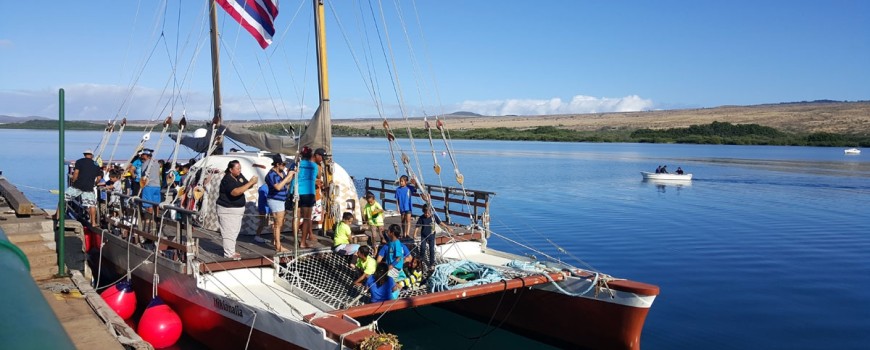
Totalling more than 100 young visitors, Hikianalia crewmembers hosted Hawaiian immersion students from Kualapuʻu Elementary School as well as classes from Akaula School. Students had the chance to learn about non-instrument wayfinding, knot tying, Hawaiian waʻa protocol and life aboard the waʻa first-hand as they toured above and below deck of the canoe.

20160125_102449The day’s visits topped off a full week of outreach and training that included Molokai’s 35th annual Makahiki festivities and visits from hundreds of residents and visitors. The week also served as a send-off for Hōkūleʻa crewmember Kawika Crivello who was recently designated as Molokai’s ‘Ohana Wa’a captain and will be departing later this week to join the Worldwide Voyage in Brazil. There he will be relieving Molokai crewmember Lohiao Paoa, son of recently passed Captain Mel Paoa, who will be completing the Africa to Brazil portion of the Worldwide Voyage.
Hikianalia is scheduled to depart Molokai this Thursday. She will sail to Maui and is expected to return to Oʻahu on Friday.

We would like to thank Molokai Youth Center, Tutu & Me, Punana Leo o Molokai Preschool, Kaunakakai Elementary School, Molokai Middle School UPLINK group, Molokai High School 21st. Century Community Learning group, Kamehameha Schools Maui, Hana High and Elementary School, Princess Nahienaena Elementary School and all the teachers and chaperones who helped make outreach programs fun, informative and safe.

We would also like to thank ʻOhana Waʻa Molokai and their respective families for your countless volunteer hours and commitment to Hikianalia’s outreach programs and anchor watches. Lastly, mahalo to the Polynesian Voyaging Society for the foresight and coordination to share Hikianalia with the Molokai community, and for including each of us as part of the Mālama Honua Worldwide Voyage – mahalo!


Help us make history

As the mainstay of support to PVS, our members are allowing us to voyage beyond the boundaries of Polynesia to inspire a global movement to care for our earth.

Celebrate voyaging past and present at Ola Nei

Aloha, please join ʻOhana Waʻa o Moku O Keawe for a night which celebrates our voyaging past and present, and welcoming Hikianalia to town.

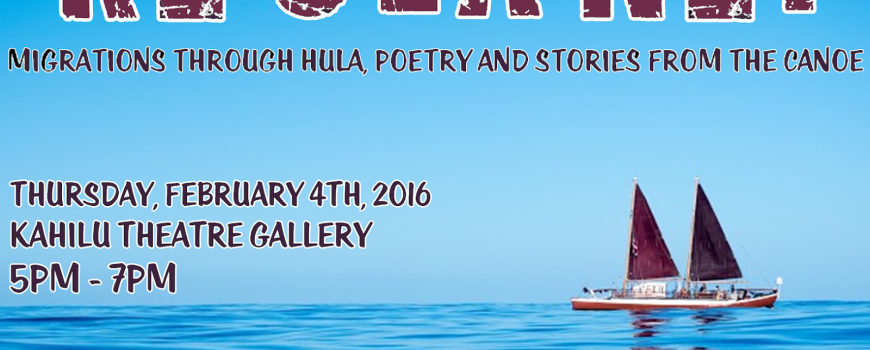
Ke Ola Nei – Migrations through Hula, Poetry and Stories from the Canoe
Thursday, February 4, 2016
Kahilu Theatre Gallery, Hawaiʻi Island
5:00-7:00 pm

Please email questions to Pomai at makawaa37@gmail.com.

To RSVP for this event, click here, or fill out the form below:


Help us make history

As the mainstay of support to PVS, our members are allowing us to voyage beyond the boundaries of Polynesia to inspire a global movement to care for our earth.

Continue Reading