Hōkūleʻa Moʻolelo: Attwood Makanani

sam_lowAs the famous Polynesian sailing canoe Hōkūleʻa voyages the world, we take a moment to celebrate earlier voyages and our kūpuna who sailed them. Eighteen years ago, Hōkūleʻa first visited Mangareva on the historic voyage to Rapa Nui that closed the Polynesian triangle for the Polynesian Voyaging Society. Here is the report filed by crewmember and documenter Sam Low.


Hokulea Moolelo GraphicI first met Attwood Makanani in 1995, in the village of Tautira where Hōkūleʻa was anchored prior to departing for Nuku Hiva on the voyage called “Na ‘Ohana Holo Moana/The Voyaging Family of the Vast Ocean.” My impression was of a sturdy and energetic elf with a pointed beard and a gleam in his eyes. I found him helping his Tahitian host weed a garden, a sight that I would often see as I bumped into “Maka” over the years. He was always busy lending a hand.attwood

One particularly vivid memory I have is from the island of Mangareva in 1999 when Maka was a crewmember on the escort boat Kama Hele. I am riding through the village of Rikitea in the back of our host Bruno Schmitt’s Land Rover with him and a large sandstone slab with strange symbols etched into its surface. For the last hour or so, he has been speaking non-stop in an enthusiastic commentary on the meaning of life, the voyage to Rapa Nui, his ancestors, and the significance of the slab we are conveying to a garden in front of Bruno’s house.

“This is a petroglyph, a traditional way of recording a historic event,” Maka explains, “I carved it for Bruno in thanks for his hospitality. It’s a mo’olelo, a story, which could easily be oral – in an oli or chant – but in this case it’s carved in stone.”

As the Land Rover bumps along the town’s main street past the gendarmerie and the post office, Maka runs his finger over the design he has etched into the stone.

“Here is a representation of Hōkūleʻa, and this is Kama Hele. Here is a manō, a shark, which is one of our ancestral guardian spirits, an ʻaumakua. I chose the manō because it’s an ‘aumakua common to many of the crewmembers sailing on the two vessels. And there’s another reason – when Hōkūleʻa passed through the reef surrounding Mangareva, a number of us saw a shark swim directly in front of the canoe. Timi Gilliom saw it clearly. The shark seemed to be guiding us through the reef and as soon as we got through safely, it disappeared.”

The Land Rover now bumps over a dirt road and arrives at Bruno’s bungalow, which is set on an ample lot bordering the ocean. We unload the petroglyph and the three of us lug it to the garden. With Bruno and his wife, Maka continues his explanation of its significance.

“I also carved a mo’o, a lizard, which is a land ‘aumakua. The mo’o lives in freshwater streams, so now we have here both a land and an ocean ‘aumakua, a lizard and a shark, which represent the fact that all life depends on the land and ocean, which is a typical way that all island people think.”

Now Maka points to a checkerboard with sixty-four depressions.

“This is a kōnane board. Kōnane is an ancient game of kings that is equivalent to chess. Kōnane is symbolic of wisdom; it makes me think of the need for our leaders to plan carefully to care for our land and our ocean, to mālama our natural resources. One goal of our voyage to Rapa Nui is to encourage all of us to respect our natural world, the sea we sail over and the islands that we sail to.”

For a time we all sit quietly, admiring Maka’s petroglyph and Bruno’s garden. It’s silent except for chickens squawking in a nearby henhouse and Bruno’s sheep bleating in a nearby pasture. Maka is usually in constant motion but now he seems serene. The petroglyph is the last of many gifts he has presented to our Mangarevan hosts. Since his arrival on the island, he has carved about three dozen nose flutes, which he presented to children all over Rikitea. He also made a kōnane board for Bianca and Benoir, a couple who hosted a reception for the crew. And from the crooked branches of trees he made and gave away many lomi sticks – a traditional implement to massage the body.

“I don’t have money for tee-shirts to give away, so I make things on every island we visit. These gifts are what we call makana, an exchange from one seafaring family to another to memorialize and enhance our cultural integrity. They are given in simple appreciation for the hospitality we have received. They are a part of our ancestral protocol of meeting and greeting one another as a family of seafaring people. Our voyages are also what we from Hawaii offer as our gift to the people of the islands we visit. Voyaging is about the spirit of exploration and the renewal of our culture. They say we have not forgotten our Polynesian heritage; they say ‘onipaʻa – stand fast.”


HawaikidustjacketrightcoverThe above moʻolelo was written by Hōkūleʻa crewmember and documenter Sam Low, author of Hawaiki Rising, Hokule’a, Nainoa Thompson and the Hawaiian Renaissance.
Hōkūle‘a Received and Celebrated in Mahina

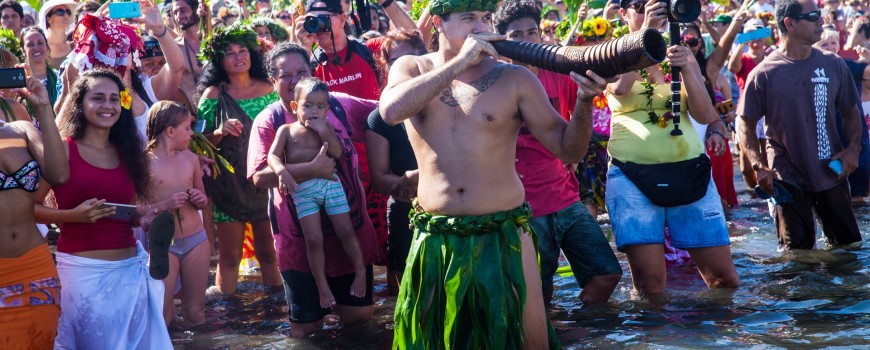
Hōkūle‘a, Hikianalia, and their crews were welcomed by the Mahina community on April 14th, 2017. The crews enjoyed performances of traditional song and dance from people of all ages during the arrival celebration hosted on the shores of Mahina, which is near Papeete in Tahiti.

The arrival was filled with the true meaning of aloha. “You could feel it from the canoe. The community here was overwhelmingly happy and thrilled with love in their hearts that Hōkūle‘a and Hikianalia were there,” says Kalā Tanaka, captain and navigator of Hikianalia. Adorned with welcome wishes and lei, the crews were treated to a front row celebration of traditional song and dance.

The arrival in Tahiti marks the reconnection of Hokulea and Hikianalia. The sister canoes were last together in Aotearoa (New Zealand) in the spring of 2015. “We started this voyage together and now we end this voyage together,” says Bruce Blankenfeld, master navigator of Hōkūle‘a.

The crew will travel throughout Tahiti and Raiatea to engage with the local communities in ceremony and educational outreach as they celebrate the close of the nearly four-year long journey. Together with her sister canoe Hikianalia, Hōkūle‘a will head home to a welcoming ceremony at Magic Island in June 2017.


Homecoming - Save the Date - Banner Feb 17 Update

Hōkūle‘a Homecoming:
Event registration is live!

Join thousands of supporters and fans to welcome Hōkūleʻa home to Hawaiʻi in June 2017! Register now for the Mālama Honua Summit, reserve your tour aboard Hōkūleʻa, and RSVP for the Polynesian Voyaging Society benefit dinner.

Hōkūle‘a and Hikianalia Arrive in Tahiti

Hōkūle‘a and Hikianalia have arrived in Tahiti! This arrival marks the first time the sister canoes have reunited since the vessels embarked on separate Mālama Honua sail plans in spring of 2015 – when Hikianalia sailed for the Hawaiian Islands to advance the education mission of the Worldwide Voyage while Hōkūle‘a continued on her unprecedented circumnavigation of the globe. The canoes’ arrival will be celebrated with the Tahiti community on April 14, 2017.

IMG_5545Master Navigator Bruce Blankenfeld on deck as the canoe approaches Tahiti.

Tahiti holds special historical significance for the Polynesian Voyaging Society as the destination of Hōkūle‘a’s first deep sea voyage in 1976, over 40 years ago. Tahiti is the largest island of French Polynesia and shares origins with the rest of the Polynesian Triangle. The mountain, Moua Orohena, tops the island and stands 7,352 feet tall, earning the distinction as the highest point in French Polynesia; its height has made Tahiti the home base of voyaging for generations.

Sister canoes Hōkūle‘a and Hikianalia will travel to Raiatea for a ceremony in Taputapuatea on April 25. Hōkūle‘a and Hikianalia will sail home in early May to begin the final deep-sea leg of the Worldwide Voyage.


Homecoming - Save the Date - Banner Feb 17 Update

Hōkūle‘a Homecoming:
Event registration is live!

Join thousands of supporters and fans to welcome Hōkūleʻa home to Hawaiʻi in June 2017! Register now for the Mālama Honua Summit, reserve your tour aboard Hōkūleʻa, and RSVP for the Polynesian Voyaging Society benefit dinner.

Crew Blog | Duane Desoto: Sailing in the Now

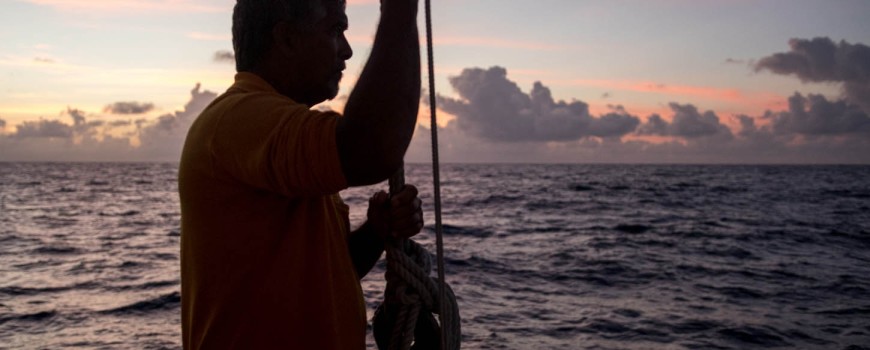
Duane on the hoe as the sun sets.Crew blog by Duane Desoto

Today we sailed along the east side of Rangiroa around 10am. This was our last visual marker prior to heading Manu Kona for Tahiti. Winds were steady and the sea was calm.

Kaleo, prior to our closeup look at Rangiroa, had us look at the color of the clouds on our starboard bow. To our amazement, the clouds where a beautiful shade of blue and green. “Rangiroa is over there,” he said. The reflection of the lagoon and the trees caused the clouds to change colors. Land was barely visible, if at all, but the color of the clouds were very distinct. Kaleo’s has the eye for the subtile changes around us.

In our daily life at home it’s very easy to start seeing everything around you as the same. Days seem more similar then different sometimes because we are so busy and distracted. At sea for a month I’ve begun noticing the subtile change in winds and the mixture of crossing swells. No wifi or cellular data has allowed me time to immerse into waʻa time and space. Repetition day after day focusing on looks and sounds of the sails, lines, wind, waves, movement of stars and the moon, sounds of the waʻa, where and how birds are flying, how the waʻa is rocking and many more finite details of voyaging on Hōkūleʻa. Everyone should go on a technology fast once in awhile to remember what it is like to live in the now and appreciate the wonderful blessings that surround us.

Sailing in the “now” has allowed me to lots of time to think. All I tend to think about at sea is my ʻohana. Of course I hope everyone is safe but it’s not that. Hōkūleʻa for some reason makes me think deeply about how I’m handling daily situations with everyone I love. My flaws seems to standout more than ever and it’s apparent how much I need to better myself as a husband, father, uncle and son. Making these changes are easier said then done but the fact that I am able to recognize and acknowledge the areas of need is a great step towards making life at home better for all those whom I love.

Mahalo to the Polynesian Voyaging Society and all of their founders for having the incredible vision in 1973 of a better Hawaiʻi. Mahalo Nainoa Thompson and ʻohana Thompson for the commitment, sacrifice, and creativity that fueled the legacy of Hōkūleʻa in which we are all beneficiaries. Mahalo to all the volunteers of PVS who have worked endlessly to keep all of our waʻa sailing. Last but most importantly, mahalo to all of our kupuna who have laid down their lives to create the paths in which we are all thriving and benefiting from in beautiful Hawaiʻi nei.

Mālama pono and aloha nui,
Duane DeSoto


Homecoming - Save the Date - Banner Feb 17 Update

Hōkūle‘a Homecoming:
Event registration is live!

Join thousands of supporters and fans to welcome Hōkūleʻa home to Hawaiʻi in June 2017! Register now for the Mālama Honua Summit, reserve your tour aboard Hōkūleʻa, and RSVP for the Polynesian Voyaging Society benefit dinner.

Crew Blog | Duane Desoto: Carry on the Tradition of Hoʻokele

Duane on the hoe as the sun sets.Crew blog by Duane Desoto

On March 10th, we left Rapa Nui on a 62 foot double hulled canoe and set out to sail to Pitcairn, Nuku Hiva and finally Tahiti. Such adventures mean different things to different people. As a crewmember of Leg 29 on the World Wide Voyage the general feeling for me is that of privilege and honor. The privilege to be one of the thirteen crew that stands side by side with Bruce Blankenfeld (self proclaimed librarian), Kaleo Wong (Navigator), and Russell Amimoto (Captain) on Hōkūleʻa as she sails this route for only a second time in her 42 year history. The honor of carrying on the tradition of hoʻokele that is alive, thriving, and inspiring our kanaka youth to reach for the stars and navigate their own dreams.

Some people see Hōkūleʻa and can’t believe how far she has voyaged, not to mention there are no motors or compass. Unlike most, I have had the privilege to sail in extreme ocean conditions on the Tasman Sea that truly displayed how technologically advanced Hōkūleʻa is as a sailing vessel. On large seas and high winds, Hōkūleʻa’s two hulls flow effortlessly side to side as the hoe uli maintains our intended direction. You can hear the lashings call out as the waʻa flexes and articulates through the rough sea as if predicting every next move. Hōkūleʻa is truly an engineering marvel.

Our sail plan for this voyage involves more than 29 days at sea. Thus far this is the most at sea days for me on any adventure and I have the honor of sharing this with 12 special people who adore Hōkūleʻa as much as I do. We are all especially honored to sail with our kupuna who are guiding us on this incredible journey. Thus far we’ve sailed from Rapa Nui to Nuku Hiva in 22 days with a 5 hour stop in Pitcairn on the 12th day. After 3 days in Nuku Hiva we sailed to Ua Pou for a quick cultural exchange. Since Ua Pou, we’ve been at sea another 4 days and are looking for Rangiroa as a marker to line us up for our trips final stretch to Tahiti.

This has been an epic time at sea and I want to aloha my wife Mālia, my 7 keiki, my inlaws and my parents, my ʻohana, and my Nā Kama Kai ʻohana for allowing me to voyage by supporting me while away. 4/7/17 marked my 18th year together and my 10th anniversary with my best friend and lover.

Aloha nui, Duane


Homecoming - Save the Date - Banner Feb 17 Update

Hōkūle‘a Homecoming:
Event registration is live!

Join thousands of supporters and fans to welcome Hōkūleʻa home to Hawaiʻi in June 2017! Register now for the Mālama Honua Summit, reserve your tour aboard Hōkūleʻa, and RSVP for the Polynesian Voyaging Society benefit dinner.

Crew Blog | ʻĀina Paikai: The Floating Classroom

Aina Paikai Crew blog by ʻĀina Paikai

These being the final days of our voyage, two emotions begin to swell; the excitement of reuniting with loved ones and the regret of leaving the ones you’ve come to love. Such is the case with every departure and arrival in this journey of life, but something about exploring the deep blue wilderness with strangers turned comrades makes this inevitable end as sweet or sour as it gets.

Throughout the entire Leg 29, from Rapa Nui and now a hundred miles from our final destination of Tahiti, master navigator and captain extraordinaire Bruce Blankenfeld has taken a step back in both of those duties and assumed the role of professor aboard Hōkūleʻa, schooling the remaining crew of 12 with a nightly lesson in Navigation 101.

What at first could be considered a general lecture in astronomy has graduated into the application of ancient wisdom, especially with the not-so-well-known canoe compass.

Perhaps you’ve heard of the star compass, an equally divided pie composed of houses, quadrants, and cardinal points, passed down from Papa Mau and redesigned by Nainoa. I’ve seen many presentations where the compass is printed on a giant mat, laid flat on the floor, and the presenter explains as best he or she can to a doubting audience as to how it’s possible to travel the Earth without maps, charts, or GPS.

Other props are included like a model canoe, a wooden bird, an orange soccer ball that represents the sun etc. Most often, I’ve noticed that the audience definitely has a deeper appreciation for voyaging after the presentation, but I can’t imagine they truly understand it. After witnessing it more than 10 times myself, only now can I extract its relevance.

Here on Hōkūleʻa, somewhere around 15 degrees in the southern hemisphere, we are completely surrounded by the Pacific Ocean. And if you can imagine at night, the sky is clear, the wind is light but constant, moving us forward at a steady pace, and the swells beneath us pass through gently, rocking us too and fro. In this setting, the waʻa is the premiere space for learning.

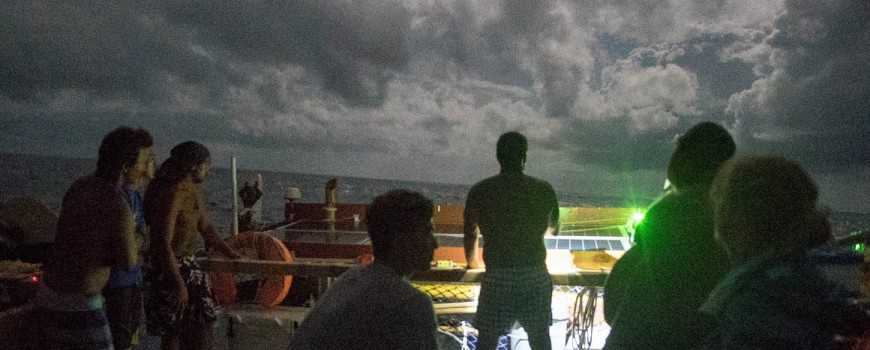
After dinner and clean-up, Uncle Bruce has us gather aft to quiz us individually. The night sky his black board and his laser pointer the chalk, he chooses one star out of millions, calls it by name, gives us it’s declination and then asks us what house and quadrant does it rise and set. Then he’ll give us a scenario like, “If we are heading in the direction of Manu Kona, where does this star need to line up along the canoe?”

Intimidating at first, mainly because we don’t want to answer wrongly, Uncle Bruce reassures us that the beauty of this art is in the simplicity. The key is to place ourselves within the star compass, let the canoe be our needle and the elements our guide.

The impossible notion of reading the stars, wind, and current, now are practical tools that don’t seem so outrageous anymore. What was skeptical to most makes complete sense on this floating classroom, which also makes perfect sense as this is where it was originally taught for generations.

And although we are much more confident, like I said, our class is very introductory. It would be remiss of me to not mention how often our navigator Kaleo Wong had studied prior to this voyage and even during our short stints at land, so that we successfully hit our targets safely. His training demands memorizing the names and declinations of over 200 stars, calculate speed and mileage including drift from the currents, and prepare his body for little to no sleep for consecutive days, weeks at a time; definitely a 400 level course.

Admittedly, Bruce and Kaleo consider themselves students, even after being so successful in fishing islands from the sea. In fact, their main philosophy is ʻimi ʻike or a continual search for new knowledge. They inspire us all with that notion of constantly striving to get better and because of this they are the best teachers.

On behalf of the crew, we’d like to mahalo all of our teachers who have helped us on our voyage of life and continue to do so as we sail on. We thank those that allowed us the opportunity for this growth and like our kumu who have enabled us to explore and adventure, we now share their fate in grooming the next generation of stargazers.

Aloha,
ʻĀina


Homecoming - Save the Date - Banner Feb 17 Update

Hōkūle‘a Homecoming – Save the Date

Sign up for updates and be the first to know as we continue to detail homecoming festivities during the week of Hōkūleʻa’s homecoming
in June 2017!

Crew Blog | Keoni Kuoha: Fulfilled by Our Coming Together

Kaʻoha Tātou i to Tātou ʻAweʻia: Fulfilled by Our Coming Together

Keoni enjoying the afternoonCrew blog by Keoni Kuoha

Those four days passed quickly, much like the midnight squalls that meet us in otherwise bright, clear skies. That squall has passed, but its memory still chills my skin. Nukuhiva and Uapou had opened my eyes and touched my naʻau.

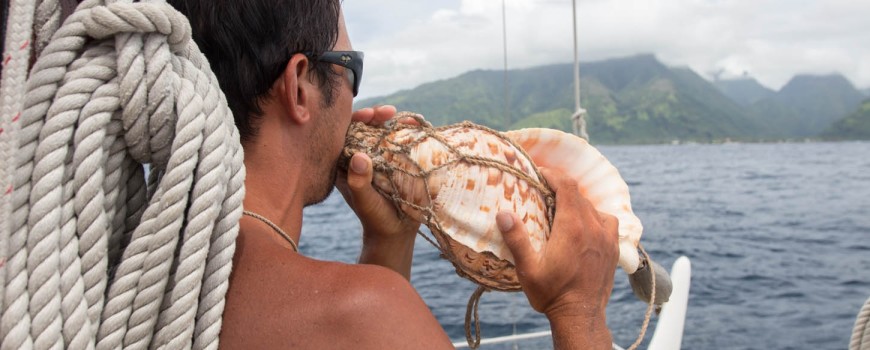
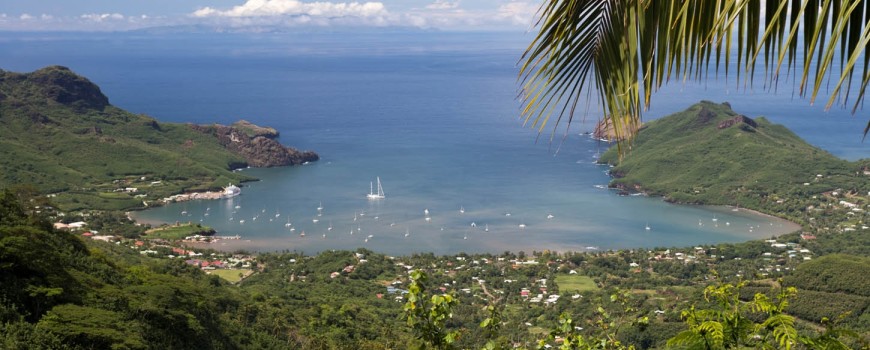
As we arrived at Taiohaʻe, Nukuhiva, a small fleet of canoes and craft came out to greet us, a sweet, nasal voiced “Mave mai! Mave mai!” wafting toward us. As I began to make out individual faces, I could see smiles that stretched sure and wide. It was a reassuring sign, given the rather stolid, shear-faced islet centennials that flank the entrance to the bay. Moments earlier, they were unmoved by the sound of our pū and the call of our kāhea, but now they seemed to acquiesce. We processed further.

The bay and valley walls ascended to a lofty ridge, deep green and misty, behind the small town. I offered an old chant, and the words manifested themselves before my eyes, showing me an ancestral kinolau I had not previously known. I offered another chant, “Uē ka lani….” It was the briefest, lightest of showers, but I knew someone was listening. Smoke rose from the western shore. A crowd was gathered there to welcome us back.

Every landfall Hōkūleʻa makes is unique–and I’ll get to more of that in a second–but there are some things I’ve come to expect and appreciate about every landfall, especially when it comes to the crew. You see, when sailing for an extended time, far from those things to which we become accustomed, there are certain comforts we all look forward to when we return to land. Among the first things we go for is usually ice cream, if not an ice cold beer. A freshwater shower is also pretty high on the list, as well as meat that doesn’t come from a can. Whatever the craving might have been, Taiohaʻe provided with much bounty.

Besides enjoying simple pleasures and working through a long to-do list around the waʻa, we got to take half a day to see more of Nukuhiva. There are three communities on the island. We were in the largest for most of our stay, but next door lay another community and a deeply storied place: Taipivai. We made our way up the steep mountain side packed into a mini bus, the scenery becoming more breathtaking the higher we went. Then, before us, Taipivai began to peek over the rolling upland forests, the valley emerging like a winter swell across the southeast side of Nukuhiva. Ostensibly, we were headed here to refill some of our water jugs with the best water on island. What we found here, though, was so much more.

Although located on the same island as Taiohaʻe, Taipivai is a world unto itself. Whether it be the landscape engineered for copra production or the unique character of the local language and narratives, Taipivai offered us a new lens by which to know and grow in our learning. Our gracious host on-island, Deborah Kimitete, took us to meet with some folks of this place. When we arrived, they were gathered at the far end of a grassy ceremonial square, under the eves of a long haʻe (hale) that sat upon a platform raised several feet higher than its surroundings. There were a number of adults waiting there to greet us, several of whom I recognized from the welcome ceremony several days earlier. But, as we drew closer, I could see that most of those gathered were children. We had come to the community intersession enrichment program being held this week while the children were on break from school.

“Mave mai! Mave mai!” The greeting we heard chanted in a mature soprano just days earlier was now being voice by two young girls. We were brought into the haʻe where the community head welcomed us, four young ones performed a haka manu, and then the boys performed another haka, less intense than when done by the men, but just as powerful. This place–the ceremonial square with surrounding, open-air haʻe–was first built for the biannual Matavaʻa Marquesas Festival, but it’s obvious from its current use that the community thought beyond the festival to the greater needs and prosperity of Taipivai when planning for this space.

As I sat there listening to the voices of young and old meld together, beneath a thatched roof of modern materials, and ruminating on what Deborah had shared with us at the previous night’s dinner about how the Matavaʻa Festival had led to cultural reawakening and solidarity across the Marquesas, I began to see before me a beautiful example of learning and knowing as community. I believe this to be yet another learning system that can lead us to a more prosperous future.

Nowadays, “learning community” is a model that many, from schools to tech companies, strive to incorporate. Collective learning and attention to continuous learning are powerful tools, to say the least, and they are certainly part of learning and knowing as community. However, there’s something more happening within Taipivai and surely across the Marquesas. For one, the Matavaʻa is providing Marquesan communities with a focal point for development around cultural vitality, purposeful community planning, and redevelopment of traditional sites. Thus, both the driver and the source for learning is the community itself, which can lead to things like the building complex at which we were welcomed to Taipivai.

Moreover, community learning can also ensure that learning is purposeful, that it’s connected to something meaningful to folks across the community. This kind of learning often starts with conversations among community members, identifying common meanings, values, priorities, and resources. Then folks align themselves to shared cycles of discovery and application that can perpetuate themselves for as long as the community finds purpose to them. Through this process, the immediate reasons for coming together can often be achieved with greater efficiency and longevity. Just as important, the community learning process becomes self-sustaining, new goals can be identified and actuated within existing structures when there’s reason to do so, with greater learning being a natural outcome of the community’s collective discovery and application process.

We arrived at Uapou the following day, with the community putting together a lavish welcome in less than 48 hours, and I couldn’t help but see in that place another example of community knowing and learning in exquisite action. The haka they performed were highly refined, graceful, and moving. The food was all provided by individual families, as though it were their daily practice to feed the whole village, and they even provided us with a demonstration of how they transform the common breadfruit into popoi–I appreciated the many similarities between their materials and methods and those we use at home to make poi from kalo.

After lunch and entertainment wrapped up, Heato showed us around the town center. He, along with his father Toti and popular recording artist Rataro, organized the welcome, each representing different organizations within the community and local government. We saw their version of the community market model we had seen in Taiohaʻe and Taipivai. The art pieces for sale were stunning, inspiring a heavy flow of cash from crew pockets to local purses. Then we closed the afternoon with canoe tours and some talkstory with Toti and Heato. It was inspiring to see these two generations express both their grounding in Uapou tradition and their aspirations for the future of their island and community. It was a future self-determined and a future for which they already have the knowledge and learning tools to achieve.

As we sailed out of sight of Uapou that evening, some of the crew softly echoed the refrain of a song we learned back at Taipivai, “Kaʻoha tātou. Kaʻoha tātou, i to tātou ʻaweʻia….” I think it captures nicely the sentiment of the crew. We are each fulfilled by our coming together, both with our Marquesan cousins as well as our family of the waʻa.

ʻAʻole i pau…


Homecoming - Save the Date - Banner Feb 17 Update

Hōkūle‘a Homecoming:
Event registration is live!

Join thousands of supporters and fans to welcome Hōkūleʻa home to Hawaiʻi in June 2017! Register now for the Mālama Honua Summit, reserve your tour aboard Hōkūleʻa, and RSVP for the Polynesian Voyaging Society benefit dinner.

Hōkūleʻa Moʻolelo: Joey Mallott

sam_lowAs Hōkūleʻa re-enters the Polynesian Triangle on the last legs of her Worldwide Voyage, we take a moment to celebrate earlier voyages and the crew who helped her find her way.  Aboard Hōkūleʻa on this leg to Tahiti is crewmember Joey Mallott. In 2000, Joey voyaged from Tahiti to Hawaiʻi and documenter Sam Low interviewed him to produce this blog.


Hokulea Moolelo Graphic“When I was younger, I fished with my Dad every summer,” says Joey Mallott. “We went power-trolling for salmon and long-lining for halibut in the Gulf of Alaska. It was a lot of hard work and long hours. The waters were rough and cold. We also fished for Coho salmon in the Inside Passage. Sometimes the water was mild and we would nest up with other boats in an isolated cove, cook dinner, tell stories. In the morning we woke up surrounded by an almost undisturbed wilderness. It was beautiful.”Joey mallot

The Inside Passage is a legendary waterway – often violent and extremely dangerous, about which author Jonathan Rabin wrote this in his recent book, Passage to Juneau: “The water on which the northwest coast Indians lived their daily lives was full of danger and disorder; seething white through rocky passages, liable to turn violent at the first hint of a contrary wind, plagued with fierce and deceptive currents. The whirlpool – capable of ingesting a whole cedar tree, and then spitting it out again like a cherry pit – was a central symbol of the sea at large, and all its terrors.”

Joey was born in Anchorage, Alaska on June 2nd, 1977 to Byron and Toni Mallott. Through his father, he was also born into the Killer Whale clan of the Eagle moiety of the Tlingit Nation and through his mother into an Athabaskan group of people – more specifically the Koyukon Tribe who lived in the interior of Alaska on the Yukon River.

IMG_8573“I spent most of my summers growing up in small Indian villages,” Joey says. “My parents wanted me to have that kind of experience, living in small indigenous communities rather than in big cities.”

Joey’s father, Byron Mallott, is well known among his people. He was born in a time when you saw signs posted which said “No Indians and Dogs Allowed.”

“From a young age, my dad was motivated by a strong desire to help his people,” Joey says, “because he saw a lot of pain among them and the problems of poverty, alcoholism and high rates of illness and early death. He worked hard all his life. When he was only 18 he captained a 56 foot schooner from Washington to Yakutat on the inland passage.”

Growing up on this difficult ocean, Byron Mallott learned early to be determined to reach his goals, either at sea or on land among his people. As a young man of only 34, he was appointed Chief Executive Officer of the Sealaska Corporation, which manages a huge tract of land belonging to native Alaskans, and he used funds from this enterprise to help lift his people from poverty and depression. Joey Mallott lived with his grandmother as a boy, where he learned many of the same values that have motivated his father.

“The day I arrived in her village,” Joey says of this experience, “my grandmother handed me a 4/10 gauge shotgun and told me to get dinner. She taught me how to hunt, fish and trap, and to live and survive in the outdoors; but more important, her lessons were about patience and kindness and about being open to everyone you meet.”

Joey graduated from elementary school and high school in Juneau, Alaska and went on to earn his Bachelor’s degree in Elementary Education at the University of the Pacific in 1999.

“Life in college was different than the way I was raised. I saw a lot of vanity there and selfish acts.”IMG_9648

In 1991, Nainoa first traveled to Juneau to meet with Byron Mallott to discuss receiving the gift of two giant spruce trees from the Sealaska Corporation to build voyaging canoe Hawaiʻiloa. The two men became fast friends which led to a joining of the Thompson and Mallott families which Joey describes as “one single family.”

When Pinky Thompson asked Nainoa to choose an Alaskan representative to journey on at least one leg of the voyage to Rapa Nui, Joey was offered the position. “I got the call in 1998,” Joey remembers, “and I knew right off that I wanted to go.”

Joey and Moku washing the manu

The experience of being involved with building Hawaiʻiloa and voyaging aboard Hōkūleʻa has allowed Joey a deep insight into Hawaiian culture. “I think there’s a great deal of similarity between any indigenous culture and how we view the world. That’s why Hawaiians and Native Alaskans share so many values. We both respect our elders and believe in taking care of our environment, for example, and we’re motivated to recover our native traditions and pride and to bring back our sense of community.”


HawaikidustjacketrightcoverThe above moʻolelo was written by Hōkūleʻa crewmember and documenter Sam Low, author of Hawaiki Rising, Hokule’a, Nainoa Thompson and the Hawaiian Renaissance.